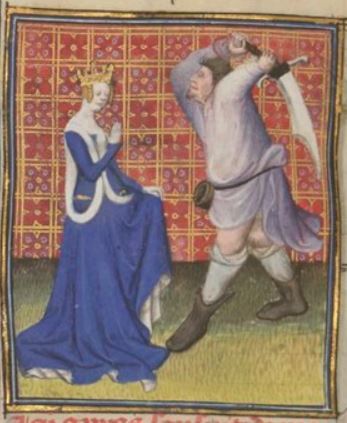
This illumination depicts Mariamne, the queen of Judaea, standing on the left side of the image wearing a blue dress and a crown. Mariamne was renowned for her incredible beauty, and for having been the wife of the jealous King Herod. Boccaccio explains that King Herod was so jealous and protective of Mariamne, that he did not want her to outlive him. He devised a plan for someone to murder Mariamne if he were to die before her, so that no one else could have her. The assassin is illustrated on the right side of the image swinging a sword above his head to kill Mariamne.
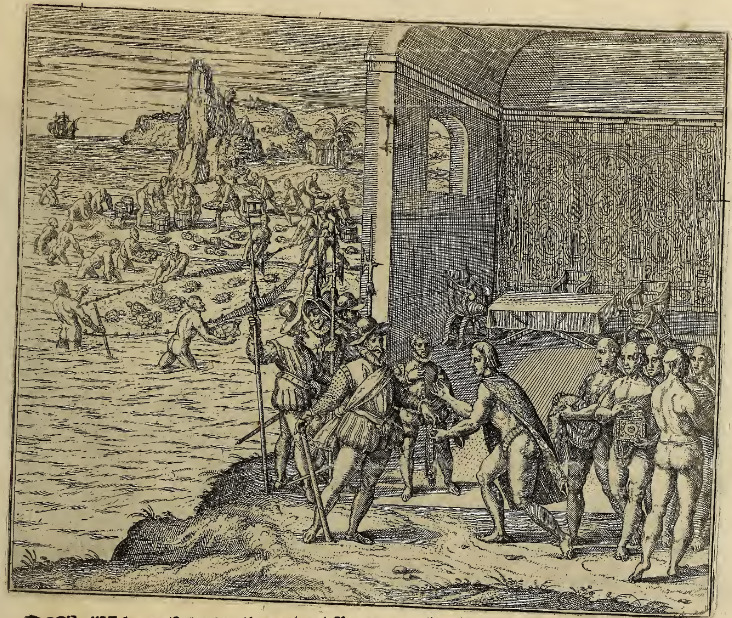
Several Indigenous people present gifts of gold to a group of Spaniards outside the entrance of a large structure that site on the riverbank. In the background, a group of Spaniards fish for turtles along the riverbank using a large net. Several other men stand on the shore, storing the caught turtles and turtle eggs in casks. In the distance, another Indigenous structure is visible. Farther away, at the mouth of the river, a European ship sails.
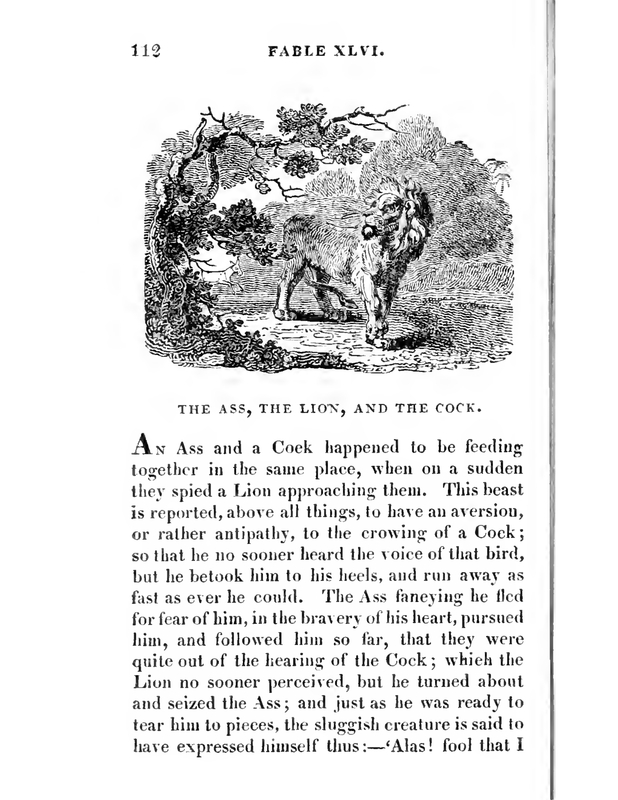
A lion is in the centre, walking right on the page but turning its head to the left. The lion is looking at a tree covering the left of the page and in the background there is a donkey following behind.
The female figure on the left is shown wearing a robe, a veil, and a necklace. The artistic choice to include a female figure in an illustration for Act II seems odd, seeing as there are no female characters involved in this act. Perhaps it represents the end of the first act, where Calisto gives Celestina 100 crowns of gold as payment for her services. The identity of the male figure on the right is also uncertain, since Calisto, Sempronio, and Pármeno all feature in this act. Regardless, we can see that he is wearing a large hat and has a sword mounted on his belt. In his right hand he is holding a satchel. Both figures are placed outside.The entire image is identical to the one found on page 68 of the text. Both the left and right panels are near carbon-copies of panels used multiple times throughout the earlier 1529 Lyon edition. However, the lower attention to detail in these illustrations makes it clear that they are reproductions and not duplicates. The artist likely referred to a copy of the 1529 edition when creating these illustrations.
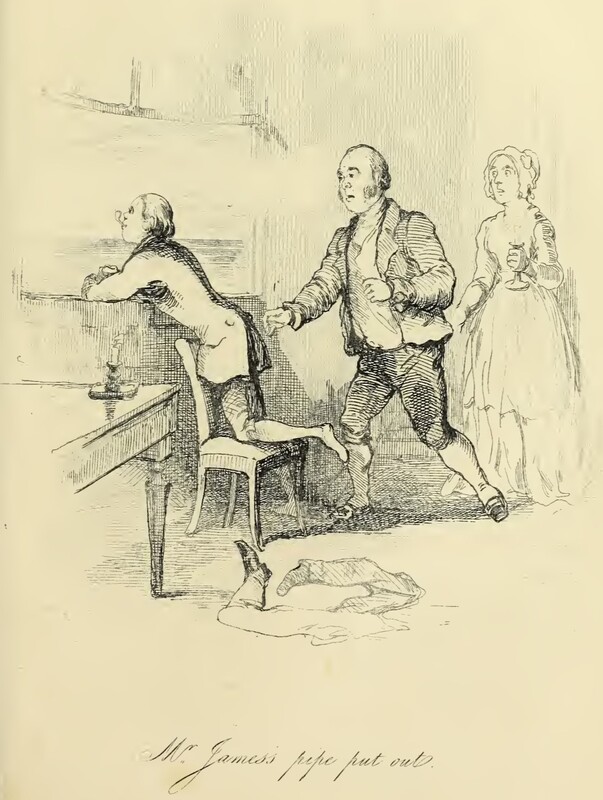
Mr. James Crawley, while visiting his aunt Miss Matilda Crawley, leans out the bedroom window while smoking his pipe. He is in his coat and breeches, with his pants and shoes in a pile on the floor next to the chair on which he is leaning. Behind him, Mr. Bowls and Mrs. Firkin have rushed into the room to stop the smoke, which is bothering Miss Crawley downstairs. Below the illustration is printed in cursive its title, “Mr. James’s pipe put out”.
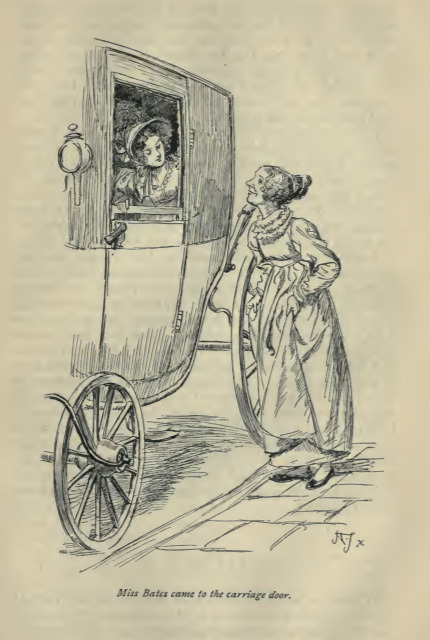
In this image Miss Bates speaks to Emma through a carriage window. Emma came to the Bates’ house to invite Jane Fairfax for a drive. Jane was recovering from an illness, and Emma thought the fresh air of a drive might do her good. Miss Bates went into the house to ask is Jane wanted to go for a drive, but Jane refused. This scene occurs in chapter 45. The characters are shown in the traditional regency style. Emma and Miss Bates wear the regency style dress with empire waists and bonnets. The regency period dated to the early nineteenth century (1811-1820) when George, Prince of Wales, later George IV (r. 1820-1830), reigned as regent for his mentally ill father, King George III (r. 1760-1820). The regency period is associated with the rise of neoclassicism in art and fashion.
Here we see Gulliver stuck in the hollowed-out marrow of a bone. The Queen of Brobdingnag’s dwarf stuck Gulliver into the bone because he was jealous that Gulliver replaced him as the Queen’s favourite. In the image we see Gulliver stuck in the bone with only his head sticking out of the bone. The bone sits on a platter with other leaves and food. The dwarf’s face is visible in the background. The same image appears in the 1843 Krabbe edition.
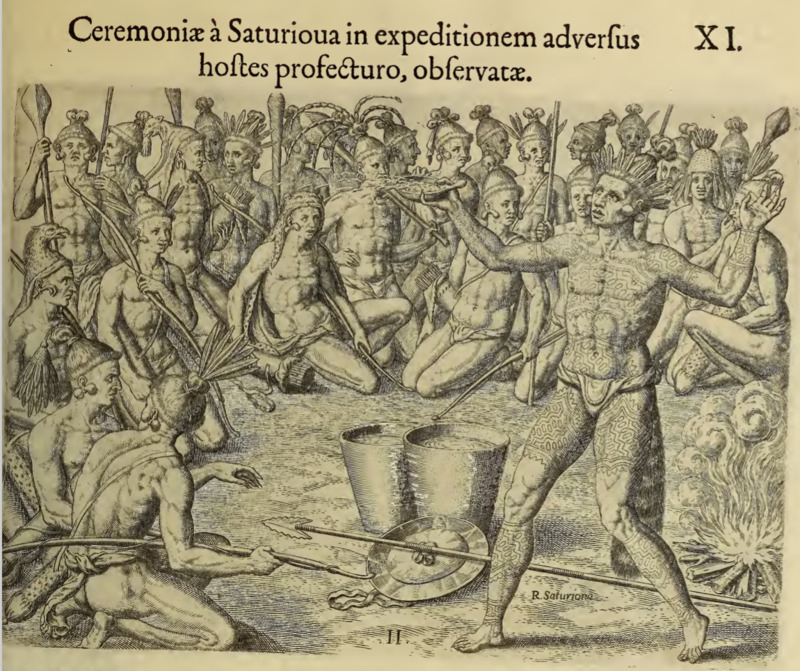
A group of Indigenous people is shown. Most kneel on the ground in a semi-circle, and hold various weapons including bows and arrows and spears. They all wear headdresses, some in the shape of birds or mammals, and some with feathers on top. In the center of the semi-circle one man stands. He is covered in tattoos and holds his arms above his head. In one hand he holds a vessel of liquid. He wears a loincloth with a racoon tail hanging from the rear and a headdress with feathers. Behind him a spear and shield and two containers rest on the ground, and a fire burns.
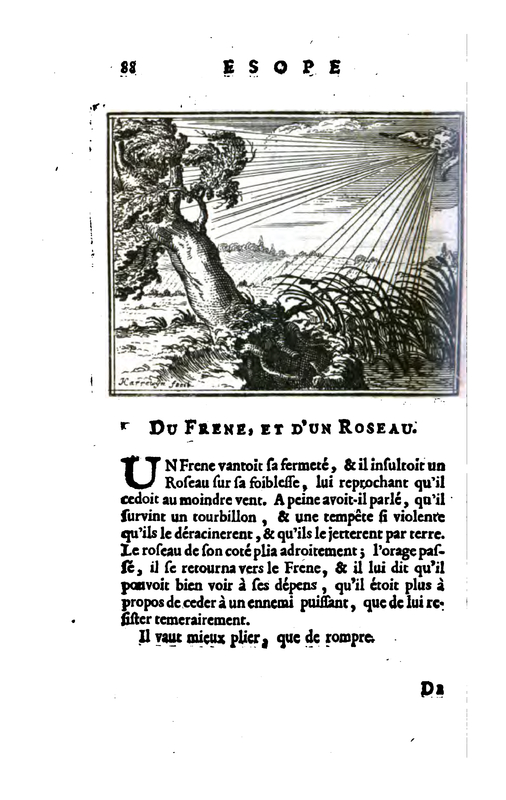
A Frene boasted of his firmness, and insulted a Reed on his weakness, reproaching him for yielding to the least wind. No sooner had he spoken, than there came a whirlwind, and a storm so violent that they destroyed him, and threw him to the ground. The reed on his side bent deftly; the storm passed, he turned back to the Frene, and told him that he could see at his own expense that it was more appropriate to yield to a powerful enemy than to resist him in a temporary manner.
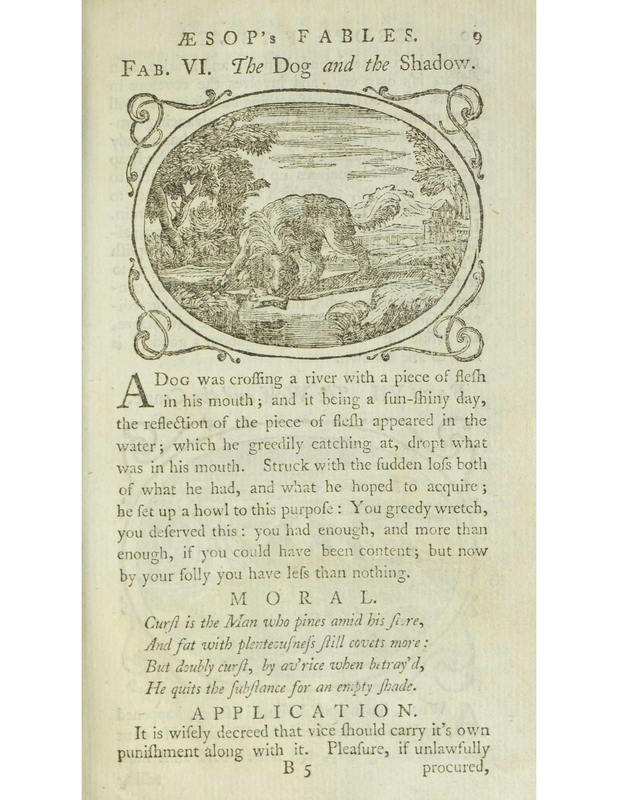
There is a dog looking into the water from upon a bridge. The dog has something in its mouth. There is a shadow of the dog in the water. Some trees are around the water and a farmhouse can be seen in the distance of the image.
King Don Sancho lies dying on the right, as Rodrigo pursues his killer Bellido Dolfos to the walls of Zamora. Dolfos was a citizen of Zamora, which was ruled by Sancho’s sister Urraca and was the last of the territories inherited by Sancho’s siblings that he had not yet conquered for himself. Dolfos tricked Sancho, saying that he would show him a way into the city. Despite being warned that this was a trap by Arias Gonzalez, a leading noble of Zamora, Sancho went along with Dolfos to his death.
Here we see the Prime Minister of England surrounded by his wife and his ministers. At this point in the story, Gulliver explains various aspects of society and politics to his master and the other Houyhnhnms. Gulliver describes the corruption of the political system. Gulliver explains how someone becomes Prime Minister. The first way is through prudent deposition of any women his life, the second is by betraying or undermining his predecessor, the third is by his zeal in public assemblies opposing the corruption of the court. The same image appears in the 1839 Krabbe edition.
This image is illustrated in a chapter that discusses the Christian priests in the colonial government in Peru. This image depicts a Spanish muleteer on the right side of the image with his indigenous servant standing in front of the mule. The servant is holding a whip as well as the mule’s reins. The mule in the centre of the image is depicted carrying six small children on its back. These are the children of Spanish parish priests who would have relations with indigenous women. The children are depicted being taken to the city of Lima. The author criticizes the actions of the priests as well as the Spanish muleteer who would have had connections to the priests for helping them transport their children.
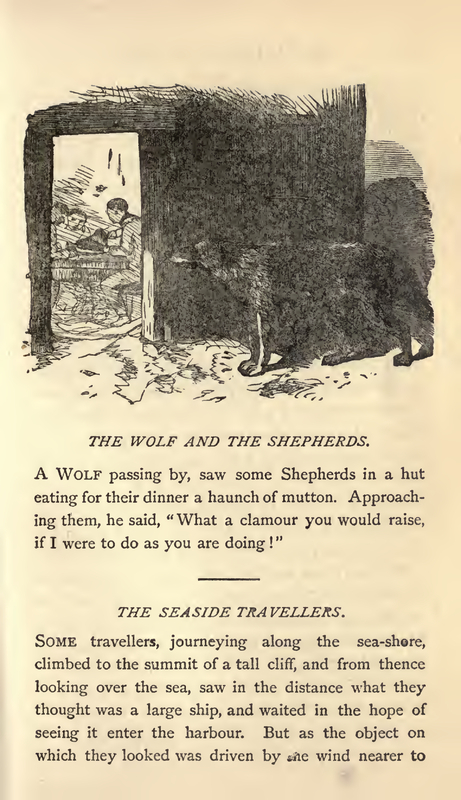
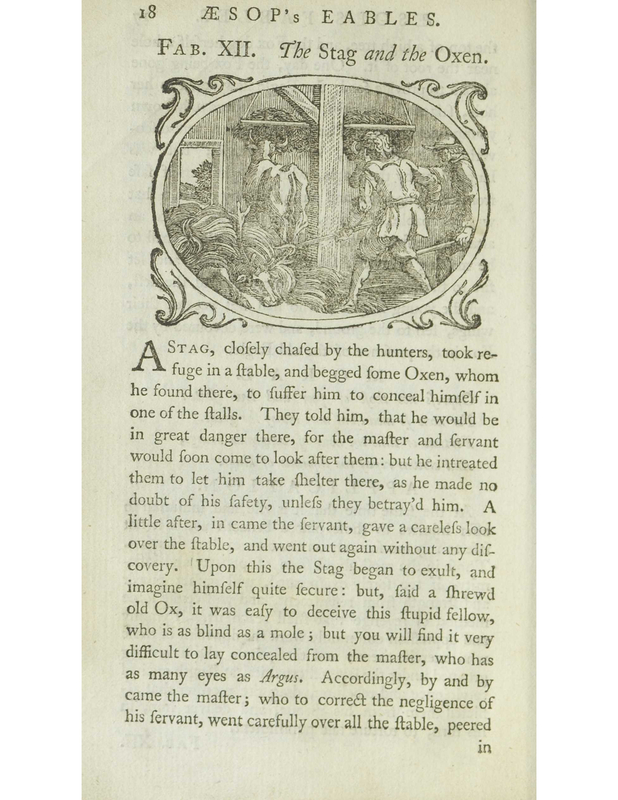
There is a stag under some hay in a barn. There are two oxen in the barn. The oxen are facing the wall, with the stag behind them hidden in a pile of hay. There is two stable keepers, who are also in the barn. The stablemen are holding tools to move hay.
This image is a depiction of Gulliver and Robinson Crusoe. The story of Robinson Crusoe is referenced several times throughout Gulliver’s Travels. Gulliver was frequently compared to Robinson Crusoe as the two were both sailors who traveled the world. Robinson Crusoe was written by Daniel Defoe and published in 1719, seven years before Swift published Gulliver's Travels. The image is a part of Swift’s Biography which precedes Part One of Gulliver’s Travels. The purpose of this illustration in the biography is to provide context for the political atmosphere and insight into Swift’s satirical writings. The same image appears in the 1843 Krabbe edition.
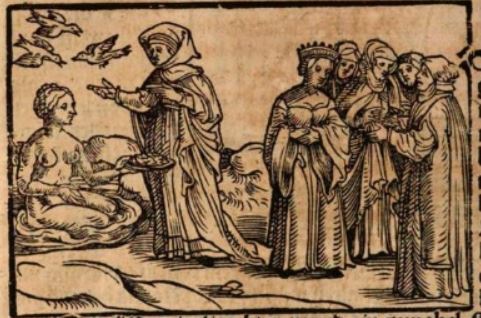
This engraving depicts Sulpicia, a woman renown for her chastity, consecrating a statue of Venus. Sulpicia is depicted on the left side of the engraving with her hands reaching out towards the nude statue of Venus. There are doves flying above the statue of Venus as doves are known to be one of many symbols of the goddess. There is a group of women standing behind Sulpicia as they were all chosen as some of the most chaste women of their time, and they all voted for Sulpicia to be the one to consecrate the statue.
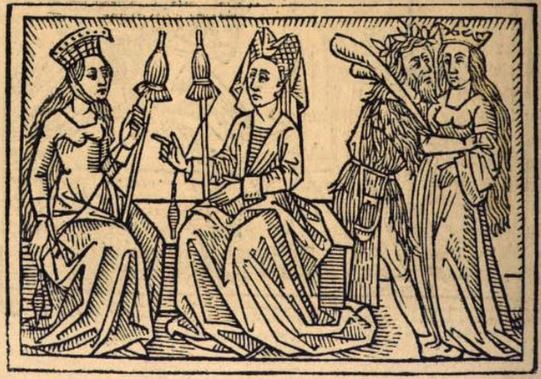
The left side of the engraving illustrates Hercules embracing his wife Iole with affection. Iole is not reciprocating the embrace. Boccaccio explains that Iole is not in love with Hercules because he killed her father after he did not give Hercules permission to marry Iole. In order to seek her revenge on her husband for the murder of her father, Iole allowed Hercules to fall madly in love with her. By doing this, Iole was able to convince Hercules to do whatever she asked. She stripped him of his pride by getting him to dress as a woman and spin wool, which is depicted on the left side of the engraving.
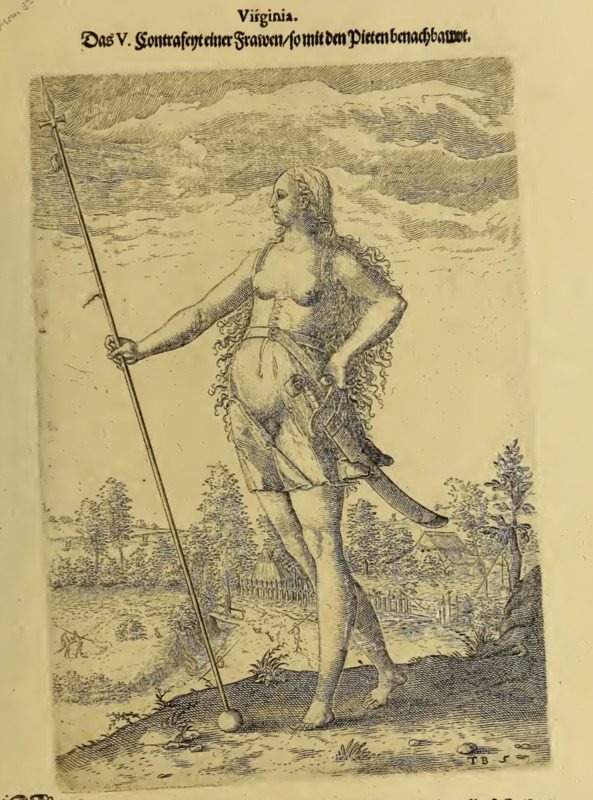
An Indigenous man is shown from the front. He carries a spear with a ball on the end in his right hand. He wears a belted tunic, and both a round shield and a sword with a curved blade hangs from the belt around his waist. This man is described as belonging to an Indigenous group that lived near the Picts. The Picts were an Indigenous group who lived in Britain long before the author’s time. Images of Picts were included in this book so that readers could compare their customs to those of the Indigenous people living in Virginia.
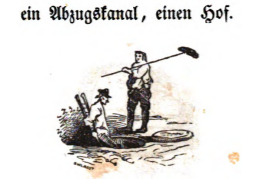
This image shows a man coming out of the sewer, while another, stands nearby. The sewer is the code word for the Court. This image comes in a description of a conspiracy found by a professor from the Grand Academy on Balnibarbi. This idea is representing code word for terms in the conspiracy that Swift is satirizing. The professor advises that those named in the conspiracy papers be closely monitored at all times, naming specifically while they were using the bathroom, as this is when men were most thoughtful. This conspiracy is thought to be an allusion to the trial of Francis Atterbury, the bishop of Rochester for allegedly plotting with the Jacobites. Atterbury was charged with treason in 1722 and was exiled to France. The same image appears in the 1843 Krabbe edition.
Here we see a horseshoe. The Houyhnhnms asks about the horses in Europe and how they live. Gulliver explains that humans or yahoos govern the country and care for the horses or Houyhnhnms, and how humans use their horses. Gulliver explained how horseshoes were made of iron and were put on the bottom of the horses’ feet to protect them from the rough roads. The same image appears in the 1839 Krabbe edition.

![[Act II – Celestina (?) and Calisto (?)]](https://cemvccol.ace-net.training/files/large/e94a06cb32d1349cdcb152c197dd25c983e30d89.jpg)
![[Gulliver stuck in a bone on Brobdingnag]](https://cemvccol.ace-net.training/files/large/cea0a2ff0df26adb32c0425d5b58f6fb76d0569c.jpg)

![[Rodrigo pursues the traitor Bellido Dolfos]](https://cemvccol.ace-net.training/files/large/7f32d8daca8d8d0088f4217eeeb934bafa06f167.jpg)
![[the Prime Minister]](https://cemvccol.ace-net.training/files/large/c259f769fb216aceedf2be01cf5c26939dcfb054.jpg)
![Hijo de los P[adres] Dotrinantes Mesticillos y Mesticilas. Lo Lleua un Harriero Espanol Alquilado a Ciudad de los Reys de Lima, Media Dozena de Ninos lo Lleua](https://cemvccol.ace-net.training/files/large/06b576fe7f313de64b24508d7b2c0010d6f94ded.jpg)
![[Gulliver and Robinson Crusoe]](https://cemvccol.ace-net.training/files/large/6c87fb61fdc0b62ad6cd2299c6bd485e3dfee460.jpg)
![[a horseshoe]](https://cemvccol.ace-net.training/files/large/a398808c654dcb2a703e1a90b5cdc94ad78d2c1d.jpg)