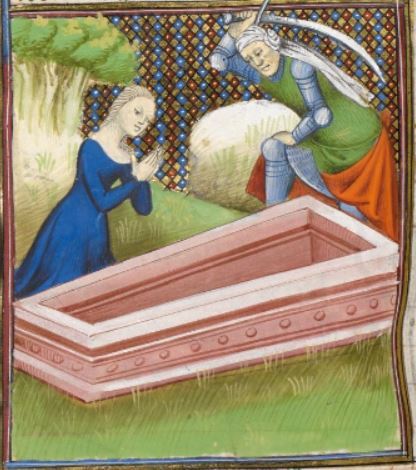
This illumination depicts Polyxena, the daughter of king Priam of Troy, about to be executed in front of Achilles’ tomb. Polyxena is illustrated kneeling with her hands together in prayer while looking down to the ground as she accepts her fate. The man executing Polyxena is Neoptolemus, the son of Achilles. Polyxena had lured Achilles into the temple of Apollo, where Paris shot and killed Achilles with his arrow. Neoptolemus is the person executing her as she is the one who is partly responsible for killing his father. Boccaccio explains that he wrote on Polyxena due to her fearlessness before her execution.
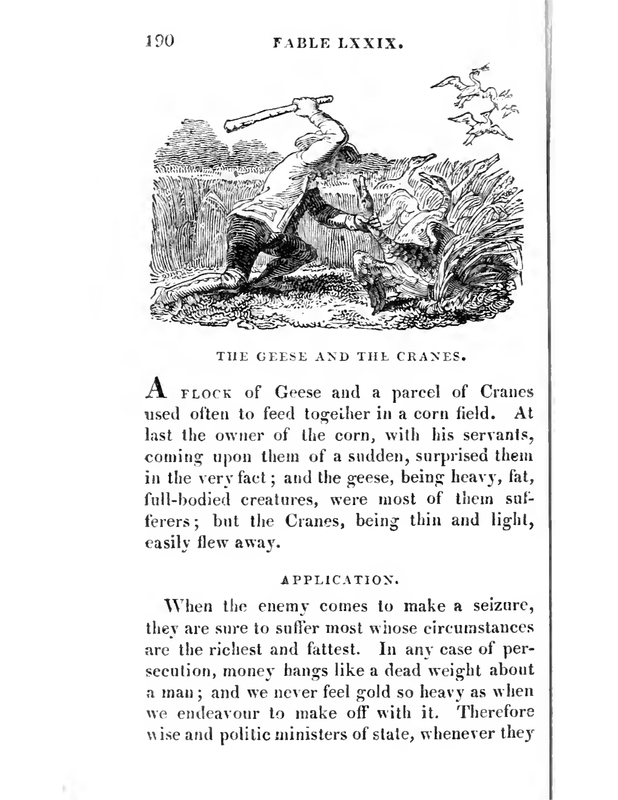
In the middle of the image a man can be seen holding a stick like object in one hand above his head, and a gooses neck in the other hand. On the left side of the image there is a cornfield. On the bottom right side of the image there are many geese trying to get away. On the top right side of the image there are many cranes flying away from the man and geese.
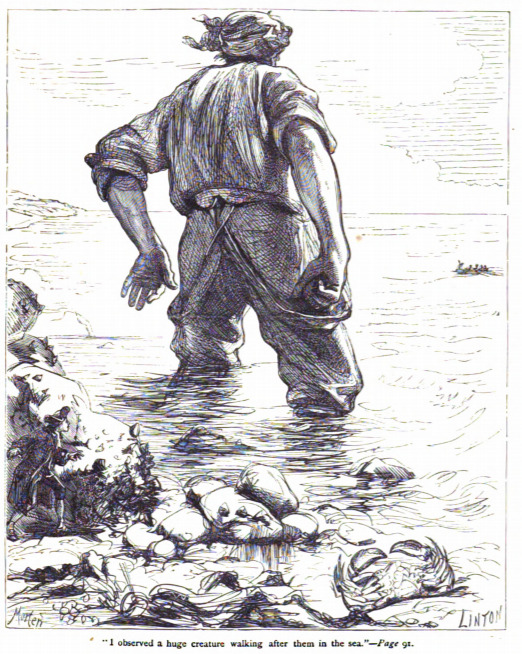
Here we see a giant from Brobdingnag chasing the members of Gulliver’s ship. The crew ran to their lifeboat and rowed back to the ship, leaving Gulliver stranded on Brobdingnag. The crew is visible in the distance in their lifeboat, while Gulliver hides behind a rock on the left side of the foreground.
Here we see the Gulliver and his guide walking through the halls of the Grand Academy of Lagado in Balnibarbi. Here scholars gather to work on problems and innovate. Gulliver visits the Academy and sees first-hand the experiment that the scholars are working on. The Academy is made up of several buildings and Swift likely took his inspiration from Gresham College in the City of London which housed the Royal Society. In this image there is the letter “C” on a light fixture because it is the first letter of the chapter. The same image appears in the 1839 Krabbe edition.
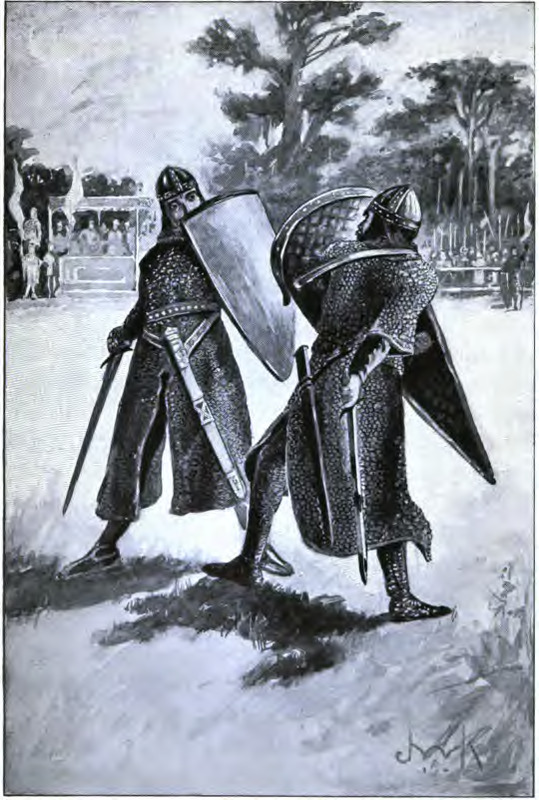
The Cid fights and defeats a knight called Ximen Garcia de Fiogelos on the orders of King Alfonso. Alfonso wants to control several castles which this knight had owned, and so sends the Cid to deal with it. The Cid is the one on the left, recognizable by his belt. A number of people are watching the fight in the background, presumably including the king.
Here we see a group of Houyhnhnms. This image appears when Gulliver tells the readers about the philosophy of the Houyhnhnms. Gulliver tells us that the two principal values of the Houyhnhnms are friendship and benevolence, represented here as we see a group of Houyhnhnms that are friends and appear happy together. The same image appears in both the 1839 and 1843 Krabbe editions.
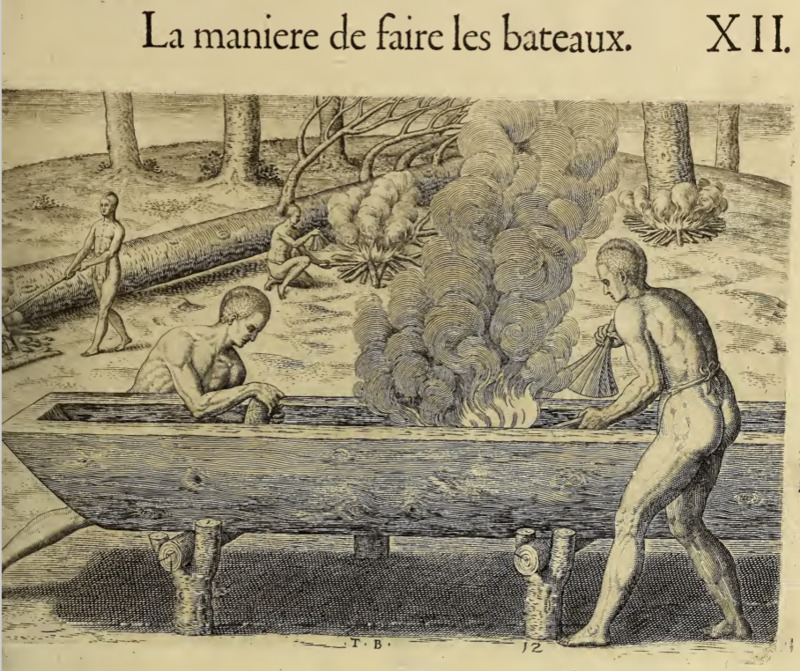
Indigenous men are shown in the process of making a canoe. The canoe they are working on is propped up on log braces. One of the men fans a fire inside the middle of the canoe while the other man scrapes the inside of one end of the canoe. In the background two other men are pictured tending to fires beside a large fallen tree, one at the base and one amongst the branches further up the trunk. There is also a fire at the base of another large tree in the background.
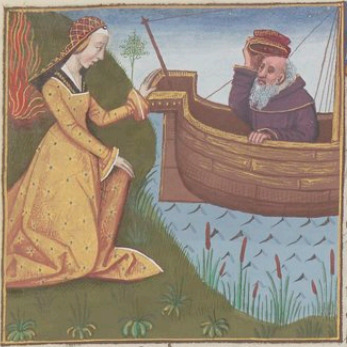
This illuminated image depicts a woman named Hypsipyle saying goodbye to her father, king Thaos of Lemnos as he sails away on a boat. Hypsipyle is illustrated kneeling by the shore as she waves goodbye to Thaos. Thaos is depicted lifting his hat as a gesture to say good bye to his daughter. Hypsipyle warned her father of an attack that the women of Lemnos had planned. The women had planned to kill every man of the city to eliminate the patriarchy. Hypsipyle, unable to allow her father to die, told him of this plan and helped him escape by means of this boat.
A group of Tupinambá women prepare for the ceremonial execution of a captive man. In the foreground, a woman kneels on the ground and paints or carves the end of a club while other women dance around her. In the background, another group of women dances around the captive man. He sits on the ground on a raised mound while a woman paints his head. He is restrained by a rope around his neck. Several of the women carry small children in baskets or slings tied to their backs.
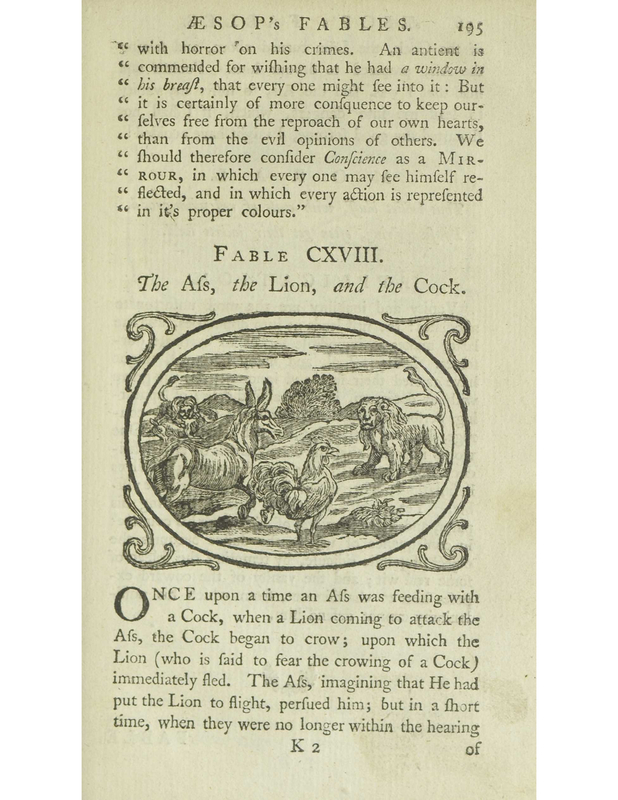
A donkey and a rooster stand facing away from the viewer, towards the lion on their right. The lion is facing the donkey and the rooster. In the background, a lion is biting into the chest of a fallen donkey.
A mermaid with long hair and a thin twisting tail floats near some rocks, mostly out of the water. She is playing a small harp beneath the full moon, which forms the letter O from “Our”.
In this image we see a crowd of Lilliputian. This image appears in the appendix to Gulliver’s travels in Lilliput. In the appendix, Gulliver discusses various aspects of life on Lilliput, including education, employment, approaches to science and philosophy, language, and interactions between people in the community. The same image appears in the 1839 Krabbe edition.
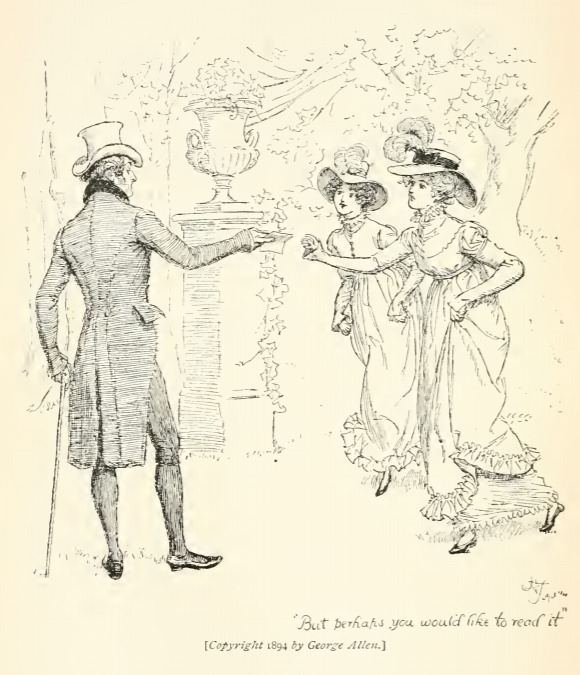
In this image Mr. Bennet hands Elizabeth and Jane the letter from Mr. Gardiner. Mr. Gardiner had gone to London to look for Lydia and Mr. Wickham. He writes that Lydia and Mr. Wickham had been found. They were not yet married, and Mr. Wickham required a small annuity and then he will marry Lydia to avoid scandal. This scene occurs in chapter 49. The characters are shown in the traditional regency style. Jane, and Elizabeth wear regency dresses with empire waistlines and bonnets. Mr. Bennet wears a tailcoat and top hat and hold a walking stick. The regency period dated to the early nineteenth century (1811-1820) when George, Prince of Wales, later George IV (r. 1820-1830), reigned as regent for his mentally ill father, King George III (r. 1760-1820). The regency period is associated with the rise of neoclassicism in art and fashion.
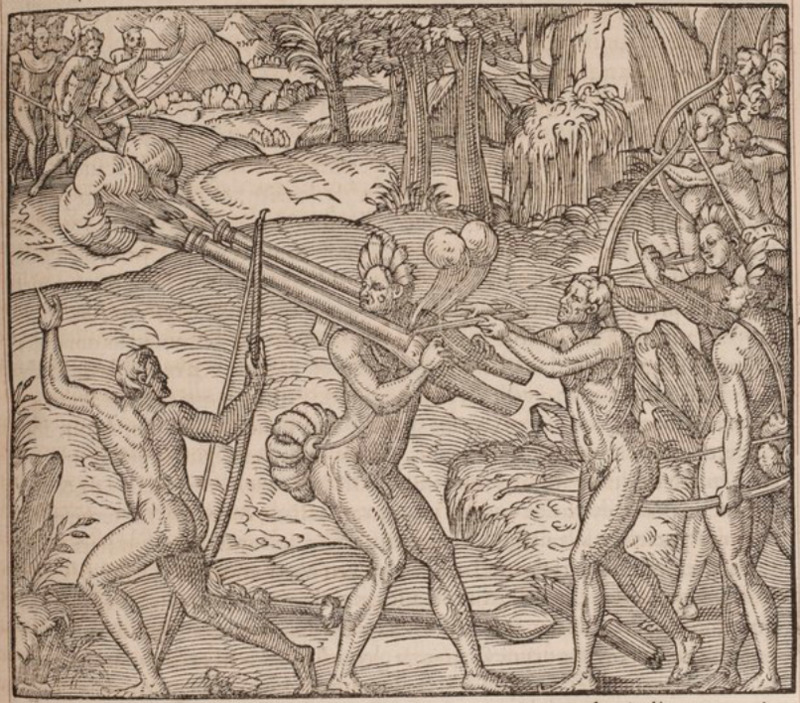
An Indigenous king or chief named Quoniambec (as identified by the author) holds two large guns or muskets, one on each of his shoulders, aiming behind him towards an enemy group. Another Indigenous man lights the fuses on both guns to fire them at the same time. Quoniambec wears a feathered headdress and a round feathered adornment hangs at his back. A decorated war club lays on the ground near his feet. Men of both groups carry bows and arrows and some wear feathered headdress and round adornments. This image is identical to one found one page 952 of Paris, 1575 (l’Huillier).
Here we see the face of Gulliver’s master, who is surprised at the things Gulliver tells him about humanity. Gulliver explains the concepts of power, malice, envy, lust, and riches. His master was shocked by these things, as they do not exist for the Houyhnhnms. The same image appears in the 1843 Krabbe edition.
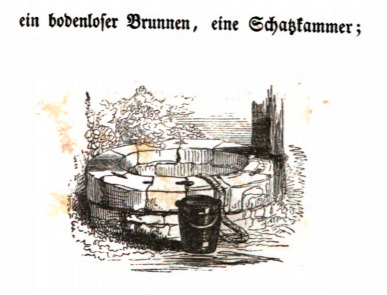
This image shows a bottomless pit, which is the code word for the treasury. This image comes in a description of a conspiracy found by a professor from the Grand Academy on Balnibarbi. This idea is representing code word for terms in the conspiracy that Swift is satirizing. The professor advises that those named in the conspiracy papers be closely monitored at all times, naming specifically while they were using the bathroom, as this is when men were most thoughtful. This conspiracy is thought to be an allusion to the trial of Francis Atterbury, the bishop of Rochester for allegedly plotting with the Jacobites. Atterbury was charged with treason in 1722 and was exiled to France. The same image appears in the 1843 Krabbe edition.
This illustration depicts the queen of the Galatians sitting on the ground on the left side of the image holding a decapitated head. This woman’s name is unknown; however, she is the wife of King Drigiagon. After being taken as a captive of Roman enemies, the Galatian woman was defiled by a Roman centurion. To seek her vengeance, once she was freed through ransom, she ordered her servant to decapitate the man who raped her. This image depicts her servant holding the sword just after severing the centurions head off. The centurion’s body is illustrated wearing a white outfit with blood pouring out of the wound. The Galatian woman is holding the head as she will use this to prove to her husband that she was defiled by this man. Boccaccio explains that she wrote on this woman to highlight her daring and courageous nature.


![[Gulliver walks through Grand Academy of Lagado]](https://cemvccol.ace-net.training/files/large/ba6f21c526cbec70064bafe56d1fa61d6fcdf6ce.jpg)
![[a group of Houyhnhnms]](https://cemvccol.ace-net.training/files/large/6ffee9fdc92df9573ffa1bc79bce3bc7ec96dbd1.jpg)

![[Tupinambá women prepare a captive man to be executed]](https://cemvccol.ace-net.training/files/large/236c59c062c29324f38ecae1106d467d52a500f8.jpg)

![[Vanity Fair Volume II. Chapter IX Inhabited Initial, O]](https://cemvccol.ace-net.training/files/large/b97ef600ec711cdecc8ffcefa77b8ac244d34b1c.jpg)
![[A group of Lilliputians]](https://cemvccol.ace-net.training/files/large/2e572455236eb6a589e10b59c2f907d86267df02.jpg)

![[the head of a Houyhnhnm]](https://cemvccol.ace-net.training/files/large/f83420320aa16d7ca64550748ed9e997e6310e9c.jpg)



![[The Wife of Drigiagon has her Defiler Decapitated]](https://cemvccol.ace-net.training/files/large/f13a233bb514342c1407b707b59b4258160cbc7f.jpg)