The left panel depicts Celestina standing outside. She is wearing a robe and veil, with what looks like a rosary hanging from her waist. On the right, we see Sempronio wearing a hat. He is holding some sort of satchel and has a sword mounted on his belt. Beneath his feet there is a decorative panel, which appears to depict a flower and roots. The entire image is nearly identical to the one found on page 82 (only the decorative panel differs). The left panel is identical to the panel found on the title page (with the exception of the colour found there), the one found at the end of the book, and those found on pages 105, 150, 162, and 221. The right panel is nearly identical to those found on pages 125 (labeled ‘Pármeno’ and no decorative panel), 229 (labeled ‘Centurion’ and no decorative panel), and 235 (labeled ‘Tristan' with a different decorative panel).
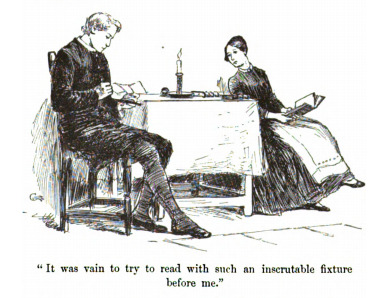
Here we see Mr. Rivers and Jane Eyre sitting across from each other at a table. He looks down at a pocketbook from Morocco, as Jane looks over at him while reading a book of her own. Mr. Rivers tried to convince Jane to join him on a mission with the church to India, but she refused.
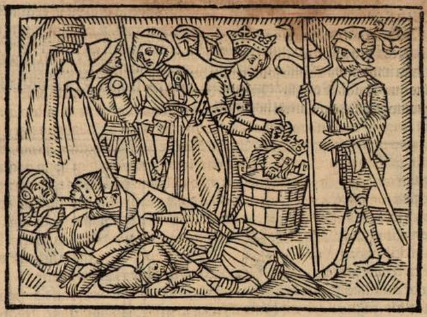
This engraving depicts Thamyris, the queen of Scythia, placing the decapitated head of king Cyrus into a bucket with the help of her soldiers. Boccaccio explains that Cyrus had invaded Scythia looking for glory, and when he had killed Thamyris’ son, she exacted her revenge by killing his entire army. When Thamyris found Cyrus’ dead body, she took his head. Cyrus’ body is depicted below the bucket. There are other dead bodies among Cyrus which were his soldiers.
A group of Tupinambá men dance in a circle. They all wear round feathered adornments hanging down their backs and ornaments, possibly noisemaking, around their calves. The group dances around three men at the center of the circle. These men wear feathered headdresses, cloaks, and adornments around their waists. Two of them blow smoke from pipes towards the dancers, and all three hold a ratel or religious object with feathers on it. In the background, three European men stand and watch the ceremony.
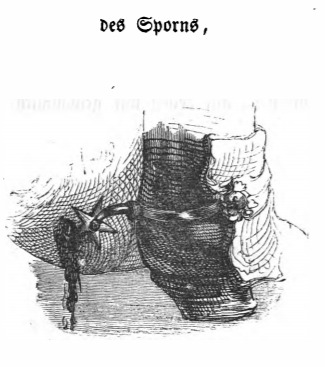
Here we see a spur on the back of a boot. The Houyhnhnms asks about the horses in Europe and how they live. Gulliver explains that humans or yahoos govern the country and care for the horses or Houyhnhnms, and how humans use their horses, including how humans use the spurs on the back of boots to control horses. The same image appears in the 1839 Krabbe edition.
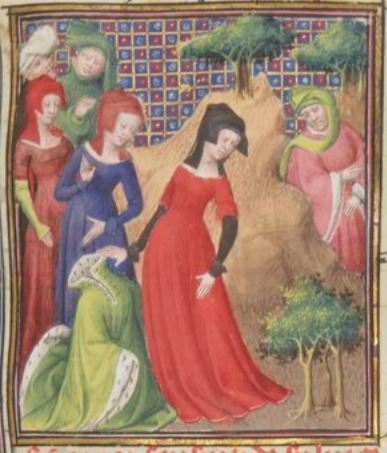
This illumination depicts a woman named Sulpicia leaving her home to find her exiled husband. Her husband, Lentulus Cruscellio, had evaded proscription and fled to Sicily to live in exile. Lentulus is depicted on the right side of the image looking over to Sulpicia who is illustrated wearing a red dress. Sulpicia was incredibly devoted to her husband and left the comfort of home to follow him into exile. There are people on the left side of the image watching Sulpicia leave. Sulpicia is depicted throwing away a green robe as she leaves behind her life to go with her husband.
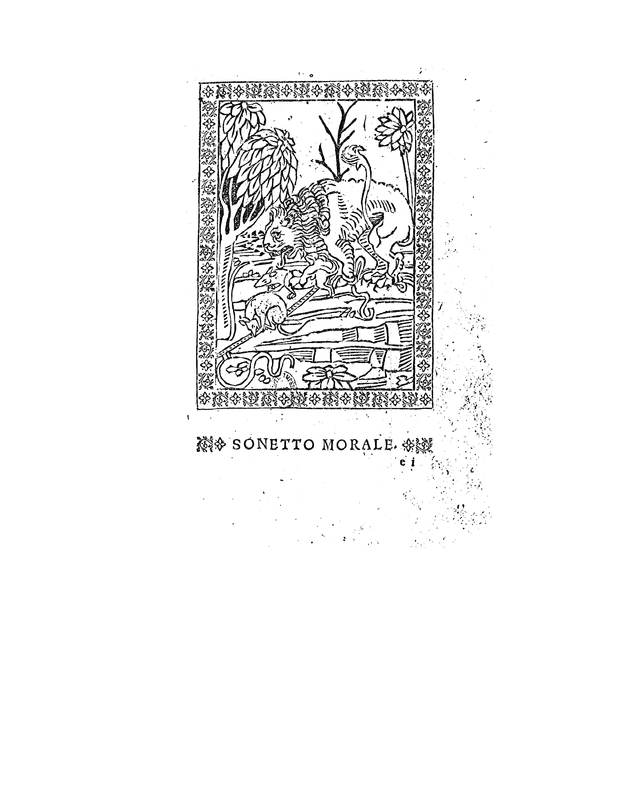
There is a lion with its tail between its legs and seems to have a rope tied to it. The left front paw of the lion is pinning down a mouse. In the forefront of the image there is mouse chewing on the rope that is trapping the lion.
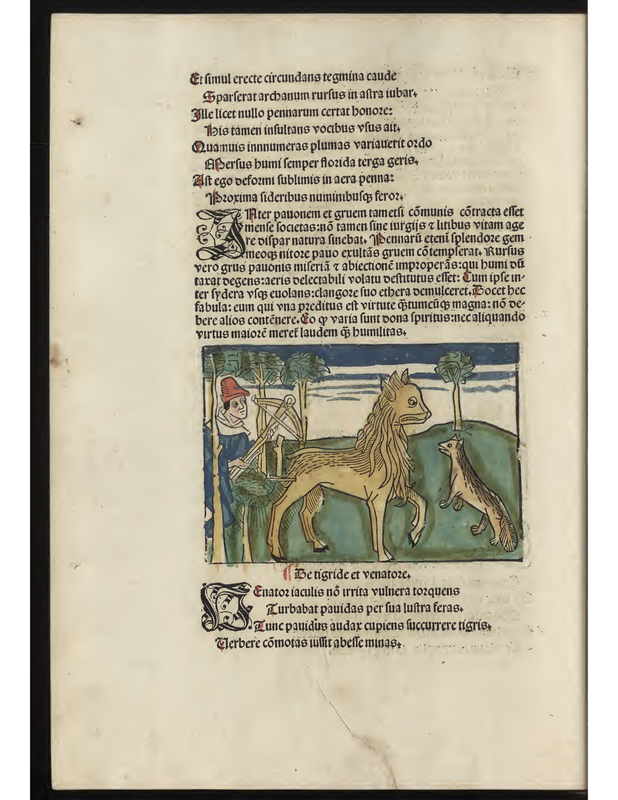
A tiger and a wolf growl at each other in the woods. A man with a bow and arrow, who appears to be a hunter, is hiding behind a tree watching the animals. The man looks like he is planning to attack the animals.
In chapter five, Gulliver explains several aspects of society in England. Here we see several animals dressed in legal robes. Most animals were birds, with one donkey. This image serves as a commentary on the legal system, and its inefficiencies. The animals represent the ignorance, stupidity, and lack of common sense that Gulliver saw in the legal system. The same image appears in the 1843 Krabbe edition.
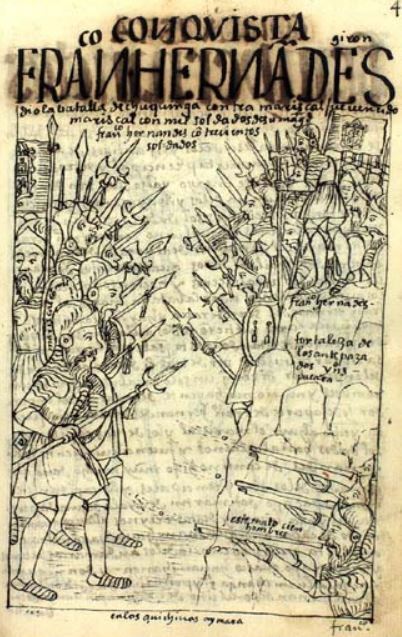
This chapter focuses on discussing the arrival of Spaniards and the Spanish conquest of Peru. Francisco Hernandez Giron, a conquistador involved in the conquest of Peru, had initiated a rebellion against the king of Spain. Marshal Alonso de Alvarado was put in charge of opposing Giron. This image depicts a battle between Francisco Hernandez Giron and Marshal Alonso de Alvarado. Alvarado and his army are depicted on the left side of the image. A caption is written on a shield on the left side of the image that reads, “mariscal con mil” [Mashal with one thousand]. A caption is written on the right side of the image that reads, “francisco hernandes/ fortaleza de los antepazados yndios, pucara/ este mato cien hombres” [Francisco Hernandez/ fortress of the Indian ancestors, in Pucara/ this one killed one hundred men].
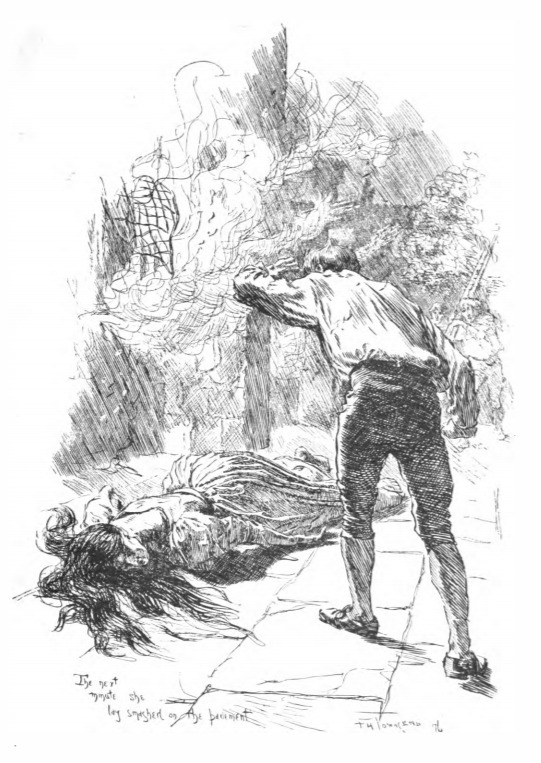
After hearing Mr. Rochester’s voice while at Moor House, Jane decided to return to Thornfield. When she arrived, she found it burned down. She learned that Mr. Rochester’s mentally ill wife had set fire to the third floor and then other rooms in the house, including the bed in Jane’s old room. She then went up onto the roof and threw herself off, seen here.
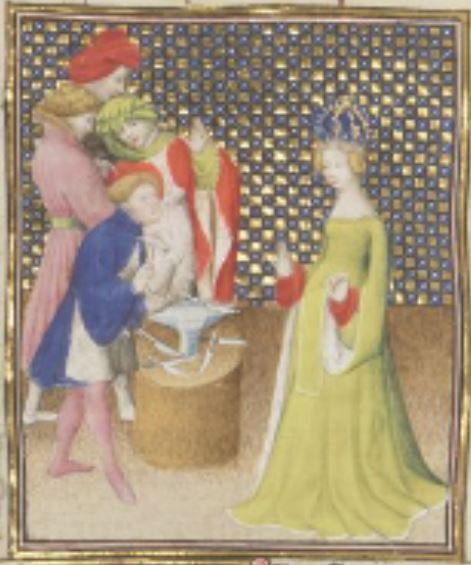
This illumination depicts Faustina Augusta standing on the right side of the image wearing a green dress and a crown on her head. She is wearing a crown because she was the wife of Emperor Marcus Aurelius, and was honoured with the title of Augusta, the first woman to have that title. She is illustrated standing in front of a person working at a smithing table. Faustina was known to be unfaithful to her husband and was in love with a gladiator. The man forging the weapons in the image is presumably the gladiator Faustina fell in love with. There are three additional figures standing behind the person working at the smithing table looking at Faustina and whispering.
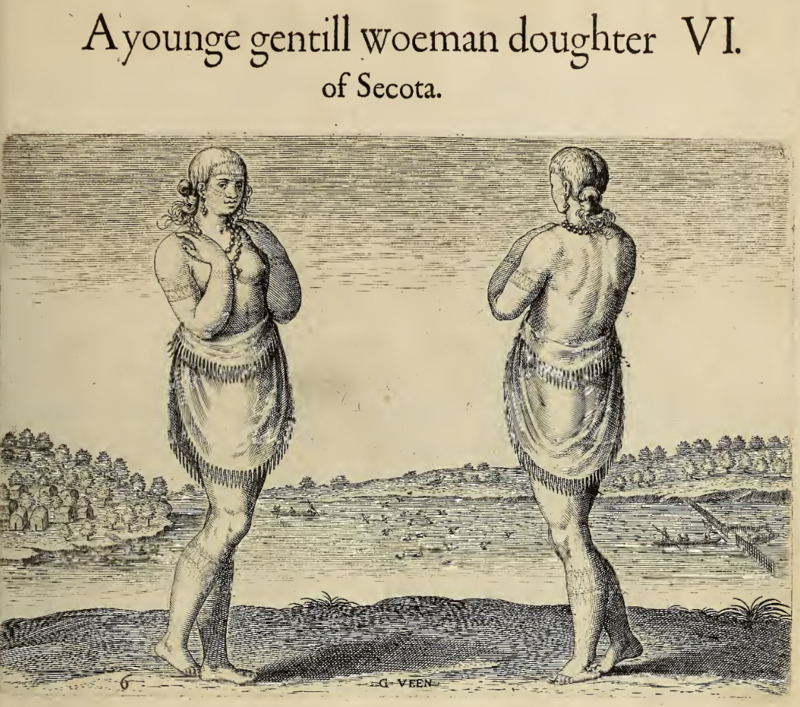
A young Indigenous woman stands on the bank of a river, shown from the front and from behind. Her hair is knotted at the nape of her neck. She wears a necklace of beads, and has an adornment, either a physical cuff or an inked design, around her biceps, her wrists, and her calves. She wears a fringed skirt tied around her waist and is barefoot and shirtless. In the river behind her, other Indigenous people are shown in canoes, and on the opposite bank there are several buildings.
Here Gulliver speaks with the King of Brobdingnag after recovering from his encounter with the monkey. The king asks Gulliver about monkeys in Europe, to which Gulliver responds there are very few monkeys in Europe unless they had been brought there from elsewhere. The king laughs at this response. The same image appears in the 1843 Krabbe edition.
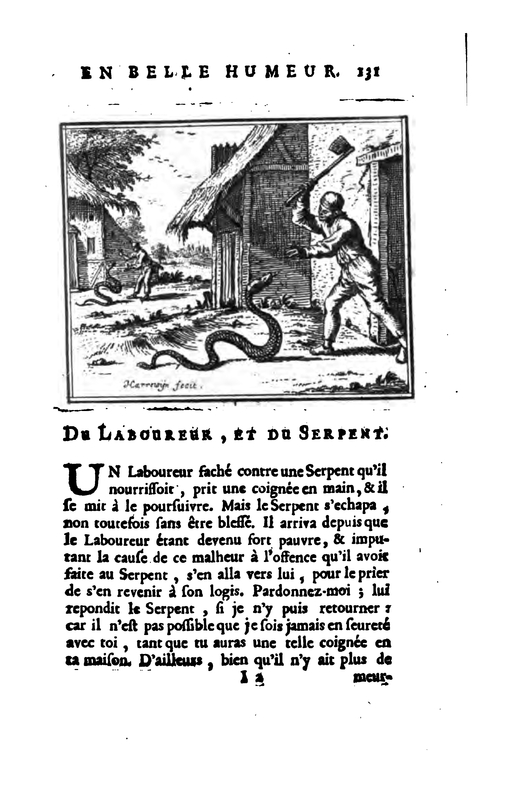
A snake having made his hole close to the porch of a cottage, bit the cottager's infant son, of which he died, causing great grief to the parents. The father resolved to kill the snake, and the next day, as it came out of its hole for food, took up his axe; but in his haste, missed the head, and cut off only the end of his tail. The cottager, afraid to be bit, tried to make peace through the offer of bread. The snake said: There can be no peace between us. whenever I see you I shall remember the loss of my tail, and whenever you see me you will be thinking of your dead son.
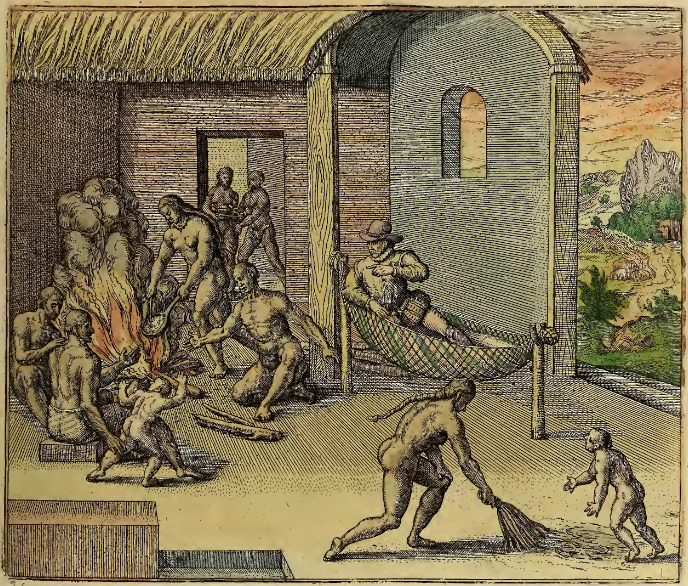
A Spanish man (Girolamo Benzoni) lounges in a hammock inside an Indigenous structure, in conversation with a Nicaraguan Indigenous leader (a Cacique). In the foreground an Indigenous woman sweeps the floor while a child frolics around her. Beside Benzoni’s hammock, a group of Indigenous men and women tend a fire and prepare food. The Cacique sits on a block close to the fire and holds onto the leg of a child while he converses with Benzoni. In the background, two women enter the room with a platter of food. This image is identical to one found on page 157 of Frankfurt, 1595, but colored.
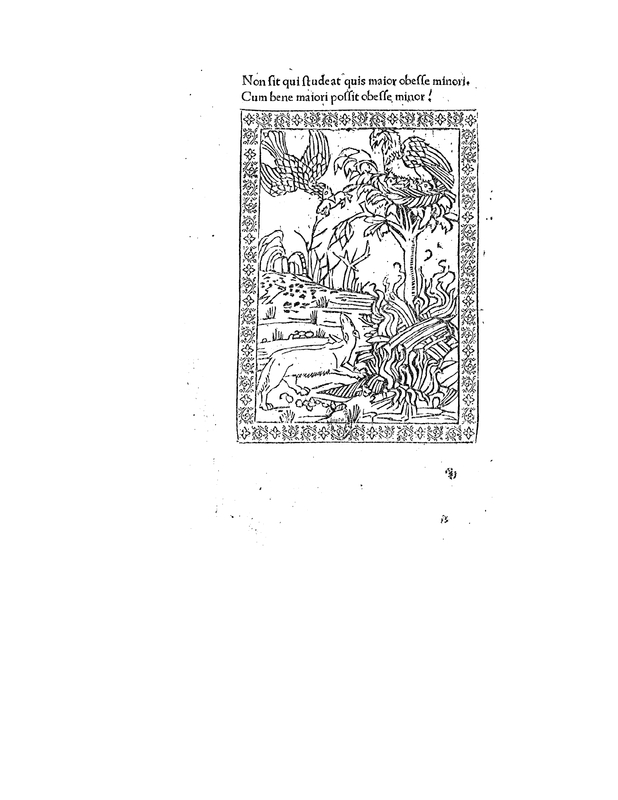
The left side of the image depicts and eagle flying with a fox's pup towards its nest, the fox which is presumably the mother is looking up at the eagle. The right side of the image shows the eagle sitting in its nest with its eaglets, the base of the tree is engulfed in flames.
As Celestina informs Calisto of her meeting with Melibea, he cannot contain his emotions (they are seen talking to the right of the image). Pármeno repeatedly makes snide remarks under his breath, insulting both Celestina and Calisto. Sempronio overhears these remarks and grows angry with Pármeno (they can be seen to the left of the image), pointing out that his words are damaging to both Celestina and to Sempronio himself.To the right of the image, we can see Celestina wearing a robe and a veil. Calisto stands beside her, wearing a coat and a hat, with a sword mounted on his belt (it can be seen protruding from behind his coat in the bottom right corner). His hung head and facial expression convey and air of sadness. To the left, we see Pármeno and Sempronio, who are both wearing hats. We also see a sword protruding from behind Pármeno. Pármeno is pointing at Sempronio as he glances toward Celestina and Calisto, perhaps warning him of Celestina’s treacherous and deceitful ways.
A man is trapped in a hole in the middle of a bush. He is being pulled out by two men. The man looks in distress as he is being saved. Behind them there is a big castle.


![[Act III – Celestina and Sempronio]](https://cemvccol.ace-net.training/files/large/e6a279e5e71425a74b159939c9c6c1f700c0fb10.jpg)
![[The Tupinambá engage in a religious or ceremonial dance]](https://cemvccol.ace-net.training/files/large/8c3ea72edbc8b7f2426a9466311c3b14d1ebaa79.jpg)

![[animals acting as lawyers]](https://cemvccol.ace-net.training/files/large/bf67eba2f73759070463ca48bd2855ae7549b2d1.jpg)
![[Gulliver speaks with the King of Brobdingnag after his encounter with the monkey]](https://cemvccol.ace-net.training/files/large/5ca38b536883d0096be4bb2dfe63903d9a919361.jpg)
![[Act VI – Sempronio Chastises Pármeno for His Snide Remarks While Celestina Talks with Calisto]](https://cemvccol.ace-net.training/files/large/f5d0255ff0aac4f8e654c7a665a64fa43020ea16.jpg)
![[Man saved from hole in bush]](https://cemvccol.ace-net.training/files/large/66f103b14bc3fbde09452a8c1d573967f995ffcf.jpg)