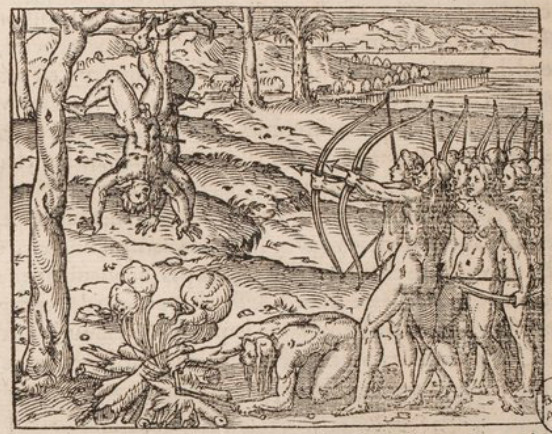
Two men have been captured by the Indigenous Brazilian warrior women, a group which the author calls ‘Amazons’. The men have been hung upside down by one ankle from a tree, and a fire has been lit beneath them. The women shoot arrows at the hanging men. This image is identical to one found on page 960 verso of Paris, 1575 (l’Huillier), and in Thevet’s Les Singularitez de la France Antarctique (page 126 verso of Paris, 1557 and page 126 verso of Paris, 1558).
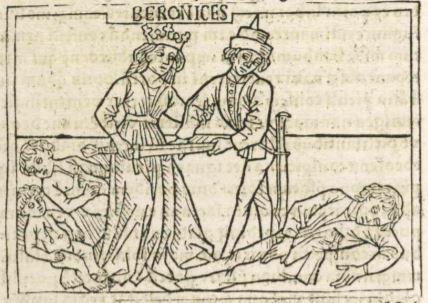
This engraving depicts Berenice, the queen of Cappadocia, stabbing a servant in his abdominal area to avenge her sons’ deaths. Berenice’s name, written as “Beronices” is engraved above her head to identify her. After her sons had died at the hand of her brother, Mithridates, Berenice sought vengeance against him. The slave that Berenice is stabbing in this engraving is Caenus, a man who was involved in the murder of her sons. Although she is depicted stabbing him with a sword in this engraving, Boccaccio explains in his story that she actually chased Caenus down in a chariot, and after hitting him in the head with a rock, she drove over his body with the chariot until he died. The dead figures in the engraving who are lying on the ground are assumed to be Berenice’s children.
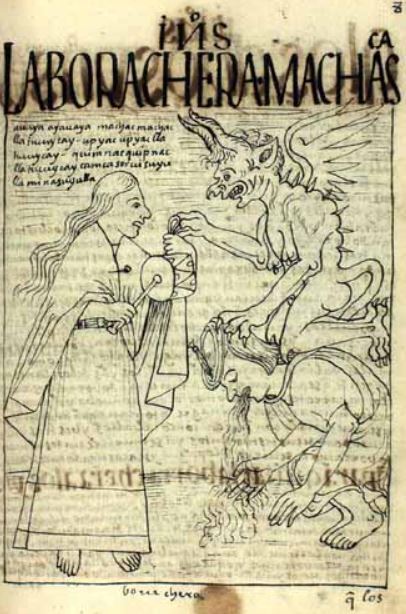
This image depicts a ritual in which an indigenous woman and man conjure the devil. The author explains that when natives of Peru would drink, they would worship their old gods and perform rituals for illness or death, which would result in the conjuring of the devil. The woman appears to be performing a ritual for the crouching man on the right who is vomiting. A horned, winged devil is depicted sitting on the back of the vomiting man to demonstrate the ritual that the woman is performing. The woman is standing as she hits her drum and speaks, “auaya ayauaya machac, machaclla tucuy cay upyac, upyaclla tucuy cay quimnac, quipnaclla tucuy cay camca serui, suyulla, mina suyulla” [the drunkard is just a drunkard, the drinker just a drinker, who vomits, only vomits, his turn is to serve you, Devil, the mines are his turn].
Joseph Sedley, in his dressing gown, stands at his dresser with one hand pressed to his temple, looking pained. In the background to his left is a table with a washbasin and a bottle on it.
Here we see a scientist from the Grand Academy on Balnibarbi who was working on methods for curing colic. He attempted to cure the illness by inserting a bellow into the anus and using them to remove the ‘excess wind’ from the patient. In another experiment he attempted to pump air into the patient using the bellows. He tried several experiments on dogs, the second method is seen here. In this second experiment, the dog inflated with the excess air, and died. The scientist then tried to revive the dog using the same method. The same image appears in the 1843 Krabbe edition.
This image has a person looking for shelter from another person. The person on the right of the image turns down the request from the person holding the sack.
Here we see a dying Houyhnhnm travelling around visiting its friends before it dies. It travels in a sedan chair carried by yahoos. These chairs were also used when a Houyhnhnm was aging, ill or injured. The same image appears in both the 1839 and 1843 Krabbe editions.
This image is a depiction of St Patrick’s Cathedral. Jonathan Swift was appointed dean of the cathedral on 23 February 1713. The image is a part of Swift’s biography which precedes Part One of Gulliver’s Travels.
Here we see a sailor kneeling on top of Gulliver’s box-house. The crew member leans over the latch of Gulliver’s house speaking to him. The house is attached to the ship with ropes. The same image appears in the 1839 Krabbe edition.
While there is no written indication of who the figures represent, the act in which it is printed only includes the characters Sempronio, Elicia, and Celestina. Celestina is depicted elsewhere as far more aged, and thus we can infer that this illustration depicts Sempronio in conversation with Elicia. Sempronio is depicted as quite small in stature, likely implying his younger age. This could also be intended to represent his lower social standing as a servant to Calisto. He is wearing a hat and a cloak of some sort, whereas Elicia is wearing a robe and a veil.The right side of the image, including the figure and the vegetation near the bottom, is reproduced on the left side of the image found on page 221 of the text (although the figure is used to depict Lucrecia in that instance). The left side, including the figure and the hatched surface at the bottom, is reproduced on the left side of the image found on page 155 of the text (although the figure is used to depict Pármeno in that instance).
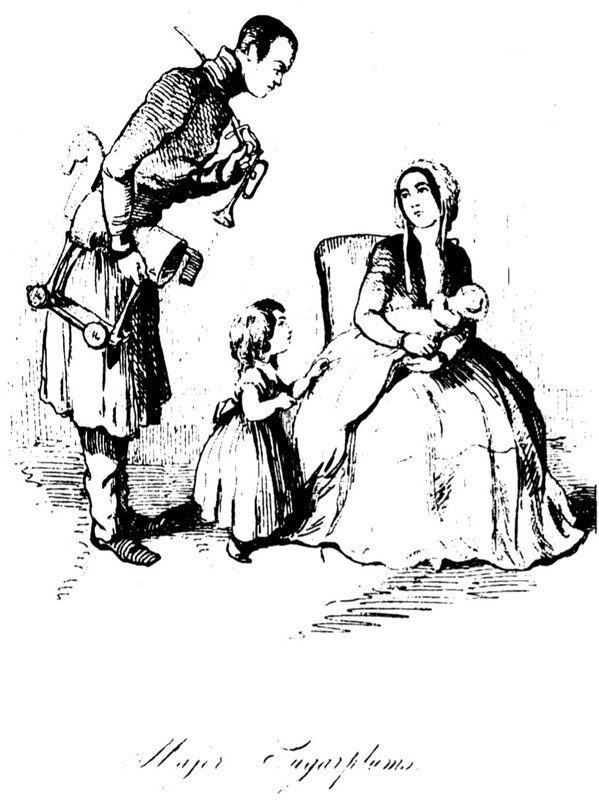
William Dobbin, carrying a toy sword, trumpet, and wooden horse on wheels, bows to Amelia Osborne. She is seated on a chair, holding her son Georgy, who is asleep. At her side is Mary Clapp, the landlord’s daughter, acting as the mistress of ceremonies to announce Dobbin, whom she calls Major Sugarplums. Below the illustration is printed in cursive its title, “Major Sugarplums”.
Here we see the great temple of Brobdingnag. The temple is built in the gothic architectural style of many European cathedrals. There is a large tower and two naves. In the foreground we see two giant couples walking among trees. The giants appear very small next to the church, showing the size and scale of the building. There are several large trees in the foreground. The same image appears in the 1843 Krabbe edition.
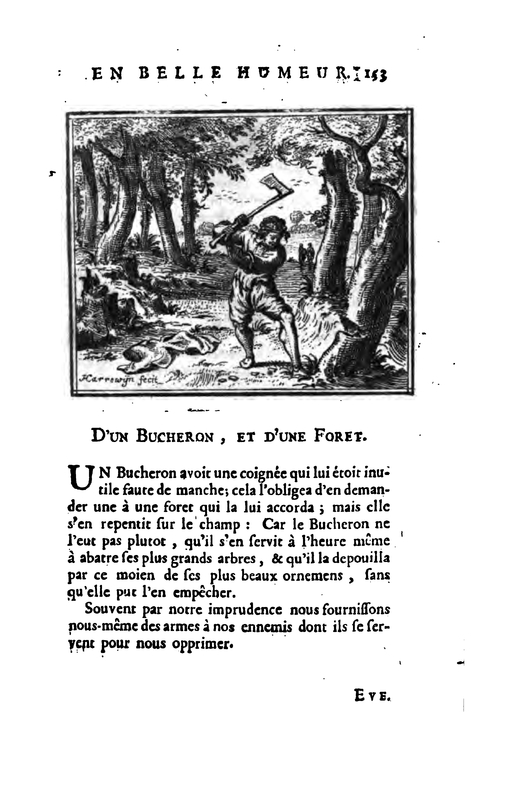
A lumberjack had a axe head which was useless to him because it lacked a handle. This forced him to ask for one from a forest, who granted it to him but regretted it on the spot: For no sooner than it was granted did the woodcutter was fervent to cut down her biggest trees and stripped her of her most beautiful ornaments, so that she could not prevent him from doing so.
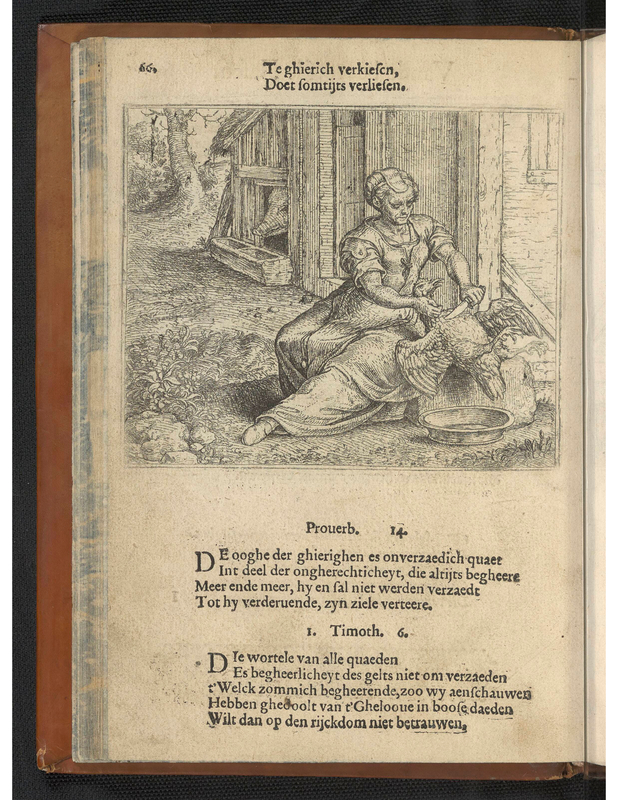
A woman sits outside her animal's shelter. She holds a duck by the neck, with a knife in her hand to kill and de-feather the bird. In the animal's barn, there is a pig sticking their snout out of a doorway.
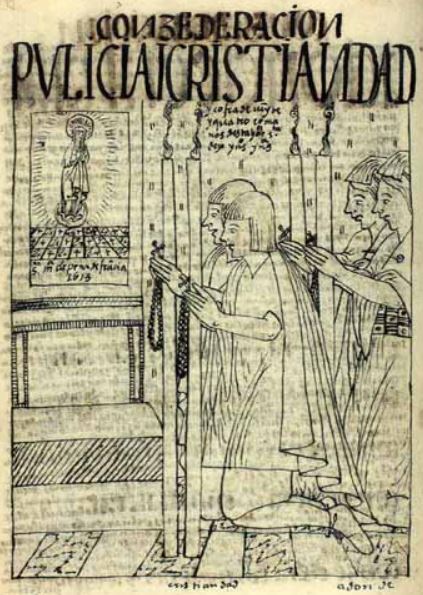
This image depicts two indigenous men and two indigenous women praying in front of an image of Saint Mary. They are illustrated kneeling and holding rosaries and tall candles in their hands. The author explains that these people were a confraternity of twenty-four indigenous men and women who dedicated themselves to a public religious order. They were a model of good conduct and Christianity. The caption below the image of Mary reads, “Santa Maria de Pena de Francia, 1613” [Saint Mary of Penafrancia]. The caption at the bottom of the image reads, “cristiandad” [christianity].
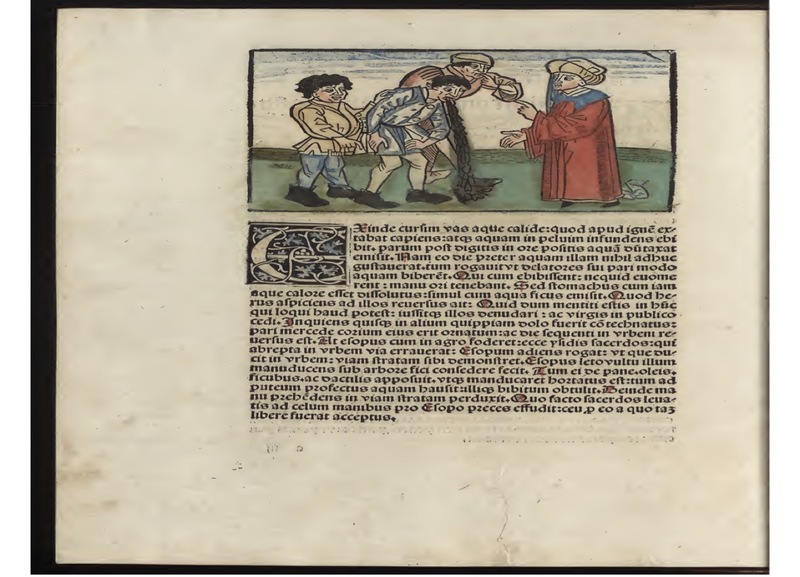
Three men stand in a group while one stands in front of them. One of the men is vomiting while the other two are supporting him upright. The man to the right of the ill man appears to be explaining the situation to the man standing away from the group.
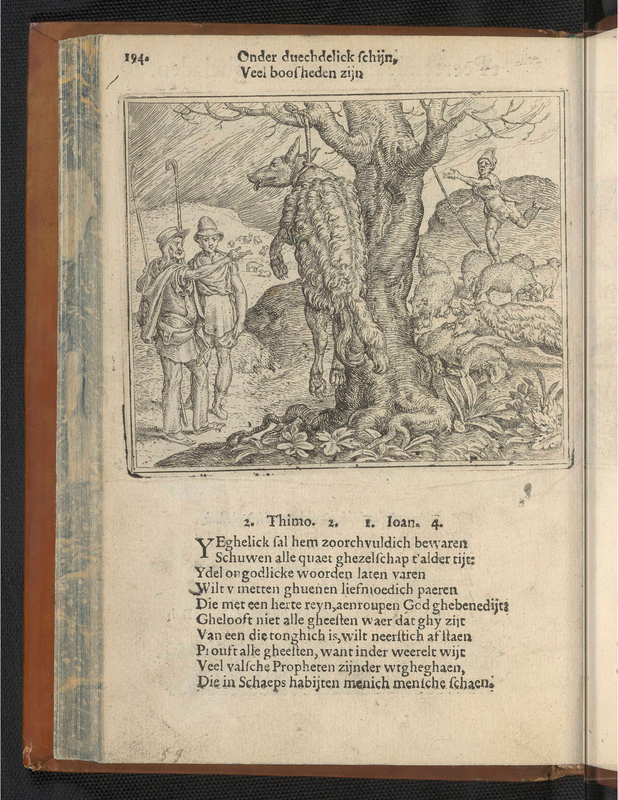
A wolf is hanged from a tree by shepherds; in the background there is a shepherd, a flock of sheep and the wolf dressed in sheep's clothing among them.
Here we see a professor from the Grand Academy on Balnibarbi holding a book which is filled with parts of sentences created by his machine. This machine had all the words in the language of Balnibarbi in different moods, tenses, and declensions written on blocks. These blocks were held together by wires on a frame, and students of the professor would rotate the handles, forming different arrangements of the words. They would then find sentence fragments and record them in this book. The goal of this experiment was to create a complete body of work that comprised all of the arts and sciences. The same image appears in the 1839 Krabbe edition.
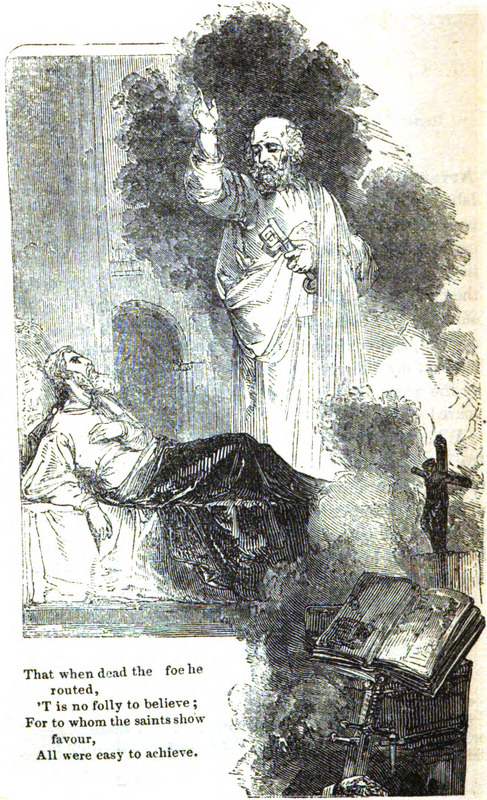
The Cid lies sick on his bed, seeing a vision of St. Peter. St. Peter tells him that he has thirty days left to live, and that once he has died his body should be brought into battle against King Bucar. This, along with the help of St. James, will give the Castilians a “glorious victory.” In his hand St. Peter holds one of the Keys of Heaven with which he is associated, and in the foreground two swords lean against a book, presumably the Bible, all underneath a crucifix.
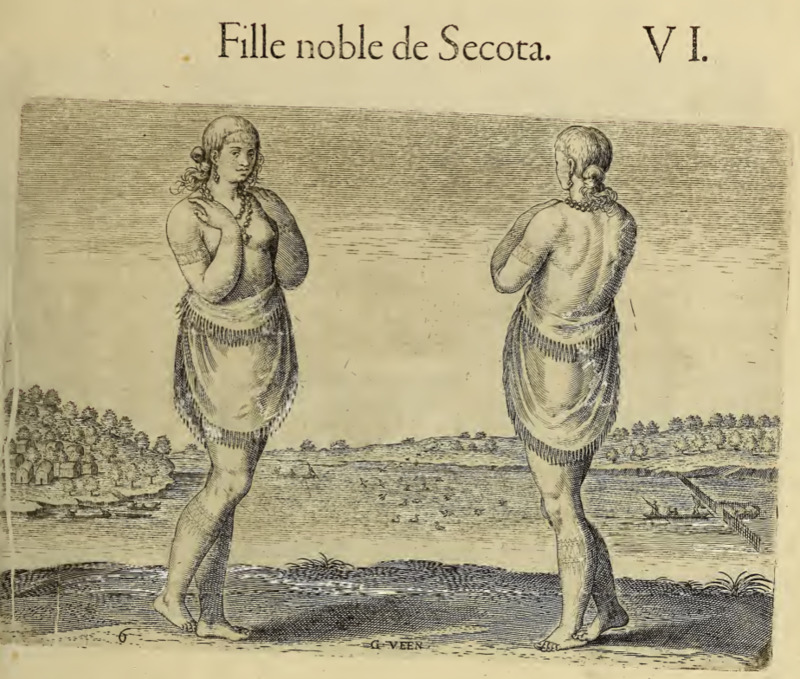
A young Indigenous woman stands on the bank of a river, shown from the front and from behind. Her hair is knotted at the nape of her neck. She wears a necklace of beads, and has an adornment, either a physical cuff or an inked design, around her biceps, her wrists, and her calves. She wears a fringed skirt tied around her waist and is barefoot and shirtless. In the river behind her, other Indigenous people are shown in canoes, and on the opposite bank there are several buildings.
Soon after Celestina visits Calisto’s house, Calisto becomes impatient and orders Sempronio to pay her a visit and hasten her along in accomplishing her task. He does not want to leave Calisto alone, so Calisto asks Pármeno to keep him company during Sempronio's absence, alleviating some of Sempronio’s concerns. Pármeno once again tries to dissuade Calisto from trusting Celestina, but he is again unsuccessful. In the top left corner of the illustration, there is a veiled woman in a window observing the other figures. We can infer that this is meant to represent Celestina, since she is the only female character that appears in the second act. Because the rightmost figure appears to be quite sad, it is likely meant to represent Calisto. Because Sempronio is consistently depicted as a bearded figure in this edition, we can infer that he is likely represented by the central figure. The leftmost figure would therefore represent Pármeno. This figure is shown looking at Celestina while also reaching out toward Calisto and Sempronio, perhaps intended to represent his desire that Calisto should avoid Celestina. All three figures are shown wearing hats and have swords mounted on their belts.

![[Joseph’s Hangover]](https://cemvccol.ace-net.training/files/large/834c1bde6684e6a5c397e31330bf79d074c91b69.jpg)
![[A scientist from The Grand Academy on Balnibarbi experiments with cures for colic]](https://cemvccol.ace-net.training/files/large/cf0705a832e4d341f23630213d3a7c233cdb52dc.jpg)

![[Person Looking for Shelter]](https://cemvccol.ace-net.training/files/large/e30bb2f73cd049d8cf84dd875bfbe403433944ea.jpg)
![[a dying Houyhnhnm visits its friends]](https://cemvccol.ace-net.training/files/large/39520b5e72a7e7e27f6faced8c5160180b87df21.jpg)
![[St Patrick’s Cathedral]](https://cemvccol.ace-net.training/files/large/5adda23b8cc1f3810474b273dc57765ba63ff18b.jpg)
![[A sailor lifts the hatch on Gulliver’s house]](https://cemvccol.ace-net.training/files/large/23464b47f62f0dc6fd43f362710acaaa26932ebd.jpg)

![[Act III - Sempronio and Elicia]](https://cemvccol.ace-net.training/files/large/35ee25f5067b4d19758ce0d990380d2642cab5de.jpg)
![[The great temple of Brobdingnag]](https://cemvccol.ace-net.training/files/large/b79abc823baa126fb1c5cdfc8e751e5697a2fe78.jpg)
![[A professor from the Grand Academy of Lagado shows Gulliver his research]](https://cemvccol.ace-net.training/files/large/622dee450126c7d66609708ebe7241d477ece199.jpg)
![[Act II] Calisto spreect tot beyde syn dienaers.](https://cemvccol.ace-net.training/files/large/fdf879d9cab311c271b46fdfeee846c9d8fa51f2.jpg)