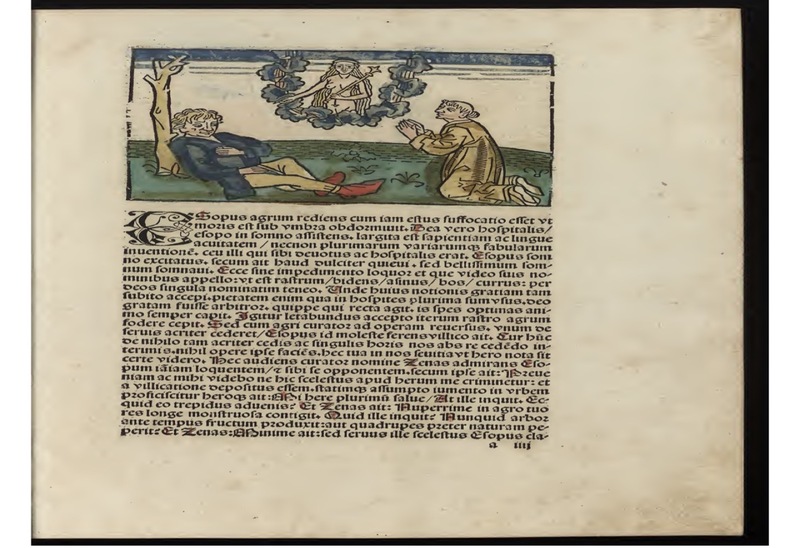
One man lays against a tree with his hand on his chest, appearing to be injured or ill. Another man kneels to his right, praying to the woman in the middle for the other man’s health. The woman is floating in the clouds between the two men, completely naked. She carries with her a sceptre in her left arm and points at the man laying against the tree with her right finger.
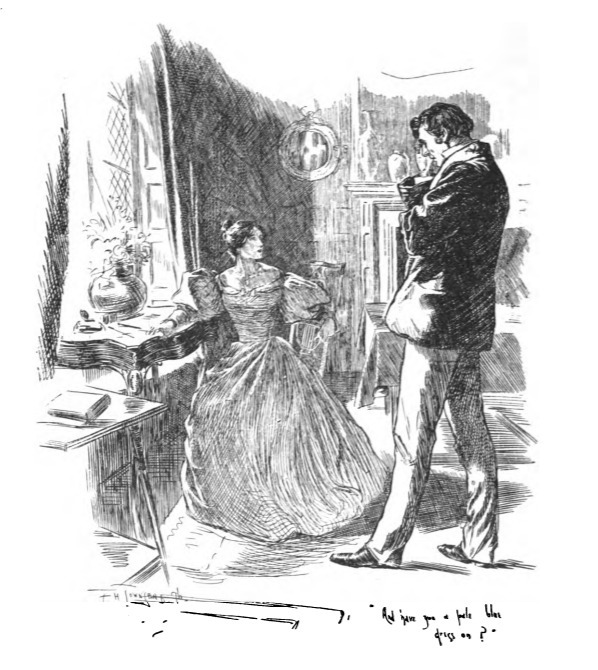
After reuniting with Mr. Rochester, they were married three days later. Over time, Mr. Rochester’s sight slowly returned in his right eye. At first, he could only see bright lights and colours, but his sight slowly improved. One day Mr. Rochester if Jane was wearing a light blue dress, showing that his sight had returned almost completely in one eye.
Here Gulliver meets a frog who accidentally got into the trough in which Gulliver sailed for the entertainment of the court of Brobdingnag. The trough was built so that Gulliver could sail and entertain the courtiers, and the water was changed every three days. The frog got in when the water was being changed and climbed into Gulliver’s boat. In the image we see the frog’s head comes out of the water, and Gulliver fends him off with a stick while in the ship. The same image appears in the 1843 Krabbe edition.
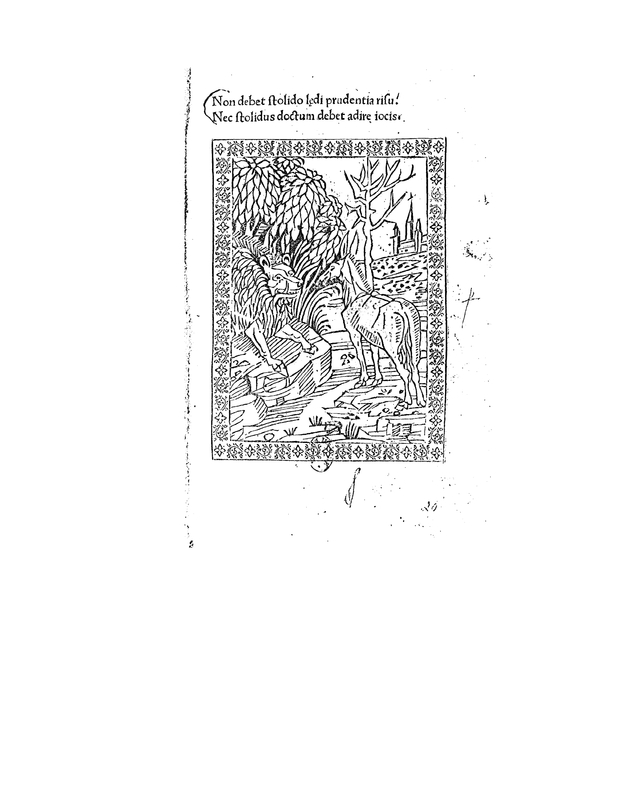
On the right side of the image there is an ass standing looking at a seemingly agitated boar who is on the left side of the image elevated on a rocky platform.
Sempronio and Pármeno (two leftmost figures) join Celestina (central figure), along with Areusa and Elicia (two rightmost figures), for dinner. Elicia grows frustrated when Sempronio begins praising Melibea’s beauty and virtue, but Celestina manages to restore peace between them. As they dine, Lucrecia knocks at the door and informs Celestina that Melibea has requested the return of her girdle. More importantly, Lucrecia tells her that Melibea is afflicted by an illness of the heart and desires her aid. Celestina’s guests depart first, after which Celestina leaves for Melibea’s house with Lucrecia.[The figures in this illustration are used in multiple other illustrations throughout this edition.]
Here we see a stack of books and scrolls. There is also an inkwell and a quill. This image appears before the story begins, and likely represents Gulliver writing the story of his adventures. This image also appears in the 1843 Krabbe edition.
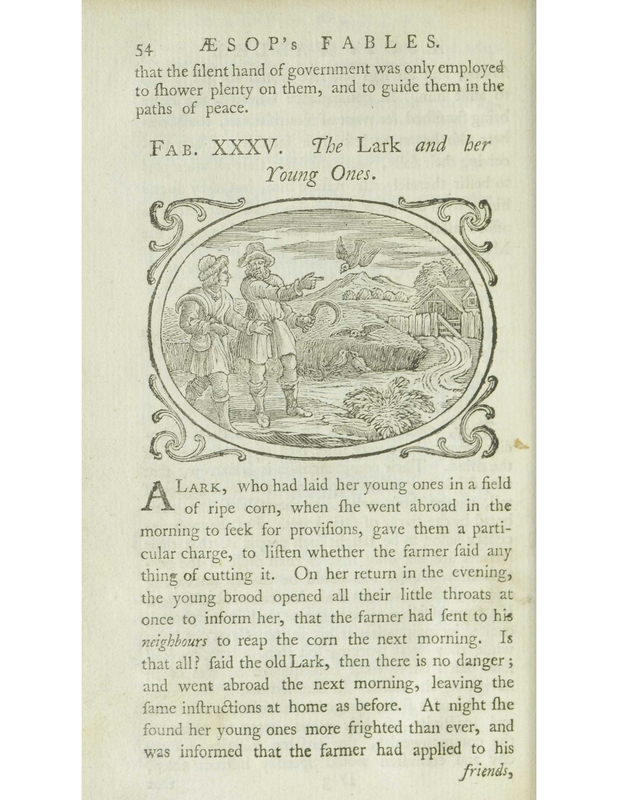
On the left of the image stands two men on a pathway to a house with a fence surrounding it. One of them holds a large hook in his left hand and points towards a lark who is swooping down towards the men. One other lark flies lower than the first, while two baby larks standing on the ground, next to a field of tall grass. The sky is cloudy with mountains in the background.
Here we see Gulliver turning his back on the farmer who found him. The farmer made Gulliver perform which took a toll on Gulliver’s health. The Queen of Brobdingnag met Gulliver and brought Gulliver and Glumdalclitch to her palace.
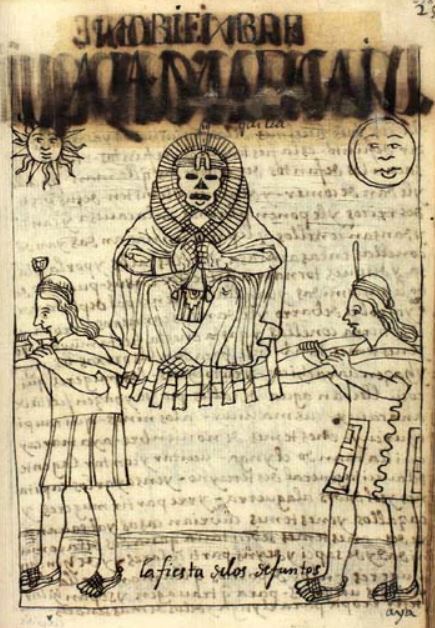
This chapter is dedicated to discussing the traditions and rituals of each month during the Inca Empire. The Incas tracked the months and years through the stars and their months consisted of thirty days. This image depicts the month of November, which was dedicated to celebrating the dead. They would take their dead out of burial vaults and dress the bodies with feathers and celebratory garments and sing and dance with them. This image depicts two people carrying a dead body on a plank of wood which is resting on their shoulders. The body is adorned in garments and a head piece. The caption at the bottom of the image reads “la fiesta de los defuntos,” which translates to “the festival of the dead.”
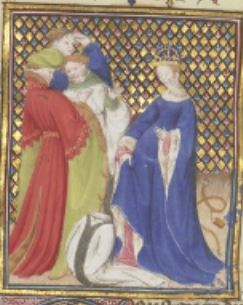
Constance, the empress of Rome and queen of Sicily, had spent her life in a convent until she was forced to marry Emperor Henry VI. She miraculously became pregnant with Emperor Henry’s child at the age of fifty-five. To avoid suspicion from his citizens, Henry ordered that all the women of Sicily be present for the birth of their child to validate Constance’s pregnancy and birth. This image depicts Constance on the right side of the image wearing a blue dress as her pregnancy shows through the dress. There are people on the left side of the image who are present to witness the birth.
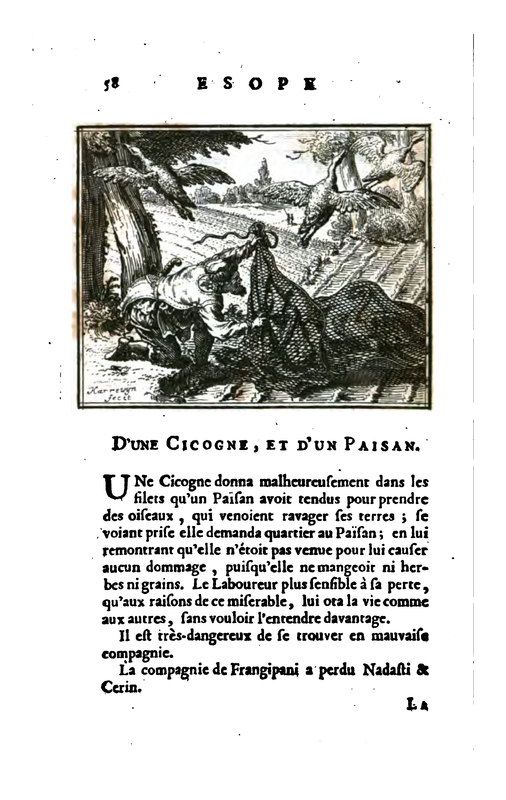
A stork unhappily fell into the nets that a Paisan had set to catch some birds that had come to ravage his land; seeing herself caught, she asked the Paisan for mercy, pointing out to him that she had not come to cause him any damage, since she was more sensitive to her loss than to the reasons of this miserable man, and she gave him her life as she had the others, without wanting to hear him more.
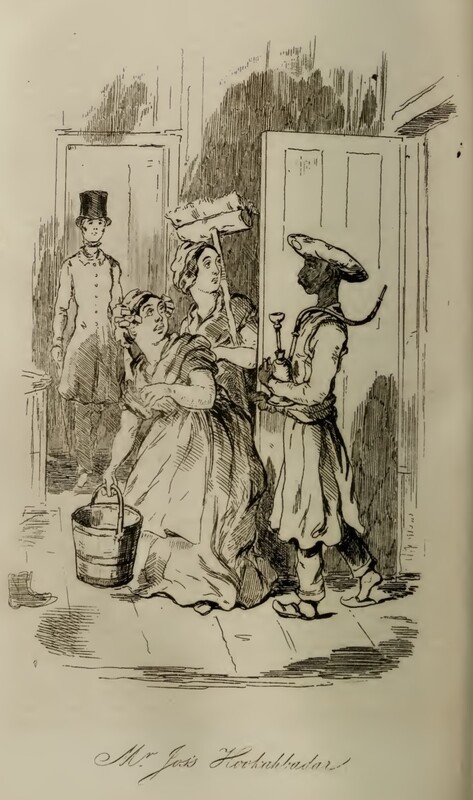
Loll Jewab, Joseph Sedley’s servant from India, carries his hookah into the house, shocking the employees. The two women, one holding a bucket and the other a broom, were cleaning the floor, while the man stands next to an inside door. Below the illustration is printed in cursive its title, “Mr. Jos’s Hookahbadar”.
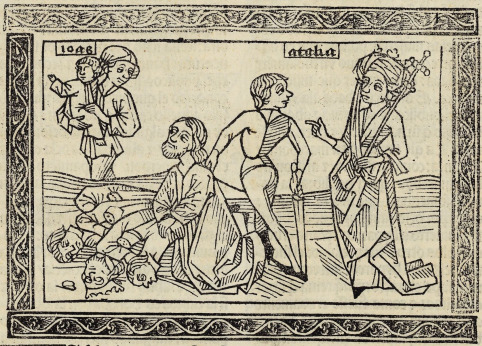
This engraving depicts Athaliah, queen of Jerusalem, executing the descendants of David. Athaliah is depicted on the right side of the engraving holding a scepter and pointing towards a man. We know that this is Athaliah as her name, written as “Atalia”, is engraved beside her head. Boccaccio explains that Athaliah’s father was the king of Israel, and her husband was the king of Jerusalem. When her husband died, and her son (who succeeded his father) died, she seized power and slaughtered the descendants of David to avoid anyone taking her power and throne. There is a man depicted with a sword who is about to execute a man, under Athaliah’s orders. There are three other men illustrated who had already been slain. There is a person in the background of the engraving carrying a child named Jehoash (his name is written as “Ioas” above his head). This child is Athaliah’s grandson who escaped her executions.
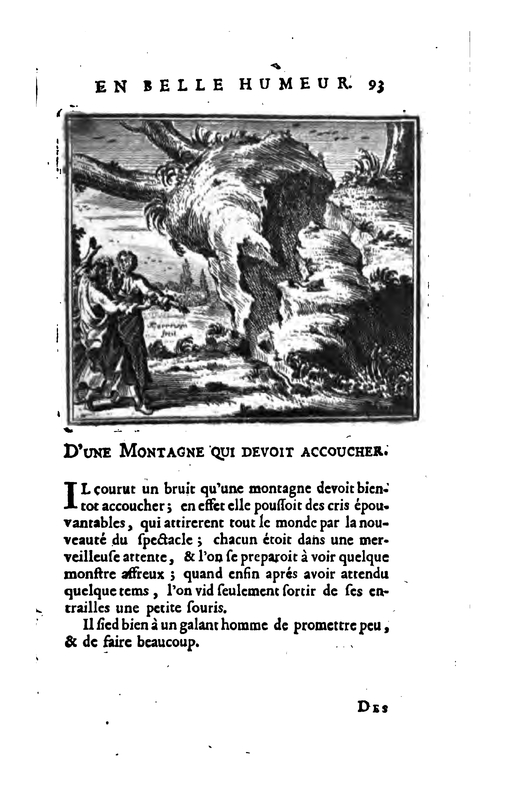
The image depicts a group of villagers gathered around a mountain about to give birth. The ground splits leaving a crack in the side of the mountain that a mouse crawls out of.
Two figures are depicted on a backdrop of the letter C from “Cuff”. The figure on the left is a boy with a toy sword and tall newspaper hat, riding a rocking horse, representing Cuff. This figure is bearing down on the other, representing William Dobbin, who has a triangular newspaper hat with a plume and a wooden sword raised to block his opponent.
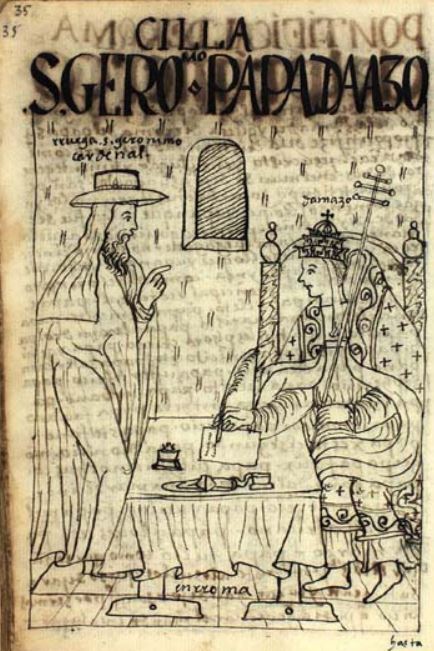
Pope Damasus is illustrated on the right side of the image wearing pontifical attire. He is also holding a staff which has three horizontal bars at the top, which symbolizes his power as Pontiff. Saint Jerome is on the left side on the image pointing to Pope Damasus. Pope Damasus, at the request of Saint Peter, is pictured writing down the history of the papacy. The words “ruega san geronimo cardenal” are written above Saint Jerome’s head, which translates to “the cardinal Saint Jerome.” The pope’s name is written above his head to identify him. The words “en Roma” are written at the bottom of the image to identify that the location is in Rome.
In this scene, we see Calisto, Sempronio, Pármeno and Celestina. Calisto is unable to see Melibea for some time, and his servant Sempronio suggests that he should request the aid of Celestina. Sempronio goes to Celestina’s house where he convinces her to follow him to the house of Calisto, with the concealed goal of scamming him out of as much money as possible. On the way, Sempronio explains to Celestina the illness that has afflicted Calisto (his enormous love for Melibea). Pármeno sees the two approach the door and warns his master about the untrustworthy Celestina. Here Pármeno can be seen receiving them as they arrive. Celestina is depicted wearing a robe and a veil, while the three male figures are all depicted wearing hats and cloaks. The entire illustration is identical to the one found on page 65 of the text (The Eagerness of Calisto).
Here we see Gulliver attempting to hold a yahoo child who appeared to need help. However, the child squirmed and got free. The child was three years old and was playing with other children and fell. In this image we see Gulliver holding the child, with others chasing each other in the background on the right, and a Houyhnhnm on the left. The same image appears in the 1843 Krabbe edition.
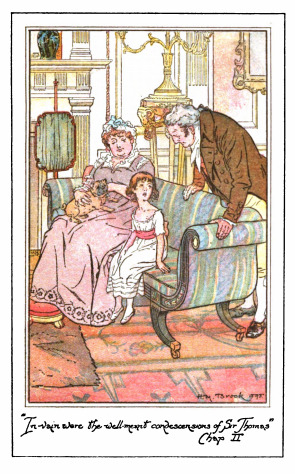
Here we see Fanny as a young girl sitting on the sofa next to her Aunt Bertram. Her uncle, Sir Thomas, leans over the sofa, speaking to her. On Lady Bertram’s lap is her pug. This scene occurs when Fanny arrived at Mansfield Park. The Bertrams brought Fanny to live with them when she was ten years old to help relieve some of the pressure on her mother, who had several children and very little money. Next to Lady Bertram, we see a fire screen, a piece of furniture used to shield a woman’s face from the heat of the fire to prevent her blushing. This scene occurs in chapter 2 as noted underneath the title of this image. The characters are shown in the traditional regency style. Lady Bertram and Fanny wear the regency style dress with an empire waist. Lady Bertram’s hair is worn tied up under a mop cap. Fanny’s hair is short, tied out of her face with a ribbon. Sir Thomas wears a waistcoat and tailcoat, and knickers that stop at the knee. The regency period dated to the early nineteenth century (1811-1820) when George, Prince of Wales, later George IV (r. 1820-1830), reigned as regent for his mentally ill father, King George III (r. 1760-1820). The regency period is associated with the rise of neoclassicism in art and fashion.
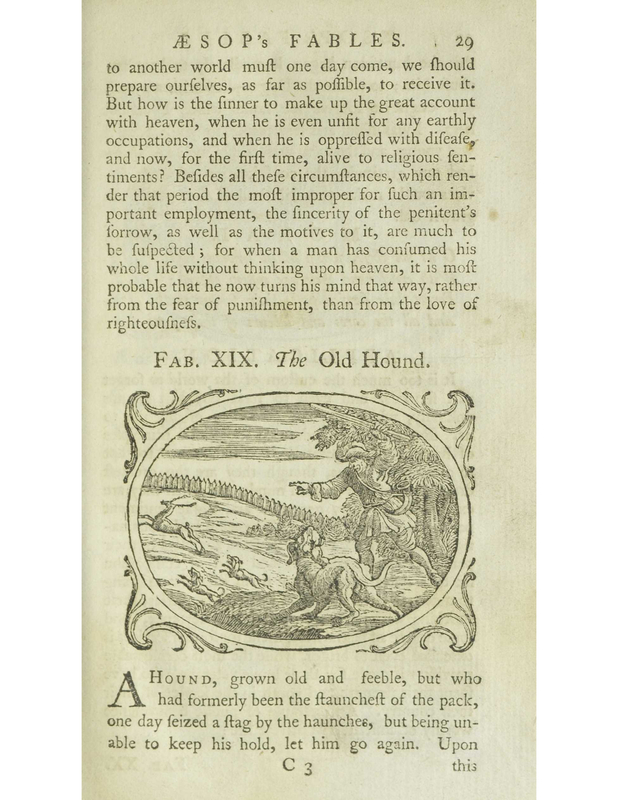
There is what appears to be older hound and a man with a stick as the right center focus of the image. There are two slimmer, and what appears to be younger hounds, chasing an animal with horns in the lower valley of the image, on the left side of the image. The area that the event of the image is happening is fenced in. The man appears to be about to beat the hound, with the stick he has in his hand, which is raised above his head and over the hound. The man is wearing a hat and has a horn draped across his side. Behind the man are some trees with foliage.

![[A frog examines Gulliver while he sails in the court of Brobdingnag]](https://cemvccol.ace-net.training/files/large/b50e18da2fd91a625d1551060055e79026345ad9.jpg)
![Esopi Appologi siue Mythologi cum quibusdam carminum et fabularum additionibus Sebastiani Brant. [Man gets pushed down as others watch]](https://cemvccol.ace-net.training/files/large/7d0008a537a795610f782539ebeb5b3f9f4e29de.jpg)
![[Act IX – Sempronio, Pármeno, Celestina, Elicia, and Areusa]](https://cemvccol.ace-net.training/files/large/c798d77840c6f467712933428eb87b9a5373d4d5.jpg)
![[writing materials]](https://cemvccol.ace-net.training/files/large/ff2565eb2a64028c769fa315aa95a2171e10bbb0.jpg)

![[Gulliver refuses to perform]](https://cemvccol.ace-net.training/files/large/0050d1b29ae4b5231a43c0e27886ec78a9a8b057.jpg)
![[Vanity Fair Vol. I Chapter V Historiated Initial]](https://cemvccol.ace-net.training/files/large/d167c438c908bbd0579ffeaa2b928acdd72f5c9b.jpg)
![[Act I (Second Illustration) - Servants Introducing Calisto to Celestina]](https://cemvccol.ace-net.training/files/large/5d5a1a315086c243296a3e6e01c22dd3498d1c3f.jpg)
![[Gulliver attempts to help a yahoo child]](https://cemvccol.ace-net.training/files/large/41a848027fe2917a93e21a2fec4a245f9b8284f1.jpg)