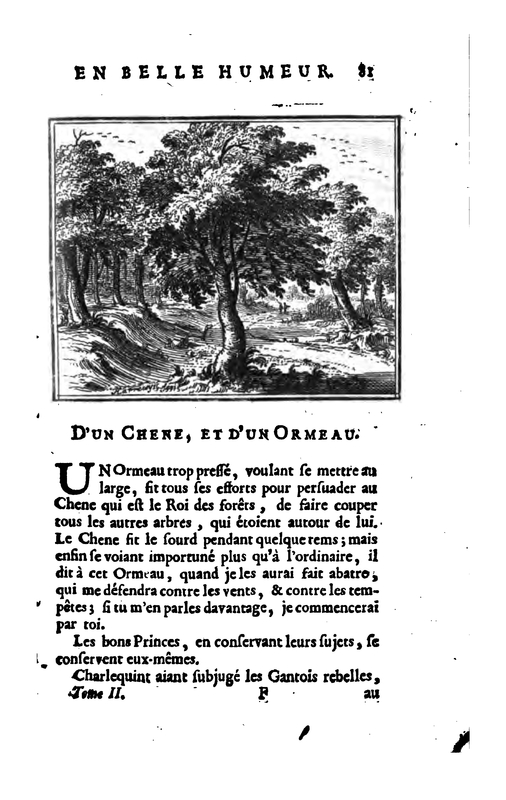
An Elm in a hurry, wanting to get out of the way, made every effort to persuade the Oak, who is the King of the forests, to have all the other trees around him cut down. The Oak sat deaf for some time; but at last, seeing himself more importunate than usual, he said to this Elm, when I have had them cut down, who will defend me against the winds, and against the storms; if you tell me more, I will begin with you.
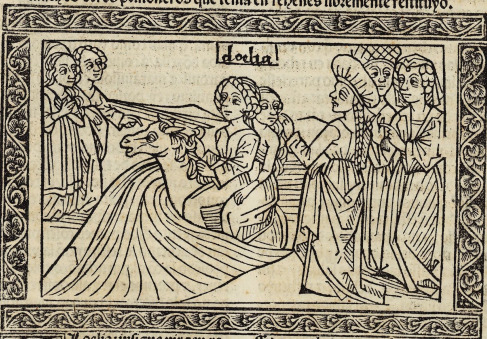
This engraving depicts Cloelia, a young Roman woman, riding a horse through a deep river with many women looking at her. Boccaccio explains that Cloelia was given to a foreign king as a hostage, and when she escaped, she took many other hostages with her to get back to Rome. While escaping, she came across a river that was too treacherous to pass. She found a horse, and despite never having ridden one, she got herself and the other women across safely by means of this horse. This image depicts her taking the other women across the river one by one as there is only one other female on the horse with Cloelia. We know that this figure on the horse is Cloelia as her name is engraved above her head.
Major William Dobbin leans back against the rail of the ship, smoking a cigar next to a cannon. Joseph Sedley is seated in front of him, smoking his hookah. The two are headed from St. Helena to England. In the background, the horizon is flat and the sky cloudy.
Inside of a triangle, a woman leans over a large trophy with one hand on her chin. At the base of the trophy are a cross and a shape that may be a sphinx or a large dog. Beneath the triangle, the word “SACRED” is printed. Above the left side is a cut-off rectangle imprinted with “O QUIES” and above the right side is the letter T from “The”.
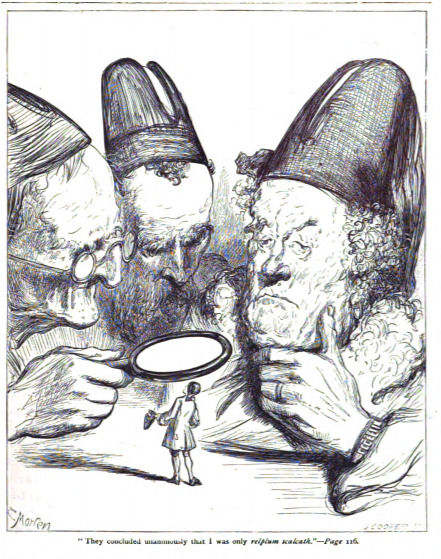
The King of Brobdingnag had his scholars examine Gulliver to determine what kind of creature he was. The three scholars examine Gulliver with a magnifying glass. This examination was a satire of natural philosophers in Europe.
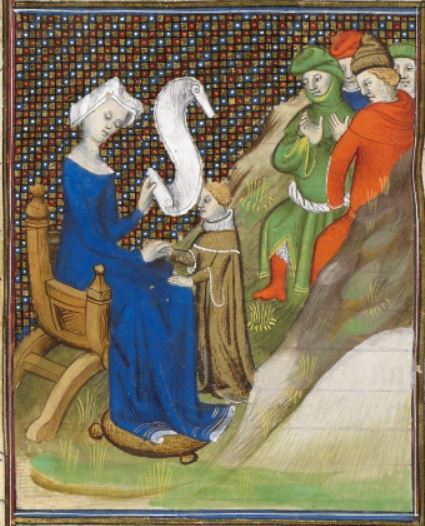
This image depicts Nicostrata (who is also known as Carmenta), a woman who was a famous prophetess during her time, holding a scroll of parchment. She is illustrated sitting down on the left side of the image with a group of people standing in front of her. Nicostrata realized that the inhabitants of Pallantium were not well educated or literate, so she decided to give them their own language with their own letters and symbols. This was the Latin language. Nicostrata taught the new letters and language to the people of Pallantium, which is what the illustration depicts.
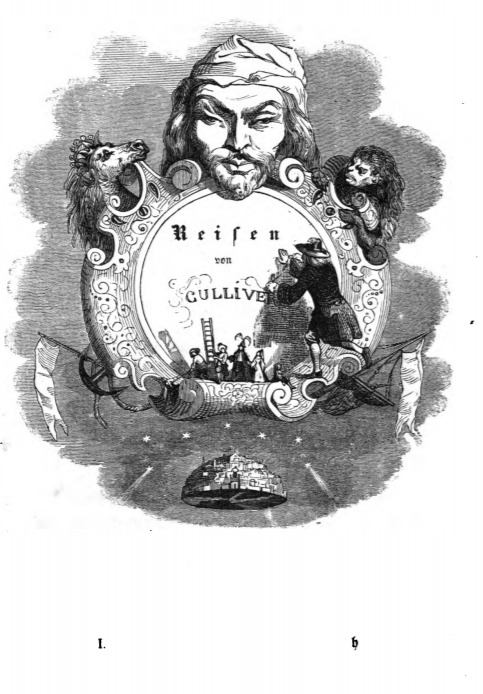
Here we see a crest with elements of all of Gulliver’s travels. Gulliver stands on the right, writing the phrase “Reisen von Gulliver” of a circular badge. On the bottom of the badge sit a group of Lilliputians. A giant from Brobdingnag’s head rests his chin on the top of the circle. On either side of the giant is a Houyhnhnm and a Yahoo. Underneath the circle is the floating island of Laputa. The same image appears in the 1839 Krabbe edition.
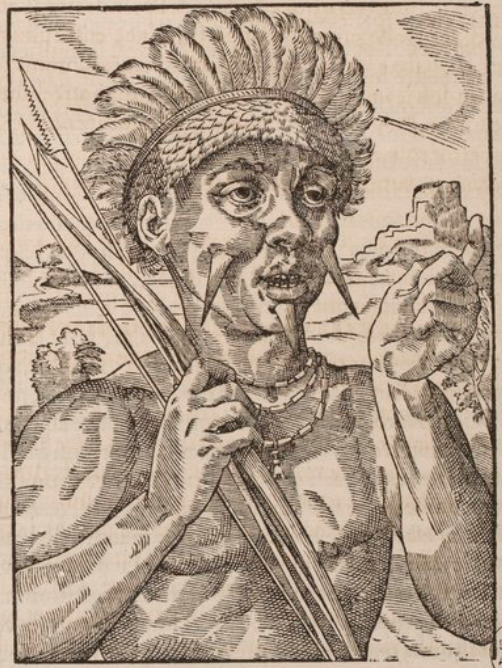
An Indigenous king or chief is shown in portrait from the chest up. He wears a feathered headdress and has three pointed face stones – one in each cheek and one in his chin. He also wears multiple strands of beads around his neck. The man carries a bow and two arrows in his right hand and gestures with one finger raised with his left hand. This image is identical to one found on page 955 verso of Paris, 1575 (l’Huillier).
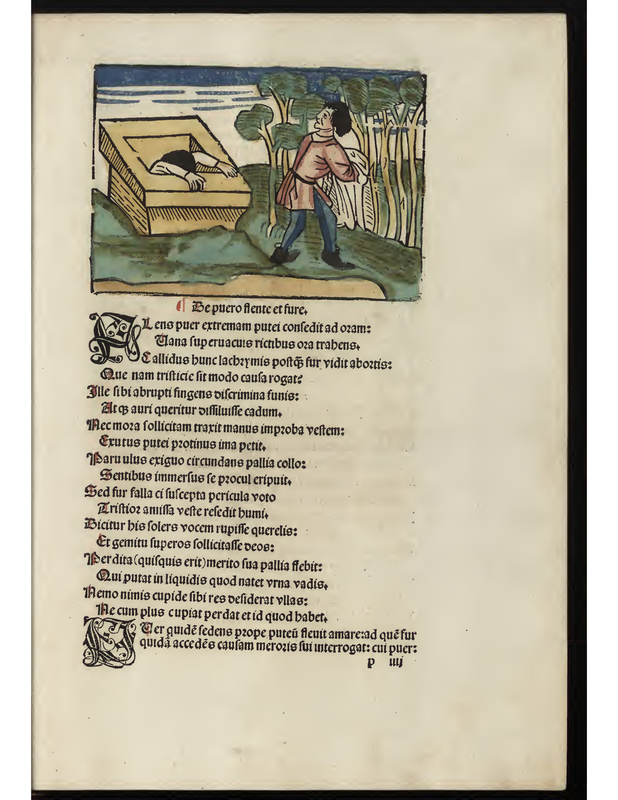
Two men are outside in a forest. One is climbing out of a small opening while the other has his back turned to him. The man with his back turned is looking back and holding a white linen in his hands.
Here we see a common horse pulling a cart and getting whipped. The Houyhnhnms asks about the horses in Europe and how they live. Gulliver explains that humans or yahoos govern the country and care for the horses or Houyhnhnms. In opposition to the well-kept horses used to pull carriages that Gulliver explained earlier, Gulliver goes on to say that common horses were often treated poorly, as they were whipped and forced to do labour and were fed low quality foods. The same image appears in the 1839 Krabbe edition.
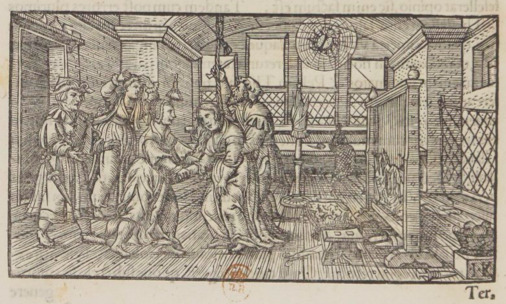
Arachne became so skilled at using her loom that she entered a contest against Pallas Athena, who had invented the tool. After losing the competition, she could not accept the defeat and decided to end her life by hanging with a rope. She may have been unsuccessful because her servants came to help her down before she died. In the photo, she is hanging from a rope with her servants surrounding her to help her down. The photo is based in the room she did her loom work in, with her tools to the right of the photo.
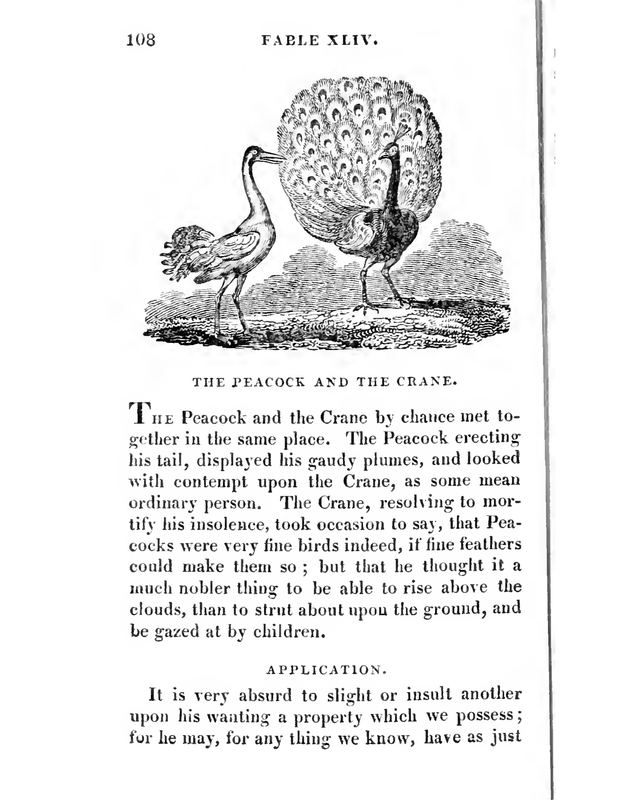
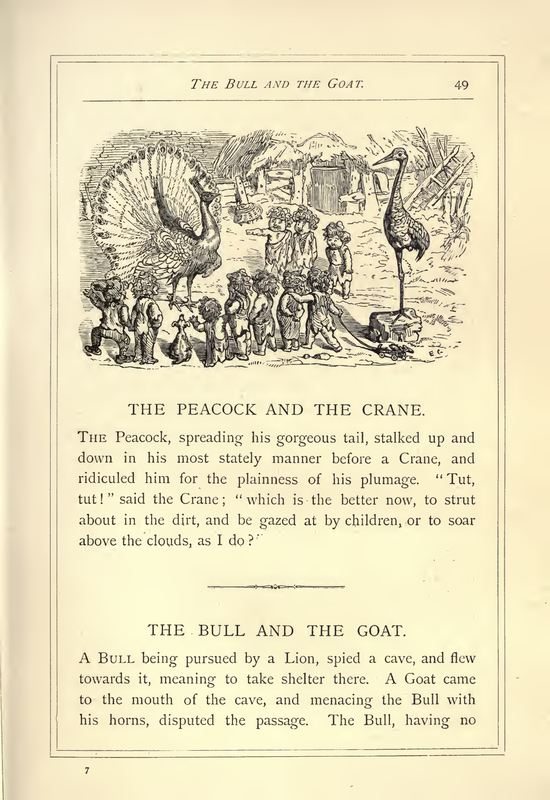
A peacock is spreading its beautiful feathers and showing them off the the people around it. The peacock, to the left, is surrounded by people looking and pointing at it beauty. To the right, a crane is perched upon a rock on one of its legs. In the background, a hut-like house with a hay roof is seen in the distance.
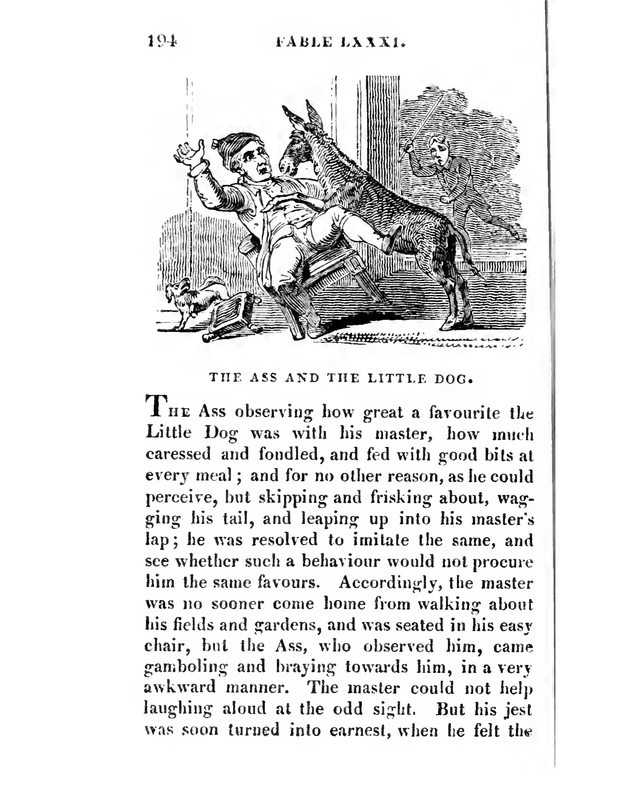
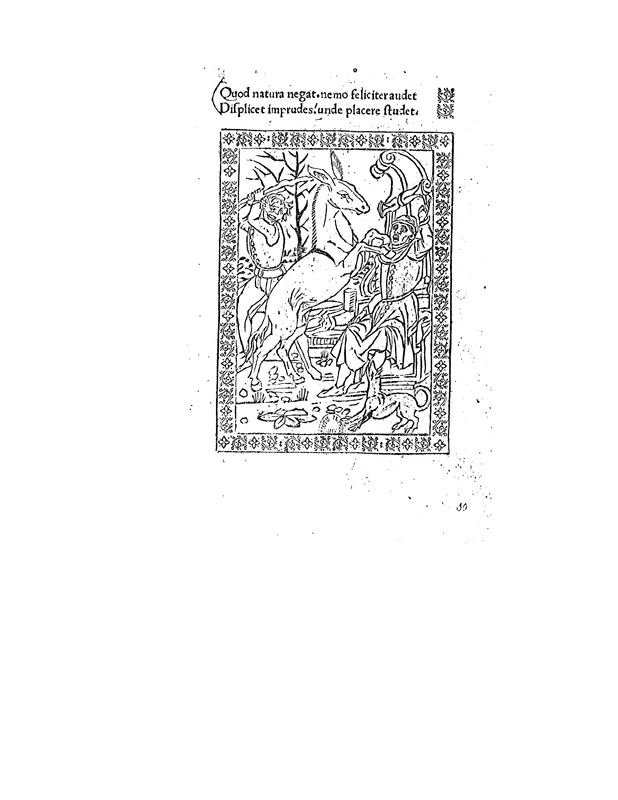
There is a man sitting on a large chair on the right of the image. There is a donkey who seems to be jumping onto the man who looks very distressed. Behind the donkey there is another man who is about to hit it with what appears to be a stick. Below the man on the chair, in the bottom right of the image, there is a dog who appears to be barking at the donkey.
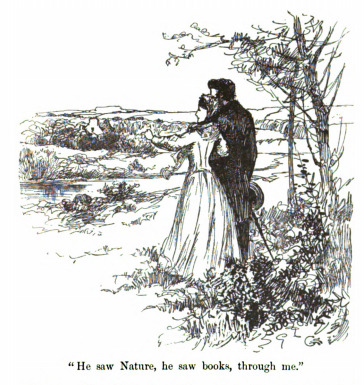
Here Jane and Mr. Rochester stand outside. Mr. Rochester has his arm wrapped around her and she holds her hand out in front of her. They stand in the orchard, looking at nature. Jane helped Mr. Rochester heal, and he slowly regained some of his vision. Jane described what she saw to him.
Here we see an image of a donkey. It appears when the Council of the Houyhnhnms discussed the possibility of exterminating the yahoos. One of the reasons for this was to correct the mistake of the Houyhnhnms ancestors, who failed to breed donkeys which were more hygienic and had better agility than the yahoos. The same image appears in both the 1839 and 1843 Krabbe editions.
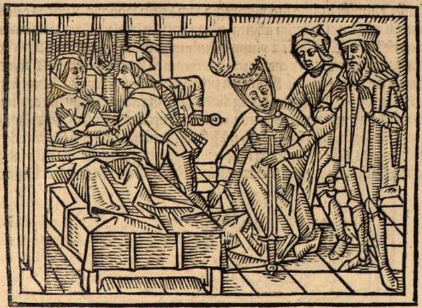
Lucretia is depicted on the left side of the engraving, lying in bed as she is approached by Sextus, her husband’s relative. Lucretia is depicted with her arms crossed against her chest as Sextus is forcing himself upon her. He is illustrated with a sword in his hands while he threatens to kill her if she screams for help. The right side of the engraving illustrates Lucretia with her husband, Collatinus, and her husband’s relative, Brutus. Lucretia told the men that Sextus had raped her in the night, and then plunged a knife into her own chest in shame.
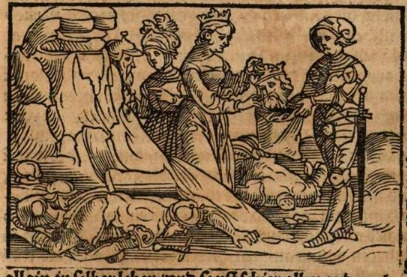
This engraving depicts Thamyris, the queen of Scythia, placing the decapitated head of King Cyrus into a bag with the help of her soldiers. Boccaccio explains that Cyrus had invaded Scythia looking for glory, and when he had killed Thamyris’ son, she exacted her revenge by killing his entire army. When Thamyris found Cyrus’ dead body, she took his head. Cyrus’ body is depicted below the bucket. There are other dead bodies among Cyrus which were his soldiers.
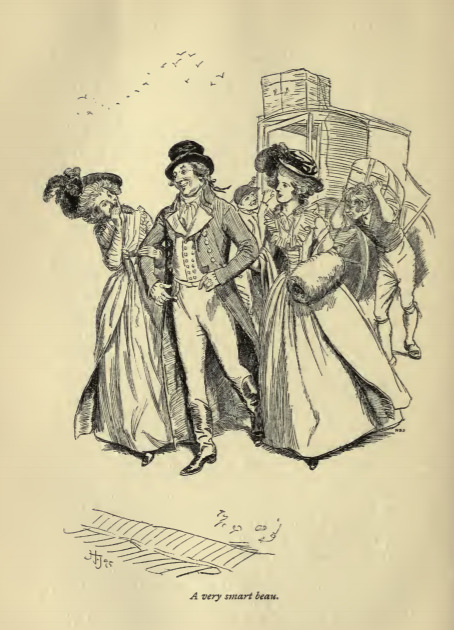
In this image Anne and Lucy Steele travel to London by post with Dr. Davies. The Steeles arrived in London after Willoughby got married to Miss Grey. Mrs. Jennings asked the Steeles how they travelled, and they said they came by post, but were accompanied by Dr. Davies who also happened to be travelling to London. This scene occurs in chapter 32. The characters are shown in the traditional regency style, as Anne and Lucy Steele wear regency style dresses with empire waistlines. They wear bonnets and carry muffs. Dr. Davies wears a waistcoat and tailcoat with breeches and a top hat. The regency period dated to the early nineteenth century (1811-1820) when George, Prince of Wales, later George IV (r. 1820-1830), reigned as regent for his mentally ill father, King George III (r. 1760-1820). The regency period is associated with the rise of neoclassicism in art and fashion.
After Celestina convinces Sempronio to join her in scamming Calisto, she departs for Melibea’s house, mumbling to herself along the way. As she nears the door, she is spotted by Melibea’s servant Lucrecia. Celestina informs her that her purpose is merely a friendly visit, but Lucrecia openly doubts this claim. Melibea’s mother Alisa, the mistress of the house, tells Lucrecia to let her in (they can be seen entering the door to the right of the image). Alisa departs to visit her dying sister, leaving Celestina alone with Melibea. Celestina eventually informs Melibea that the true purpose of the visit is to alleviate the heartache afflicting Calisto, to which Melibea is the only cure. Melibea is infuriated, forcefully asserting that she wants nothing to do with him. Celestina lies to Melibea, telling her that the cure to Calisto’s pain rests in her girdle cord and a handwritten charm/spell. This quells Melibea’s rage, and she sends Celestina off with the girdle, telling her to return the following morning to retrieve the charm. Every figure in this illustration is female, and each is wearing a robe and a veil. Based on the narrative, we know that the two figures on the right are Lucrecia and Celestina, and we can infer that the rightmost figure is Celestina since she is being led into the house. The particular identities of the figures to the left of the image are less certain, although we can suppose that the figure on the right is Melibea, seeing as her robe appears more refined, and her facial expression and body language imply anger. If she is indeed expressing anger, then we can also suppose that the other two figures are Celestina and Lucrecia, since Alisa has already departed when Celestina mentions Calisto to Melibea. The entire image is identical to the one found on page 157 of the text.
In the middle of the image there is a man sitting in a chair that is about to fall over as an ass is jumping up on him. On the left side of the image there is a dog, and on the right side of the image we see a man holding an object in his hand.
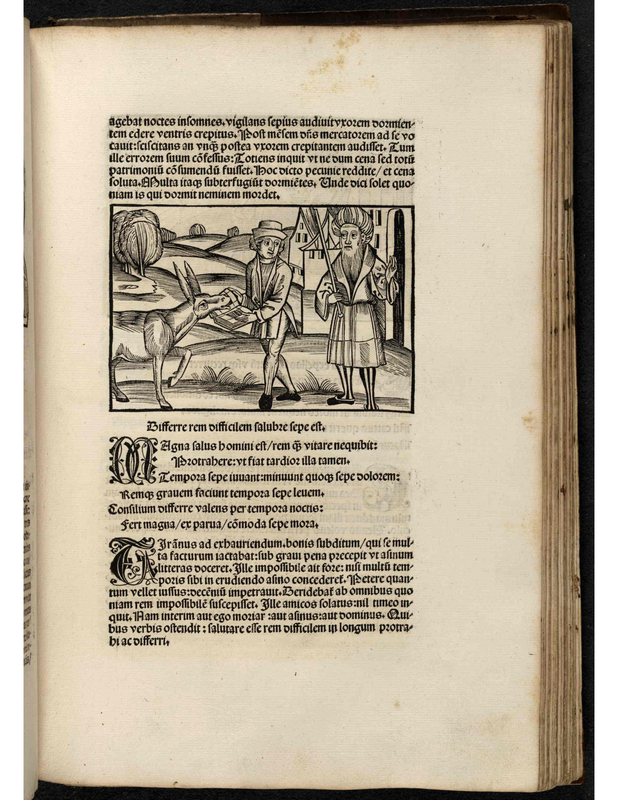
A man with a donkey stands with another man outside of the castle. The man holds a book in front of the face of the donkey. The other man has a beard and holds a long pole.
![[Dobbin and Jos]](https://cemvccol.ace-net.training/files/large/4c75168589c8a1ebc6350055e779b5d64cd5dafe.jpg)
![[Vanity Fair Vol. I Chapter XXXV Inhabited Initial]](https://cemvccol.ace-net.training/files/large/1ea8e1af51581c328ccab68fcbebbc8c28e3f867.jpg)

![[common horses working pulling a cart]](https://cemvccol.ace-net.training/files/large/70707a6be787818f552116acf85f7377dc5c5230.jpg)
![[A donkey]](https://cemvccol.ace-net.training/files/large/65e9cbda83e545b6382471a9f560978a5de5b7a5.jpg)

![[Act IV] Celestina spreect teghen haer zelven gaende over wech](https://cemvccol.ace-net.training/files/large/13359c47648bfb70726908e3ea622e35d52a675d.jpg)