Inside of a triangle, a woman leans over a large trophy with one hand on her chin. At the base of the trophy are a cross and a shape that may be a sphinx or a large dog. Beneath the triangle, the word “SACRED” is printed. Above the left side is a cut-off rectangle imprinted with “O QUIES” and above the right side is the letter T from “The”.
Here we see European sailors who found Gulliver in New Holland. The sailors saw Gulliver’s boat in the creek where it was anchored, and went and investigated it, finding Gulliver hiding. Gulliver explained his situation to the sailors who spoke Portuguese. The sailors were startled by Gulliver’s clothes and story, however, they took him in, and brought him back to Europe. The same image appears in both the 1839 and 1843 Krabbe editions.
This image shows five characters: Calisto and Melibea sitting under a tree in the midground, Lucrecia in the background, and Sosia and Tristan in the foreground. Calisto, Melibea, and Lucrecia are within the walls of Melibea’s garden. Sosia and Tristan are standing guard outside the garden wall while Calisto and Melibea talk and hold hands. The moon in the upper left corner indicates that the scene is taking place at night. Lucrecia is standing in the background, waiting from a distance for Melibea to conclude her rendezvous with Calisto.
This illustration depicts Olympias, queen of Macedon and mother to Alexander the Great, being tied at the hands by a man standing in front of her. She is also being grabbed at the arm by a man standing behind her. There is one other man standing behind her in the image. These men are tying her up because she had surrendered to Cassander after he besieged the city of Pydna. The men are taking her to await her execution.
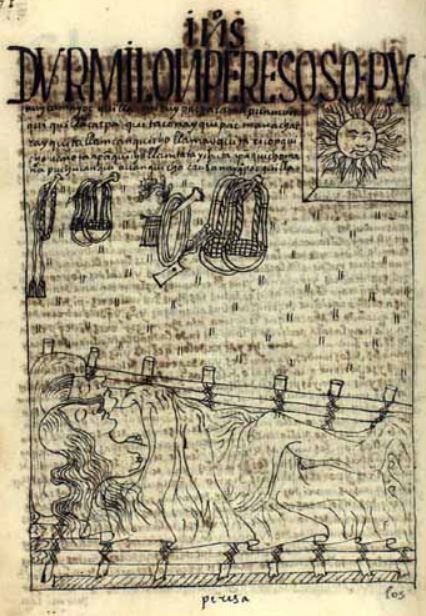
This image depicts a native couple sleeping in a bed. There is a window in the top right corner which depicts the sun shining through. The author criticizes lazy indigenous people who would sleep late and avoid their duties and work in the fields. Hanging on the wall above the sleeping couple are their tools and sandals. The large caption at the top of the image reads, “pvnuy camayoc, quilla, micuy pacha cama punucunqui, quilla caspa, quitaconayquipac mana chacrayquita llamcanquicho, llamayquita riconquicho, uanota apanquicho, llamtata ychuta apanquicho. Mana puchucanqui, auanquicho causanayquipac, quilla” [sleepy and lazy, because you are lazy you will sleep until lunch time to escape sowing the field, you do not bring manure, you do not bring firewood or straw, you do not finish or knit for a living, lazy].
Here we see a scientist from the Grand Academy of Lagado on Balnibarbi who greeted Gulliver by embracing him. Gulliver is now dressed in the style of the locals, wearing a jacket with a motif of astronomical and mathematical symbols on it. Gulliver was unhappy to be greeted in this manner as the room had a terrible stench. This smell was caused by the scientist’s experiments. He was attempting to restore excrement to the food that was consumed. The same image appears in the 1843 Krabbe edition.
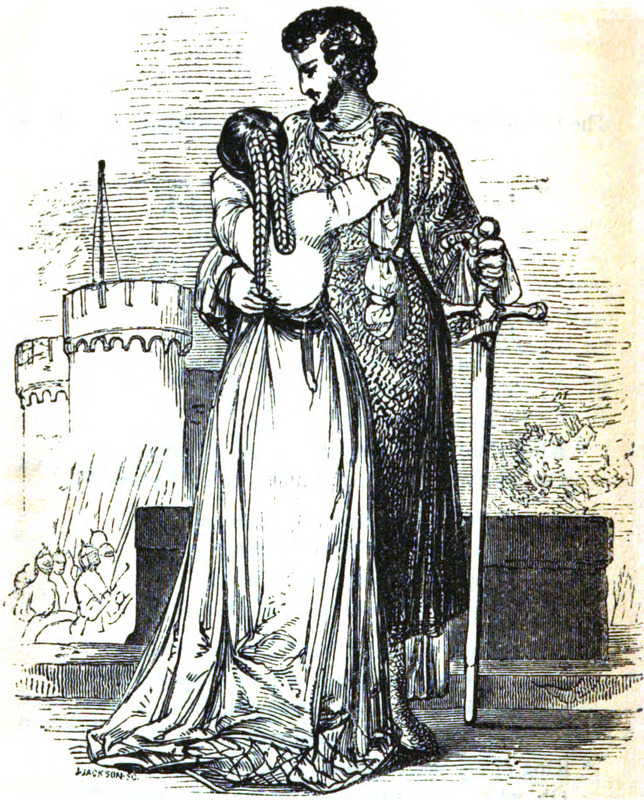
Ximena embraces Rodrigo as he is preparing to leave for a campaign. She begs him not to leave her, but he is resolved to go. It is not entirely clear where exactly he is originally planning to campaign, but he eventually ends up in Estremadura. During this scene they appear to be standing on the walls of a castle, and Rodrigo holds his sword in his left hand.
Gulliver’s master explained various aspects of the Yahoos that lived in the Country of the Houyhnhnms. He explained that the Yahoos had one who was the ruler, seen here. He wears a crown made of leaves, a cape made of an animal pelt, a sceptre made of an animal bone, and an orb made out of a fruit. The same image appears in the 1843 Krabbe edition.
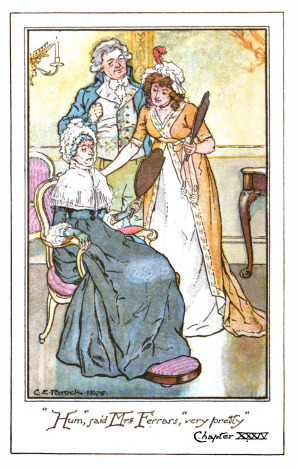
Here we see Mrs. Ferrars sitting in a parlor with her daughter, Fanny, standing next to her, and John Dashwood, her son-in-law. This scene occurs while Fanny and John Dashwood host a dinner party in London, inviting Elinor, Marianne, Mrs. Jennings, Colonel Brandon, Lucy and Anne Steele. The quote that is the title of the image is when Fanny introduced Elinor and Marianne to her mother, who was very dismissive of them. Fanny and Mrs. Ferrars hold fire screens in their hands fire screens painted by Elinor and given to her half-brother and his wife. Fire screens were used to block a woman’s face from the heat of the fire. The fashion of the time was for women to have pale skin, and the fire screen would keep a woman’s face from flushing from the heat. Colonel Brandon was admiring the screens, and Fanny informed her mother that they were done by Elinor. Mrs. Ferrars’ response was “Hum, very pretty” without really looking at them. Fanny blushed thinking her mother’s response was quite rude, praised their beauty, but not wanting to praise Elinor too highly, compared them with the paintings of Miss Morton, a rich woman whom Edward Ferrars was supposed to marry. This scene appears in chapter 34 as indicated underneath the image. The characters are shown in the traditional regency style, as Elinor and Lucy wear the regency style dress with an empire waist. Their hair is worn tied up, as was tradition for women after their “coming out” before the queen, signaling her entrance into society. They wear bonnets to protect their faces from the sun. Going for walks was a popular pastime among young upper-class women at this time, and bonnets were worn to protect the face from getting tanned, because having light skin was more fashionable. They also carry muffs used to warm the hands. The regency period dated to the early nineteenth century (1811-1820) when George, Prince of Wales, later George IV (r. 1820-1830), reigned as regent for his mentally ill father, King George III (r. 1760-1820). The regency period is associated with the rise of neoclassicism in art and fashion.
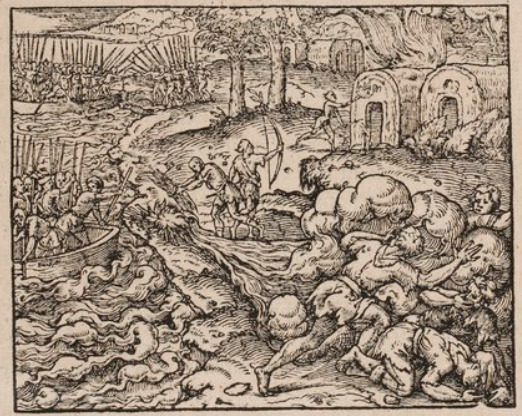
A group of Indigenous Canadians attacks the village of another group. The attackers arrive by canoe, bearing spears, bows and arrows, and torches. Some of them set fires along the shore and in the village. A few individuals on the right flee the fire by running and crawling away in an attempt to avoid the smoke. This image is identical to one found on page 1012 of Paris, 1575 (l’Huillier), and in Thevet’s Les Singularitez de la France Antarctique (page 156 of Paris, 1557 and page 156 of Paris, 1558).
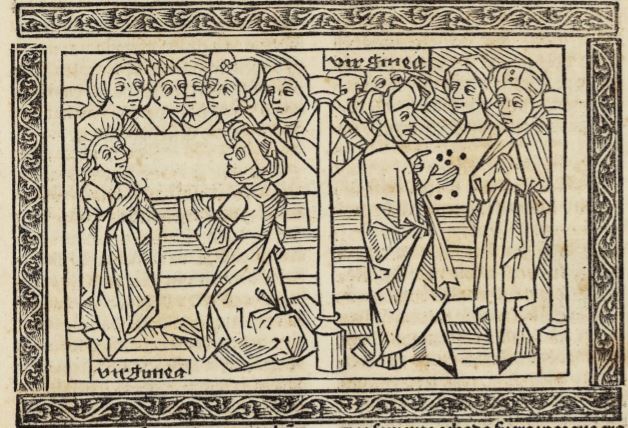
Verginia, a noble Roman woman is depicted in this engraving in both the right-hand and left-hand scenes. Her name is engraved as “Virginea” at the bottom on the left side and at the top on the right side. Boccaccio explains that Verginia, despite being a noble woman, was cast out of a temple in Rome by the other noble patrician women due to her being married to a plebeian man. The left side of the engraving depicts Verginia at the altar with noble women surrounding her as they cast her out of the temple. The right side of the engraving looks similar to the left side; however, the right side depicts Verginia with plebeian women. After being cast out of the Patricia Pudicitia temple, Verginia created her own temple and altar named it the Plebeia Pudicitia, and opened it up to the plebeian class.
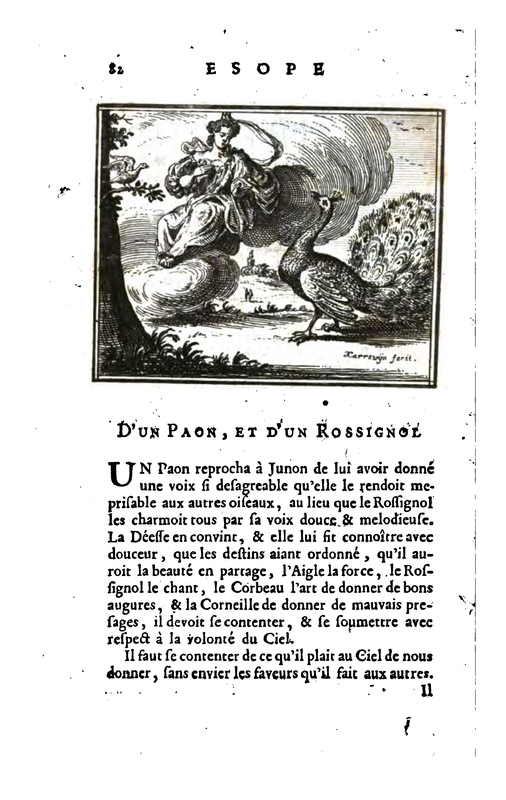
The image depicts a peacock who complains of his voice to the goddess Juno. The peacock envy’s the voice of the nightingale and is told by Juno to appreciate the beauty he has and not to compare himself to others. Juno sits in the middle of the image on clouds with the peacock standing to her right and a nightingale perched on a branch to her left.
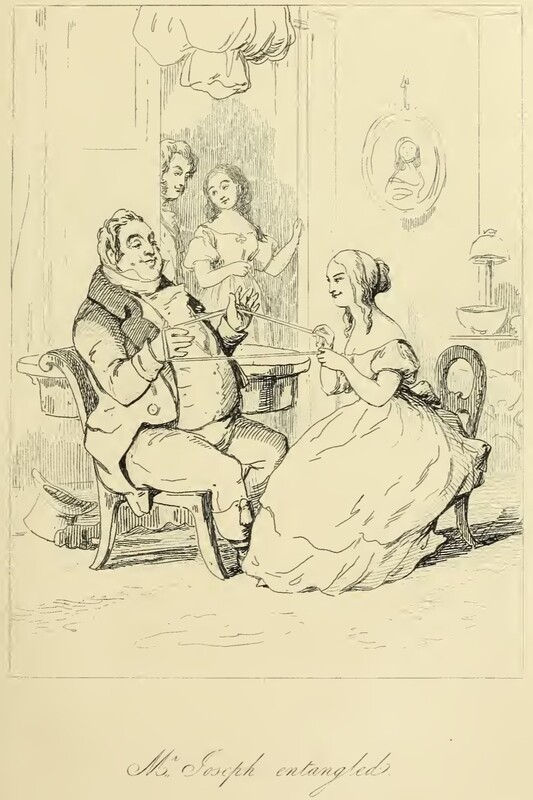
Joseph Sedley and Rebecca Sharp sit at two chairs in front of a round table; she holds both ends of a string of silk which is wound around his hands. Beneath the table is Joseph’s hat, and in the background, another table with a lamp and bowl and a portrait upon the wall. Amelia Sedley and George Osborne are entering through the doorway behind the round table at which the others sit. All four look pleased. Below the illustration is printed in cursive its title, “Mr. Joseph entangled”.
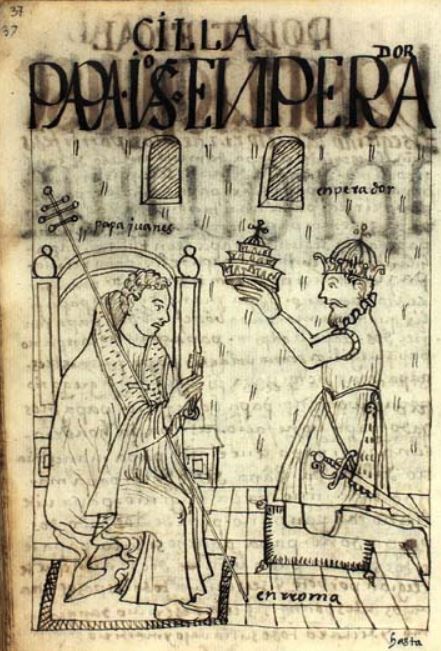
This illustration depicts Emperor Constantine IV crowning John V as Pope. John V is pictured kneeling on the left side of the image with his hands together. He is holding a staff with three horizontal bars at the top of it, which symbolizes pontifical power. The words “papa juanes” are written above his head, which translates to “Pope John.” Emperor Constantine IV is depicted on the right side of the image kneeling as he prepares to place the papal crown on John’s head. The word “enperador” is written above his head, which means emperor. The words “en roma” are written below Constantine, which identifies the city in which the crowning is taking place.
While outdoors practicing falconry (in the top right corner we can see a bird that is presumably his falcon), Calisto enters the garden where he first meets Melibea. From the moment when he first lays eyes on her, he begins calling Melibea his goddess. In his own words, “por Dios la creo, por Dios la confieso y no creo que ay otro soberano en el cielo; aunque entre nosotros mora” (translation: by God I believe it, by God I confess it, and I do not believe that there is another sovereign in heaven; although she dwells among us) [Page 7 of the text].Calisto is depicted wearing a hat and a cloak of sorts, while Melibea is depicted wearing a robe and a veil.
In this image we see Gulliver watching a giant from Brobdingnag carrying a large fish over his shoulder. The image comes when Gulliver describes the countryside in Brobdingnag. Gulliver leans on a rock, relaxing. The giant is hunched over with a large fish thrown over its shoulder. We see the backs of Gulliver and the giant. Next to Gulliver is a large basket. The same image appears in the 1843 Krabbe edition.
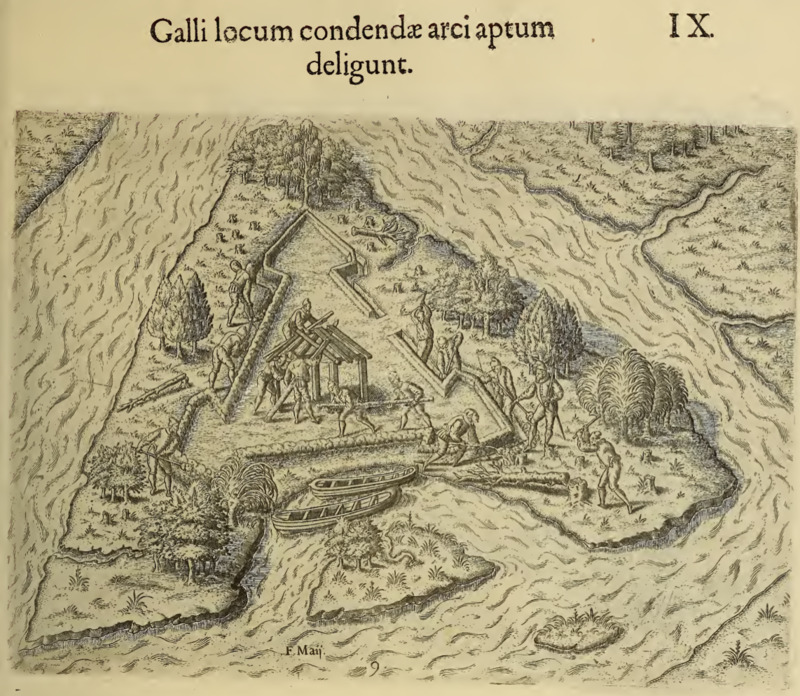
A group of colonists is shown. They are in the process of building a stronghold on an island in the middle of the river. The stronghold in triangular and is being built of wood.

![[Vanity Fair Volume I. Chapter XXXV Inhabited Initial, T]](https://cemvccol.ace-net.training/files/large/1d73bfd82251c1c853674c5b4972764d6b9ba943.jpg)
![Esopi Appologi siue Mythologi cum quibusdam carminum et fabularum additionibus Sebastiani Brant. [A man is making a copy of a book while two men examine a book nearby]](https://cemvccol.ace-net.training/files/large/63b400126aca04f43ac28bec3d0dcc0d7e828e84.jpg)
![[Gulliver meets Portuguese sailors on New Holland]](https://cemvccol.ace-net.training/files/large/8edc0ae6f2df487abe7a81713b3d21c95cd722dc.jpg)
![[The Argument - While Calisto and Melibea Talk, Sosia and Tristan Stand Guard and Lucrecia Waits at a Distance]](https://cemvccol.ace-net.training/files/large/7cbc943995103dd3de825767a1c98320c990a1eb.jpg)
![[Olympias Being Tied at the Hands Before Getting Executed]](https://cemvccol.ace-net.training/files/large/6ef093cbaf48e6cd671f0ba16024b6e2c4a79993.jpg)
![[A scientist from the Grand Academy of Lagado on Balnibarbi hugs Gulliver]](https://cemvccol.ace-net.training/files/large/453d2c7f458c3a707d7fd63d04574a0a73615e06.jpg)

![[the ruling Yahoo]](https://cemvccol.ace-net.training/files/large/0d9cdb9a17520c2c1e92844f6d91afddbea4d058.jpg)


![[Act I - Calisto Meets Melibea in a Garden]](https://cemvccol.ace-net.training/files/large/f6a11e852f95c8934add9b96441c2c46e7abfcc1.jpg)

![[Gulliver observes a giant carrying a fish on Brobdingnag]](https://cemvccol.ace-net.training/files/large/6a70dc03dc927c6eb508356f24461236fd095bb1.jpg)