Here we see Gulliver waving to the Houyhnhnms he lived with during his time on the Country of the Houyhnhnms as he sails away. The Council of the Houyhnhnms told his master that Gulliver either had to live with the yahoos or return to Europe but could not live with the Houyhnhnms any longer. Gulliver was shocked by this, and decided he had to leave rather than live with the yahoos. On the shore behind the Houyhnhnms we see the special trees that grow in the Country of the Houyhnhnms, seen in an earlier image. Gulliver sails away in a small sailboat that he built with the help of the Sorrel Nag during his last two months in the Country of the Houyhnhnms. The same image appears in the 1843 Krabbe edition.
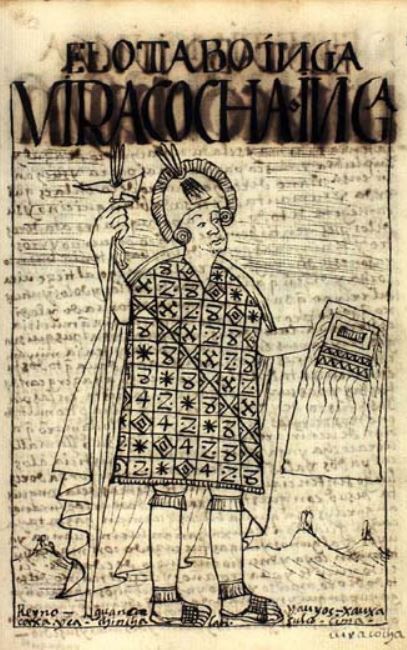
This illustration depicts the eighth king of the Inca Empire, Viracocha (also spelled as Wiraqucha). He is illustrated wearing traditional royal garb and holding a shield in his left hand and a long ax in his right. The author describes him to be a religiously devout leader and explains his conquests were vast. The bottom of the image reads “Reynó Guanca, Yauyos, Xauxa, Caxa, Yca, Chincha, Lati, Sulco, Lima,” which are all the cities this king had conquered.
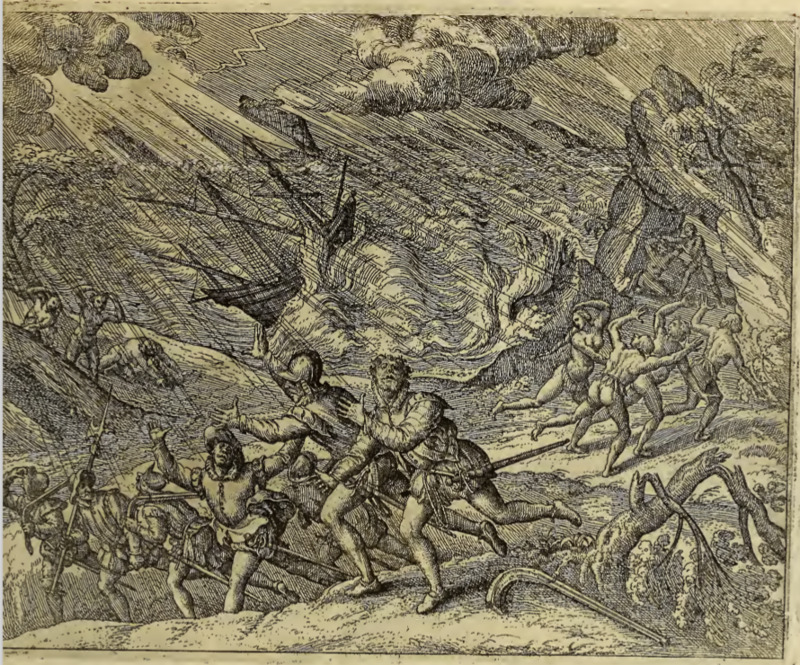
A violent storm hits the island of Hispaniola, capsizing a European ship and knocking down trees. A group of Spaniards flee the hurricane to the left and a group of Indigenous people run to the right amid the driving rain. Lightning forks through the sky and large waves lash the shore.
The image depicts the fictional land of Brobdingnag, off of North America. The cities of Flagnlamic and Lorbrulgrud are shown. Underneath Brobdingag reads “Entdecket Ao. 1703”, meaning “Discovered in 1703”. The bottom half of the map includes New England. A ‘man-of-war' ship is shown off the coast of New England, and a dolphin is near the bottom of the image. The map in this edition is the same as that in the 1727 German von Wiering edition.
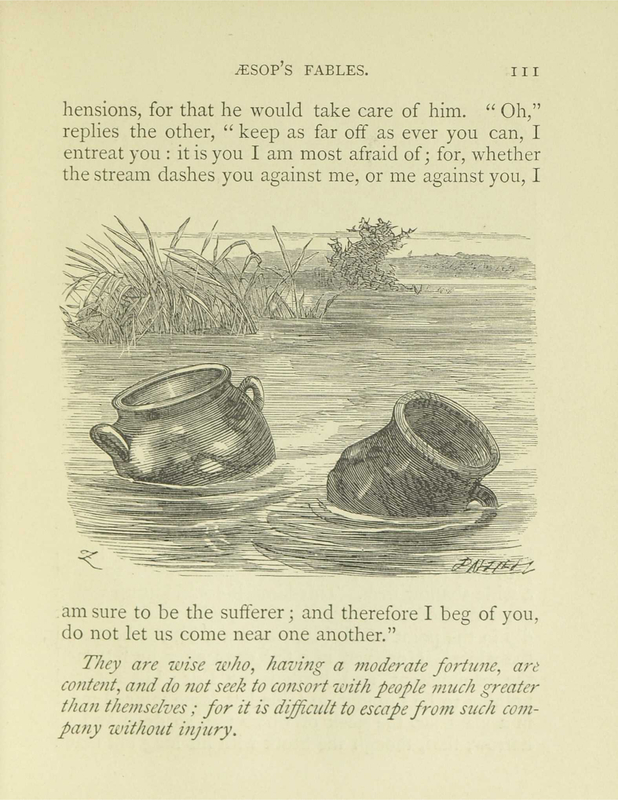
Two pots sit floating in a river, one made of brass and one of clay. The one pot is made wide with two small handles on each side, the other is taller and shapelier with a single large handle on one side.
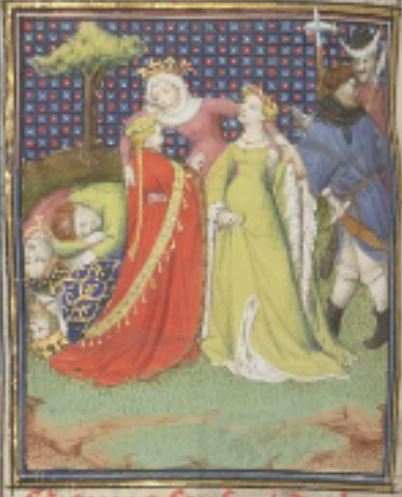
This illumination depicts Olympias, the queen of Macedonia, executing people for personal revenge and for the throne. Olympias’s husband, King Philip II of Macedonia, accused her of being unfaithful to him and proceeded to marry another woman and have children with her. To exact her revenge, Olympias had Cleopatra (Philip’s new wife) and their daughter murdered. She also arranged for the assassination of King Philip. The dead bodies of those she had killed are on the left side of the image, one being King Philip as he has a crown on his head. Olympias is in the centre of the image wearing a crown and a pink dress with her arms around two women. These women are most likely Cleopatra and her daughter.
Here we see the Queen of Brobdingnag’s dwarf shaking a tree, dropping fruit on Gulliver. The dwarf resented Gulliver because he replaced him as the Queen’s favourite. The dwarf started teasing Gulliver, trying to get rid of him.
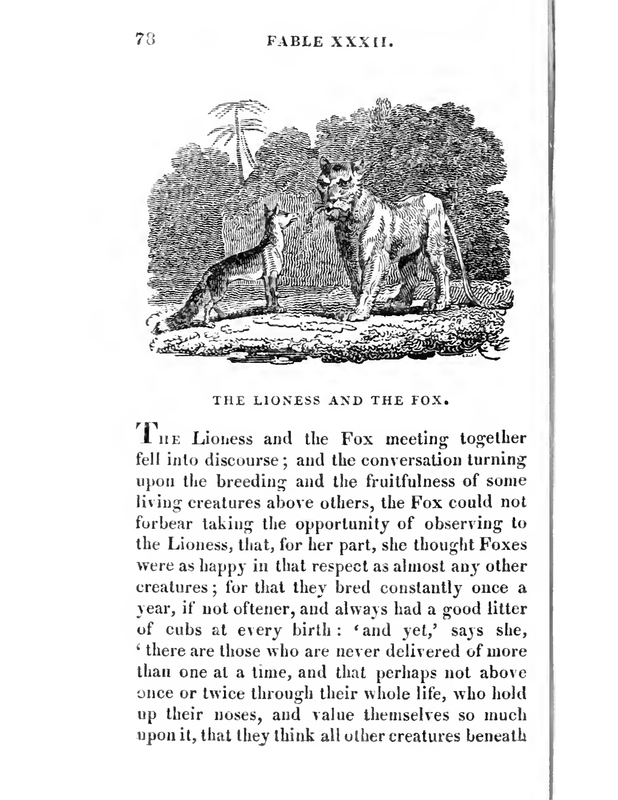
In the centre of the image is a fox facing the right looking at a lioness to its right. The fox is standing on all fours with an upright posture and a bushy tail lying on the ground. The lioness looks stoically out at the viewer and not back at the fox. There are many bushes and two palm trees in the background.
When Celestina (second figure from the right) and Sempronio (one of the figures to the left) arrive at Calisto’s house, Celestina tells Calisto (rightmost figure) about her meeting with Melibea. Calisto experiences impassioned mood swings with every sentence that Celestina speaks, and Pármeno (one of the figures to the left) starts chiding both him and Celestina. Sempronio grows impatient with Pármeno and tells him that his words are harming the happiness of all. Celestina eventually shows Calisto Melibea's girdle (presumably the scene depicted here), and he is overjoyed. When the time comes for Celestina to depart, Calisto asks Pármeno to accompany her and ensure that she arrives home safely.
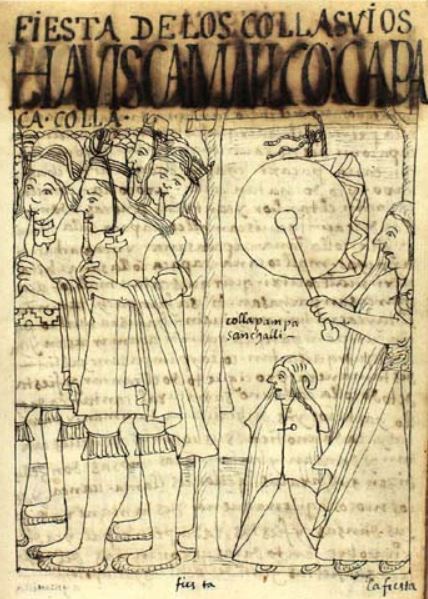
This chapter is dedicated to discussing the various celebrations and festivals that would be held in the Inca Empire. This image depicts the celebrations held in the Collasuyo region in the Inca Empire. There is a figure on the right side of the image playing a large drum hanging from a wooden post with a child standing beside them. There is a large crowd of people illustrated on the left side of the image taking part in the festivities. Some figures are illustrated with flutes in their mouths as they play music. There is a caption written under the drum which reads “colla pampa/sanchalli” [the plateau in that quarter/in Sanchalli].
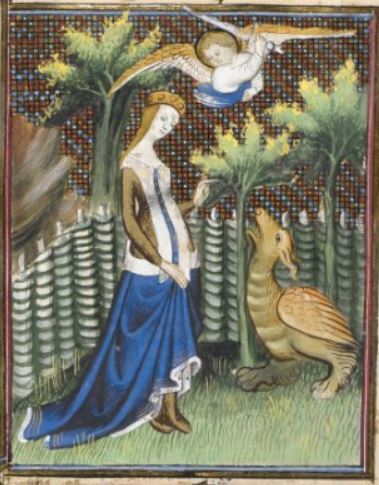
This illumination depicts Eve standing in the Garden of Eden. She is illustrated standing in front of the Tree of Good and Evil while looking at the serpent who persuades her to take an apple from the tree. The Garden itself appears to be a contained area with a fenced wall behind Eve. Eating the apple caused the expulsion of Adam and Eve from the Garden of Eden. As a protector of the garden, there is a cherub dressed in white holding a sword above Eve’s head as it expels her from the garden. Boccaccio explains that as the world’s first mother to us all, Eve is worthy of remembrance and praise.
A group of Indigenous Brazilian woman, called ‘Amazons’ by the author, fight against a group of Indigenous Brazilian men who attack from the water. The women fight with bows and arrows, spears and shields, while the men in canoes use bows and arrows and clubs. The women are unadorned with their hair worn unbound. Some of the men wear feathered headdresses.
There is a creature that appears to be half man and half fish laying on the ground. He has a human face but has fins and horns. There are four animals staring at him. The creature looks unphased while the animals look upset.
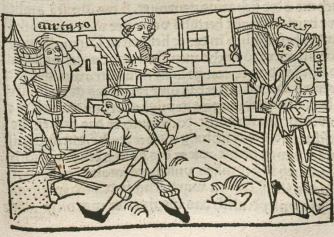
This engraving depicts Elissa, who was later called Dido, standing at the foreground of the engraving watching people build the city of Carthage. She is illustrated with her hands pointing at the city and men as she over sees the construction. Boccaccio explains that Dido had stolen her brother’s treasure in retaliation of him murdering her husband. After fleeing with her brother’s treasure, she made her way to Africa where she established Carthage and became queen of the city. Dido’s name is engraved beside her body to identify her. The name “Carthage”, written as “Cartago” is engraved at the top left corner of the image.
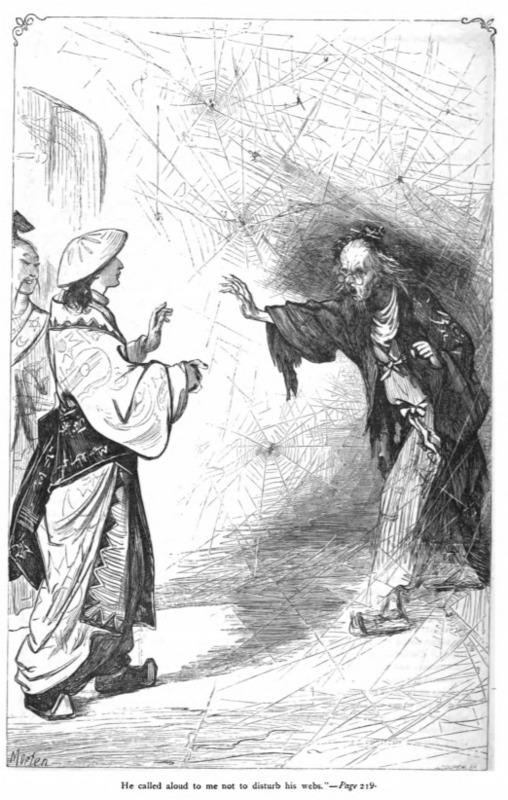
During his time on Balnibarbi Gulliver visited the Grand Academy of Lagado and the scholars who worked there. Here we see a scholar who was working to create fabric out of spider webs. His study was covered in webs, as the scientist tried to use the spiders like silkworms and feed them different things to dye the webs.
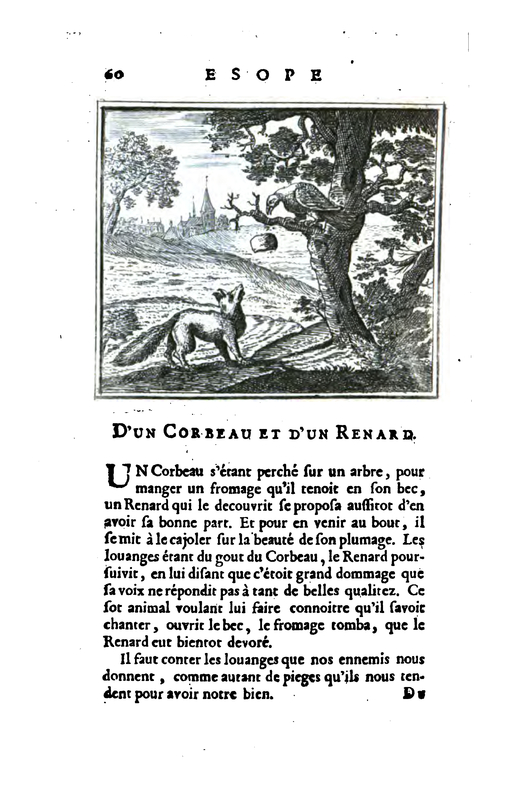
There is a fox looking up at a raven who is sitting on the tree. The fox expresses expectation, while the raven looks unimpressed. There is a block with rounded corners handing from the tree. In the vast distance there is a castle and between the tree and the castle there is empty field.
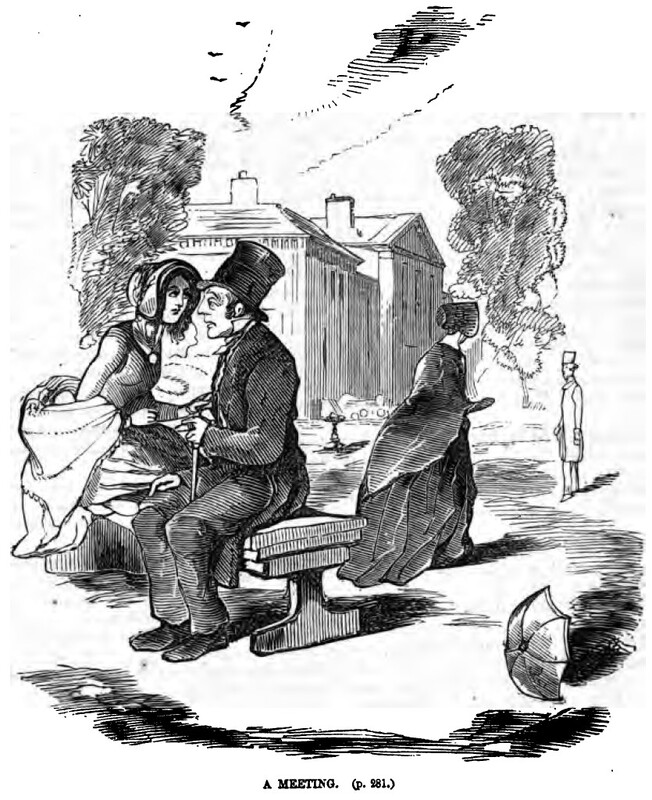
John Sedley sits on a bench in the park, holding onto his cane. Next to him is his daughter, Amelia Osborne, holding onto his arm. Mary Clapp, also in a shawl and bonnet, is standing facing away from them. In front of her is William Dobbin, who she has brought to meet the pair. On the ground near the bench is a small, open parasol or umbrella, and in the background two houses are behind a fountain and between some trees. Below the illustration is printed its title and location in the story, “A MEETING. (p. 281.)”.
This image is a depiction of Gulliver interacting with the scientists and philosophers on Laputa. The object that the characters surround is an invention which the Laputans thought would reimagine their language. There are squares which would be turned by handles, which can be seen on the front side of the table. On each of the squares is a symbol representing a phrase in the Laputan language. The scientist stands in front of the table with his invention, explaining it to Gulliver who stands to the left side of the image. Students are surrounding the invention, listening to the scientist, waiting to operate it. A map of the island of Balnibarbi is on the wall behind the students. The same map, which shows how the island moves, is included in several other German editions of Gulliver’s Travels, including the 1727 von Wiering edition. A picture above the map depicts a child playing with branches and a man on horseback. Underneath this internal image is the phrase “jüng gebogen, recht gezogen”. The same image appears in the 1761 German edition.
This image is a depiction of a scholar from the Royal Society of Laputa. The image is a part of Swift’s Biography which precedes Part One of Gulliver’s Travels. The author compares these scholars to Sir Isaac Newton. The purpose of this illustration in the biography is to provide context for the political atmosphere and insight into Swift’s satirical writings, as the Royal Society was satirized in the Third Part of the Book with the Philosophical Society of Laputa. The same image appears in the 1843 Krabbe edition.
Here Gulliver eats with the captain of the ship who rescued him from his box from Brobdingnag. Gulliver tells the captain about his time in Brobdingnag, much to the disbelief of the captain. He tells Gulliver how they found him, much farther from land than Gulliver imagined because he felt he was only in the water for a few hours. The same image appears in the 1839 Krabbe edition.

![[Gulliver waves as he leaves the Country of the Houyhnhnms]](https://cemvccol.ace-net.training/files/large/70d3d509be379bd3c679e0c4ab231e4c06e050f3.jpg)

![[Map depicting Brobdingnag]](https://cemvccol.ace-net.training/files/large/64bf8305d903836583854707f01411a3b38fd48a.jpg)
![[Vanity Fair Chapter XLVIII Inhabited Initial]](https://cemvccol.ace-net.training/files/large/fc69903144157f18db9b5ce190dc3d0bef6f0a8b.jpg)
![[The Queen of Brobdingnag’s dwarf shakes a tree dropping fruit on Gulliver]](https://cemvccol.ace-net.training/files/large/48c1e9de1810349ccbf8e59fc7887a567afcc6b2.jpg)
![[Act VI – Celestina Talks with Calisto While Sempronio Chastises Pármeno for His Snide Remarks]](https://cemvccol.ace-net.training/files/large/d6435a16190d4a6d408b9a55d9c3558706c1dea3.jpg)
![[Indigenous Brazilian women on land in conflict with Indigenous Brazilian men in canoes]](https://cemvccol.ace-net.training/files/large/14f4658b69d3ded127733a29f3eb8d302d3ca028.jpg)
![[Half man half fish]](https://cemvccol.ace-net.training/files/large/377c2ee1f5304655d1dfeff4164f3c3a5bc3f03f.jpg)
![[Gulliver and the scientists on Laputa]](https://cemvccol.ace-net.training/files/large/7ef1ab8dc58e33103672c264f17922ae07fcbac2.jpg)
![[a scholar from of the Royal Society of Laputa]](https://cemvccol.ace-net.training/files/large/ad21945bbcc7b7934606a290bebf2bcfe813454d.jpg)
![[Gulliver dines with the captain of the ship who rescued him]](https://cemvccol.ace-net.training/files/large/3962e9702d204b0ca076ea26eb110d9eb263d4d0.jpg)