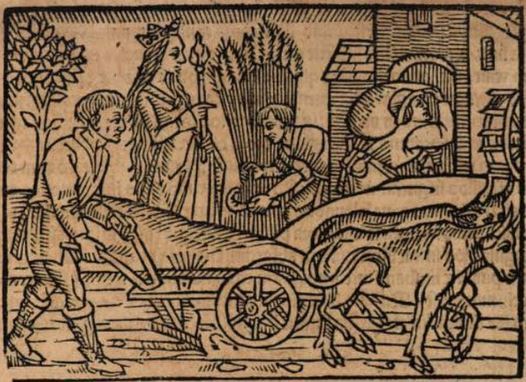
The goddess of agriculture, Ceres, is depicted in the background of the engraving wearing a crown and holding a scepter. Boccaccio explains that after discovering agriculture, Ceres had tamed oxen and trained them to yoke. She also discovered planting seeds and then taught men how to harvest them once they matured. There is one man plowing the fields with the oxen, and another in the background husking grain. There is another man with a bag of flour over his head, as Ceres also taught men how to turn flour into an edible fare. Ceres wears the crown and scepter to signify her importance linked to agriculture and harvest.
In this image Mr. Collins examines a portrait at Longbourn as Mrs. Bennet and Lizzy stand by. After turning down his proposal Mr. Collins was very cold to Lizzy and the rest of the family. Mrs. Bennet hung around him, trying to convince him to forgive Lizzy, and trying to get Lizzy to accept his offer. This scene occurs in chapter 21. The characters are shown in the traditional regency style. Lizzy and Mrs. Bennet wear regency style dresses with empire waistlines. Mr. Collins wears a waistcoat and tailcoat. The regency period dated to the early nineteenth century (1811-1820) when George, Prince of Wales, later George IV (r. 1820-1830), reigned as regent for his mentally ill father, King George III (r. 1760-1820). The regency period is associated with the rise of neoclassicism in art and fashion.
This image is a depiction of Gulliver interacting with the giants on Brobdingnag. Gulliver is the central figure, bowing on a small stage surrounded by giants. Gulliver is also the only character in this image who is coloured, shown wearing a red coat. The young girl, Glumdalclitch, stands behind the stage, leaning over the back to give Gulliver his directions. There are several other giants watching Gulliver in awe, including a baby who is reaching out to Gulliver in the foreground. The scene takes place in the farmer’s living room, with a portrait of a man above the heads of the giants, and a large window looks out onto mountains. A small dog runs under the bench. The image is coloured, however the same image appears in the 1762 German edition, however the 1762 German edition is not coloured.
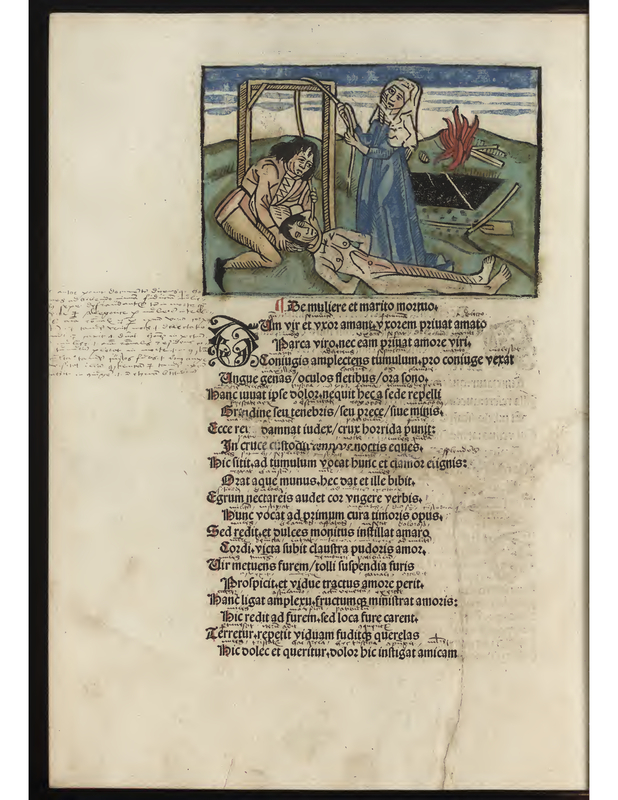
A dead man is lying on the ground with a rope around his neck. A man is holding the dead man’s neck up while the woman is holding the other end of the rope. She is releasing him from the place where he was hung. In the background there is a fire pit and hills.
Two Tupinambá men are shown, each holding a different weapon. One man stands in front of the other, holding a club with feathers on the end in one hand. The man standing behind him points a bow and arrow at something beyond the right edge of the image. Both men are nude and have an adornment on their chin. The man in front has marks (tattoos or paint) on his chest, biceps and thighs. The head of another man from an enemy group lays on the ground behind the men.
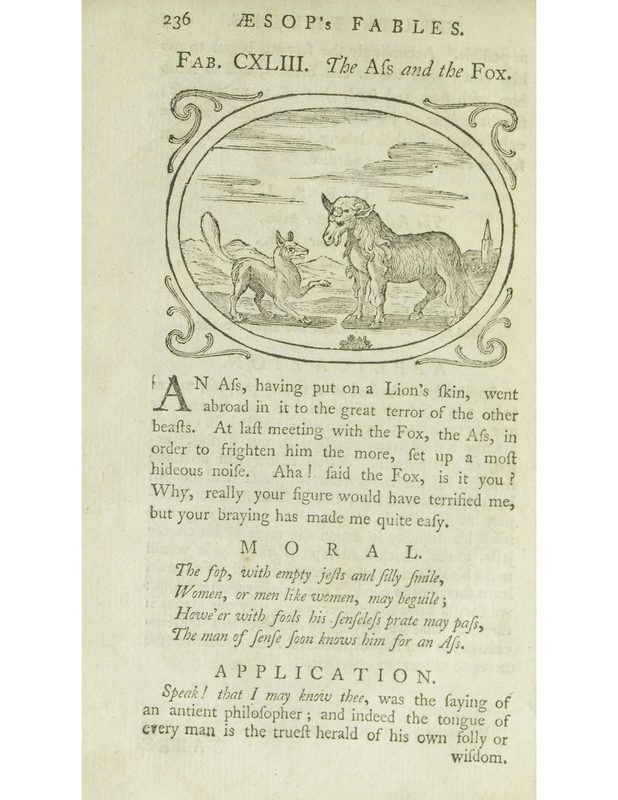
The scene is taken place outside, there are three large mountains in the distance as well as a building with plants surrounding it. There is a Fox and a Ass facing each other, the Ass has a Lions skin on him as a disguise to go try scare other beats and comes across the Fox, but he was not frightened.
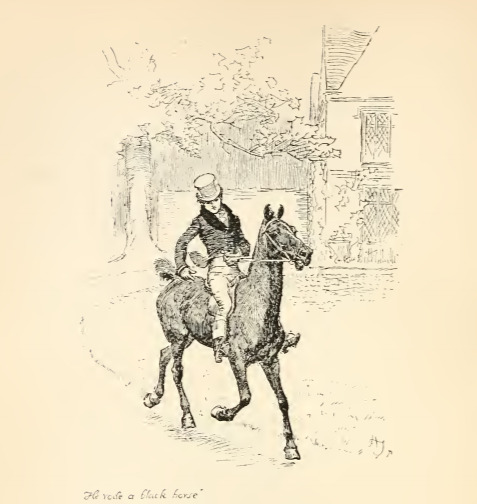
In this image Mr. Bingley rides up to the Bennet’s house on horseback. After Mr. Bennet called on Mr. Bingley, he returned the call, coming to Longbourn. This thrilled Mrs. Bennet and her daughters, as it was the first time they met Mr. Bingley. This scene occurs in chapter 3. The characters are shown in the traditional regency style. Mr. Bingley wears a waistcoat and tailcoat with a top hat. The regency period dated to the early nineteenth century (1811-1820) when George, Prince of Wales, later George IV (r. 1820-1830), reigned as regent for his mentally ill father, King George III (r. 1760-1820). The regency period is associated with the rise of neoclassicism in art and fashion.
The front page of this edition has a bard with a lyre. He is wearing a black shirt with white cuffs and white waist. He ahs stripped red pants and red shoes. He has short light brown hair with a little black hat on top.
Here we see a personal library on Lilliput. Gulliver tells us that the only person on Lilliput with an extensive library is the Emperor, and even the very wealthy have only a small library, with most people not having any sort of library. Gulliver compares the small libraries of individual Lilliputians to a library that could be carried on a donkey’s back; thus, we see a donkey sitting by the base of the bookshelf. This image comes in the appendix to Gulliver’s travels to Lilliput, in which Gulliver critiques the Lilliputian education system. The same image appears in the 1843 Krabbe edition.
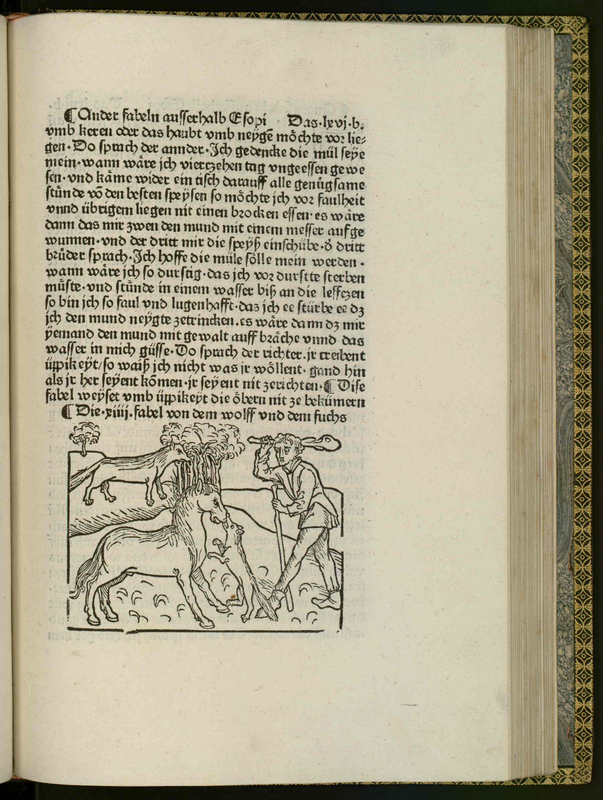
On the left side of the image, a wolf is standing on a hill. Below the wolf, there is a horse getting his nose bitten by a fox. On the right side of the image, a human is standing ready to hit the horse or fox with a piece of wood.
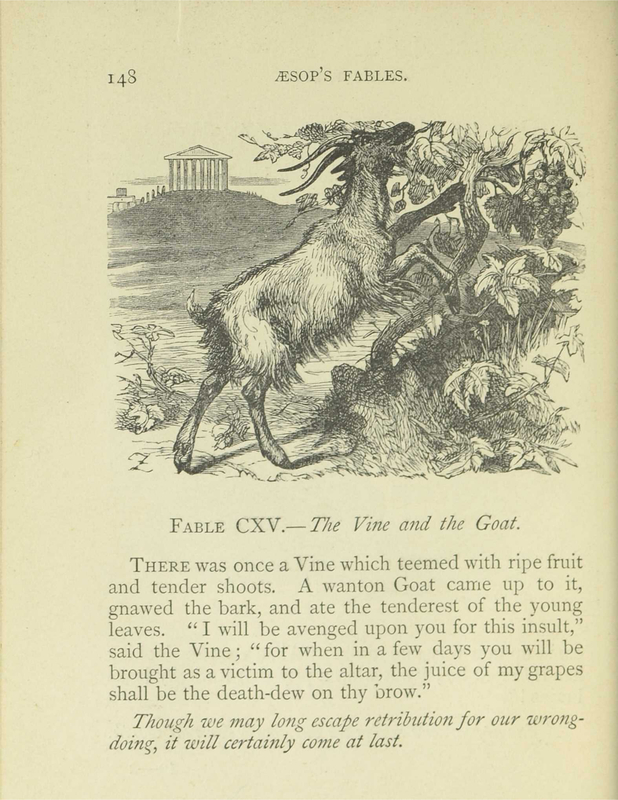
A goat strips the leaves off of a vine sprouting tree like out of the ground. It bows a bit to the left hand side of the page under the goats weight. In the background, there is a Parthenon-like temple.
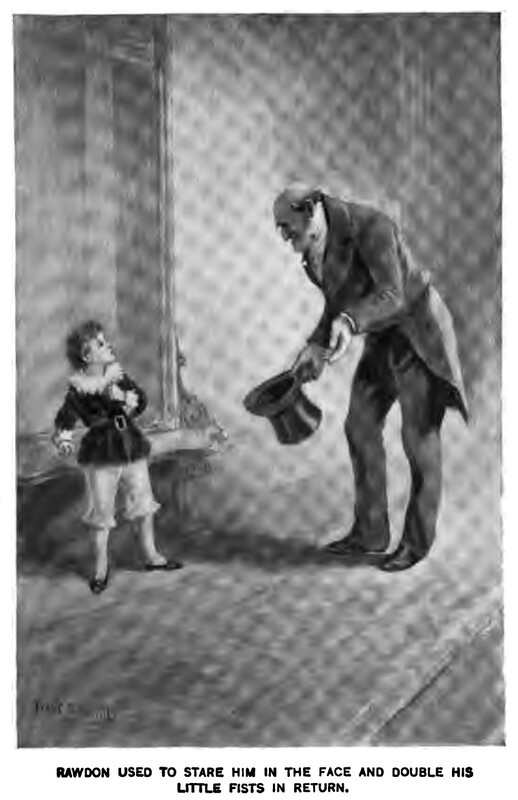
The image depicts a scene from page 89, in which little Rawdon and Lord Steyne are making faces at each other. Lord Steyne is shown leaning over towards the boy, holding out his top hat in one hand. Little Rawdon Crawley is leaning away from him, with one fist at his side and the other held to his chest.
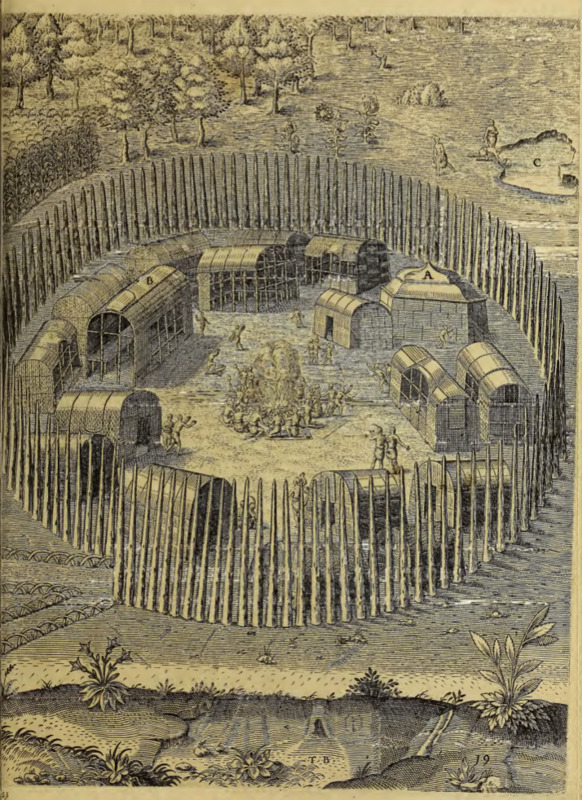
The Indigenous town of Pomeiooc is shown. Multiple structures are arranged in a circle. At the centre of the circle is a large bonfire, and surrounding the structures is a fence of tall poles stuck into the ground. There is one gap in the poles that serves as an entrance. There is a cornfield to the left of the village.
This image is illustrated in a chapter that discusses and criticizes the government and society in Spanish conquered Peru. This image depicts a judge on the right side of the image robbing a noble indigenous man on the right side of the image. He appears to be taking a cloak from him. These judges were sent by Spanish mine owners to rob indigenous peoples of noble and lower status. The author criticizes the mine owners as they disrespected, abused, overworked, and took advantage of the indigenous peoples who worked in the mines. The caption at the bottom of the image reads, “de las minas” [from the mines].
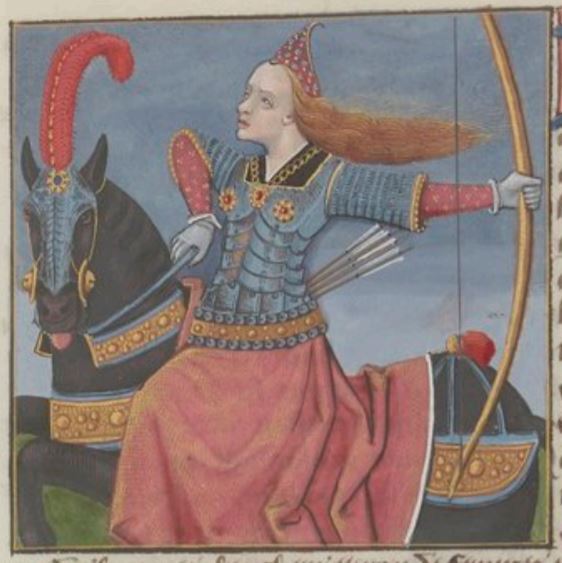
This illumination depicts Penthesilea, the queen of the Amazons, riding a horse while pointing her bow behind her. Penthesilea, as Boccaccio describes, was a great warrior. She wanted to secure a strong heir for the Amazons, so she sought out Hector of Troy to provide her with an heir. She fought in a battle against the Greeks to prove herself worthy of bearing Hectors child. She died in battle trying to impress Hector.
After leaving Glubbdubdrib, Gulliver went to the Kingdom of Luggnagg, where he was told he could get permission to go to Japan in the hopes of returning to England. It was customary for a visitor to the court of Luggnagg to lick the floor in front of the throne as a sign of respect. This ceremony is shown in this image. This image appears at the beginning of chapter nine, and the letter “T” is in the top corner because “the” is the first word of the chapter.
Lady Jane Crawley sits on a chair in the nursery, listening to her son Pitt Binky’s morning prayers. Next to her chair is a toy horse, and above it the letter T from “The”.
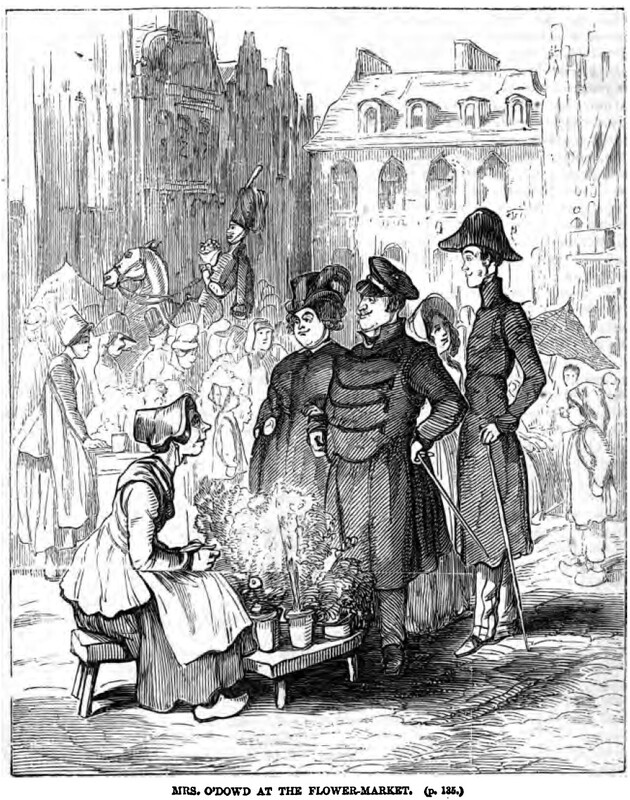
Peggy O’Dowd, in a feathered hat, stands in front of a flower seller at the market in Brussels. She is holding onto the arm of her husband, Major Mick O’Dowd, who has on a cap and is wearing his sword at his hip. Behind the pair are William Dobbin, also with his sword, and Amelia Osborne, who is in a bonnet and looking up at Dobbin. The flower seller is dressed in a bonnet, apron, and clogs, and seated on a low stool behind the table which holds her rows of potted plants. In the background of the image are the crowds of shoppers, another flower seller standing at her table of plants, a mounted officer holding a bouquet, and the tall, ornate buildings that surround the market square. Below the illustration is printed its title and location in the story, “MRS. O’DOWD AT THE FLOWER-MARKET. (p. 135.)”
In this image we see Gulliver and Glumdalclitch – the daughter of the farmer, who became Gulliver’s nurse. Gulliver kneels on a cushion, and hands Glumdalclitch his sword. A small sleigh bed that Glumdalclitch made for Gulliver is in the foreground, with Gulliver’s clothes lying on the ground. Glumdalclitch wears a dress with laces in the front, and a cap with her hair coming out from the bottom. The same image appears in the 1839 Krabbe edition.
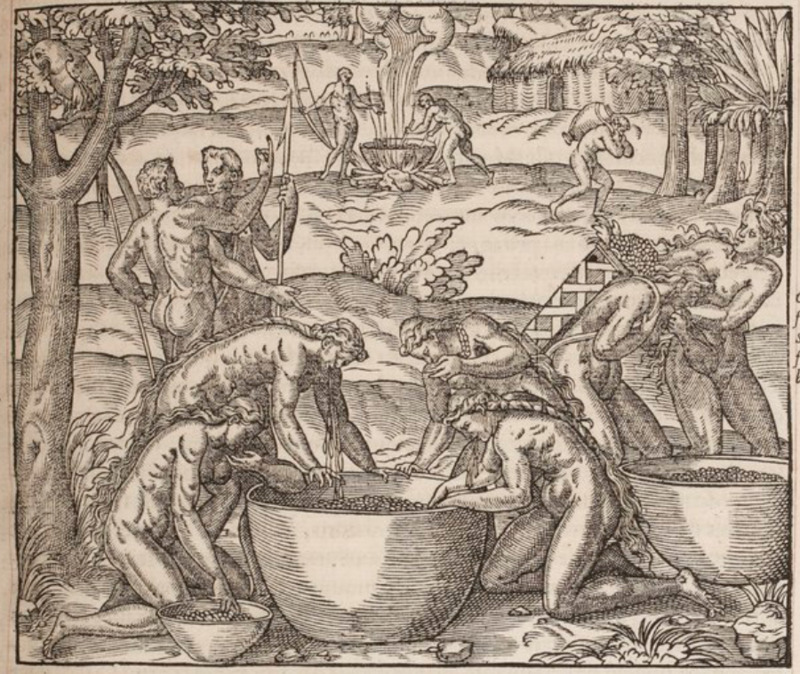
A group of Indigenous women crouch around large pots on the ground. They chew roots (manioc/cassava) and then spit them into the vats, after which the concoction is boiled and strained. A woman by the pot on the right carries a large basket on her back full of more roots. Two men, one holding a bow and the other a spear, stand talking just behind the women. In the background, two people tend a large pot over the fire where the beverage is being boiled. Another individual walks by carrying a large container on their back. One structure is also visible in the background. This image is identical to one found on page 917 of Paris 1575 (l’Huillier).
One dog is looking at four rats in front of him, two of them are small rats and two of them are rather large. In the background there’s a castle and two trees, there’s also a bunch of wheat stacked together in the middle of the image.
In this image Lady Catherine de Bourgh walks into Longbourn. Lady Catherine came to Longbourn to discuss the rumours that Mr. Darcy was going to propose to Elizabeth. Lady Catherine wanted Elizabeth to deny the rumours and promise not to accept his proposal should he offer one. This is because Lady Catherine wanted Mr. Darcy to marry her daughter instead. Elizabeth refused Lady Catherine’s request, saying that if Mr. Darcy proposed she would happily accept. This infuriated Lady Catherine and she left in anger. This scene occurs in chapter 56. The characters are shown in the traditional regency style. Lady Catherine wears a regency dress with an empire waistline. She wears an overcoat and a bonnet and carries a purse and walking stick. The regency period dated to the early nineteenth century (1811-1820) when George, Prince of Wales, later George IV (r. 1820-1830), reigned as regent for his mentally ill father, King George III (r. 1760-1820). The regency period is associated with the rise of neoclassicism in art and fashion.

![[Mr. Collins ignores Lizzy]](https://cemvccol.ace-net.training/files/large/b0bd553c843564ac2db5f20d33e0048853cabc81.jpg)
![[Gulliver performs for the giants on Brobdingnag - Colourized]](https://cemvccol.ace-net.training/files/large/ce586aa83e9266adbf0cbeb41d4b6ce536abefd1.jpg)
![[Two Tupinambá men with weapons]](https://cemvccol.ace-net.training/files/large/7624af403d40f4c6a06020dba9ac74e7a29b751b.jpg)
![[Bard playing a mandolin]](https://cemvccol.ace-net.training/files/large/b2a1871e00cca594ffa5000fd551f3bc6c424955.jpg)
![[Library on Lilliput]](https://cemvccol.ace-net.training/files/large/51006a69bce046bd5c52a5e5bebb2a9e3b331213.jpg)
![Q[v]e los D[ic]hos Mineros Enbian a Jueses a que Rrobe a los Caciques Prencipales y a los Pobres Yndios en su Pueblo](https://cemvccol.ace-net.training/files/large/954746f4900c9157848514371408a21e3be6e75f.jpg)
![[The licking ceremony in Luggnagg]](https://cemvccol.ace-net.training/files/large/4f14840bb06da52882266b1ebf3713334239e8b9.jpg)
![[Vanity Fair Volume II. Chapter XIX Historiated Initial, T]](https://cemvccol.ace-net.training/files/large/589e058a6cd830eed0a171a524b80d5e2d29dff6.jpg)

![[Gulliver and his nurse, Glumdalclitch]](https://cemvccol.ace-net.training/files/large/1a6a279c8c8a4c31100e7de98d0ac911774752b8.jpg)
![[The Dog and Rodents]](https://cemvccol.ace-net.training/files/large/dbcf274321af34bcc1cb27280fbf61990c308fa8.jpg)
![[Lady Catherine de Bourgh visits Longbourn]](https://cemvccol.ace-net.training/files/large/0f984f0f226dbb72a2d75837f53506c2ba41d7bc.jpg)