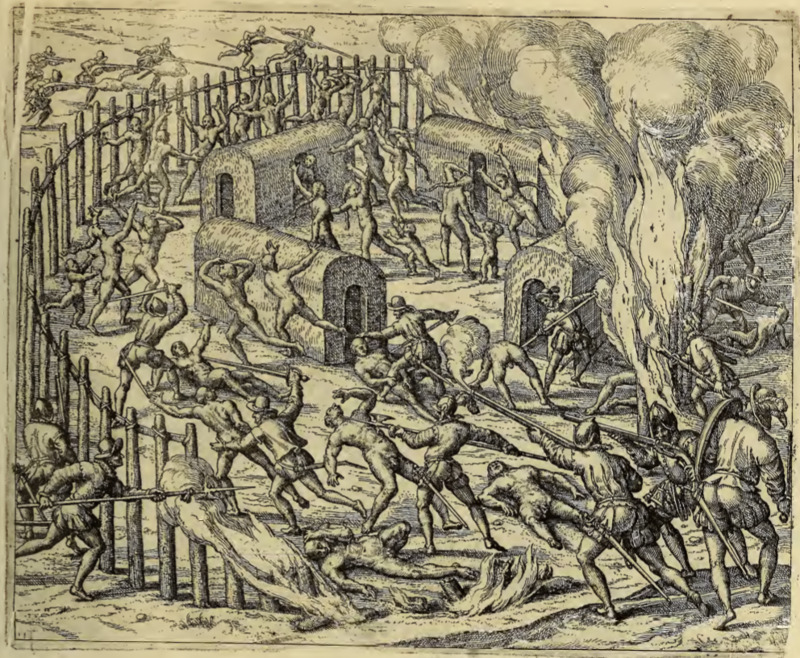
A group of Spanish soldiers attack an Indigenous village, killing the inhabitants with swords, spears, and muskets, and setting fire to the village. The Spaniards have surrounded the village and attack from all side with their assorted weapons. The Indigenous men, women and children are trapped in the village, several have already been killed and those alive have no escape. The fire, set against the fence encircling the village, is burning around the fence and has caught two of the four dwelling that make up the village.
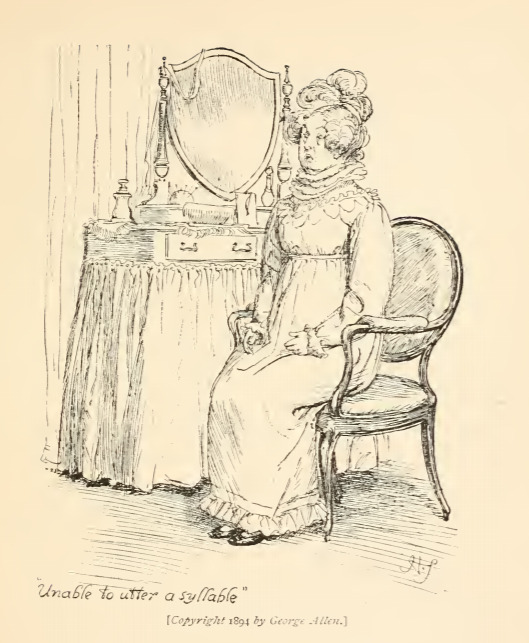
In this image Mrs. Bennet sits in shock after Elizabeth tells her that Mr. Darcy proposed to her and she accepted. Mrs. Bennet was initially speechless, but quickly recovered and exclaimed that she will be very rich, even richer than Jane. This scene occurs in chapter 59. The characters are shown in the traditional regency style. Mrs. Bennet wears a regency dress with an empire waist. The regency period dated to the early nineteenth century (1811-1820) when George, Prince of Wales, later George IV (r. 1820-1830), reigned as regent for his mentally ill father, King George III (r. 1760-1820). The regency period is associated with the rise of neoclassicism in art and fashion.
Here we see Gulliver bowing and thanking his master standing on the shore before he leaves the Country of the Houyhnhnms. The Council of the Houyhnhnms told his master that Gulliver either had to live with the yahoos or return to Europe but could not live with the Houyhnhnms any longer. Gulliver was shocked by this, and decided he had to leave rather than live with the yahoos. Gulliver built a boat to leave the Country, seen in the water behind Gulliver. The same image appears in the 1843 Krabbe edition.
Here we see a crowd of ghosts. Gulliver asked the King of Glubbdubdrib to speak with Homer and Aristotle as well as the commentators of Homer and Aristotle. This resulted in a large crowd. To Gulliver’s surprise neither Homer nor Aristotle knew much about their commentators, and Gulliver happily introduced the commentators to the writers.
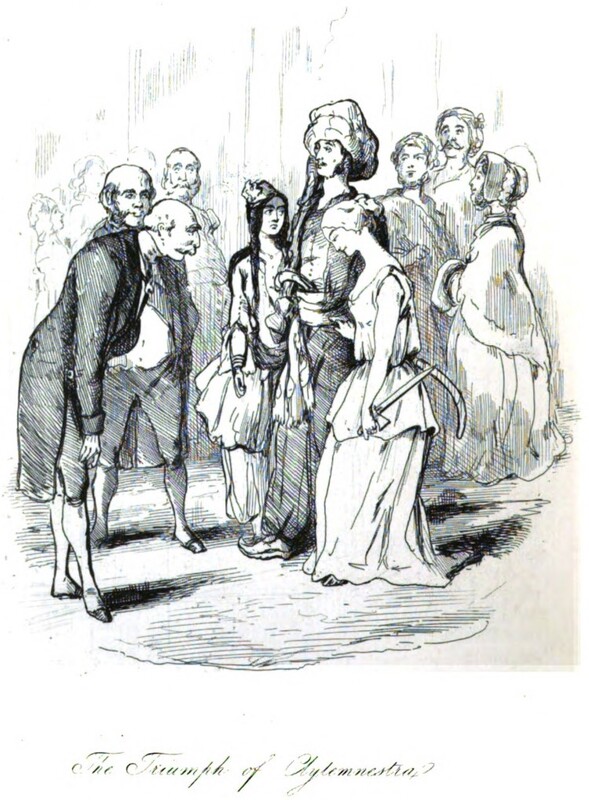
Rebecca Crawley, dressed in a toga and holding a dagger in the character of Clytemnestra, curtseys slightly to his Royal Highness, the prince of Peterwaradin, as he bows and compliments her performance. Next to her is Mr. Bedwin Sands, dressed as a Turkish officer, and behind him Mrs. Winkworth, whose performance as Zuleikah had been the focus of admiration prior to Becky’s appearance. Between Mrs. Winkworth and the prince of Peterwaradin is Lord Steyne, smiling jovially. In the background are several other admiring partygoers. Below the illustration is printed in cursive its title, “The Triumph of Clytemnestra”.
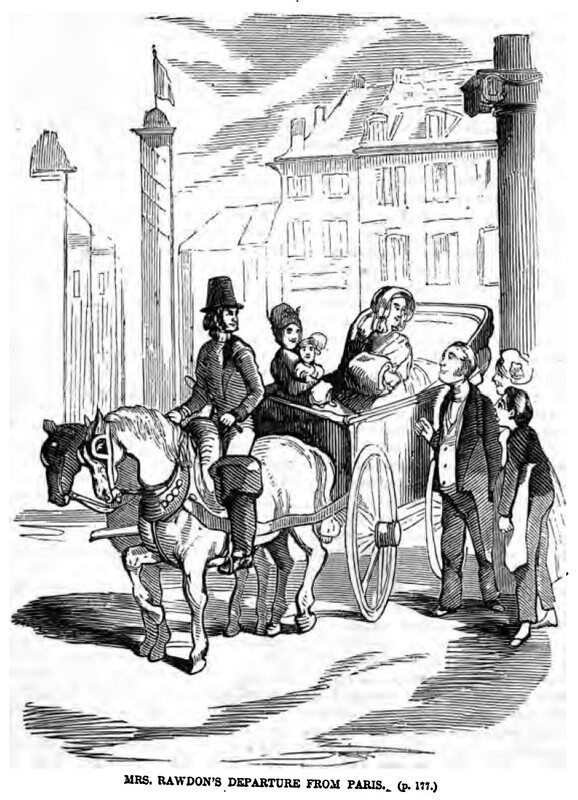
Rebecca Crawley sits grandly in a carriage, wearing a bonnet and muff and saying her farewells to the people standing beside the carriage. Opposite her sits Genevieve, the maid, holding little Rawdon. The carriage is pulled by a pair of horses, with the driver seated astride the larger of the two. In the background, the buildings of Paris and a tall tower topped with a flag can be seen. Below the illustration is printed its title and location in the story, “MRS. RAWDON’S DEPARTURE FROM PARIS. (p. 177.)”.
In this image we see Gulliver speaking with the king and queen of Brobdingnag. On the left is the queen who wears a long, embroidered dress and a headpiece with a veil and long earrings. The king in on the left and wears an embroidered tunic and a tall headpiece that is embroidered with a six-pointed star. Another woman stands behind the king and queen. Gulliver stands on a writing desk next to a quill in an inkwell. His hat is in his hand as he bows to the King and Queen. The same image appears in the 1839 Krabbe edition.
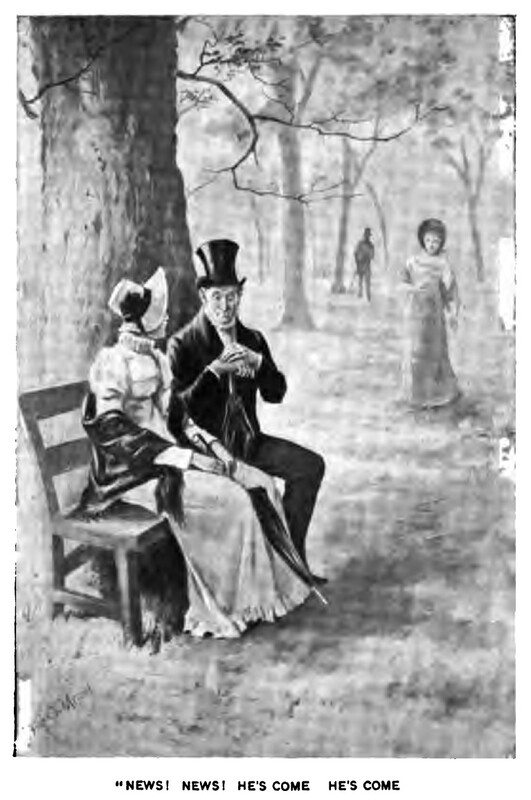
The image depicts a scene from page 232, in which Major Dobbin comes to see Amelia Osborne and her father, John Sedley. Amelia is seated on a bench in front of a large tree, wearing a bonnet and shawl and holding an umbrella in her hands. Her father is seated next to her, wearing a top hat and resting both hands on his umbrella. Mary Clapp is in the background, coming to announce the visit of William Dobbin, who can be seen even further back.
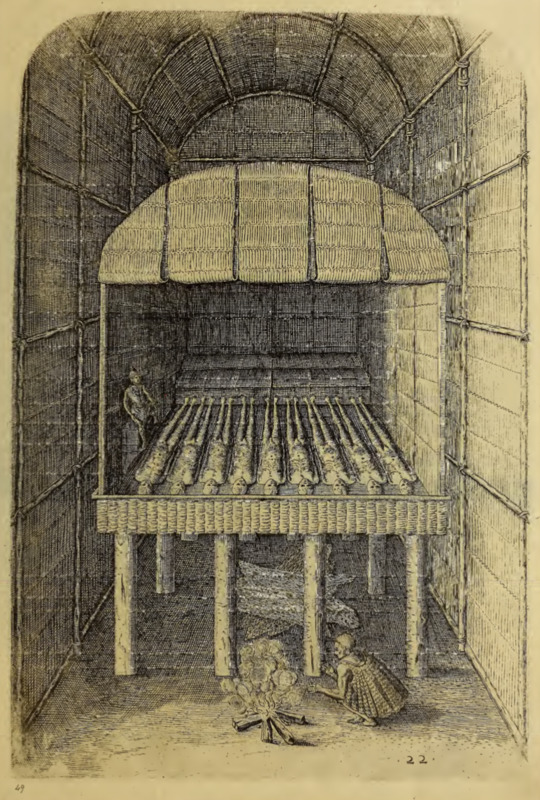
A tomb is shown, where the chiefs of this Indigenous group are laid to rest. The tomb sits inside a larger structure. It is set on thick logs that elevate it off the ground. The bodies of the chiefs are laid out side by side on a platform on top of the poles. Walls and ceiling enclose the bodies. At the base of the tomb a man crouches beside a fire.
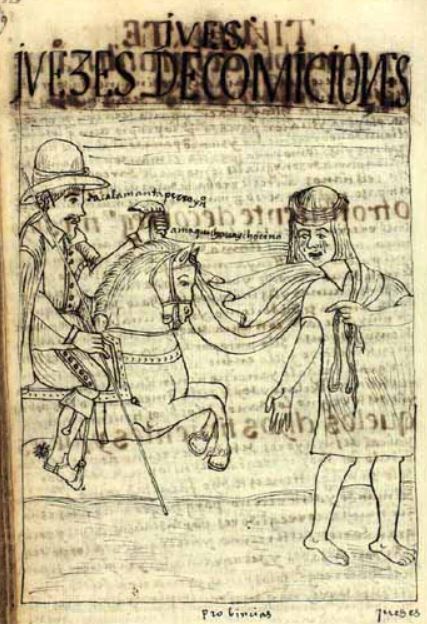
This image is illustrated in a chapter that discusses and criticizes the government and society in Spanish conquered Peru. This image depicts a Spanish judge on official duty riding a horse as he pulls a blanket off the back of an indigenous man standing in front of him. The indigenous man has tears on his face as he tries to hold on to his blanket. There is dialogue written beside the judge which reads, “daca la manta, perro yndio” [give me to blanket, Indian dog]. The indigenous man replies, “ama quichouaycho, cino” [don’t take it from me, sir].
After Lucrecia (left-central figure) tells Celestina (right-central figure) that Melibea (rightmost figure) has requested her presence, they both go to Melibea’s house. There, Melibea informs Celestina about the pain in her heart and asks what the cause might be. [The identity of the leftmost figure is uncertain, since Alisa does not enter the scene until after the next illustration. This may be intended to represent another of Melibea’s servants.]
Here we see a swallow building a nest. It appears when the Council of the Houyhnhnms discussed the possibility of exterminating the yahoos. Gulliver’s master defended Gulliver, arguing that Gulliver, like other Europeans were very civilized and explained their accomplishments, including building – much like the swallow - and industry - like the ant. Gulliver’s master that there was nothing wrong with learning from them. This passage is a reflection of European ideas about North Americans, who believed that the North Americans were a form of lesser being because of their racists and colonial ideologies. The same image appears in the 1839 Krabbe edition.
Here we see Gulliver’s meal at the Court in Laputa. It is served by a Laputan servant, identified by his tilting head and eyes – one of which is turned inwards, the other looking up. The meal was presented in different shapes. In the first course – seen here – all the food was cut into geometric shapes. For example, the mutton was cut into a triangle, the beef into rhomboids, and the pudding into a cycloid. The bread was cut into cylinders and other mathematical shapes. In the second course, the food all resembled musical instruments. For example, the duck was cut to look like a violin, sausages and puddings were made to look like flutes and oboes, and veal in the shape of a harp. In this image we see the table set and served for the first course, with the beef in the shape of a rhombus sitting on the plates and the servant serving the pudding in the shape of cycloids. The same image appears in the 1843 Krabbe edition.
Here we see Homer and Aristotle speaking with Gulliver. When asked who Gulliver wanted to speak with, he chose Homer and Aristotle as he thought these two men epitomized wit and learning. Homer is on the right and Gulliver notes that he stands taller than Aristotle, walks with straight posture, and has piercing eyes. Many think Homer was blind, however, in Swift, as in Lucian’s A True Story, Homer can see. He carries a lyre, as Homer was a poet. Aristotle is on the left and is stooped and relies on a cane. He has thin hair and a weak voice. Aristotle’s voice is weak because his words were continually misrepresented by commentators. This idea is borrowed from Dante’s Virgil in the Commedia. Homer and Aristotle appear at the head of all their commentators throughout history. Gulliver quickly discovered that neither Homer nor Aristotle had ever heard or seen their commentators. Gulliver tried to introduce the men to their commentators, however, neither of the men were interested nor receptive to them. The commentators all kept their distance from both Homer and Aristotle because they felt guilty that they had misrepresented their writings. The same image appears in the 1843 Krabbe edition.
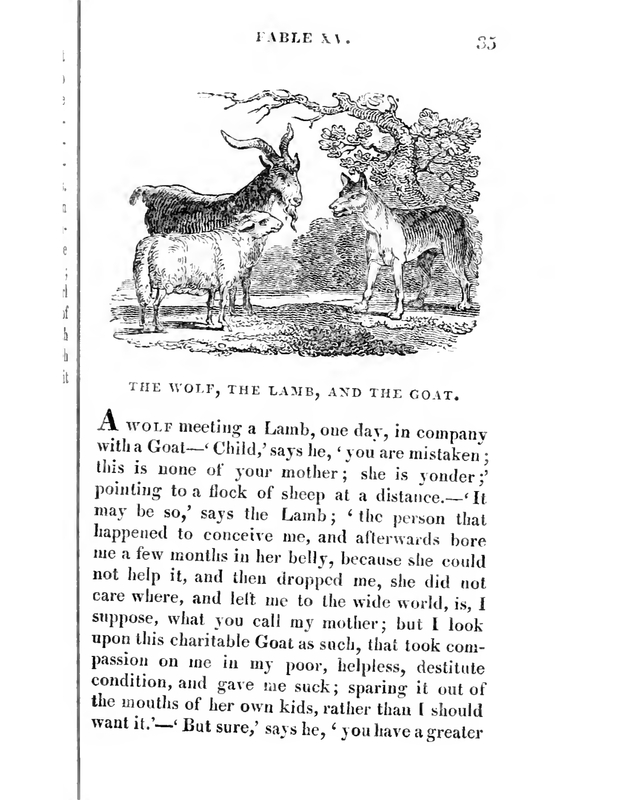
A Wolf encountered a Lamb with a Goat in the forest. Wolf was hostled towards them as he was telling the Lamb that the Goat was not his mother. The Goat remained calm and indifferent when facing his judegment. The Lamb stood firmly in fornt of the Goat and explain the situation. The Lamb firmly believed the effort the Goat dedicated to bring him up proved her as his mother.
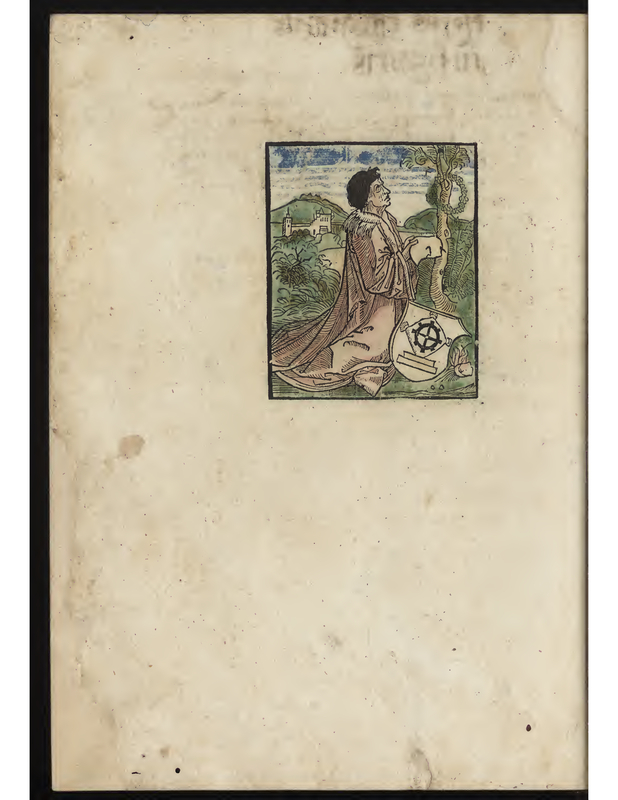
Sebastion Brant kneels under a tree with a wreath around it in the woods holding what could potentially be parchment and wearing a robe. Beside him is a shield with an insignia that resembles a gear. In the background a castle can be seen
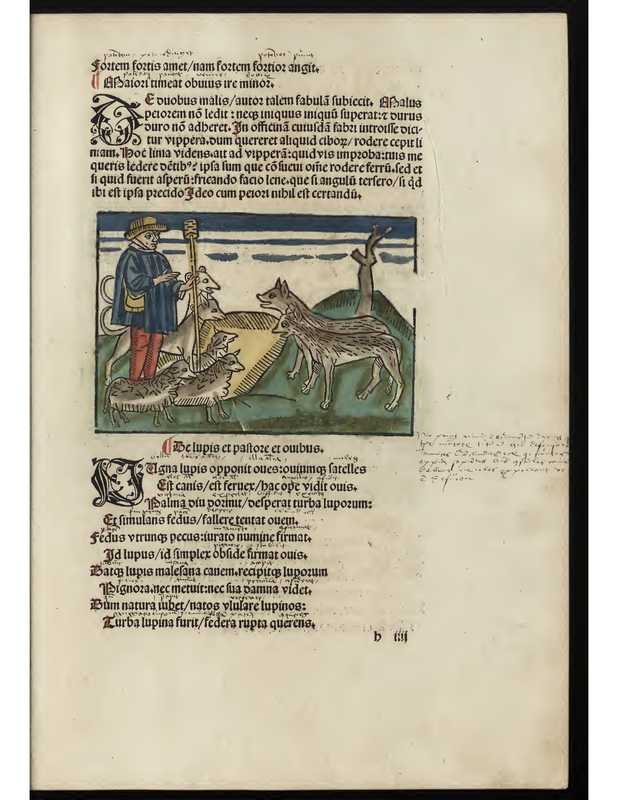
There is a man standing before two wolves. On the left side stands the man, sheep and shepard dogs. To the right there are two wolves facing off to them. The man is dressed well and is holding a long stick. They are standing on hills; a tree stands alone in the background.
William Dobbin walks along a path next to a high, thick wall - possibly the side of the boat - looking shy with his hands clasped in front of him. He is led by a child in the appearance of a cupid, with small wings and a bow. A window high up in the wall forms the letter O from “Our”.
Two Tupinambá people – a man and a woman – and a European man are shown. The woman has long hair twisted into two braids and is nude. She crouches on the ground with her hands over her face, seemingly in emotional distress. The European man sits in a hammock, also holding a hand over his face in a display of emotion. There is a bucket on the ground under the hammock. Behind the two, the Tupinambá man balances a bow and arrow in one hand and holds a knife against the end of the arrow in his other hand.
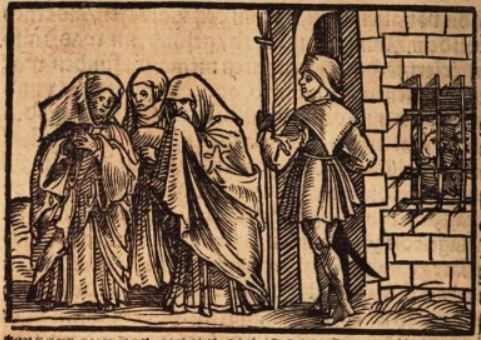
The engraving depicts a man guarding a jail with figures visible through the window of the prison cell, and three figures leaving the jail wearing heavy garments. The three figures leaving the jail are Minyan men who had been sentenced to death for their crimes against their city. Boccaccio explains that the Minyans wives had gone into the jail and swapped clothing with their husbands and switched places with them. The men in disguises slipped past the guards unnoticed and into freedom, while their wives were executed in their place. Boccaccio explains that he chose to write on these women to demonstrate that there is no greater love than a wife’s love for her husband.
William Dobbin sits slouched against the base of a tree, reading a book. In the far background are the buildings of Dr. Swishtail’s academy. Near the buildings are a few distant figures of boys playing games. Between Dobbin and the buildings, on the right side of the image, Cuff holding George Osborne by the collar and threatening him.



![[Gulliver thanks his master before he leaves the Country of the Houyhnhnms]](https://cemvccol.ace-net.training/files/large/b26fae65f567743451a8215df858db296720d735.jpg)
![[A crowd of ghosts]](https://cemvccol.ace-net.training/files/large/e4acfcba0c00cf5508b3b29977215eb8dc630608.jpg)

![[Gulliver speaks with the King and Queen of Brobdingnag]](https://cemvccol.ace-net.training/files/large/4b064d3944b98a68b6b4715ed142426ddbb90b1d.jpg)
![[Act X – Melibea, Celestina, and Lucrecia Talking as a Fourth Figure Approaches]](https://cemvccol.ace-net.training/files/large/c66365920f227137d507dc9c2110ce09ce7fbf66.jpg)
![[a swallow building a nest]](https://cemvccol.ace-net.training/files/large/35fc528c05b2ed528b5be2abcad3827378604e6a.jpg)
![[Gulliver’s meal at the Court in Laputa]](https://cemvccol.ace-net.training/files/large/ceae85832a4666471898886cbf6bf1b9b17807c3.jpg)
![[Homer and Aristotle speak with Gulliver]](https://cemvccol.ace-net.training/files/large/134f282b81989eb9086f984dd1c5ab1581470813.jpg)

![[Vanity Fair Volume II. Chapter XXIII Historiated Initial, O]](https://cemvccol.ace-net.training/files/large/88f5e5ad29a6e9533a9b58b7215d14bdf08d084d.jpg)
![[A European man and a Tupinambá woman weep into their hands while a Tupinambá man stands behind them]](https://cemvccol.ace-net.training/files/large/dbc62e27c99c292761a260664b851db00a9c2b6a.jpg)
![[Dobbin Reading]](https://cemvccol.ace-net.training/files/large/51c936aee5c16f67aa5ce8675286f38c3f2632a9.jpg)