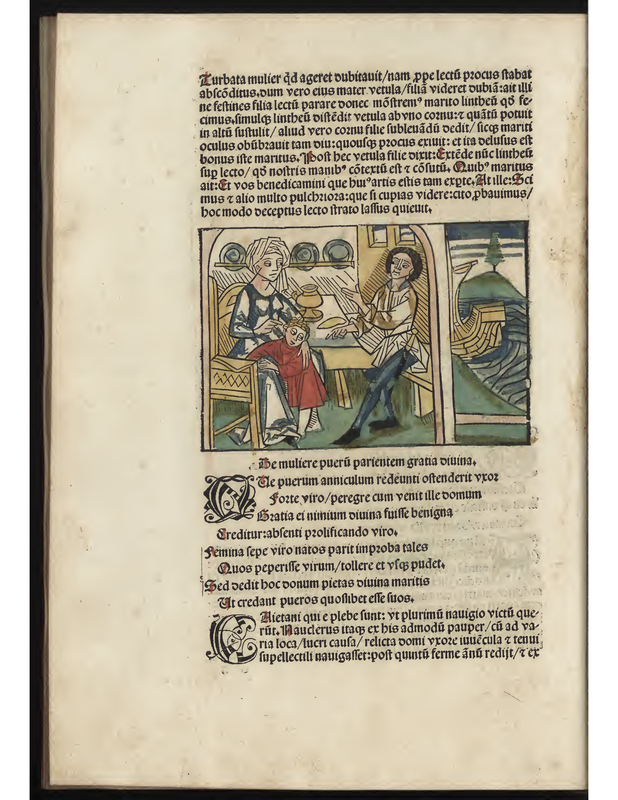
A woman is sitting in a intricate chair talking to a man with a short sword on his belt inside of a house by a table. Her son is standing between her legs and leaning on her lap. on the table there is a vase and there are plates on a shelf behind the table. Outside of the house there is water with a big sailboat parked outside.
This image depicts the Holy Trinity, the Father, the Son, and the Holy Spirit. God depicted as the Father is sitting on the right side of the image wearing a long, decorated robe as he holds an orb which symbolizes the Earth. He is also wearing a triangular halo which represents the Holy Trinity. Jesus Christ, the Son, is illustrated sitting on the left side of the image holding the cross that he was crucified on. There are nail marks on the cross and on his hands and feet, and a puncture wound below his right breast which was stabbed by the holy lance. The letters written at the top of the crucifix spell “I.N.R.I” [Iesus Nazarenus Rex Iudaeorum/Jesus of Nazareth King of the Jews]. The Holy Spirit is represented through the dove that is in the centre of the image. There are clouds beneath the feet of Christ and God which demonstrates they are in Heaven. The caption at the bottom of the image reads, “trinidad” [trinity].
Celestina (upper figure) informs Melibea (lower figure) that she can only be cured if she reveals her love for Calisto, which causes Melibea to experience intense emotions and faint. Upon waking, she finally acknowledges her love for Calisto. Celestina tells her that she will be cured if she meets with Calisto at midnight, and Melibea agrees. As Celestina departs for home, she encounters Melibea’s mother Alisa, who asks her the purpose of her visit. Alisa asks Melibea the same question, and when the two answers differ, she warns Melibea to avoid Celestina.
Here we see Gulliver's master seated before the Council of the Houyhnhnms, where represented his district. Every four years a representative council of the Houyhnhnms meets in a large plain about twenty miles from the house where Gulliver was staying. They discuss the conditions of the different districts of the country. This image appears at the beginning of chapter nine, and the letter “U” appears on the back of the chair because it is the first letter of the chapter. The same image appears in the 1839 Krabbe edition.
Here we see Gulliver’s arrival on Balnibarbi, the continent underneath the flying island of Laputa. After sailing for several days, he sees land. He sailed around for several hours to find the best place to come inland, and after finding a creek, he arrives on shore. He then prepared his food by making a fire, seen in this image. His small boat is visible behind the cliff. After eating, he found a small cave where he slept and stored the rest of his provisions. The same image appears in the 1843 Krabbe edition.
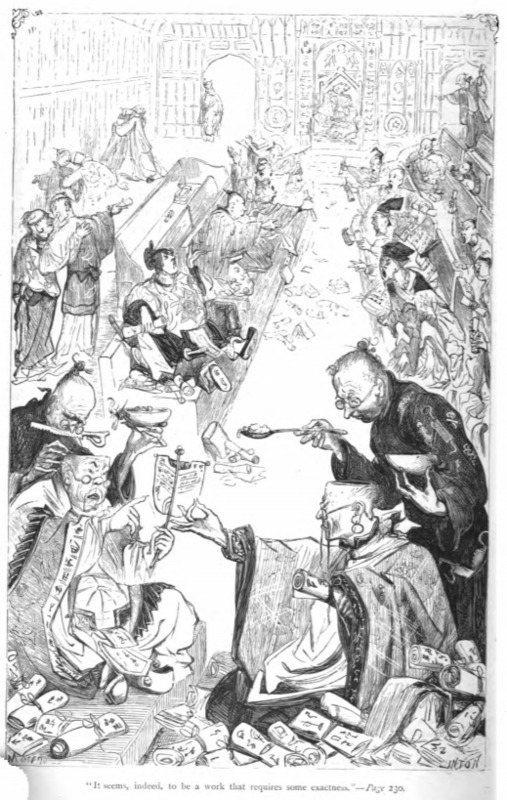
During his time on Balnibarbi Gulliver visited the Grand Academy of Lagado and the scholars who worked there. At the academy, several doctors worked to resolve political differences through medical intervention. One doctor suggested that issues could be resolved by cutting into the brains of two opposing politicians and switching half their brains. The idea behind this was that the two halves of the brain would see both sides of the argument more clearly and be able to come up with a compromise. In this image we see two doctors in the foreground performing this procedure, while behind them parliament argues.
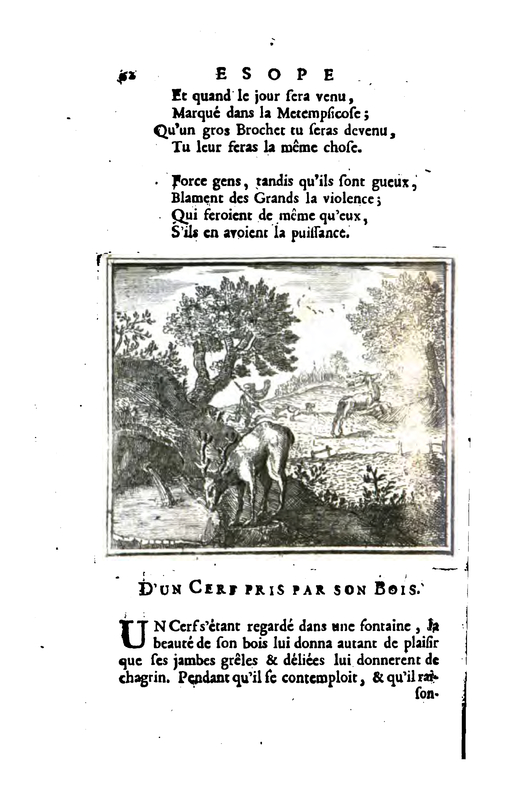
There is a deer drinking water from a pond under a den. On top the den there is a tree and while the deer is drinking, it gets caught by its antlers. Behind this scene there is a deer running away from a man holding a hunting equipment and chasing this deer. There are birds on the clear sky. There are trees surrounding this scenario.
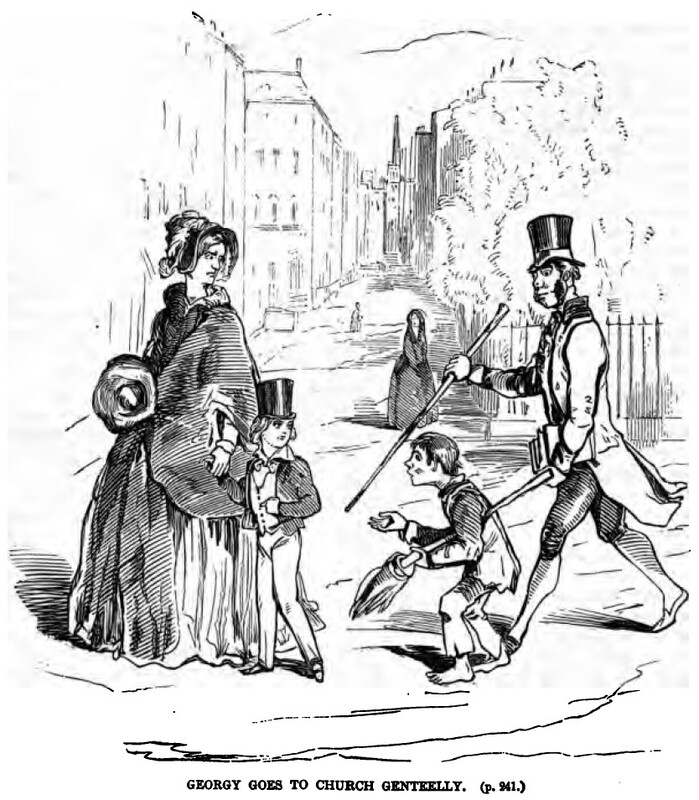
Georgy Osborne in a top hat and suit, holds onto his aunt Jane Osborne’s hand, and is turned to face the boy who has come up behind him. The boy is a young sweep, barefoot and with ragged clothes, begging for money. The footman, carrying the church books, is behind the sweep, trying to drive him away with a cane. In the background is Amelia Osborne, who was going for a walk on the cross-street to the one the others are taking to church, watching proudly as her son gives money to the sweep. Below the illustration is printed in cursive its title, “GEORGY GOES TO CHURCH GENTEELLY. (p. 241.)”.
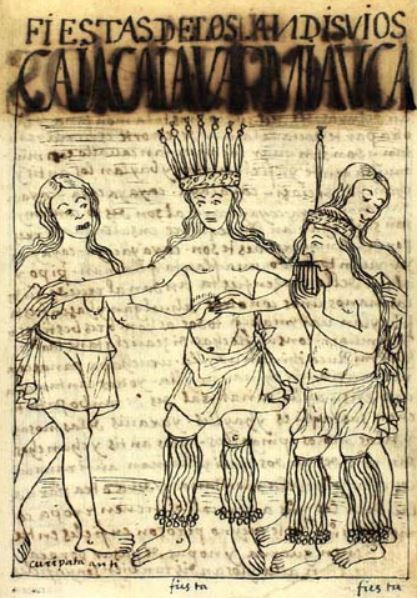
This chapter is dedicated to discussing the various celebrations and festivals that would be held in the Inca Empire. This image depicts the music festivities celebrated by the people in the Antisuyo region of the Inca Empire. There are three figures depicted dancing in a circle holding hands, with the figure on the right playing a flute. There is a fourth figure in the background on the ride side of the image. They are depicted nude from the waist up. The author explains that the men would dress up as women during these celebrations.
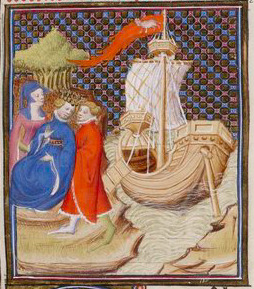
Europa, in the blue gown, is being placed in a boat that will take her to Crete. The white bull is symbolic of Jupiter – he turned himself into a white bull and followed the ship to Crete, where he raped the virgin Europa.
Two men have been captured by the Indigenous Brazilian warrior women, a group which the author calls ‘Amazons’. The men have been hung upside down by one ankle from a tree, and a fire has been lit beneath them. The women shoot arrows at the hanging men.
Two men are outside riding on horses. they are having a conversation with one another. a fox is running next to the men. surrounding them is trees, rocks, hills, and a stream.
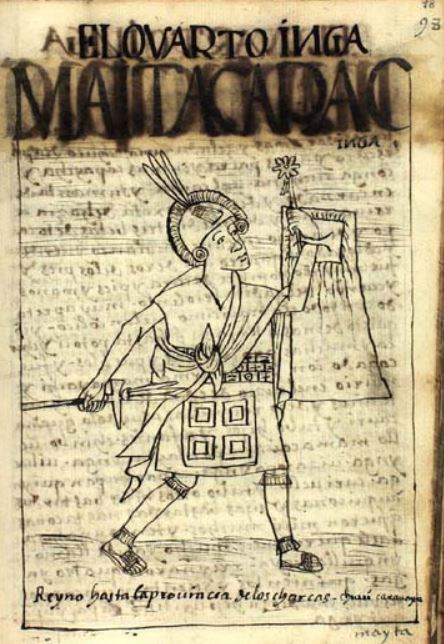
This illustration depicts the fourth king of the Incas, Mayta Capac. He is depicted holding a shield with his left hand and a mantle in his right. He is wearing a feathered visor and appears to be going into battle by the way he is standing with his shield up. The words at the bottom of the image read “Reynó hasta la prouincia de los Charcas, Chuui, Carauayos,” which translates to “King to the province of Charcas, Chuui, Carauayos.” Charcas is a small city in modern day Bolivia and Chuui refers to the country Chile. Here, the author is demonstrating the expansion of the Inca Empire.
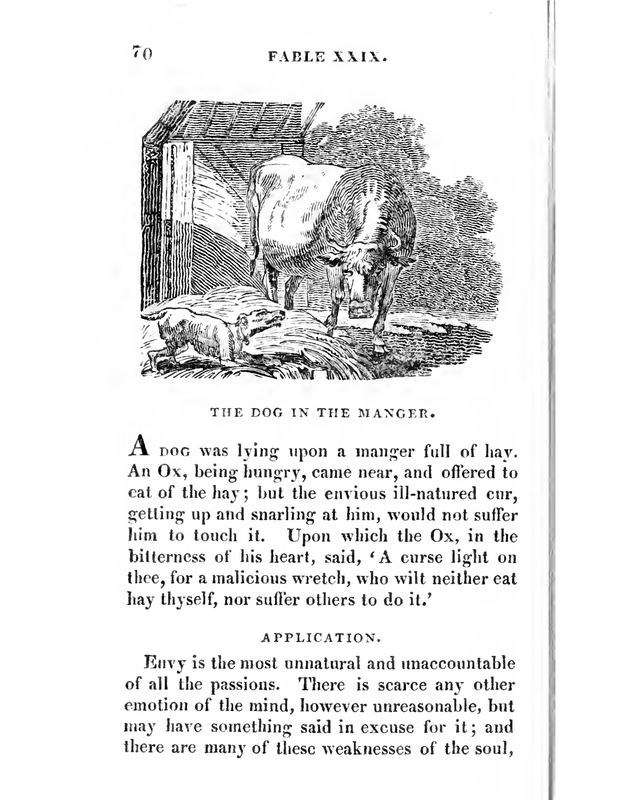
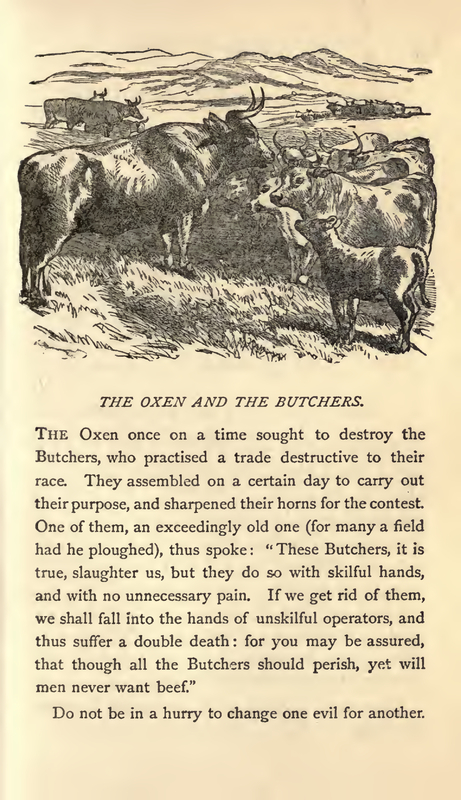
In the middle of the image is an ox bending down to look at a dog who is atop a pile of hay in the bottom left corner. The dog is on all four legs, bending down slightly and snarling at the ox. In the left of the background is a barn and the rest of the background is trees and bushes.
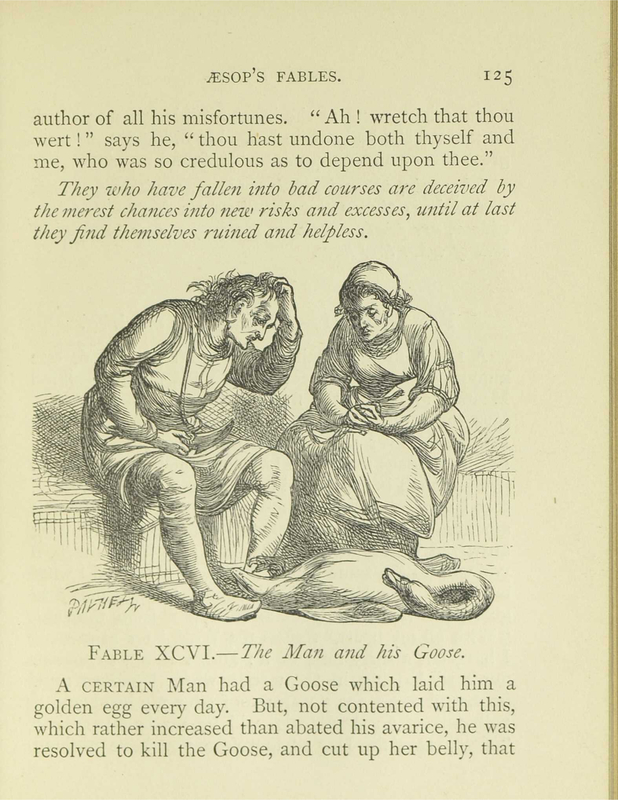
A man to the left sits on a bench holding a knife while putting a hand to his head. A woman sits to the right and looks down at the dead goose at their feet.
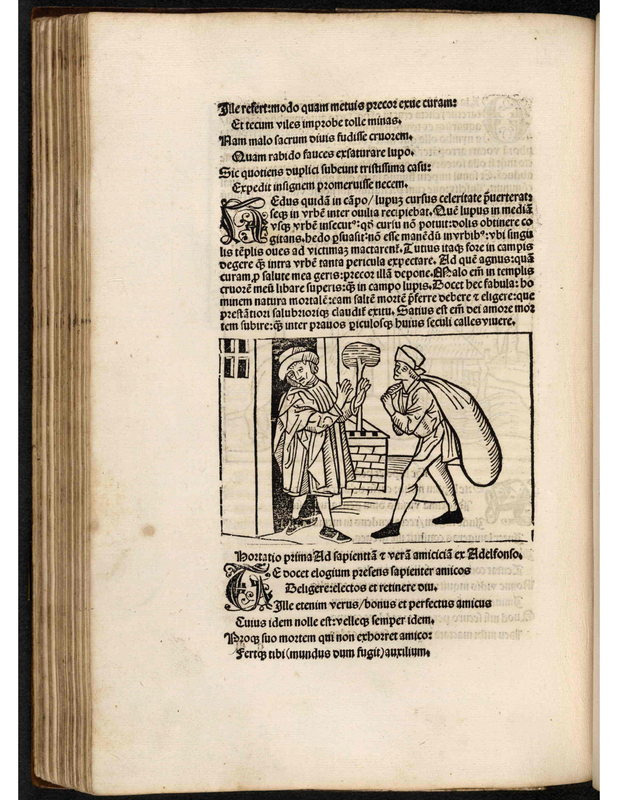
There is a man standing by a door of a building with his hands up. On the right side of the image, there is another man with a bag over his shoulder walking towards the main by the door.
Here we see Gulliver drinking from a barrel of wine, while tied up. Lilliputians roll another barrel of wine up a ramp on Gulliver’s chest, as the barrels were quite small for Gulliver, because the Lilliputians were one twelfth of Gulliver’s size. The same image appears in both the 1839 and 1843 Krabbe editions.
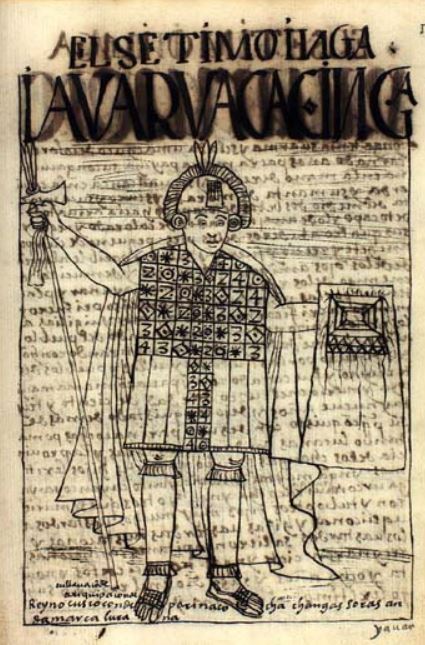
This illustration depicts the seventh king of the Inca Empire, Yahuar Huacac (or Yawar Waqaq). He is depicted holding a shield in his left hand and an ax in his right. He is pictured wearing traditional royal garb and a feathered head visor. The author explains that this Inca king began the tradition of fasting and penance and commanded his subjects to do so as well. There are words at the bottom of the image that reads, “Reynó Cullaua Conde, Ariquipa Conde, Cusco Conde, Parinacocha, Changas, Soras, Andamarca, Lucana,” which describes the cities that he ruled over.

![A de Rezar a la S[antici]ma Trinidad](https://cemvccol.ace-net.training/files/large/27e4e8286de2a93113fa136d05360f65bc0bb622.jpg)
![[Act X (Second Illustration) – Melibea Collapses After Celestina Pressures Her to Reveal Her Love for Calisto]](https://cemvccol.ace-net.training/files/large/c1ab8007e74bc173a49ba5f549d22ba1c4dde9fa.jpg)
![[Gulliver’s master speaks at the Council of the Houyhnhnms]](https://cemvccol.ace-net.training/files/large/51f0d7225bcbc6429ef218e0053fb3dfd7cc0947.jpg)
![[Gulliver arrives on Balnibarbi]](https://cemvccol.ace-net.training/files/large/b1239e84ad7455030be52cd0f5543015d6e38917.jpg)
![[Gulliver’s hat and sword]](https://cemvccol.ace-net.training/files/large/7b118f4212618ee6574b01c8216d13ecb79bd265.jpg)
![[How the Indigenous Brazilian warrior women treat captives]](https://cemvccol.ace-net.training/files/large/d894b62499f7805b76a38585905f8f6c3d0e7836.jpg)
![[Men riding horses]](https://cemvccol.ace-net.training/files/large/8a4c0fce61ba1d2eff01fc2a0785dbb61f6e84ce.jpg)

![[Vanity Fair Chapter XLVII Inhabited Initial]](https://cemvccol.ace-net.training/files/large/17f235d8b29ac446c7ee8ce0a584efc032d4d875.jpg)
![[Gulliver drinks from a barrel of wine]](https://cemvccol.ace-net.training/files/large/a7db5de1f834490f54d5827afbfe8583dff15b6e.jpg)