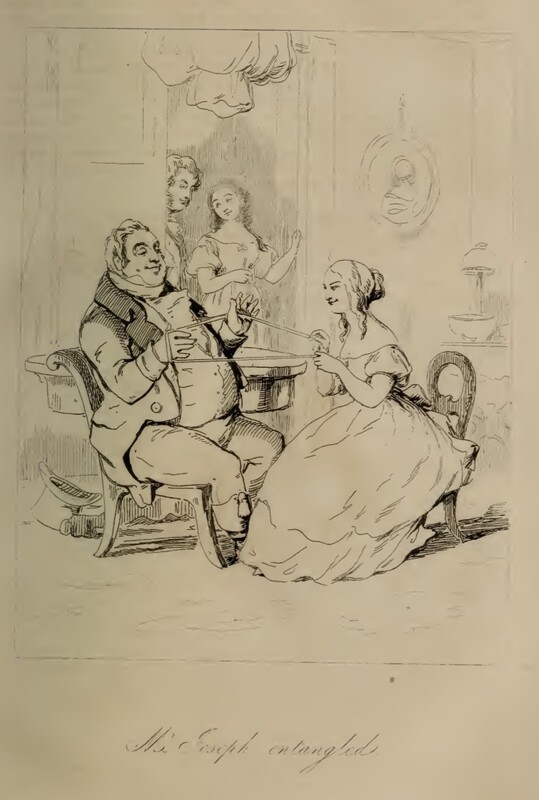
Joseph Sedley and Rebecca Sharp sit at two chairs in front of a round table; she holds both ends of a string of silk which is wound around his hands. Beneath the table is Joseph’s hat, and in the background, another table with a lamp and bowl and a portrait upon the wall. Amelia Sedley and George Osborne are entering through the doorway behind the round table at which the others sit. All four look pleased. Below the illustration is printed in cursive its title, “Mr. Joseph entangled”.
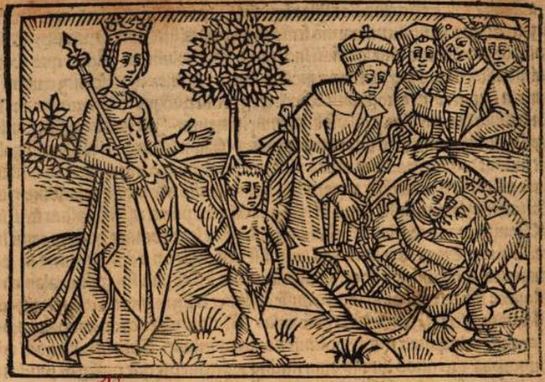
The goddess Venus is depicted on the left side of the engraving wearing a crown and holding a scepter in her right hand. Her son, Cupid, is depicted walking alongside her with his bow and arrows in hand and his wings erected in the air. The right side of the engraving also depicts Venus as she commits adultery with her half-brother, Mars. They are illustrated laying down wrapped in each other’s embrace. Venus’ husband, Vulcan, had walked in on the adulterous crime. He is illustrated leaning over Venus and Mars. There are unidentified figures in the background of the engraving in the top right corner. Boccaccio explains that Venus was highly adored in Cyprus as well as Rome, and he chose to write on her for her beauty. He criticizes her highly due to her invention of brothels.
In this image we see Gulliver kissing the little finger of the queen of Brobdingnag. The queen wears rings on her ring and pinky finger of her left hand. Gulliver stands on the edge of a table, leaning forward to kiss her finger. This takes place after the King and Queen of Brobdingnag purchase Gulliver from the Farmer who found him, and Glumdalclitch accompanied him to the royal palace. The same image appears in both the 1839 and 1843 Krabbe editions.
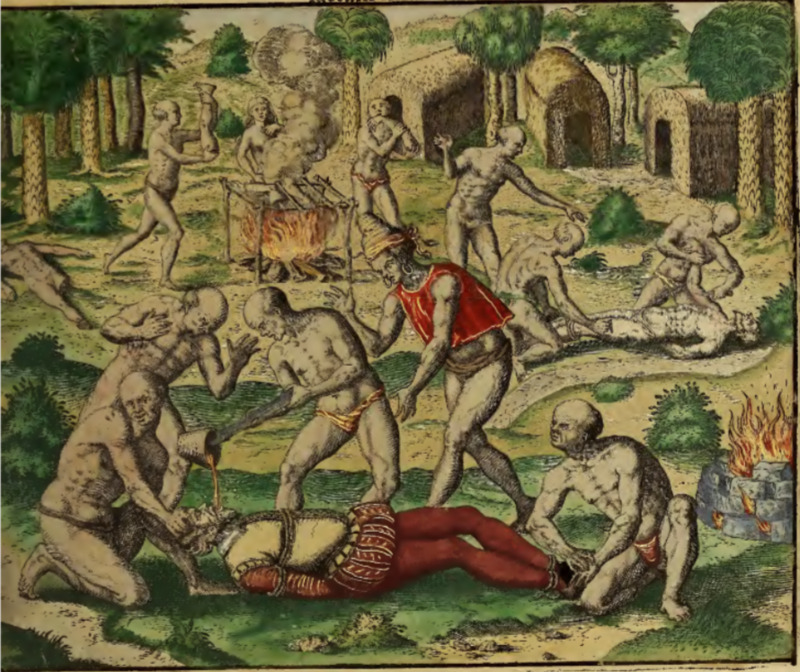
A Spanish man lies on his back on the ground, bound by ropes and restrained by Indigenous men who hold his head and feet. Another Indigenous man pours melted gold into the Spaniard’s mouth, while two other Indigenous men watch. To the right, two Indigenous men dismember the body of a second Spaniard. In the background, another body lies on the ground, this one missing a leg. Nearby, several Indigenous people stand around a fire with a wooden frame set over it for roasting limbs, and one of the men begins to eat a dismembered arm. There are several dwellings in the background. This image is identical to one found on page 187 of Frankfurt, 1594, but colored.
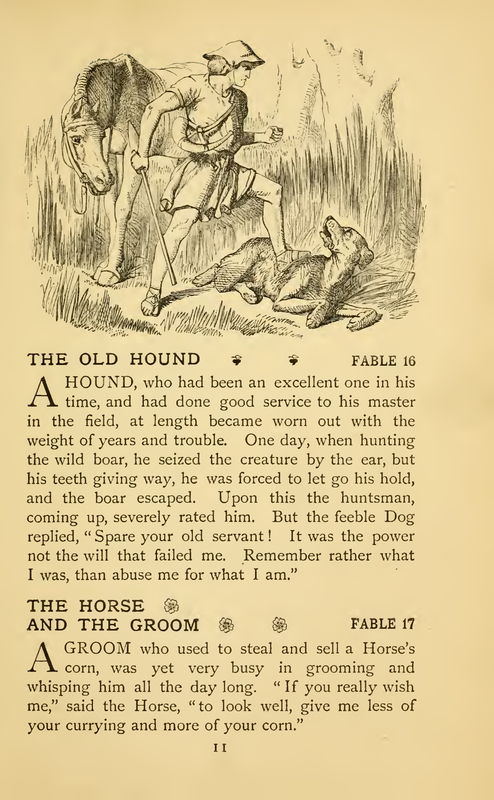
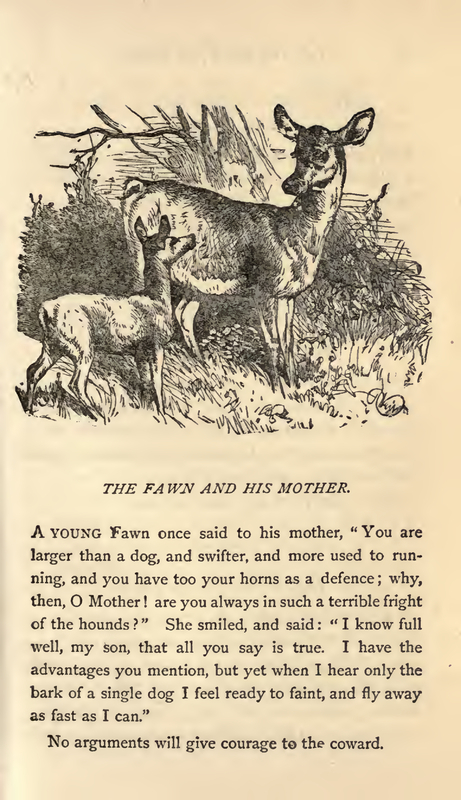
A man is stepping down on a hound. A horse is behind the man, looking down at the hound looking concerned. The man looks mad while the hound looks like he is asking for pity.
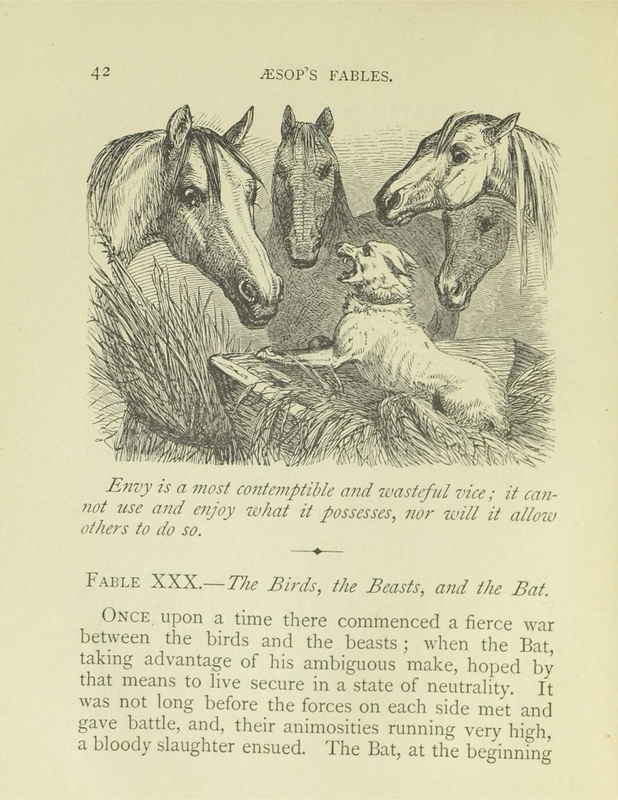
A dog that appears to be barking while perched on the edge of a manger filled with straw or wheat. Four horses surround the dog all looking at its intense expression. The dog appears angry and as though it may lunge at the horses any second.
The Laputan wives and daughters were confined to their homes, however they frequently tried to sneak out and go into the city. The image here is of a court Lady and her daughter who was married to the Prime Minister. The Prime Minister gave his wife and children a beautiful Palace, however they went into the city. The Prime Minister’s wife said she was going into the city was in rags in an Eating House. She had pawned her clothes and was in the company of another man who was abusive. an Eating House. She had pawned her clothes and was in the company of another man who was abusive. The same image appears in the 1843 Krabbe edition.
Here we see Gulliver and the Governor of Glubbbdubdrub, who was a necromancer. After speaking with Alexander the Great, and Hannibal, the Governor brought Caesar and Brutus forward. Caesar told Gulliver that his assassination was far more glorious and better for society than what he did while he was alive. Gulliver then spoke to Brutus, praising his virtue, love of his country, and benevolence. Swift evidently believed Brutus to be a much better man than Caesar, and was a true patriot, as it was better for the country to kill his friend. In talking to Brutus, Gulliver learned that other patriots whom he admired and called the sextumvirate were always together. With Brutus, the other men in the sextumvirate were Lucius Junius Brutus who expelled the last king from Rome in 509 BCE, Socrates (c. 470-399 BCE) who taught Plato and opposed the Athenian government, Epaminodas (c. 420-362 BCE) the Theban general and politician, Cato the Younger (95-46 BCE) who defended the Roman Empire against Julius Caesar, and Sir Thomas More (1478-1535) who opposed King Henry VIII of England’s departure from the Catholic Church. All of these men opposed tyranny, and in some cases were killed for their beliefs. In this image, Brutus is seen on the left holding a dagger. The same image appears in the 1843 Krabbe edition.
Here we see a dying Houyhnhnm travelling around visiting its friends before it dies. It travels in a sedan chair carried by yahoos. These chairs were also used when a Houyhnhnm was aging, ill or injured. The same image appears in the 1843 Krabbe edition.
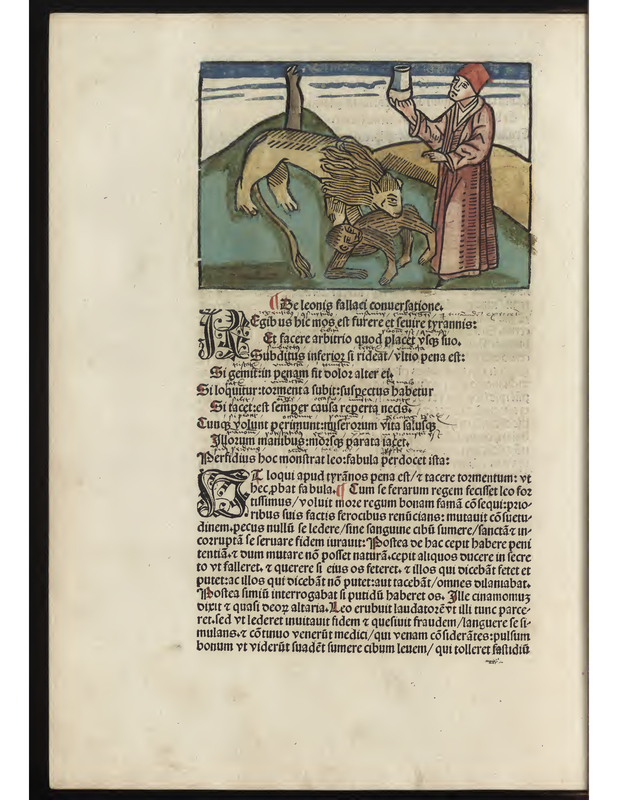
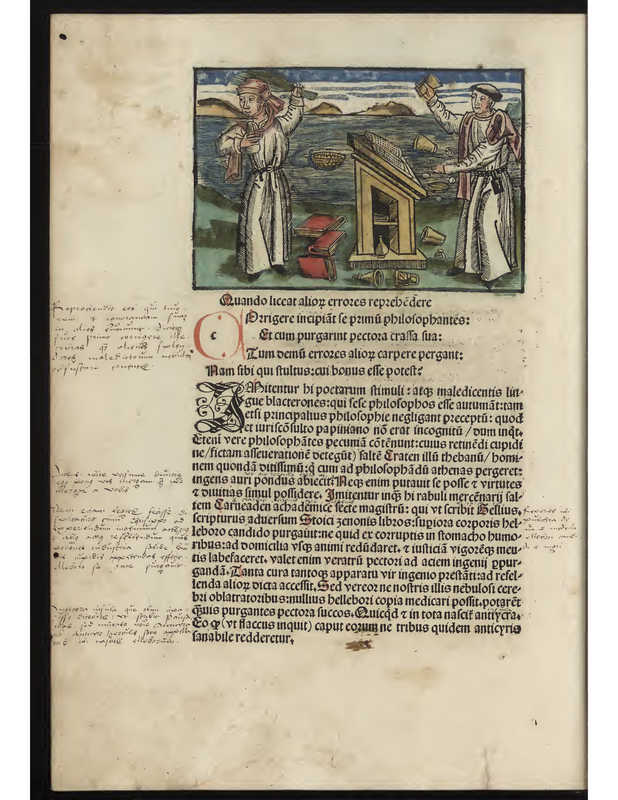
A man and woman wearing white robes stand on the shoreline. The man has a scarf around his neck and is reading from a book on a podium and holding up a cup. The woman is wearing a head scarf and holding up what appears to be a bundle of straw in one hand and a vial in the other. There are baskets and cups scattered on the ground and in the water. There are books beside the podium on the ground.
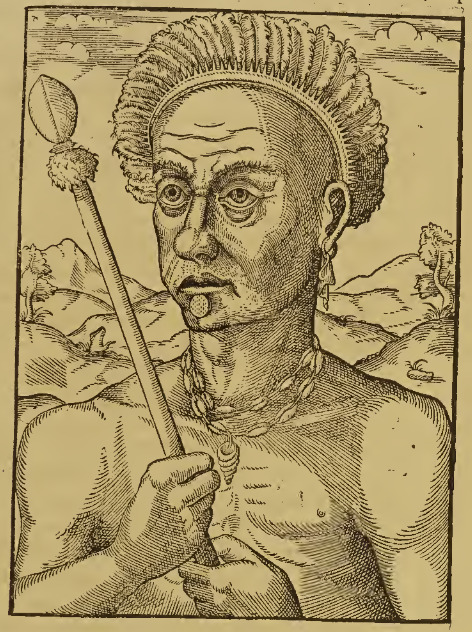
An Indigenous man, a king by the name or title of Quoniambec, is shown from the chest up. He is shirtless, and wears a feathered headdress, earrings, an adornment on his chin, and a necklace made of shells strung together. He holds a decorative club with both hands, and gazes intently into the distance. This image is identical to one on page 924 of Paris, 1575 (Chaudière).
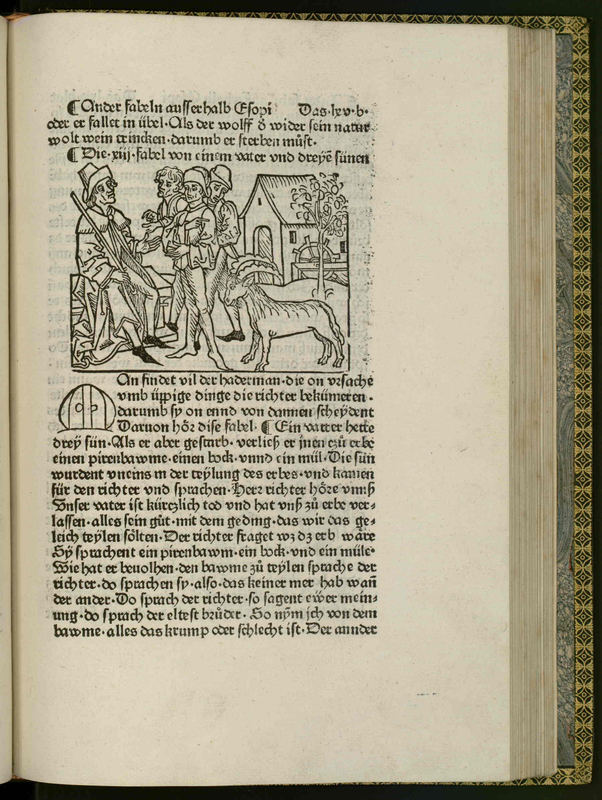
On the left side of the image, there are four men talking. On the right side of the image, there is a goat facing the men and a house behind with a water wheel on its side.
Here scholars on Lilliput debate philosophy. Gulliver says that they do not have the same approach to philosophy as Europeans. He says that Lilliputians do not use Aristotelian categories, but is instead based on infallible principles, and imagining oneself as a member of another class. Thus, here we see two well-dressed men acting as servants to the third. This image comes in the appendix to Gulliver’s travels to Lilliput. The same image appears in the 1843 Krabbe edition.
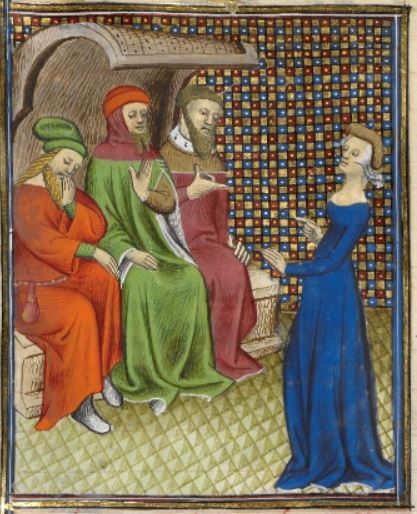
This illustration depicts Hortensia, the daughter of famous orator Quintus Hortensius, speaking in front of the triumvirs. Hortensia inherited the gift of oration from her father, and when the triumvirs raised taxes unbearably high, she spoke so eloquently to them that they revoked the taxes. The triumvirs have pleasantly surprised looks on their faces as they are impressed with Hortensia’s abilities. Hortensia appears to look confident as she speaks to them.
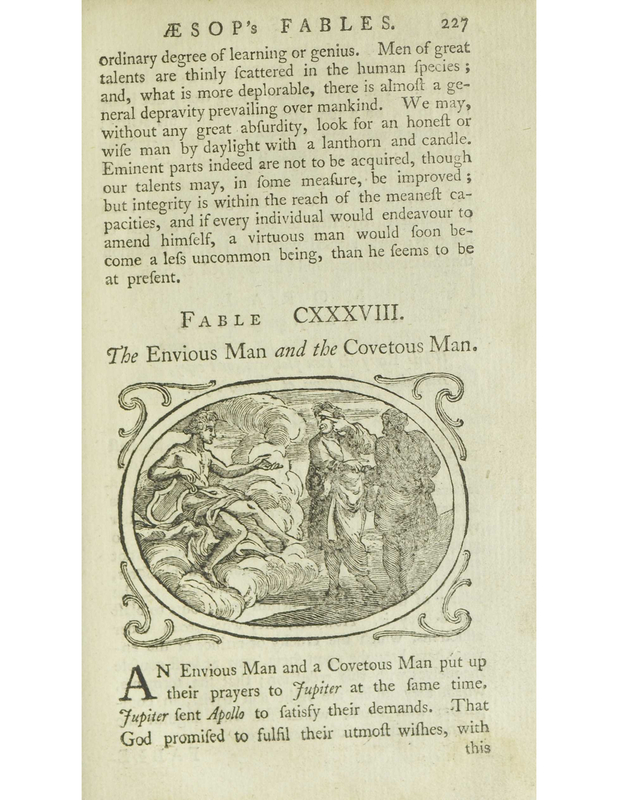
The scene seems to be taken place outside somewhere, Apollo sits on a could or some sort of gathering of smoke with a harp under his arm. The Envious Man and Covetous Man stand side by side next to Apollo talking to Apollo after they put up their prayers to Jupiter. Apollo promises to fulfil their wishes.
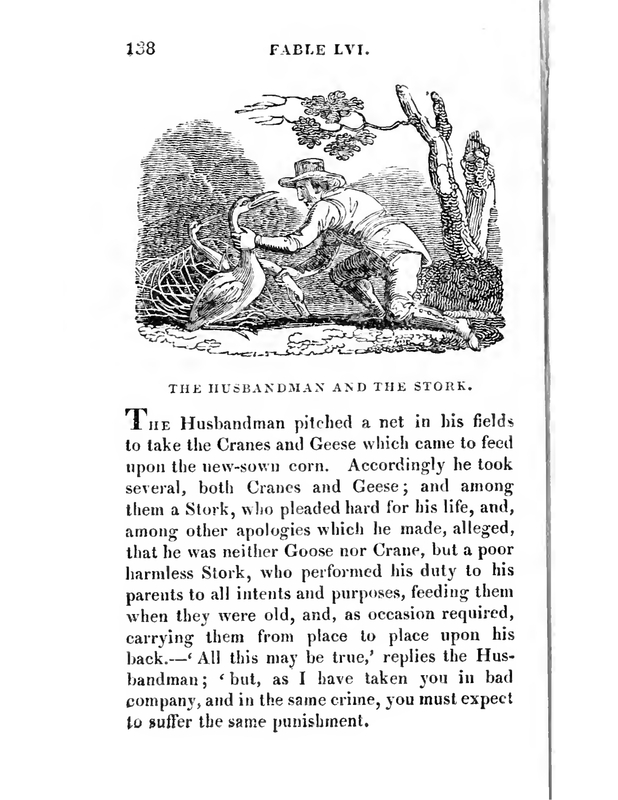
A man leans over three large birds caught in a net. The birds have expressions of distress on their faces. The bird in the foreground is being grabbed by the neck by the man's left hand. One of the birds in the background has got its neck caught in one of the holes in the net. The other bird in the background leans down towards the ground while being grabbed by the man's right hand. The man has a wide brimmed hat, a long-sleeved shirt, and tall boots. On the right-hand side of the image there is a leafy tree.
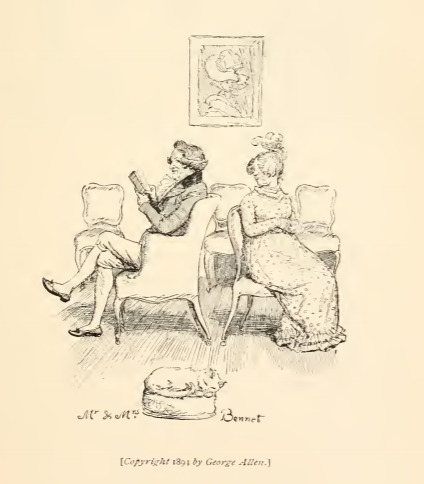
Here we see Mr. and Mrs. Bennet reading. Mrs. Bennet loved to gossip and Mr. Bennet was very reserved. Mrs. Bennet wanted to talk about Mr. Bingley who had just come to Netherfield Park and how she might get Jane married well. This scene occurs in chapter 1. The characters are shown in the traditional regency style. Mr. Bennet wears a waistcoat and tailcoat and a cravat. Mrs. Bennet wears a regency style dress with an empire waist and a feather in her hair. The regency period dated to the early nineteenth century (1811-1820) when George, Prince of Wales, later George IV (r. 1820-1830), reigned as regent for his mentally ill father, King George III (r. 1760-1820). The regency period is associated with the rise of neoclassicism in art and fashion.
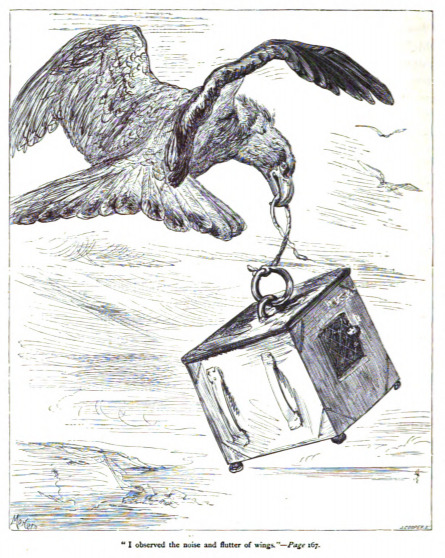
Here we see an eagle carry Gulliver’s house away from Brobdingnag. Gulliver leans out the window to see what was going on. The eagle picked up Gulliver’s house and carried out over the water. The eagle eventually dropped the house and Gulliver was rescued by a nearby ship.
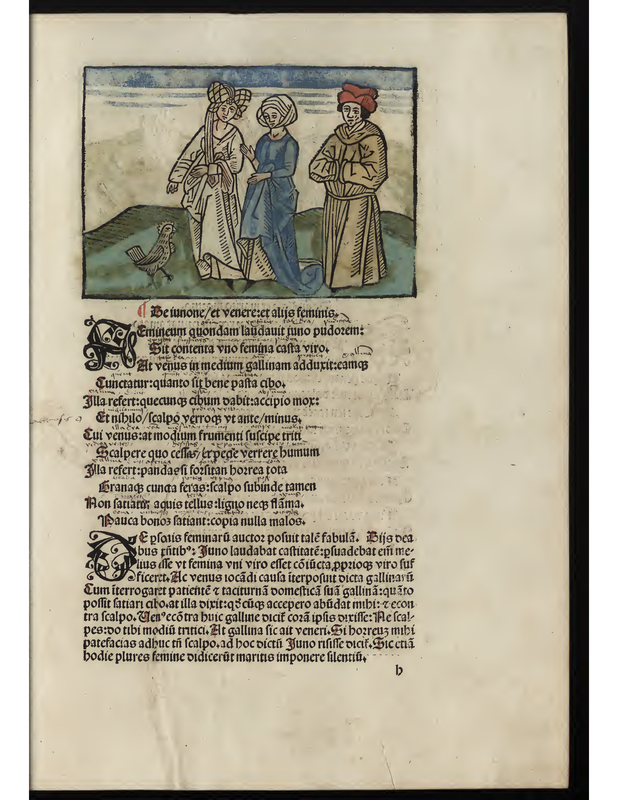
There are three people standing on the grass, along with a small bird. The three women are dressed in plenty of layers and long dresses/robes, they each have a headpiece on. Juno and Venus appear to be speaking to one another, while the other woman seems to be lonely.
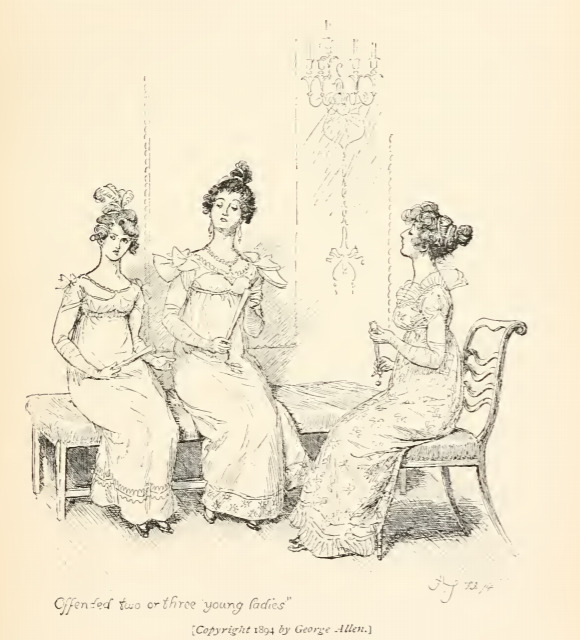
In this image three young ladies sit, offended, at Mr. Bingley’s ball. Elizabeth was relating Mr. Bingley's love for Jane to her aunt, Mrs. Gardiner. Elizabeth tells her that Mr. Bingley had offended several young ladies by spending most of his time dancing with Jane, rather than dancing with several young ladies, as was customary. This scene occurs in chapter 25. The characters are shown in the traditional regency style. These young women wear the regency style dresses with empire waistlines. Their hair is tied up and they hold fans. Fans at this time were used to communicate across the room, with different ways of holding the fan conveying different messages. The regency period dated to the early nineteenth century (1811-1820) when George, Prince of Wales, later George IV (r. 1820-1830), reigned as regent for his mentally ill father, King George III (r. 1760-1820). The regency period is associated with the rise of neoclassicism in art and fashion.
Here we see two men fist fighting in the street, while a crowd watches from behind a short wall. Their hats and coats are on the ground. In the background we see a large castle, and a rooster. In this chapter Gulliver talks with the king of Brobdingnag about English traditions. Gulliver tells the king about diplomacy, religion, the justice system, the arts, the financial system, and the nobility, then debated these issues with the king. This image comes when Gulliver is discussing the judicial system. The same image appears in the 1839 Krabbe edition.

![[Gulliver kisses the Queen of Brobdingnag’s finger]](https://cemvccol.ace-net.training/files/large/cb4e07f4e82be6cbd79cf573c6497119b550e71c.jpg)
![[A Laputan court Lady and her daughter]](https://cemvccol.ace-net.training/files/large/234aaf6f27d88c183a95b04110f8d7a8b5b286d8.jpg)
![[Gulliver and the Governor of Glubbdubdrib speak with Caesar and Brutus]](https://cemvccol.ace-net.training/files/large/40807aef8f5bbfbdc98bab03ef8716bb217ad47b.jpg)

![[a dying Houyhnhnm travels in a sedan chair]](https://cemvccol.ace-net.training/files/large/803401d327955f7b1c5e4e76750a1baeb96d7e8e.jpg)

![[Lilliputian scholars discuss philosophy]](https://cemvccol.ace-net.training/files/large/31af892eb1d5ed8052f685f294465818c4c6118e.jpg)
![[Two men fist fight in the street]](https://cemvccol.ace-net.training/files/large/171285e28a76cfc95e13c81e497159335e690d1a.jpg)