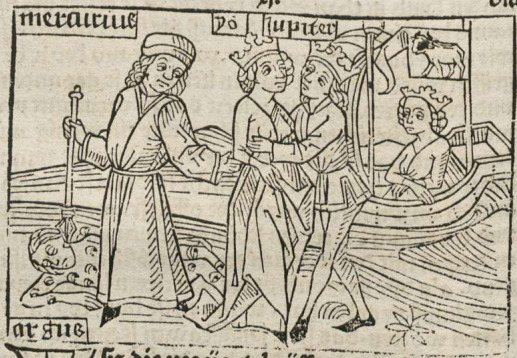
This engraving illustrates the story of Isis and Jupiter. Jupiter is depicted in the center of the engraving with his arms wrapped around Isis as he shows his affection for her. We know that these figures are Jupiter and Isis as the creator engraved their names directly above their heads. Isis’ name reads “Yo”, as she is also known by this title. Boccaccio explains that Jupiter had transformed her into a cow and gave her as a gift to Juno in order to hide his crime of raping her. Mercury had saved Isis as he killed Argus, Isis’ 100 eyed guardian. Mercury is on the left-hand side of the engraving holding a staff in his left hand, standing above the body of Argus after killing him. Mercury’s name is engraved beside his head, and Argus’ name is engraved just below his own arm. Isis is visible in the background of the engraving sitting on a ship, as she had sailed to Egypt after being transformed back into her human form. The sail on the ship has a heifer emblem to signify her transformation into a cow.
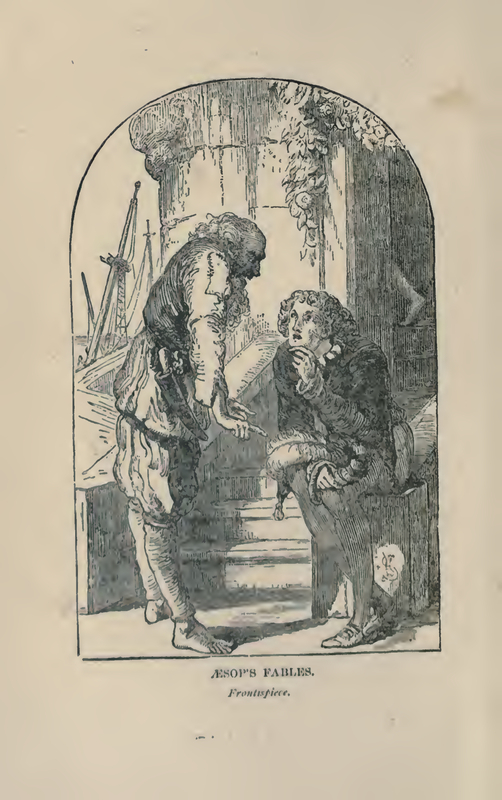
Inside of an arch-shape, a man stands on the left side with his shoulders reaching his ears and both arms stretched straight down the sides of his body. He is barefoot, and wears knee-length trousers with a blouse and a vest. A knife hangs on his right hip. The man has a long beard, and shoulder length hair with the top of his scalp bald. He is looking down at a younger man that is sitting down on the railing of a staircase. He wears tights and a long sleeve blouse. The man seems younger, and hair covers all of his head. The younger man wears shoes, and is looking at the older man questionably, resting his left hand under his chin. Behind them, someone is seen walking off in the inside of the house. To the far left, a boat is seen sailing off at sea.
Captain MacMurdo lies in bed in his room, surrounded by boxing, sporting, and dancing pictures. Rawdon Crawley sits backwards in a wooden chair next to his bed, looking gloomy. He has come to ask Captain MacMurdo to act as his second for a duel with Lord Steyne.
The left panel depicts Celestina’s prostitute Areusa wearing a veil and a long robe. To the right, we see Celestina’s other prostitute Elicia, who is also sporting a veil and a robe. In her right hand, she is holding a flower. Both figures are placed outside.The entire image is identical to the one found on page 287. The left panel is identical to those found on pages 173 and 317, and is nearly identical to those found on pages 12, 208 and 271 (where it is labeled ‘Melibea’), page 84 (labeled ‘Lucrecia’), and page 350 (labeled ‘Alisa’). The right panel is nearly identical to those found on pages 84 (where it is labeled ‘Celestine’), 235 (labeled ‘Lucrece’), and 299 (labeled ‘Alisa’).
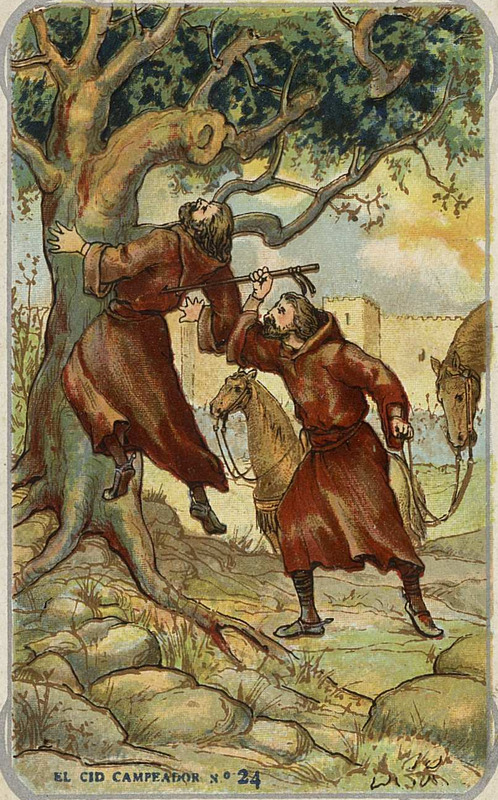
In this image Don Sancho is murdered by Bellido Dolfos. Bellido Dolfos is wearing brown robes. He has a brown beard and hair. In one of his hands he is holding the knife that is plunged in Don Sancho’s back, his other hand is holding the reins of his horse. Don Sancho is pinned against a tree wearing brown robes and a knife plunged in his back. He has brown hair and a brown beard. There are two horses behind them. In the background there is a city wall. The tree that Don Sancho is pinned on has many branches and leaves. At the foot of the tree there are rocks.
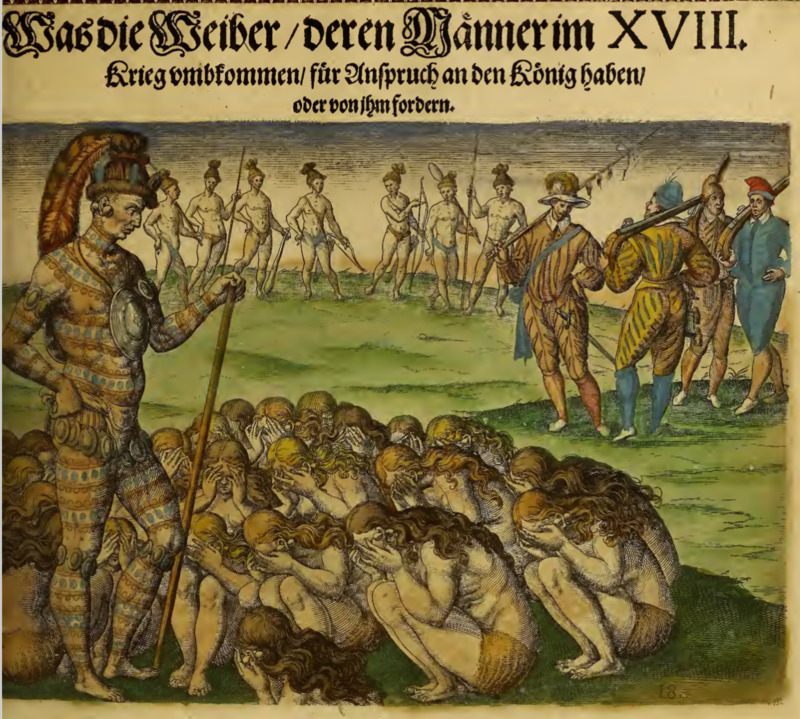
A group of Indigenous women crouch close to the ground with their hands covering their faces, in front of the chief. The chief wears a headdress with a large feather and animal tail hanging from the back, a round plate against his chest, a loincloth with small ovals hanging from it, and jewelry featuring the same small ovals around his upper arms and below his knees. His body is covered in designs, and he gazes down at the woman. In the background, a group of settlers stand together holding rifles. To the left of the group, a group of Indigenous men stand holding bows and arrows and clubs. This illustration is identical to the one found on page 71 of Frankfurt 1591, but colored.
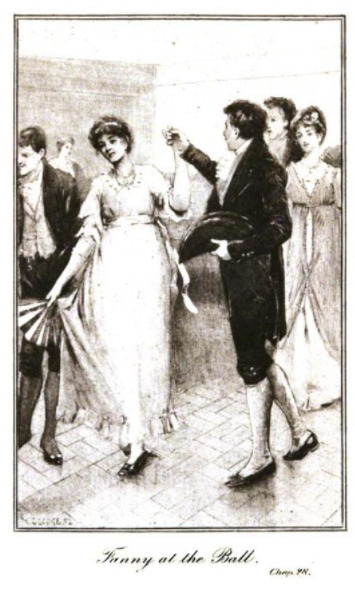
Here we see Fanny dancing with Mr. Crawford at the ball held by her uncle, Sir Thomas. Sir Thomas held this ball while Fanny’s brother was visiting them at Mansfield while on leave from the navy. Mr. Crawford had decided that he wanted to pursue Fanny and get her to like him and ended up falling in love with her. This scene occurs in chapter 28 as noted underneath the title of this image. The characters are shown in the traditional regency style, with Fanny wearing the regency style dress with an empire waist. Her hair is worn tied up, and she holds a fan in her hand. A fan in this era was often used to signal to communicate with others at the party. Using the fan, a woman could signal if she was married, single, or engaged, that she was being watched by a chaperone, that she loved another man, among other things. Mr. Crawford wears a waistcoat and tailcoat with knickers that stop at the knee. He hold a bicorn hat under his arm. The regency period dated to the early nineteenth century (1811-1820) when George, Prince of Wales, later George IV (r. 1820-1830), reigned as regent for his mentally ill father, King George III (r. 1760-1820). The regency period is associated with the rise of neoclassicism in art and fashion. The same image appears as the frontispiece for the Dent 1893, 1894, 1895, 1896, and 1897 editions of Mansfield Park.
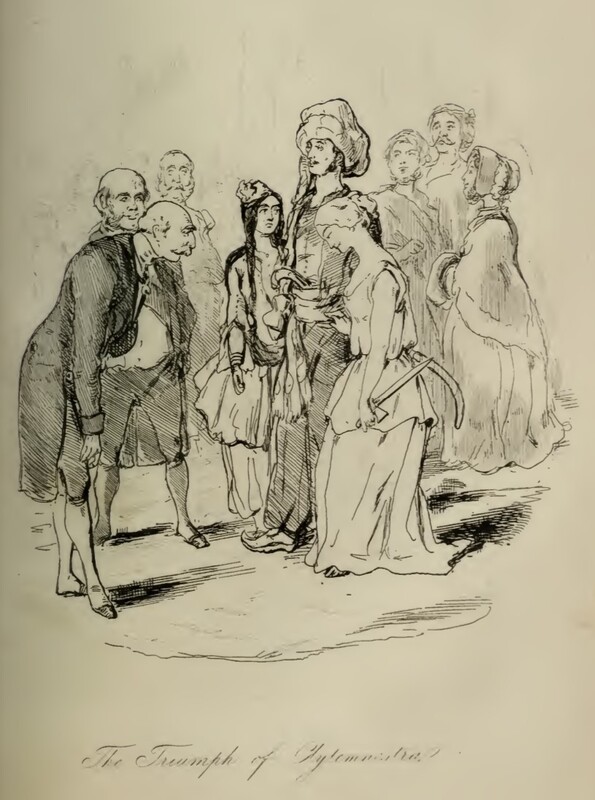
Rebecca Crawley, dressed in a toga and holding a dagger in the character of Clytemnestra, curtseys slightly to his Royal Highness, the prince of Peterwaradin, as he bows and compliments her performance. Next to her is Mr. Bedwin Sands, dressed as a Turkish officer, and behind him Mrs. Winkworth, whose performance as Zuleikah had been the focus of admiration prior to Becky’s appearance. Between Mrs. Winkworth and the prince of Peterwaradin is Lord Steyne, smiling jovially. In the background are several other admiring partygoers. Below the illustration is printed in cursive its title, “The Triumph of Clytemnestra”.
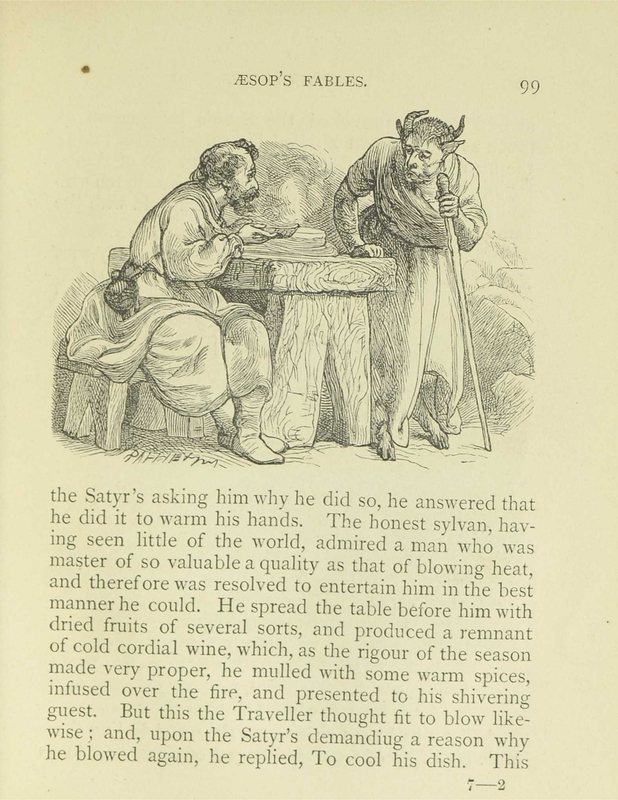
Two people sit at a small wooden table, one a man and one a satyr. The satyr leans on the table and on his walking stick, looking at the man. The man, holding a steaming bowl of food, looks back.
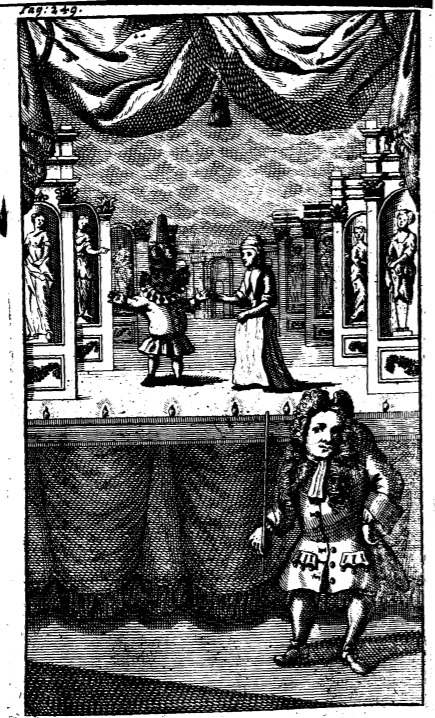
This image is a depiction of a court scene from Gulliver’s Travels, likely in the land of Glubbdubdrib. The image is of a stage, with curtains along the top of the image, and lights lining the bottom of the stage, denoting the difference from the stage and the man, likely Gulliver, who observes the king and a courtier on the stage. A wall separates Gulliver from the other characters. Statues in the Classical or Neoclassical style line the walls of the hall, with stairs at the back leading to a throne. The image in this edition is the same as that in the 1728 German von Wiering edition.
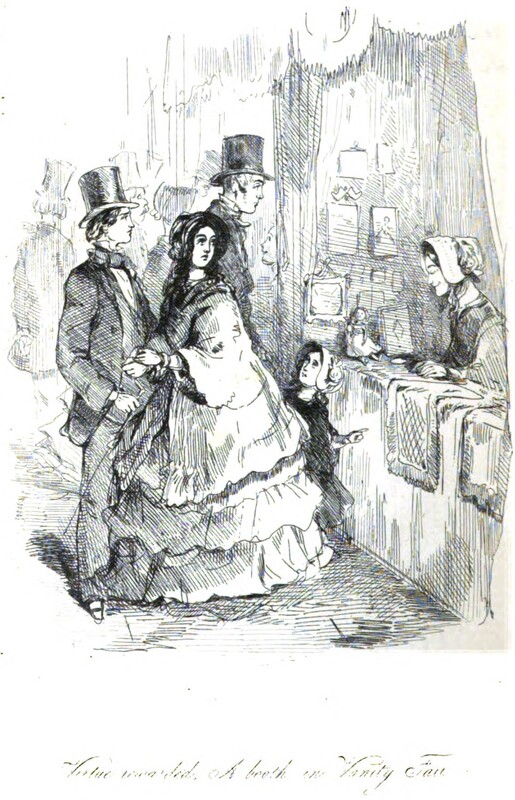
Rebecca Crawley sits behind the counter of a stall at the fair in London, selling items for charity. In front of the booth, Amelia Dobbin, holding onto the arm of her son George, is turning away upon seeing her. Behind them, William Dobbin is reaching out to pick up Janey, their daughter, who is looking up at him in puzzlement. Below the illustration is printed in cursive its title, “Virtue rewarded; A booth in Vanity Fair”.
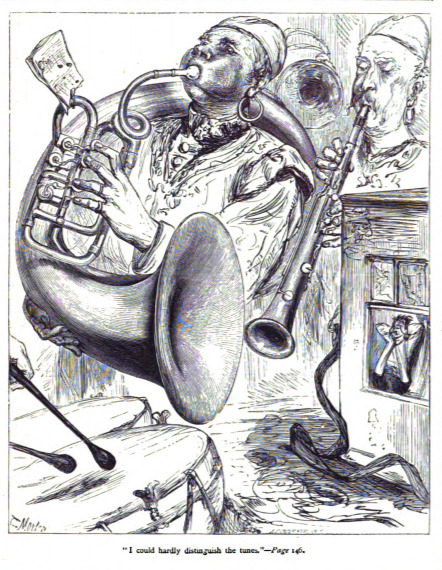
During his time on Brobdingnag, Gulliver attended concerts in the royal court. Gulliver complained that the music was too loud, so much so that it just became noise. Gulliver would listen from his house, however he often covered his ears to cut down on the noise, seen here. In this image musicians are playing, one playing a sousaphone, another playing a clarinet, and a third on drums.
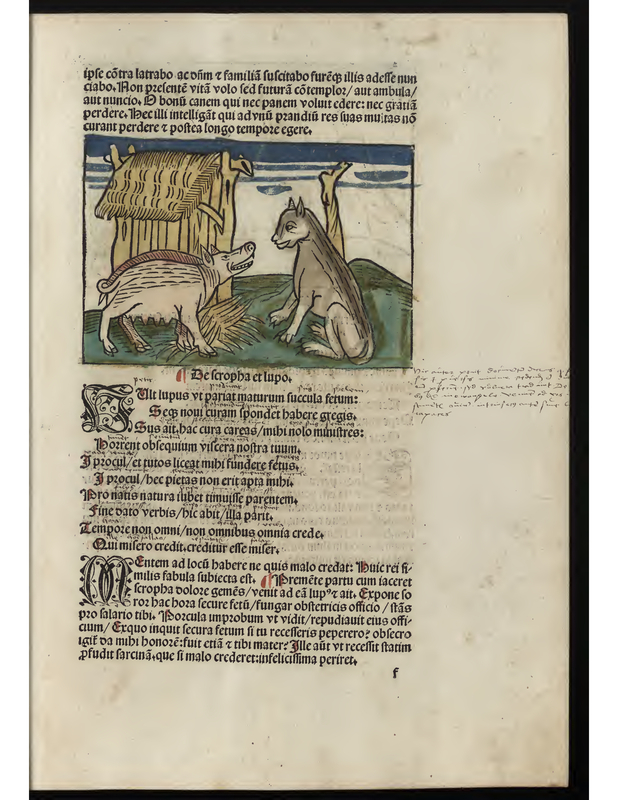
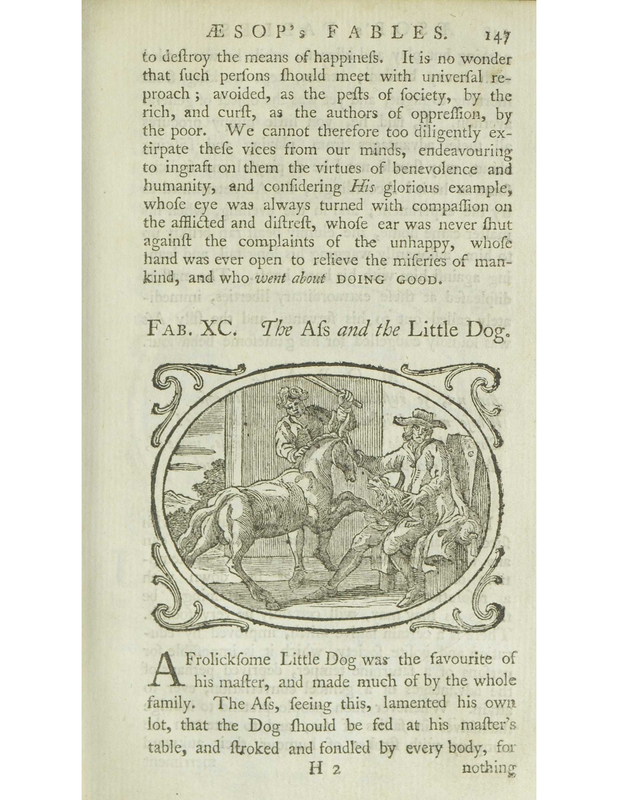
A donkey has its two forelegs on the lap of its owner where a little dog can also be found. The two men (owner included) are not pleased, and while the owner holds the donkey's head, the other has his arm raised with a long stick, about to bring it down on the donkey.
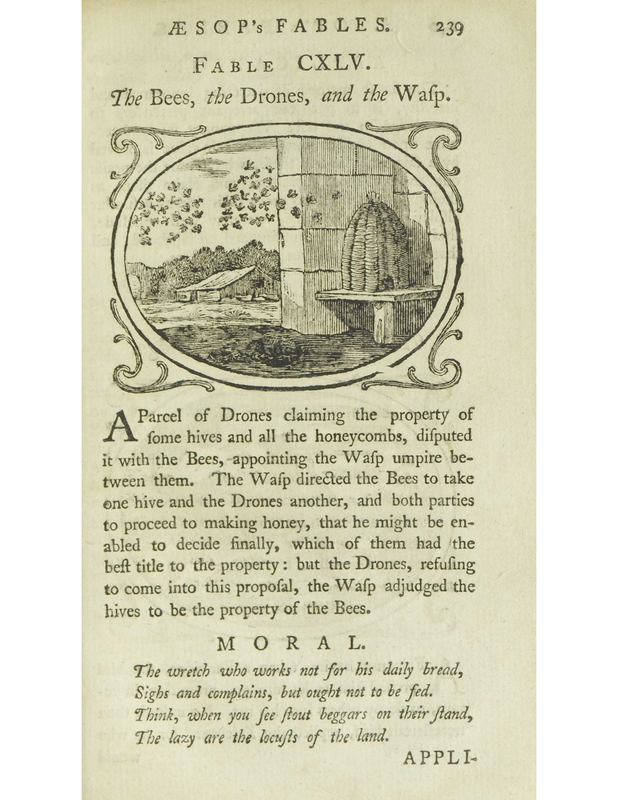
The scene is taken place outside, there are buildings in the background and tall trees and plants. And another tall building near the front along with a large hive with a swarm of bees, drones and wasps. The drones are trying to claim some hives and all the honeycombs, disputed it with the bees, appointing the wasp umpire between them.
A coach drawn by two horses, driven by a coachman in a three-cornered hat. Beside him sits Sambo, the footman. On the right side of the image is the gate to Miss Pinkerton’s academy for young ladies, at which the coach has just arrived. In the background there are two trees and a building. In the top right of the image is the letter W, from “While”.
Six people are around a dining room table. All of them are standing except for one. The table has lots of dishes on it. A woman wearing a long robe is standing by the door. She holds onto and watches a horse who is outside, on the other side of the door.
This image is depicted in the author’s chapter where he discusses cities, towns, villages, and provinces in colonial South America. This image depicts the city of Santiago in modern day Chile. The city is arranged in a cluster of buildings which forms a square in the centre. The city is enclosed by fortification walls. There is a queue of people in the town square with three people holding large crucifixes, three people holding large guns, and one person at the left end of the queue holding a flag. There are two paths outside the city walls that lead in and out of the city. The author explains that the city of Santiago was rich in their supplies of fruit, meat, and bread. The caption at the bottom of the image reads “ciudad” [city].
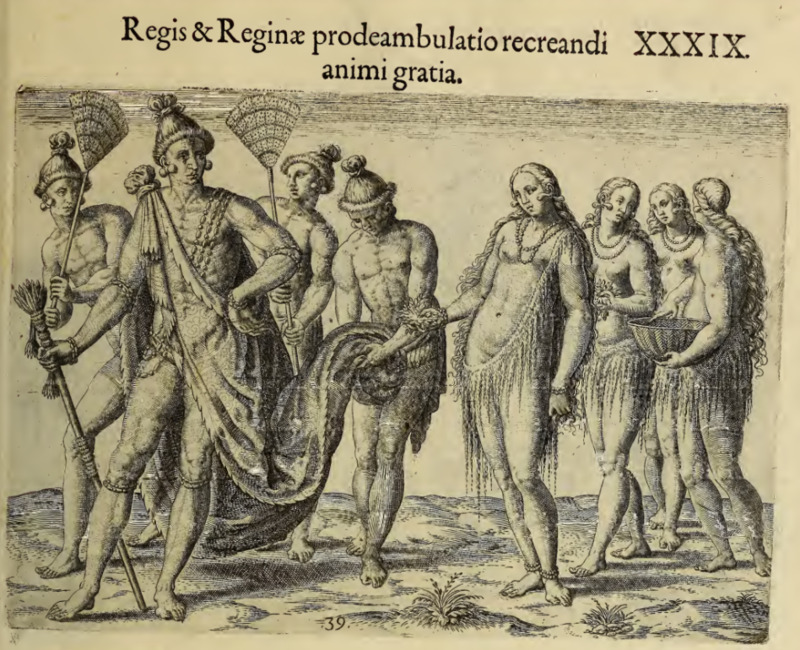
The king wears a robe tied at one shoulder and draping around his body and under his opposite arm. He wears several strands of beads draped from his other shoulder across his body, as well as around his arms and legs. In one hand he holds a staff with feathers at the top end. A man stands behind him and holds the end of the robe. Two other men stand beside the king waving long fans around him. A woman – perhaps the queen – stands slightly behind the king, and wears a garment draped from one shoulder around her body. Several women stand behind the group - one holds a basket and the others hold handfuls of leaves or herbs.
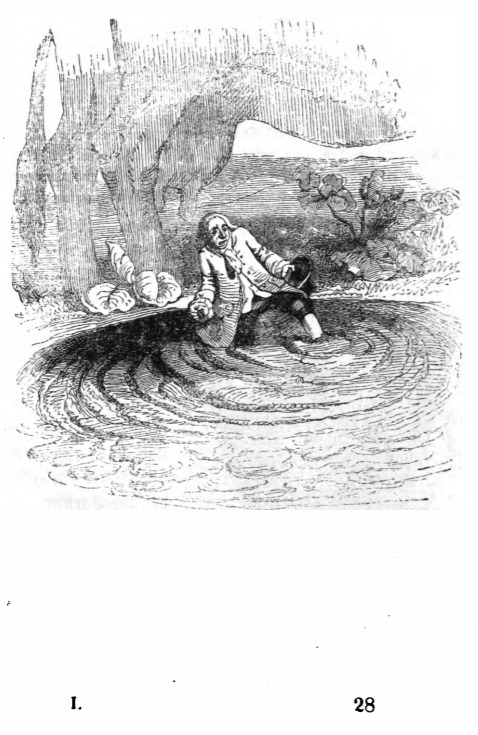
Here Gulliver walks through cow-dung. While walking outside, Gulliver came across cow excrement and tried to jump over it. He missed and landed in the middle. He then waded through it and was picked up by a footman who wiped him off and carried him until they returned home. The same image appears in the 1839 Krabbe edition.
A man in hat and robe walks down a city street lined with buildings. He is carrying a stick with a gourd hanging from it in one hand, and a small rod in the other. On the building next to him is the letter I from “It”.
A group of Tupinambá people – four women and a man – gather around a deceased man who lays in a hammock. Two women crouch beside the hammock with their hands over their faces in distress. Behind the hammock, two more women hold each other by the shoulders as they mourn, and a man stands behind them holding a rattle or ornament with one hand and wiping his face with the other. Both the deceased and living man have a facial adornment on their chin.

![[Captain MacMurdo and Rawdon Crawley]](https://cemvccol.ace-net.training/files/large/27758f72bdff9f288d7f5476d1472b9c66aedc67.jpg)
![[Act XVII – Areusa and Elicia (Repeated)]](https://cemvccol.ace-net.training/files/large/d22709ca4d0bd3555c36156fc14b389f539438e0.jpg)
![[Vanity Fair Chapter I Historiated Initial]](https://cemvccol.ace-net.training/files/large/239a45d8c3ba7ca75eaa6df652f12b264bd5e2f7.jpg)
![[Dining room and horse]](https://cemvccol.ace-net.training/files/large/708371354c7f7997a56bdaf5f7a163280b6836c8.jpg)
![La Civdad de S[an]tiago de Chile, Obispado. No Tiene Juridicion](https://cemvccol.ace-net.training/files/large/2a1e0ab7f09920e73f28985b7c947d7e7640ee36.jpg)
![[Vanity Fair Volume II. Chapter XXII Inhabited Initial, I]](https://cemvccol.ace-net.training/files/large/62fe1f9cdf50cccfaf8c3fcbc8a31d9fadb7a40b.jpg)
![[Tupinambá men and women mourn a deceased man]](https://cemvccol.ace-net.training/files/large/59ef2e38ac4459d84fdb8f70b09e6ce16769d0c7.jpg)