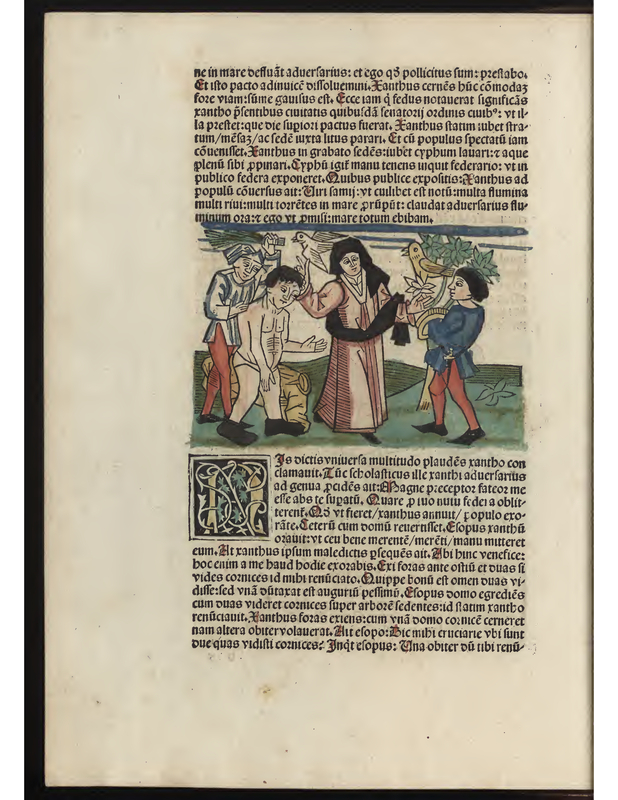
A sleeping giant lies on the ground, large enough that only his head and the upper half of his torso are visible in the picture. A man in glasses stands on the giant’s chest, observing his face. Another man, carrying a mallet, leans against the side of the giant’s face. Above their heads is the letter A, from “After”.
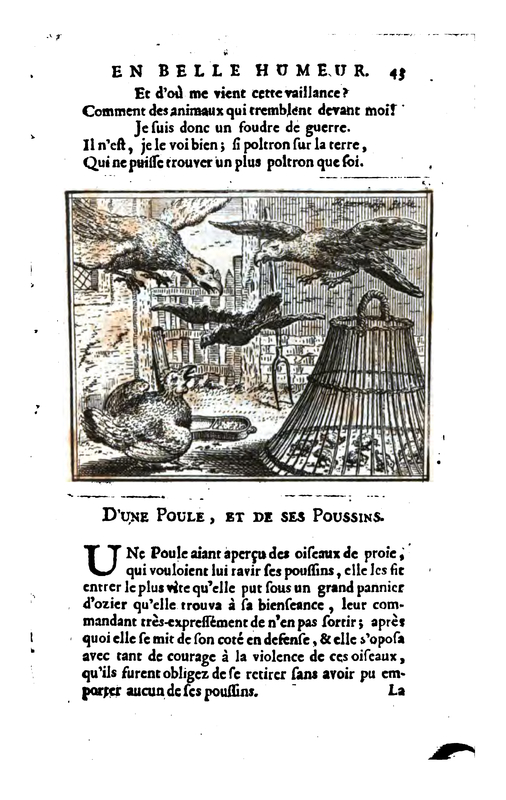
A Hen after seeing some birds of prey, which wanted to steal her chicks, she made her chicks enter as quickly as they could under a large oak basket which she found at her convenience, urging them not to break into it; after which she put herself on her side in defense, and she opposed with so much courage the violence of these birds, that they were obliged to withdraw without having been able to carry away any of her chicks.
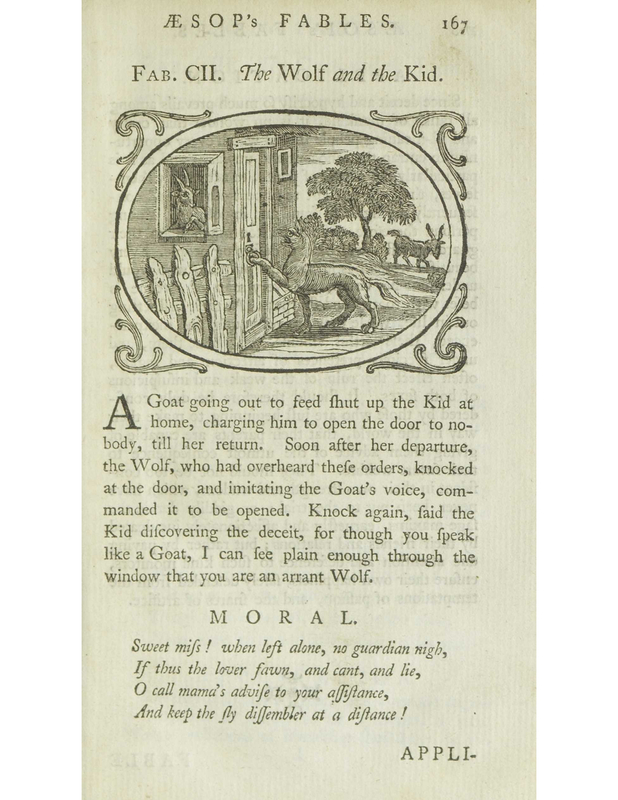
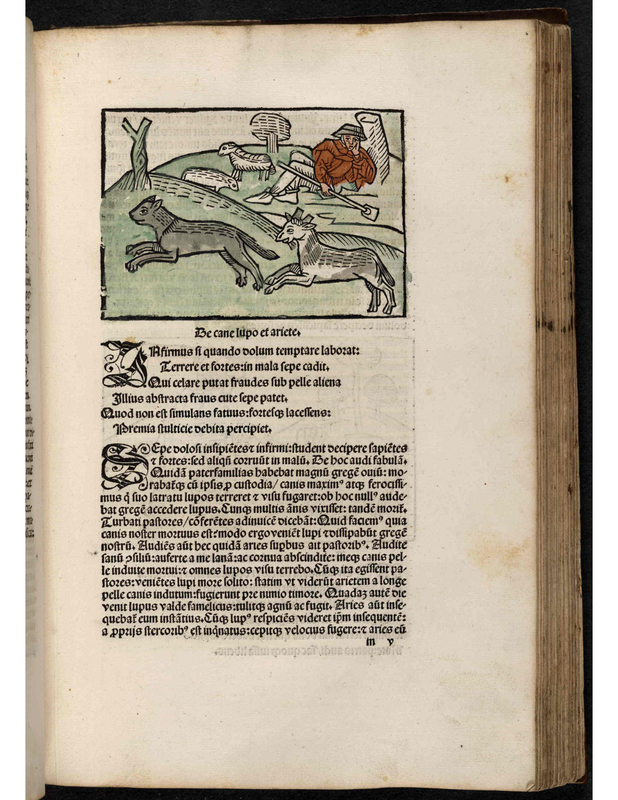
A wolf faces the left, and knocks on the door of a house on the left side of the image. There is a fence next to the house, and a window. A baby goat sits in the window and is watching the wolf. On the horizon are some bushes, a tree, and the silhouette of a goat walking away on toward right side of the image.
In this image El Cid is riding his horse at full speed in a field. El Cid is wearing armour and a cloak that is billowing in the wind. He is wearing a helmet and carrying a shield and a sword. His horse is white with black spots on him. In the background there is a little hill with trees on top. There are also more trees that can be seen on the left of the background. The sun is shown as very large so it eithers means it is dawn or dusk. In the front of the image on the right there long pieces of grass sticking out of the earth.
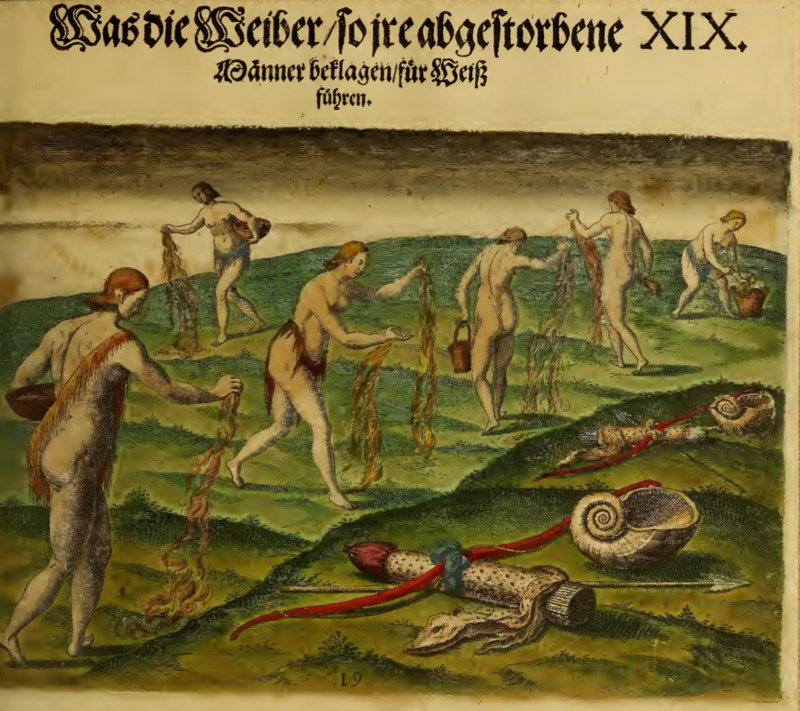
Several Indigenous women are shown scattering a substance, possibly leaves or a grass, onto the ground. The women are mostly nude, although some wear a light skirt of grass tied around their waist. This illustration is identical to the one found on page 73 of Frankfurt 1591, but colored.
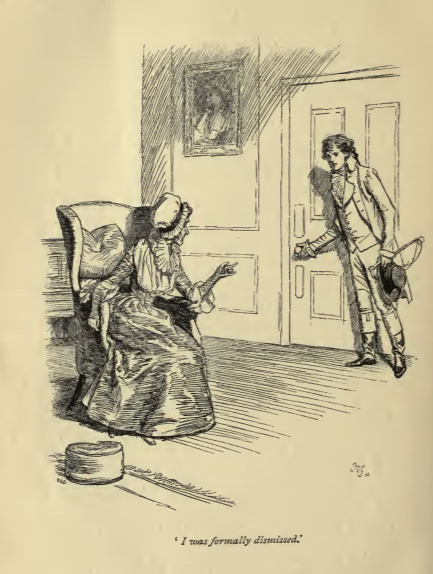
In this image Willoughby’s aunt, Mrs. Smith, disowns him because he got a young woman, Eliza, pregnant and refused to marry her. Upon hearing this, Mrs. Smith was shocked and took away his inheritance. Willoughby told Elinor that when he was at Barton he had no intention of marrying, but that he enjoyed spending time with Marianne. After being disowned, Willoughby needed to marry well in order to be able to support his lifestyle, and married Miss Morton. This scene occurs in chapter 44. The characters are shown in the traditional regency style. Mrs. Smith wears a regency style dress with an empire waistline, and a mop cap. Willoughby wears a waistcoat and tailcoat with a cravat and holds his top hat and whip in his hand. The regency period dated to the early nineteenth century (1811-1820) when George, Prince of Wales, later George IV (r. 1820-1830), reigned as regent for his mentally ill father, King George III (r. 1760-1820). The regency period is associated with the rise of neoclassicism in art and fashion.
Man in orange/ brown pantaloons has a lion tied in ropes on its back with the ropes attached to pegs in the ground. The man is using one stick to pin the lion down, while another is raised in a position that suggests he will beat the lion. There are three trees in the background.
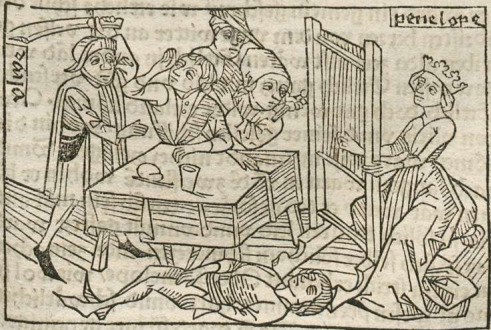
This image depicts Penelope, the wife of Ulysses, weaving on the right-hand side of the engraving as she waits for her husband to return from the Trojan War. We know that this is Penelope as her name is engraved above her head. Penelope had many suitors over the 20 years that she waited for Ulysses to return home; however, Boccaccio explains in his story that Penelope remained entirely faithful over the duration of his absence. Penelope told the suitors that she would continue to wait for her husband to return until she was done weaving a cloth, which is why she is depicted weaving in this engraving. Each night, she would undo all the weaving she had done that day so she could continue waiting for Ulysses. When Ulysses finally returned home, he had slain every suitor in his palace. Ulysses is depicted on the left side of the engraving, disguised in peasant clothing with a sword in his hand as he kills the suitors. His name is engraved behind his head in order to identify him.
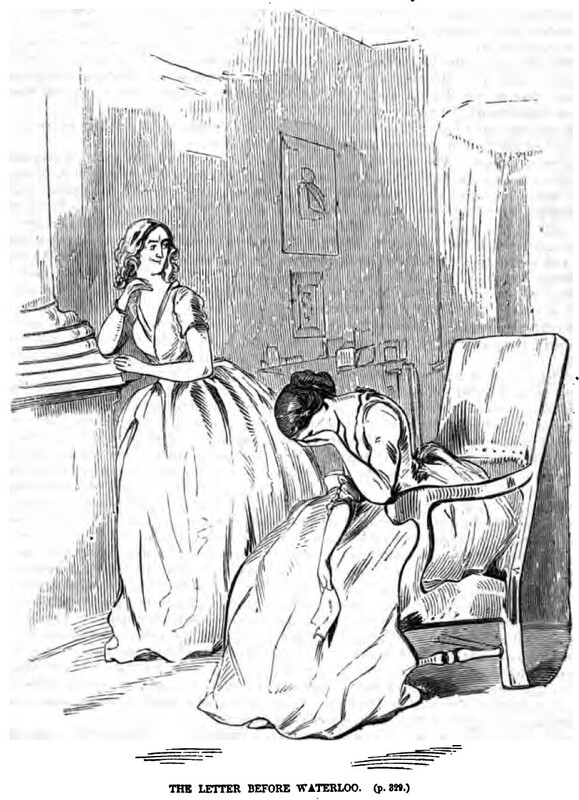
On the left, Rebecca Sharp is standing against a column and looking to the right towards Amelia Sedley, who sits crying in a chair with one hand over her face. In her other hand she holds the letter which her husband gave to Becky in Chapter XXIX, asking her to run away with him. In the background can be seen two pictures on the wall, a dresser with various objects placed upon it, and part of the canopy of a bed. Below the illustration is printed its title and location in the story, “THE LETTER BEFORE WATERLOO. (p. 329.)”.
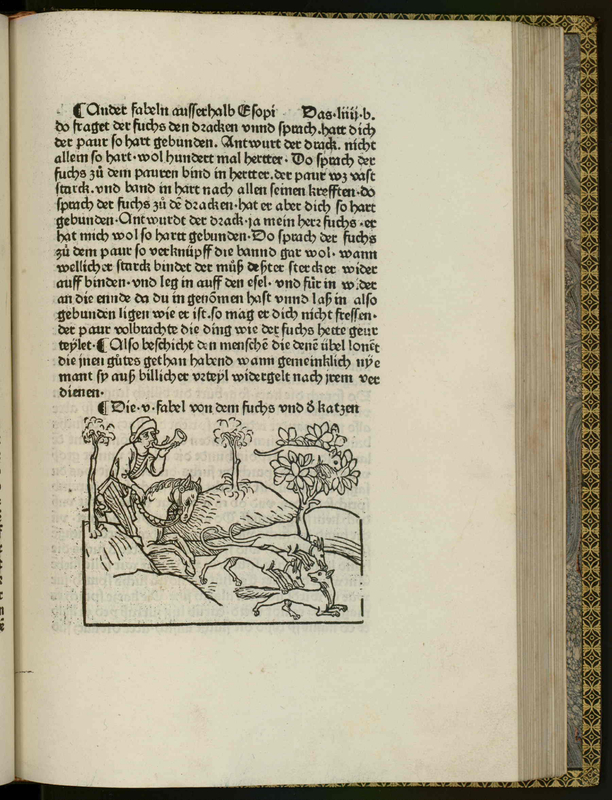
On the left side of the image, there is a man riding a horse blowing into a horn. On the right side of the image, there is two dogs attacking a fox on the ground. Up in a tree there is another dog looking down at the other animals.
Here we see a portrait of Niccolò Machiavelli, the early sixteenth century Italian humanist who became famous for his book The Prince, in which Machiavelli describes the characteristics that make a successful Renaissance Prince. These characteristics often tended to be rather violent. The image is recalling Machiavelli’s ruthlessness while Gulliver describes gunpowder to the King of Brobdingnag. Machiavelli holds a book with “Machiavel” written on it the French version of ‘Machiavelli’. The term “Machiavel” in English is used to reference someone who shares the same values as Machiavelli, often meaning to value efficiency and personal advantage over morality. The King of Brobdingnag sees Gulliver and his description of European war and politics as Machiavellian. The same image appears in the 1843 Krabbe edition.
This image contains two scenes taken after Gulliver was granted his freedom. On the left side we see Gulliver standing as a triumphal arch for a military procession. After Gulliver agreed to the terms of his freedom, the Emperor of Lilliput requested that Gulliver stand with his legs apart acting as an arch for a military procession. The procession included three-thousand men on foot and one thousand cavalry members. On the right-side Gulliver lies on the ground looking in the window of the imperial palace. He was impressed by the splendor of the palace and saw the Queen and her sons inside the palace.
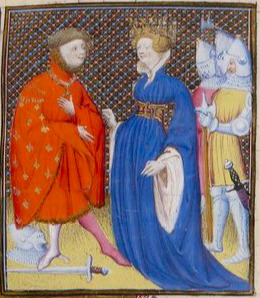
Semiramis, on the right of the photo, wears a blue gown and talks to her son. Her son, Ninyas, on the left side of the photo, wears a red cloak. Her son was born to her and her late husband, Ninus. Ninyas would later kill his mother, meaning this photo depicts a time before the murder. Semiramis’ stomach appears to be swollen, as if she was pregnant, which suggests the promiscuity she was suspected to embody. Her pregnant stomach was said to expose her feminine identity when she was disguised as her son.
A lion is aggressively biting a monkey outside while the monkey looks up to a man. The man is holding a vase in his left hand and starring at it while the animals fight.
This illuminated image depicts a woman named Penelope, who was the wife of the hero Ulysses. Penelope is renowned for having remained chaste while her husband was away fighting in the Trojan War. Ulysses was gone for ten years during the war, and another ten years trying to get back home. Penelope had many suitors over the twenty years of Ulysses’ absence, however she remained faithful to her husband.
During his time on the Country of the Houyhnhnms, Gulliver began to hate all humans, because he viewed the Houyhnhnms to be superior beings, while the yahoos were inferior. It got to the point where Gulliver began to hate his own reflection because he looked like the yahoos. This sentiment stuck with Gulliver even after he returned home to England, and he could never look at a human the same way. The same image appears in the 1839 Krabbe edition.
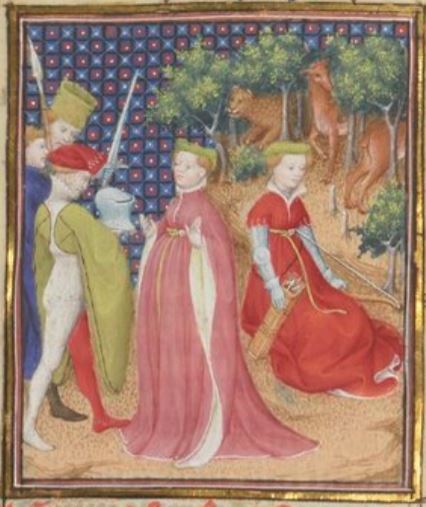
This illumination depicts Zenobia, the queen of Palmyra, with a bow and arrow on the right side of the image about to shoot an animal. There are deer depicted in the trees in the background of the illustration. Boccaccio explains that Zenobia was famous for her bravery, as she had cast aside womanly duties and practices and was incredibly strong and independent. She often spent her time in the woods where she would hunt animals. Zenobia had such strength that when her husband went to war, she hid under her armor and fought alongside him. Zenobia is also depicted in the centre of the image wearing a pink dress while being handed a helmet so that she can go to war.

![[Vanity Fair Chapter LI Inhabited Initial]](https://cemvccol.ace-net.training/files/large/e98945cb0f74a2fa26a9b5ead5f45b313a6162c8.jpg)
![[The Cid riding his horse]](https://cemvccol.ace-net.training/files/large/9a3cc766d24ce3ec920c510665289357fef31e0a.jpg)
![[bust of Machiavelli]](https://cemvccol.ace-net.training/files/large/6705b3bee2c9b532e308693a2230749b4caa7115.jpg)
![[Gulliver stands as a triumphal arch for a military procession and looks into the imperial palace in the city of Mildendo]](https://cemvccol.ace-net.training/files/large/5251ae25e06324ae7225ae958a2a5d37f0808221.jpg)

![[The Lion and Monkey]](https://cemvccol.ace-net.training/files/large/f91123bfba0ea07dbca489c753255578c85c74fd.jpg)
![[Gulliver shudders at his own reflection]](https://cemvccol.ace-net.training/files/large/4f076f9180deb004bbe2a1475fde4e304dff257f.jpg)