A group of Indigenous Canadians (identified as such by the author) hunt wild boar and deer with spears. They wear tunics, hats, leggings or tall socks with fur, and snowshoes on their feet. One individual in the background drags the body of an animal towards their village.
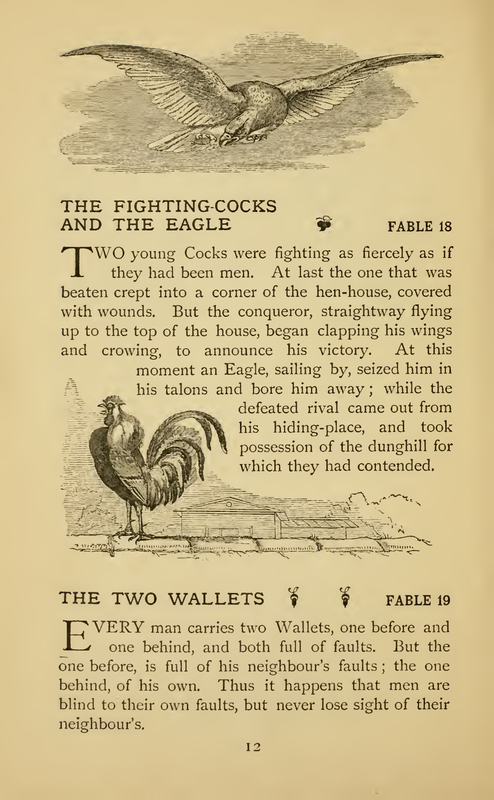
A man is holding a bird on top of a sheep. An eagle is flying away as it grasps a sheep in its claws, taking it with him. The man, bird, and sheep watch in fear as the eagle takes off
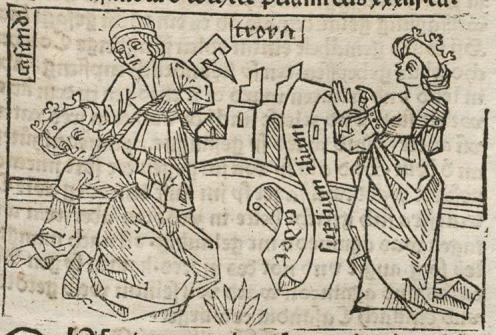
This engraving depicts Cassandra, the daughter of king Priam of Troy on the left side of the engraving being killed under the order of Clytemnestra, who is on the right side of the engraving watching the murder. Boccaccio explains that Cassandra was brought to Mycenae after the Trojan War as king Agamemnon’s concubine. Agamemnon’s wife, Clytemnestra did not like this, and ordered Cassandra to be killed. Cassandra is depicted with a rope around her neck and a man pulling on the rope. Clytemnestra is depicted with a pleased look on her face as she watches Cassandra die. Cassandra’s name is engraved in the top left corner of the engraving to identify her. The fallen city of Troy is depicted in the background of the engraving.
Here we see a tree that grows on the Country of the Houyhnhnms. These plants were used as stakes in fences and as other building materials. The same image appears in the 1843 Krabbe edition.
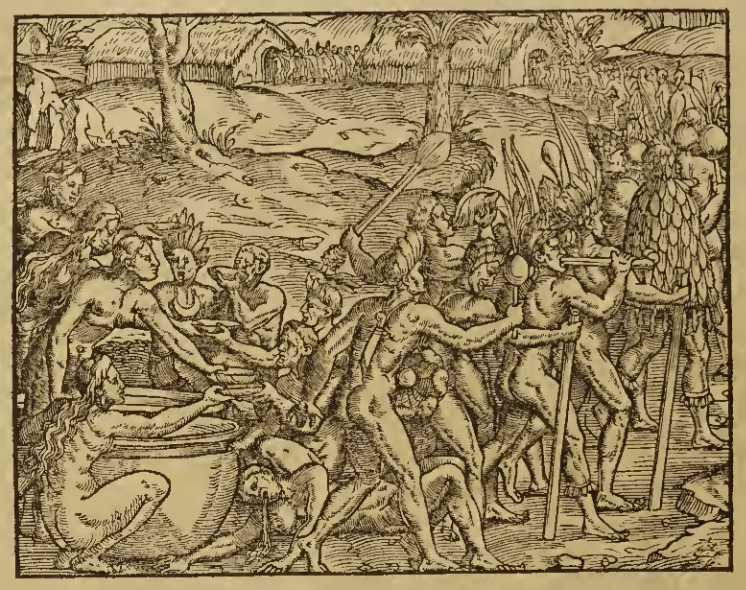
A large group of Indigenous Brazilian people take part in a long procession, possibly preceding or following a burial as part of a mourning practice. They first stop at a vat on the ground where they take a bowlful of the beverage inside. The group then proceeds towards their village and through several of the structures. Many members of the group wear feathered headdress, ornaments around their neck or waists, necklaces, and/or feathered capes. Many also carry bows, clubs, rattles, conch shells or other wind instruments, or pipes. This image is identical to one found on page 927 verso of Paris, 1575 (Chaudière), and in Thevet’s Les Singularitez de la France Antarctique (page 83 of Paris, 1557 and page 83 of Paris, 1558).
This image depicts an indigenous Christian couple kneeling and praying before an image of a crucified Christ that is hanging on the wall in front of them. Their hands are together in prayer while also holding a rosary. They are both dressed in traditional clothing and have cloaks draped over their shoulders. The man took his hat off to pray and rested his hat on the ground in front of him. This image is in a section of the book where the author aims to highlight the Christianity of the indigenous commoners in Spanish colonial Peru. The caption at the bottom of the image reads, “cristiano” [Christian].
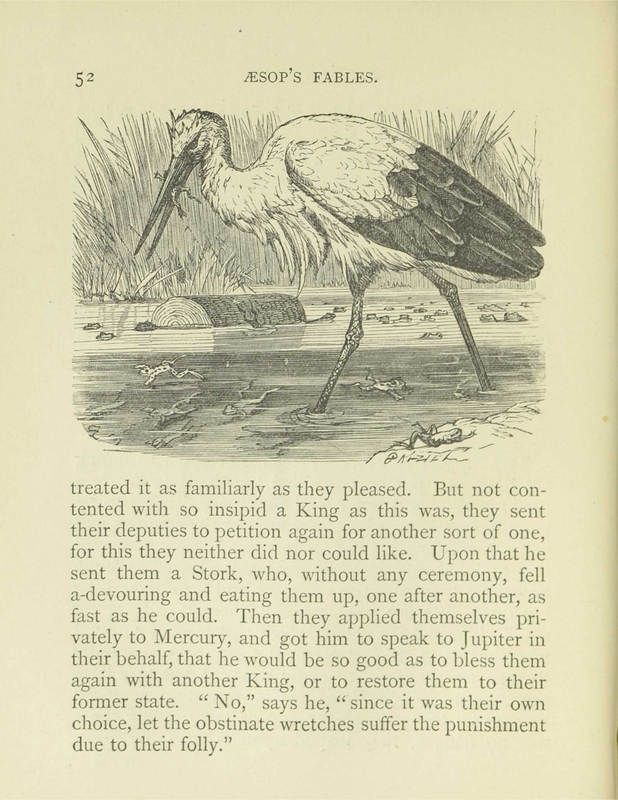
A large heron stands in motion in the middle of a small river with reeds growing on the side of it. In the river there are many frogs, many in the background, some jumping out of the water and one on the bank closest in the foreground that lies on its back possible dead. There is also a large log in the river floating to the left of the heron. In the heron’s mouth it holds frog with its limbs sticking out.
Gulliver leaves Balnibarbi and arrives at the port of Maldonada on Balnibarbi hoping to take a ship to Luggnagg, then to Japan. He hired a guide and two mules to show him from Lagado to Maldonada and carry his baggage, seen in this image where Gulliver pays a man for his services and the use of his mules. The same image appears in the 1843 Krabbe edition.
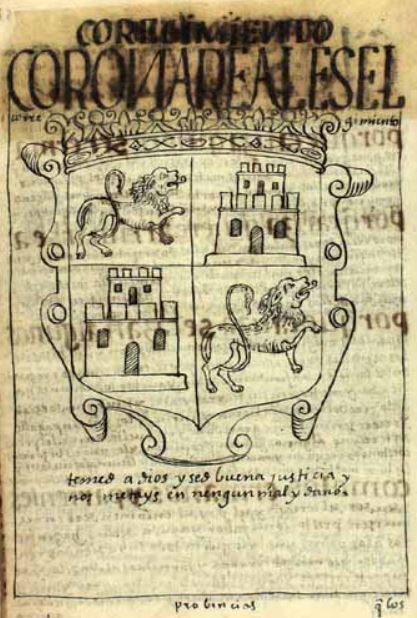
This image is illustrated in a chapter that discusses and criticizes the government and society in Spanish conquered Peru. This image depicts the Castilian coat of arms. The author explains that he proposed a motto for the Corregidors [Magistrates] to be written with the coat of arms and painted on the doors of all municipal buildings. The motto below the coat of arms reads, “temed a dios y sed buena justicia y no [o]s metays en nengun mal y dano” [fear God, be a good justice, and do not become involved in doing evil or harm]. The author had many criticisms of previous Corregidors, which is why he proposed a motto for them to follow in order to do good and do no harm to the indigenous peoples of Peru. The caption at the bottom of the image reads, “probincias” [in the provinces].
Joseph Sedley is seated in a small, open, two-wheeled carriage pulled by a single horse. He holds the reins in his left hand with the whip raised high in his right as the buggy passes a post. At his side is seated another, unspecified, male figure in a tall hat. In the background can be seen the outside of some trees and two buildings.
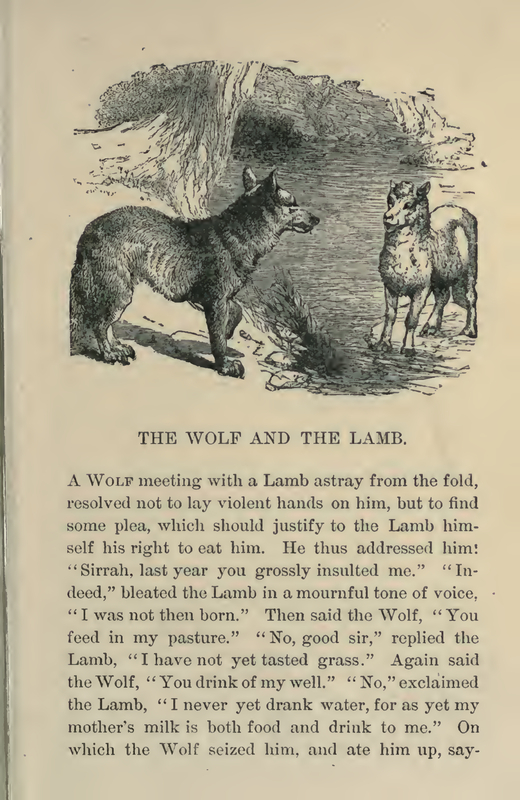
A wolf and a lamb are facing each other. The wolf, to the left side of the image, is looking at the lamb with an angry expression, its left paw slightly lifted in the air as it slightly bares its teeth. On the right side of the image, the lamb is standing with awareness in its stance, slightly bending backwards not to intimidate the wolf.
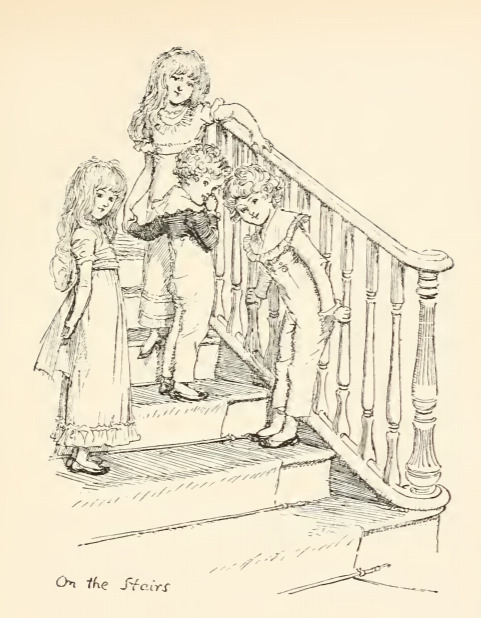
In this image we see the Gardiner children, Lizzy and Jane Bennet’s cousins. Jane was going with her aunt and uncle Gardiner to London. This trip was proposed to help Jane recover from the heartbreak of Mr. Bingley’s sudden departure. This scene occurs in chapter 27. The characters are shown in the traditional regency style. The girls’ dresses have empire waists and the boys wear short coats and breeches. The regency period dated to the early nineteenth century (1811-1820) when George, Prince of Wales, later George IV (r. 1820-1830), reigned as regent for his mentally ill father, King George III (r. 1760-1820). The regency period is associated with the rise of neoclassicism in art and fashion.
In this image we see Gulliver being examined by three scholars from Brobdingnag. The scholars were invited by the King to examine Gulliver’s ‘physical form’. They came to the conclusion that he did not conform to the ‘usual course of nature’, as he was significantly smaller than any other creature on Brobdingnag. They also questioned him regarding his diet and his education. There are three giants crowded around Gulliver who is standing on a table. They each wear elaborate hats and have beards. The giant on the left holds a magnifying glass to his left eye. His hat has what looks like a tree and an insect on top. The centre giant’s face is somewhat in shadow, and his hat has an image of a compass and a globe. The man on the right has depictions of scientific instruments on his hat. Gulliver is seated on a table that is elaborately carved and looks up at the giants. The same image appears in both the 1839 and 1843 Krabbe editions.
Here we see four different wigs, representing different levels of society. On the right we see the church, represented by the mitre. In the centre right, we see the king, represented by the crown. On the centre left we see the long wig traditionally worn by the lords, in the House of Lords with a tag that says “Lords.” On the far left we see the wig tied back, traditionally worn by the upper class who were in the House of Commons, with a tag that says “Communes.” In this chapter Gulliver talks with the King of Brobdingnag about English traditions. Gulliver tells the king about diplomacy, religion, the justice system, the arts, the financial system, and the nobility, then debated these issues with the king. The same image appears in the 1839 Krabbe edition.
Rebecca Crawley kneels in front of Sir Pitt Crawley, clinging to his hand as she begs him to help her reconcile with her husband. Sir Pitt is seated in an armchair and seems inclined to help her, but Lady Jane, who is entering the room from the door behind them, is opposed.
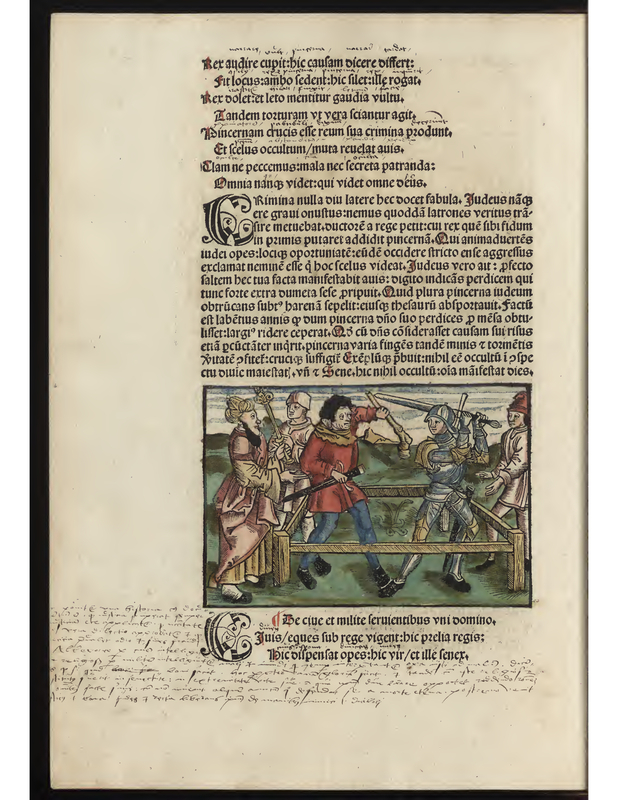
There are five people in this image. There is a man and a knight inside of a small wooden fence battling with swords. Surrounding the fence is a woman and two men, watching the battle between the citizen and the knight.
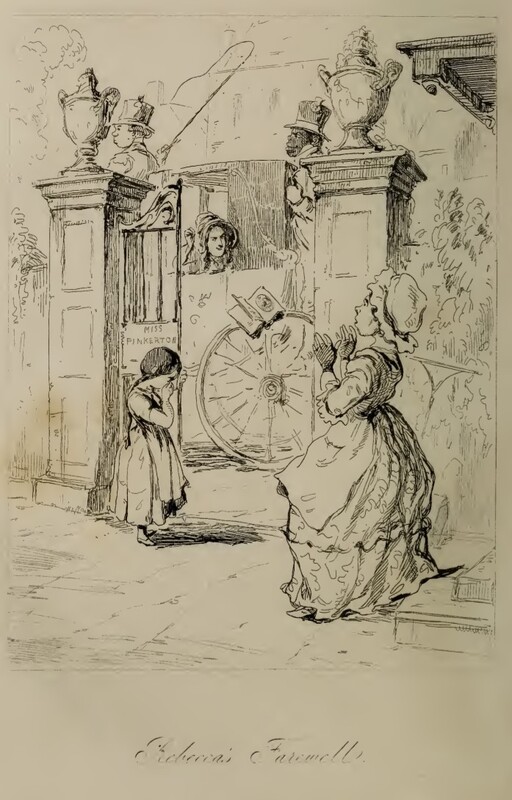
The image depicts two pillars topped with cups, between which is an open gate with a plate reading “Miss Pinkerton”. The pillars frame a carriage with very large wheels, at the front of which sits the coachman, holding his whip, and at the back of which stands Sambo. Rebecca Sharp’s face can be seen from the window of the carriage as she flings a book at the surprised Miss Jemima, who stands on the right side of the image at the bottom of the stairs. Next to the left pillar is a young girl with long braids, possibly Laura Martin, crying and covering her face with her hands. Below the illustration is printed in cursive its title, “Rebecca’s Farewell”.
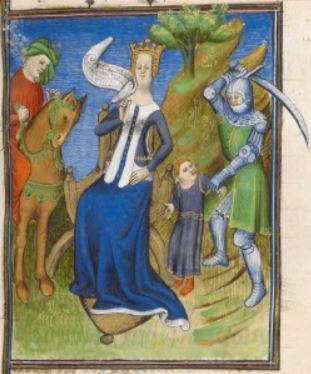
This illumination depicts Medea sitting in the centre of the image wearing a blue dress and holding a scroll of parchment. She was renowned for her skills in magic and potion making. She had fallen in love with the Trojan hero Jason, and she betrayed her family to help him achieve his endeavors. She took her father’s treasure and fled with Jason, and to delay her father from going after them, she dismembered her young brother and scattered his remains for her father to find. Medea’s brother is about to be dismembered by a solder on the right side of the image. The sword of the soldier is illustrated going outside of the frame of the illumination. Jason is illustrated sitting on a horse on the left side of the image.
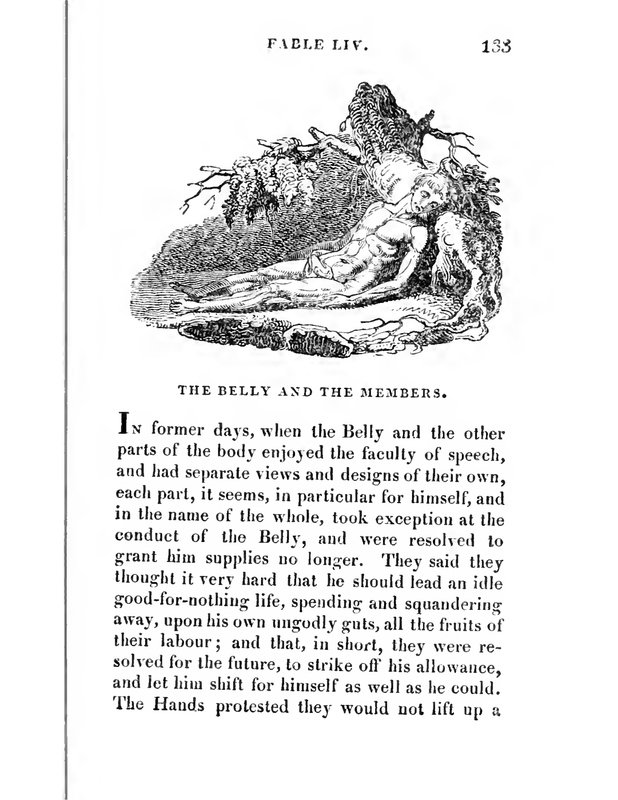
A person rests their head on the trunk of a tree, head turned towards the viewer. Their limbs seem relaxed as they lay on the ground. They are shirtless and wear nothing but a loin cloth. In the background there are leafy branches coming out of the tree trunk.
The King of Brobdingnag ordered that should any other ship be seen off the coast of Brobdingnag it should be captured. The King wanted to breed more humans for the giants. Gulliver compared this to living like a caged bird, a metaphor shown in this image.

![[Indigenous Canadians hunt in the winter]](https://cemvccol.ace-net.training/files/large/70d655a4a843328fbff68511503297bb2b152dee.jpg)
![[Eagle takes sheep]](https://cemvccol.ace-net.training/files/large/f5a1e7295637ec96f8177d9ad8870e17bab9f421.jpg)
![[a plant from the Country of the Houyhnhnms]](https://cemvccol.ace-net.training/files/large/84afe3d1d951f712d3e340c2edc6693fba093243.jpg)
![In[di]os Cristianos Cazados](https://cemvccol.ace-net.training/files/large/9addaa4974f62be0bd6d90648311aad1e08d087a.jpg)
![[Gulliver hires a guide and two mules to show him Maldonada]](https://cemvccol.ace-net.training/files/large/0cfd5f212541ca6fd65d236cddf2b318de08185e.jpg)
![[Joseph Driving his Buggy]](https://cemvccol.ace-net.training/files/large/cfdf7f28fb01ac9302e27d6446c5984d243918b3.jpg)
![[Three scholars from Brobdingnag examine Gulliver]](https://cemvccol.ace-net.training/files/large/ce06434093455ed933b2b96cffc14fc1fcd73d41.jpg)
![[Different factions of society represented by wigs]](https://cemvccol.ace-net.training/files/large/20ffe4637ba19117e236bc21818e1c10fed991d4.jpg)
![[Becky Begs for Assistance]](https://cemvccol.ace-net.training/files/large/94ae7988d27d3fa7018d0d7efac1bec19a22a210.jpg)
![[Gulliver imagines his life on Brobdingnag]](https://cemvccol.ace-net.training/files/large/cd71f75be54e8573fafc32364770da2883c5c855.jpg)