A group of Indigenous Brazilian woman, called ‘Amazons’ by the author, fight against a group of Indigenous Brazilian men who attack from the water. The women fight with bows and arrows, spears and shields, while the men in canoes use bows and arrows and clubs. The women are unadorned with their hair worn unbound. Some of the men wear feathered headdresses. This image is identical to one found on page 960 of Paris, 1575 (l’Huillier), and in Thevet’s Les Singularitez de la France Antarctique (page 124 verso of Paris, 1557 and page 124 verso of Paris, 1558).
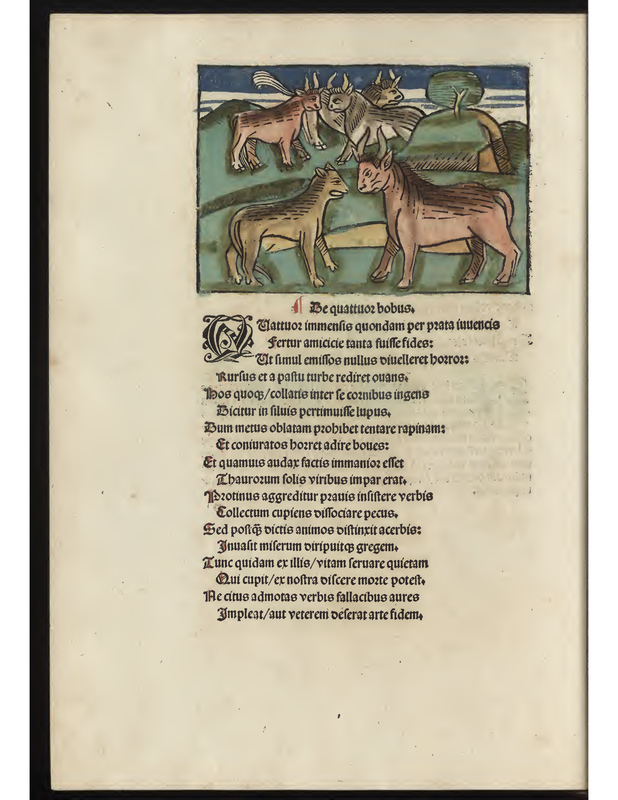
Four ox and a wolf are outside. One ox and a wolf are staring directly at one another. Two oxen behind them are staring at one another. There is one more ox alone in the distance. The animals are in a standoff getting ready to fight.
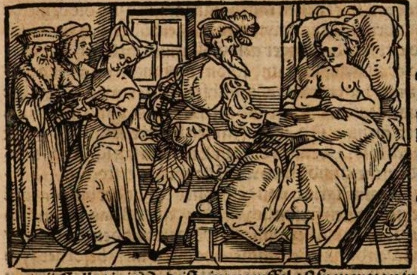
Lucretia is depicted nude on the right side of the engraving, lying in bed as she is approached by her husband’s realative, Sextus. Sextus is illustrated with a sword in his left hand as he threatens to kill Lucretia if she screams for help. The left side of the engraving illustrates Lucretia with her husband, Collatinus, and her husband’s relative, Brutus. Lucretia told the men that Sextus had raped her in the night, and then plunged a knife into her own chest in shame.
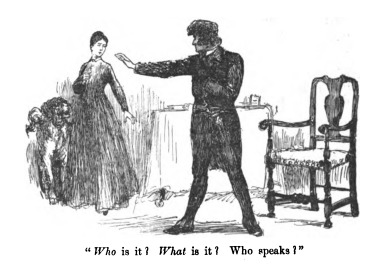
Here Jane first sees Mr. Rochester after he was blinded by the fire. He did not believe it was her at first, wondering who was there. She came in to bring him his food, in place of his housekeeper. She stands near the table, with his dog, Pilot, next to her. Mr. Rochester stands with his hands held out in front of him, disoriented.
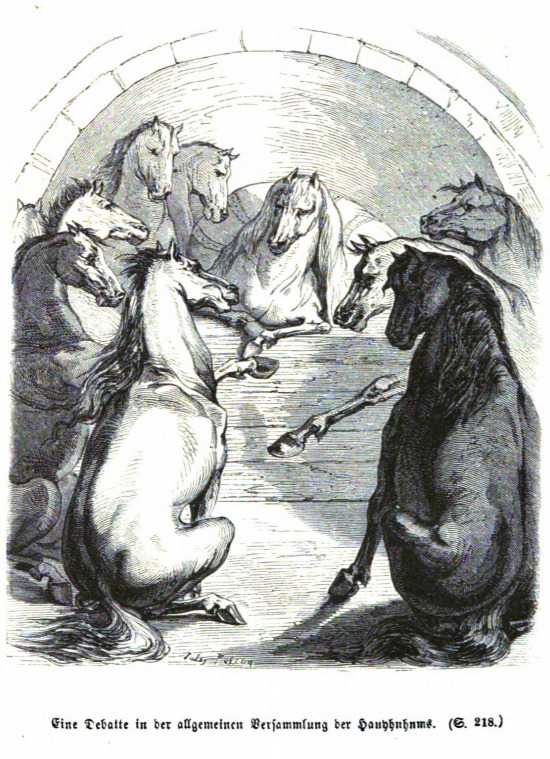
Here we see a group of Houyhnhnms in debate at the general assembly. At this assembly, representatives from the different regions of the Country debate issues facing the Houyhnhnms. The council met every four years. One of the issues debated at this Council was whether Gulliver should be allowed to continue to live with the Houyhnhnms. The council ultimately decided Gulliver could not continue to live with the Houyhnhnms, and he must either live with the yahoos on the Country of the Houyhnhnms or return to Europe.
After Calisto (the leftmost figure) is rejected by Melibea during his first encounter with her, he finds himself in a state of discontent and despondency. His servant Sempronio suggests that he should employ the aid of Celestina (the rightmost figure, wearing a robe and a veil), a matchmaker and brothel owner. Calisto sends Sempronio to fetch her (they can be seen arriving at Calisto’s house to the right of the image). While Sempronio is away, Calisto talks with his other servant Pármeno, who unsuccessfully tries to dissuade him from procuring Celestina’s services (to the left of the image). The entire image is identical to the one found on page 86 of the text.
The left panel depicts Melibea’s father Pleberio, who is wearing a hat and has a sword mounted on his belt. To the right, we see Melibea’s mother Alisa wearing a veil and a robe. In her right hand, she is holding a flower. Both figures are placed outside.The left panel is nearly identical to those found on pages 60, 146, 173, and 187 (where it is labeled ‘Parmeno’), and pages 263 and 326 (labeled ‘Sosia’). The right panel is nearly identical to those found on pages 84 (where it is labeled ‘Celestine’), 235 (labeled ‘Lucrece’), and 287 and 306 (labeled ‘Elicia’).
Here we see the exterior of Gulliver’s house in Brobdingnag. The house is a box that is sixteen square feet and twelve feet high. It was built to resemble the style of the houses in London in the early eighteenth century. There is a large front door, with two arched windows on the front and a square window on the side. The roof comes off so the giants could see Gulliver more easily. The house is still under construction in this image, as the front door is not attached, and Gulliver’s furniture is outside. Gulliver’s sleigh bed, writing desk, and chairs are on the table, outside his house. Gulliver sits on a bench outside his house. His house sits on a table with a drawer and a chair. The same image appears in the 1839 Krabbe edition.
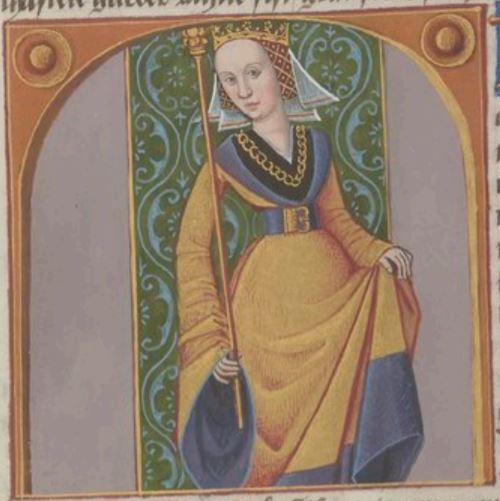
This illumination depicts a portrait of a woman named Nicaula, who was the queen of Ethiopia. Nicaula is renowned for her incredible intellect, and for her determination to meet king Solomon of Jerusalem. When Nicaula heard of the wisdom of Solomon, she traveled from Ethiopia to Jerusalem just to meet him and speak with him.
Here we see the busts of the types of men that Gulliver thought to ruin his life in Europe, and whom he was glad to be free of in the Country of the Houyhnhnms. These men include: physicians, lawyers, informants, censurers, backbiters, pick-pockets, highwaymen, housebreakers, attorneys, bawds, buffoons, gamesters, politicians, tedious talkers, controverters, ravishers, murderers, virtuosos, and robbers. The same image appears in the 1839 Krabbe edition.
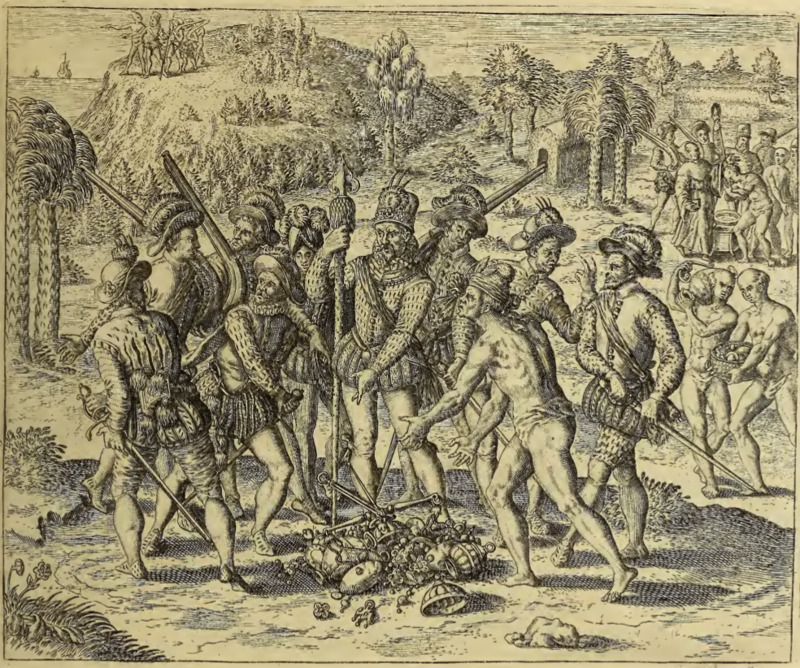
An Indigenous man stands amongst a group of Spaniards, gesturing emphatically at a pile of gold treasure on the ground in front of them. The Indigenous man has guided the Spaniards to the treasure to satisfy their greed. The Spanish men, finely dressed and bearing muskets, swords, and spears, converse amongst themselves. Two Indigenous men bearing more treasure approach from the right. In the background, a Spanish priest baptizes an Indigenous person while several other Spaniards and Indigenous people look on. There is also a single dwelling in the background. In the distance, on a hilltop, an Indigenous person indicates to a group of Spaniards the nearness of the ocean.
This image shows five characters: Calisto and Melibea sitting under a tree in the midground, Lucrecia in the background, and Sosia and Tristan in the foreground. Calisto, Melibea, and Lucrecia are within the walls of Melibea’s garden. Sosia and Tristan are standing guard outside the garden wall while Calisto and Melibea talk and hold hands. The moon in the upper left corner indicates that the scene is taking place at night. Lucrecia is standing in the background, waiting from a distance for Melibea to conclude her rendezvous with Calisto.
In the outdoors there’s a man standing with three sheep and two goats by his side as they face two lonely wolves in front of them. The outdoor area around them looks dry and deserted.
In this image the wedding carriage drives away from the Meryton church. Jane married Mr. Bingley on the same day Elizabeth married Mr. Bingley. Jane and Mr. Bingley moved into an estate near Pemberley shortly after their marriage. Here we see the wedding carriage as wedding guests stand on the steps outside the church and wave as the carriage leaves. This scene occurs in chapter 61. The characters are shown in the traditional regency style. The women wear regency dresses with empire waistlines. The men wear waistcoats and tailcoats. The regency period dated to the early nineteenth century (1811-1820) when George, Prince of Wales, later George IV (r. 1820-1830), reigned as regent for his mentally ill father, King George III (r. 1760-1820). The regency period is associated with the rise of neoclassicism in art and fashion.
Here Gulliver stands on a stack of military regalia of the army of Brobdingnag. We see a sword, axe, circular shield, helmet, and chest plate. The armour is highly decorated with engraving and gemstones, particularly on the chest plate and the sword. The same image appears in the 1843 Krabbe edition.
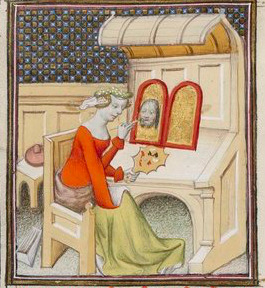
Irene was most famously known for her exquisite talent at painting, one of which was located at Eleusis. This image depicts Irene painting a gladiator at her desk.
Sempronio (rightmost figure) arrives at the house of Celestina (central figure) and angrily chastises her for the slackness with which she is fulfilling Calisto’s request. She explains that she will be able to extract more compensation from Calisto if she takes her time. She asks him to join her in scamming Calisto, offering him an equal share of the profits and her prostitute Elicia (top-left corner, looking out from the window) in exchange for his loyalty. Sempronio readily agrees, and when Celestina departs for Melibea’s house, he stays behind to spend time with Elicia.
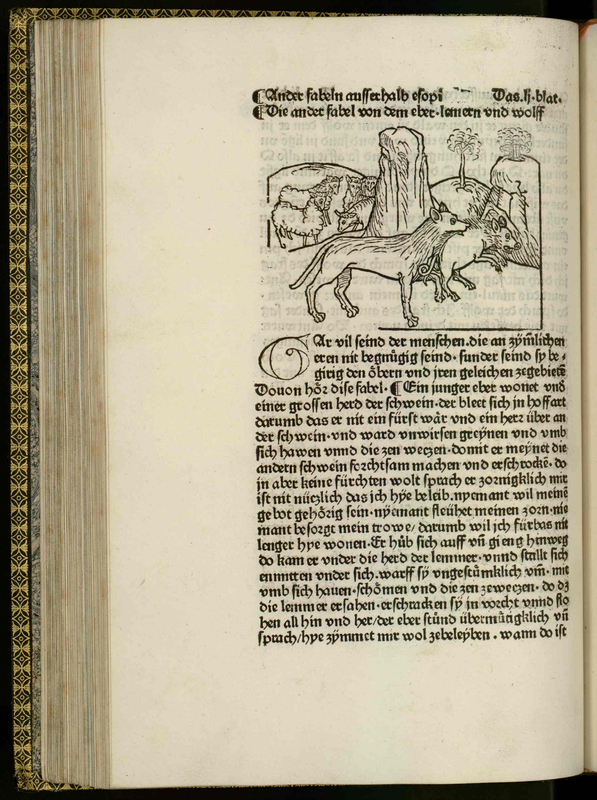
At the bottom of the image there is a wolf and a hog walking towards the right. In the top left side of the image there are some sheep and a bull. On the top right corner of the image, there are hills and tree trunks.
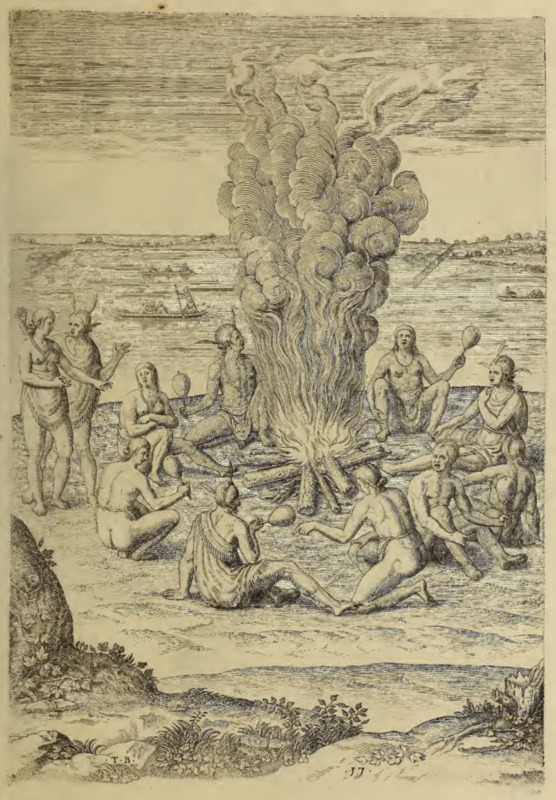
A group of Indigenous people sit on the ground around a bonfire on the bank of a river. Some of the individuals hold rattles. All wear fringed garments, either draped around their bodies and over their shoulders, over one shoulder, or tied around their waist. The men wear feathers in their hair, and at least one woman wears strands of beads. Behind the group, other individuals are seen in canoes on the river.
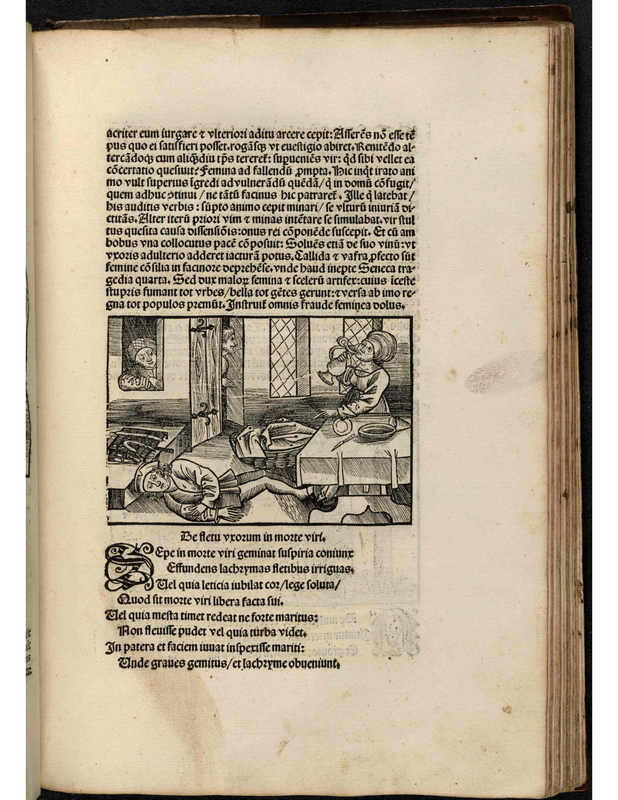
A person is laying on the floor to the left of a dinner table. A person standing behind the table is drinking from a large pitcher. A person is looking into the room through a window, and another person is looking in through the doorway.
Here we see Gulliver leaving Balnibarbi. He hired a guide and a mule to take him to Maldonada. After he found out that there was not a ship ready to take him to Japan, Gulliver continued on to Glubbdubdrib.
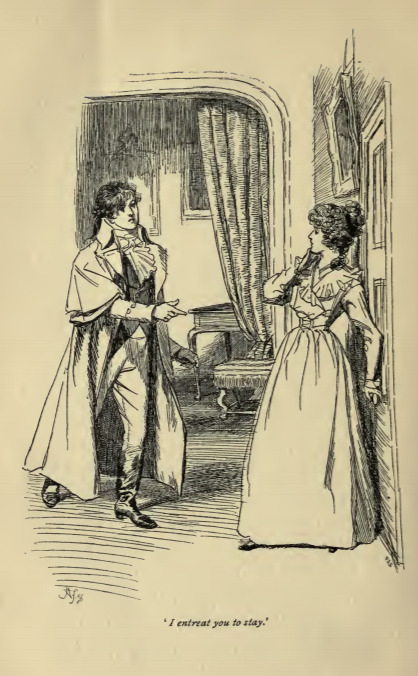
In this image Willoughby begs Elinor to listen to him. He heard of Marianne’s illness, and he had come to tell her that he had truly cared for Marianne and the letter he sent to her in London was written by his wife who was jealous. Willoughby begged Elinor to listen to him and pass his message on to Marianne once she had recovered. This scene occurs in chapter 44. The characters are shown in the traditional regency style. Elinor wears a regency style dress with an empire waistline, and a sash tied around her waist. Willoughby wears a waistcoat and tailcoat with a cravat and overcoat. The regency period dated to the early nineteenth century (1811-1820) when George, Prince of Wales, later George IV (r. 1820-1830), reigned as regent for his mentally ill father, King George III (r. 1760-1820). The regency period is associated with the rise of neoclassicism in art and fashion.

![Les femmes se deffende[n]t contre leurs ennemys.](https://cemvccol.ace-net.training/files/large/7b28e11b9b846c78228099a2741c81f7b8084a93.jpg)

![[Act I – Calisto Waits with Pármeno While Sempronio Fetches Celestina]](https://cemvccol.ace-net.training/files/large/b3a5200bff30e47ba53b09484ec2b3549e934a0e.jpg)
![[Act XVI – Pleberio and Alisa]](https://cemvccol.ace-net.training/files/large/8225ac70cf9f64c9304c51c97950442b7735f280.jpg)
![[Gulliver’s home on Brobdingnag]](https://cemvccol.ace-net.training/files/large/868afa13f996c5901749ed58996de9dad327d424.jpg)
![[Men representing professions that Gulliver thought to destroy his life in Europe]](https://cemvccol.ace-net.training/files/large/8a923e949ade1eb931a88a574cc971421dd55d41.jpg)
![[Argument – While Calisto and Melibea Talk, Sosia and Tristan Stand Guard, and Lucrecia Watches from a Distance]](https://cemvccol.ace-net.training/files/large/852df851760c64653109f445c3f0a049f5710870.jpg)
![[A Man and the Animals]](https://cemvccol.ace-net.training/files/large/9187593c760ac04afa1262dc1e701e56ca4d4c85.jpg)
![[The wedding carriage drives away]](https://cemvccol.ace-net.training/files/large/3656bf27009f07834a054be065401390b740b256.jpg)
![[Gulliver stands on the military regalia of the army of Brobdingnag]](https://cemvccol.ace-net.training/files/large/044c983db96fa130635799f87de14f95342baa9f.jpg)
![[Act III – Elicia Watches as Sempronio and Celestina Arrive]](https://cemvccol.ace-net.training/files/large/22de9ac954f6728c8a9f49191f3ed3c1ef12c175.jpg)
![[Gulliver leaves Balnibarbi]](https://cemvccol.ace-net.training/files/large/ef942cc8ada4fff3b7994204d3499802189e542b.jpg)