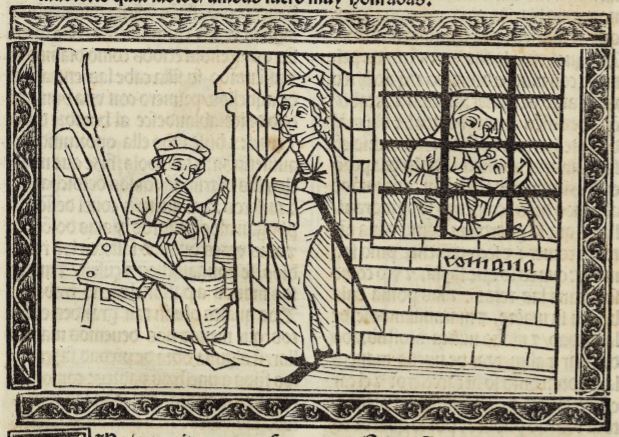
This engraving depicts a story of a young Roman woman who saved her mother from starving to death. Boccaccio explains that this unknown woman’s mother had been sentenced to death, and when she was locked away to die of starvation, her daughter saved her with her own breast milk. The girl and her mother are depicted behind the window of the jail cell as the mother drinks the milk of her daughter’s breast. The word “romana” is engraved below the jail cell window. The men that are standing guard outside the prison cell seem unconcerned and relaxed. They are unsuspecting of the young woman because they searched her every time she visited her mother and she never seemed to carried food with her. The young woman saved her mother’s life through her breast milk, and Boccaccio explains that he wrote on this unknown young woman due to her filial devotion.
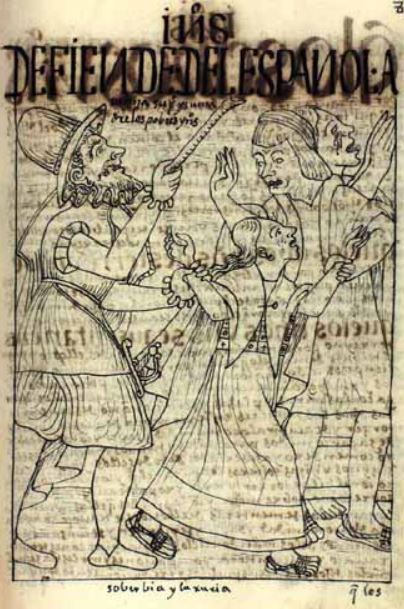
This image depicts an indigenous mother and father attempting to protect their young daughter against the cruelty of a Spanish official. The Spaniard is depicted on the left side of the image grabbing the arm of the young indigenous girl. He is also holding up a stick which is is trying to use to beat the girl. The father is illustrated grabbing his daughter’s arm to pull her away from the Spaniard. He right hand is being held up to stop the blow of the stick. The mother is standing behind the father with tears running down her face. The indigenous family is depicted wearing traditional clothing such as unkus [tunics], ussutas [sandals] and cloaks. The Spaniard is dressed in European clothing with puffed trousers and a ruffled shirt.
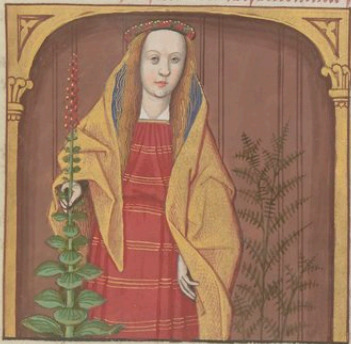
This illumination depicts a portrait of a woman named Circe, who is known as the daughter of the sun. Boccaccio explains that Circe was incredibly skilled at working with herbs for her magic and would often use enchantments to change people who arrived on her shores into animals. Circe is depicted holding a plant in the illustration to demonstrate her involvement with herbs and magic.
This image depicts the first encounter Calisto (figure to the left) has with Melibea (figure to the right). While practicing his falconry, Calisto follows his bird (top-left corner) into Melibea’s garden, where he first lays eyes upon her. He is struck by her beauty and instantly falls in love. In addition to these figures, a horse is depicted behind Melibea.
Rodrigo holds a leper whom he has found on the side of a road while en route to Santiago de Compostela. His companions on the journey, twenty hidalgos (nobles), sit on their horses in the background, while further back a city can be seen. Rodrigo later brings the leper to an inn and shares a supper and bed with him. In the night, the leper reveals that he is actually Saint Lazarus, and delivers a prophecy that Rodrigo will always be victorious in battle.
Here we see a scientist from the Grand Academy on Balnibarbi’s hypothesis for a new manner of construction. This scientist’s suggestion was to build the house from the top down, starting with the roof and ending with the foundation. The roof would be held up by balloons during construction. The scientist claims he was inspired by the building methods of spiders and bees. Gulliver was quite impressed with this idea unlike many other ideas he saw at the Academy. The same image appears in the 1843 Krabbe edition.
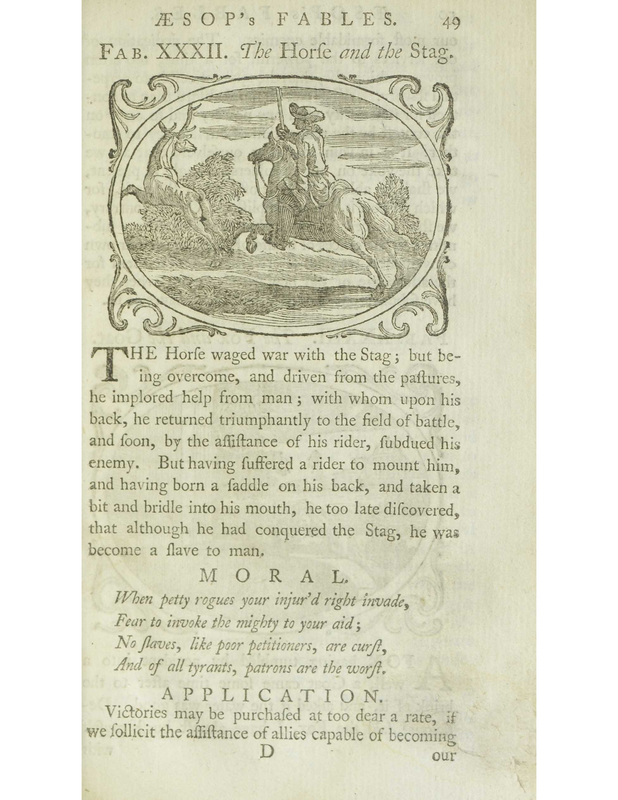
A deep runs away into the bushes from a man on a horse, bearing a sword. The horse is mid-jump, directly behind the deep, preparing to allow the man on top to strike. Above, the sky appears dreary and cloudy.
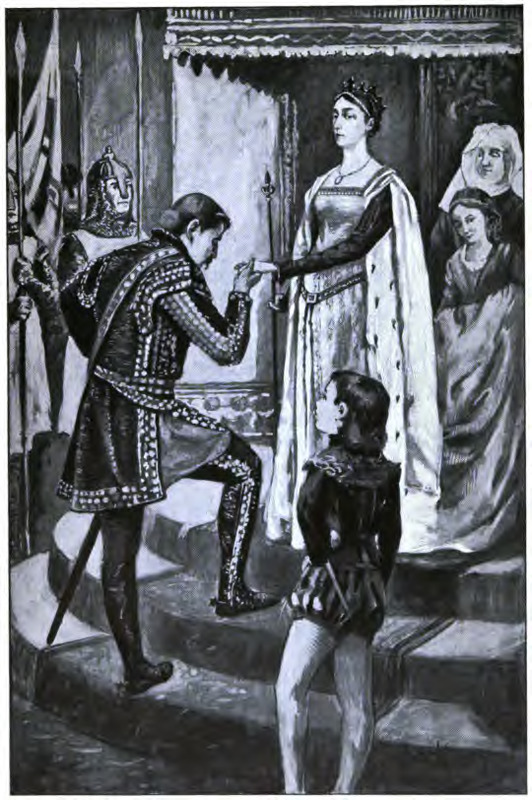
The Cid meets with Doña Urraca, who rules the city of Zamora. He has been sent by King Don Sancho, her brother, to negotiate the future of Zamora. Don Sancho wants the city, but does not want to risk attacking it due to its fortifications, and so proposes to buy it from her or exchange it for two others. She refuses, leading to Don Sancho choosing to besiege the city.
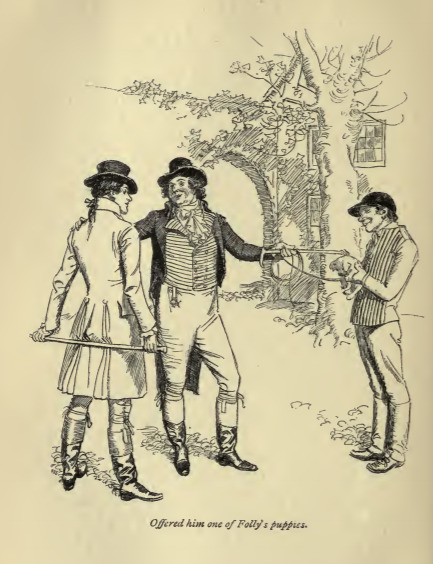
In this image Willoughby offers Sir John one of his dog, Folly’s puppies. Sir John and Elinor discuss Willoughby and his deceitfulness. Sir John thought that Willoughby was a good and upstanding man, but the recent news of his jilting Marianne totally changed his opinion of Willoughby. This scene occurs in chapter 32. The characters are shown in the traditional regency style, as Sir John wears a waistcoat and tailcoat with breeches and a top hat. Willoughby wears a riding coat and a top hat and holds a whip. Willoughby’s stable boy wears a riding outfit and holds a puppy on a leash. The regency period dated to the early nineteenth century (1811-1820) when George, Prince of Wales, later George IV (r. 1820-1830), reigned as regent for his mentally ill father, King George III (r. 1760-1820). The regency period is associated with the rise of neoclassicism in art and fashion.
Here Gulliver sails on a boat made for him after telling the Queen about his travels. The Queen had a boat and a trough built for Gulliver to sail on and entertain the court. The trough is surrounded by the women of the court, all wearing long embroidered dresses with caps and veils. Some of the women hold fans, which was customary of court life in the eighteenth century. On the left-hand side, we see the Queen’s dwarf, looking angrily at Gulliver, resentful of all the attention Gulliver was getting. The same image appears in the 1843 Krabbe edition.
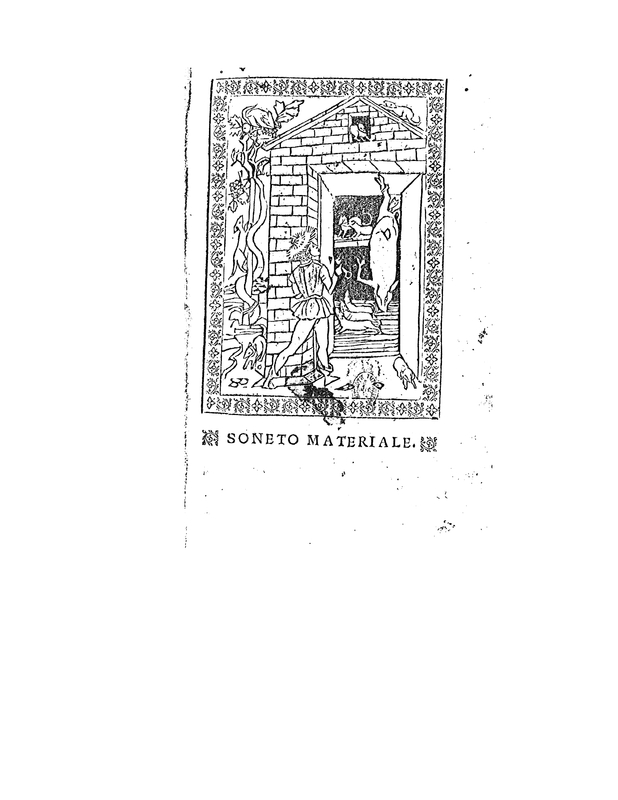
There is a man in the centre of the image looking at a mouse in the cut out of the brick building. Inside the building there is a pig hanging from the ceiling by its foot. All around the image there are mice crawling. They are crawling up vines on the left side of the image, on the ground in the building, on the roof, and on the ground outside. There even seems to be mice nibbling at the pig.
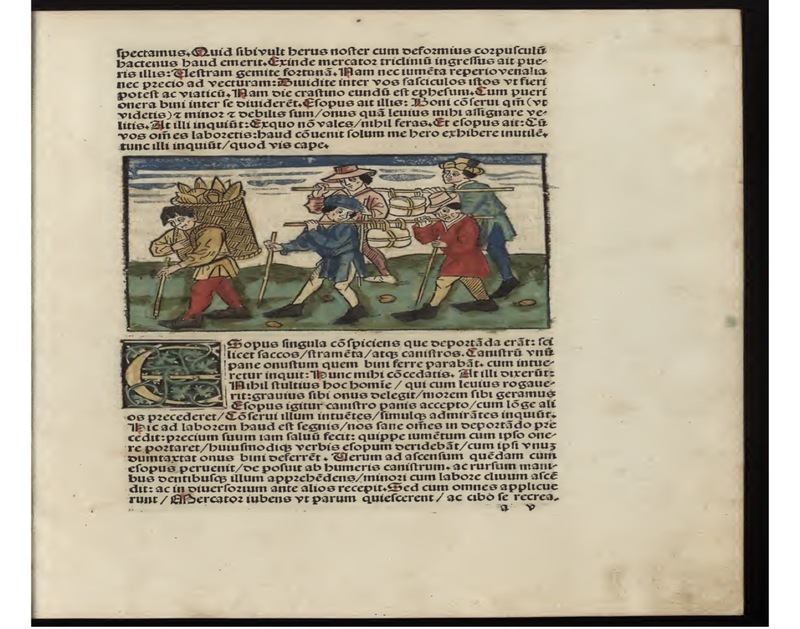
Five men are on a long walk. The man at the front carries on his back a large basket of food. The four men behind him carry in groups of two, long rods with an object hanging by rope from the middle.
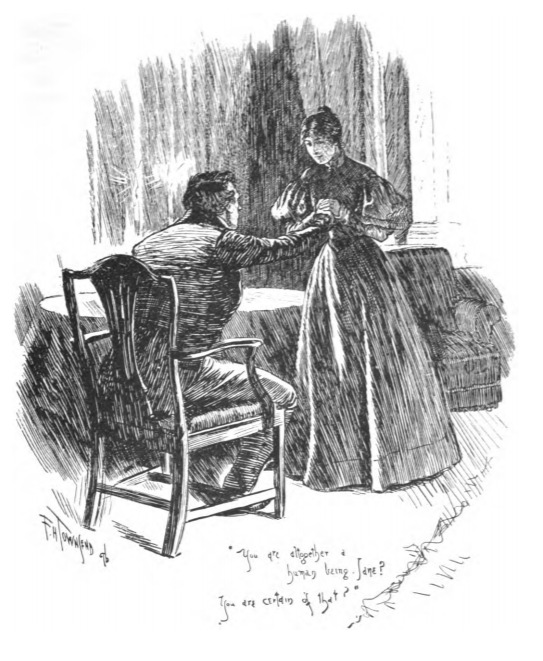
After hearing about the fire at Thornfield, Jane went to Ferndean Manor where Mr. Rochester now lived. He was blinded helping people get out of Thornfield, and his hand had to be amputated because it was crushed by a falling beam. When Jane arrived at Ferndean, Mr. Rochester could not believe that she was really there. She entered the room bringing him water instead of his housekeeper.
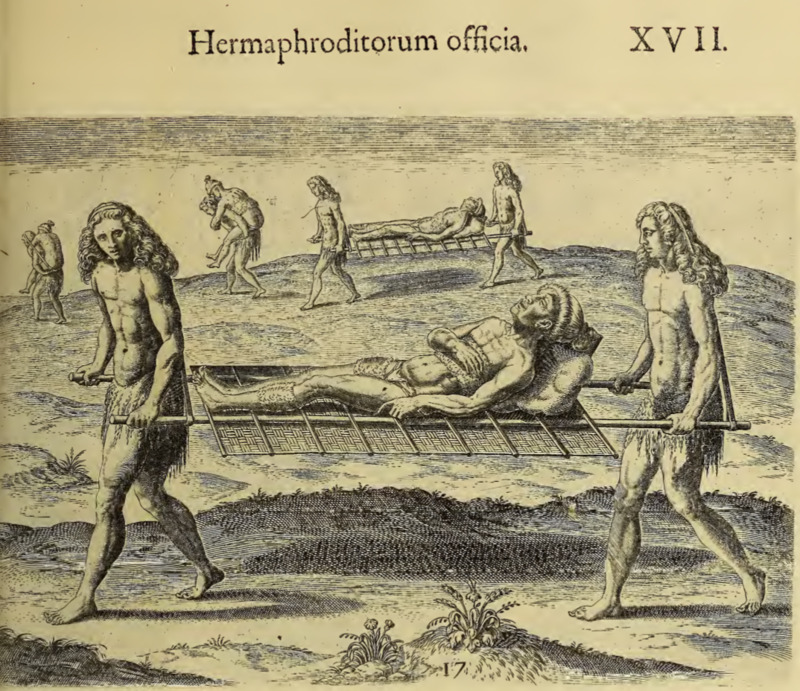
In this image two pairs of Indigenous people (one pair in the foreground of the image and one in the background) carry stretchers between them with another individual on it. In the background, two people each carry another individual on their back. In the foreground, the stretcher bearers wear their long hair unbound and grass skirts around their waists, with no other clothing or decoration. The original caption of the image indicates that the individuals carrying the stretchers and carrying others on their backs are hermaphrodites (today known as intersex individuals).
Here we see two dead horses lying on a beach. The Houyhnhnms asks about the horses in Europe and how they live. Gulliver explains that humans or yahoos govern the country and care for the horses or Houyhnhnms. Gulliver tells his master that horses were beloved by humans until they became sick of injured and could no longer work. Then, they would be sold to do menial work until they died, at which point their skins were stripped and sold. One of the horses is only a skeleton, implying his skin was sold. The same image appears in the 1839 Krabbe edition.
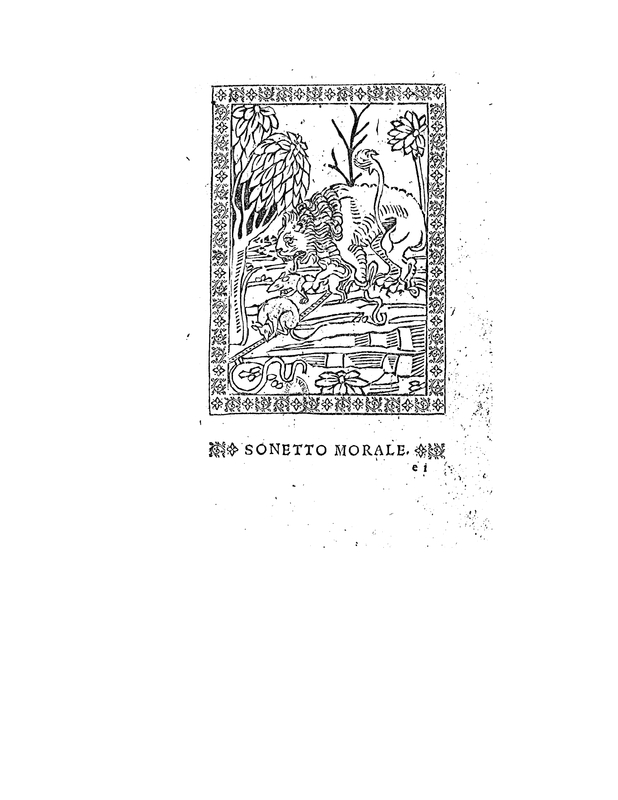
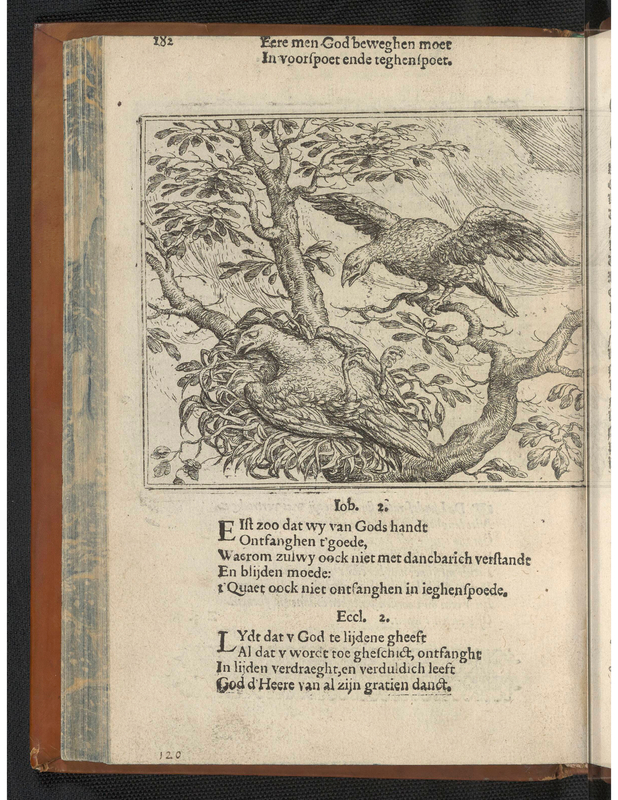
There is a lion with its tail between its legs and seems to have a rope tied to it. The left front paw of the lion is pinning down a mouse. In the forefront of the image there is mouse chewing on the rope that is trapping the lion.
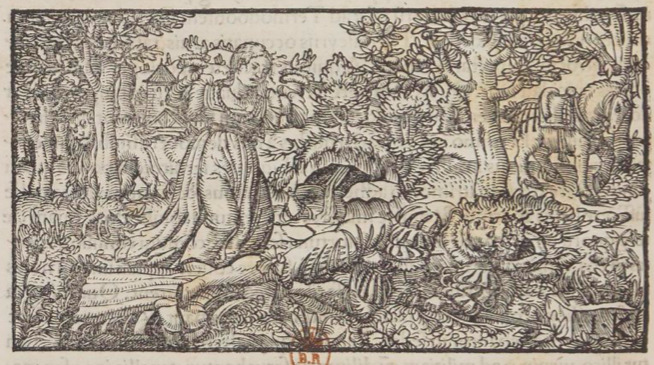
Thisbe and her forbidden lover, Pyramus, made plans to sneak out to see each other. After finding Thisbe’s cloak smeared with the blood of a lion, he assumed it to be her blood and that she was dead. He laid down on his sword to end his life, and before dying, Thisbe returned to find him almost dead. She, too, decided that she could not live without her lover, so she laid down on top of him and ended her life. They were tricked by fortune. In the photo, Thisbe is discovering her lover who is dying on the ground. In the background, the lion that tricked them is peering at them from behind a tree.


![[Act I (First Illustration) – Calisto Encounters Melibea]](https://cemvccol.ace-net.training/files/large/9142f2518537f48ef15d6f0ba62a48c99a859995.jpg)

![[Rodrigo and the leper]](https://cemvccol.ace-net.training/files/large/5e3a92f23ce78eb41959fc6864d262caa1ac78d8.jpg)
![[A scientist from The Grand Academy on Balnibarbi suggests a new manner of construction]](https://cemvccol.ace-net.training/files/large/b43e5c613f3b9fd5f266f2ada6392dcb37518451.jpg)

![[Gulliver sails in a trough in the Royal Court of Brobdingnag]](https://cemvccol.ace-net.training/files/large/4f896633e712c88f9f5f1f42b9506b96c83e804c.jpg)
![[deceased horses on a beach]](https://cemvccol.ace-net.training/files/large/520c3ea6dfa57ffec31698ca4802c3a6fbe29f0b.jpg)