A man in hat and robe walks down a city street lined with buildings. He is carrying a stick with a gourd hanging from it in one hand, and a small rod in the other. On the building next to him is the letter I from “It”.
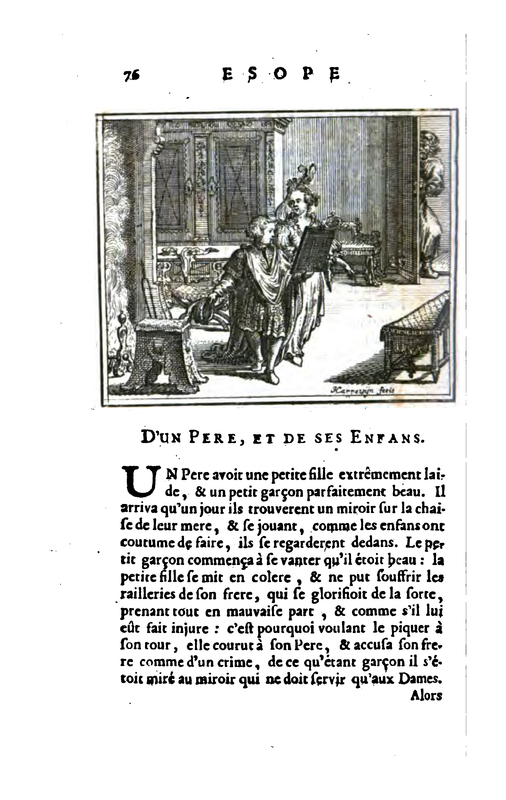
A father had a little girl who was extremely ugly, and a little boy who was perfectly beautiful. It happened that one day they found a mirror on their mother's chair, and playing, as children are will do, they looked at themselves in it. The little boy began to boast that he was handsome: the little girl became angry, and could not bear the mockery of her brother, who boasted of her strength, taking everything in the wrong way, and as if he had done her an injustice: This is why, wanting to prick him in his turn, she ran to her father and accused her brother of a crime, because, being a boy, he was looking at the mirror which should only be used by the ladies.
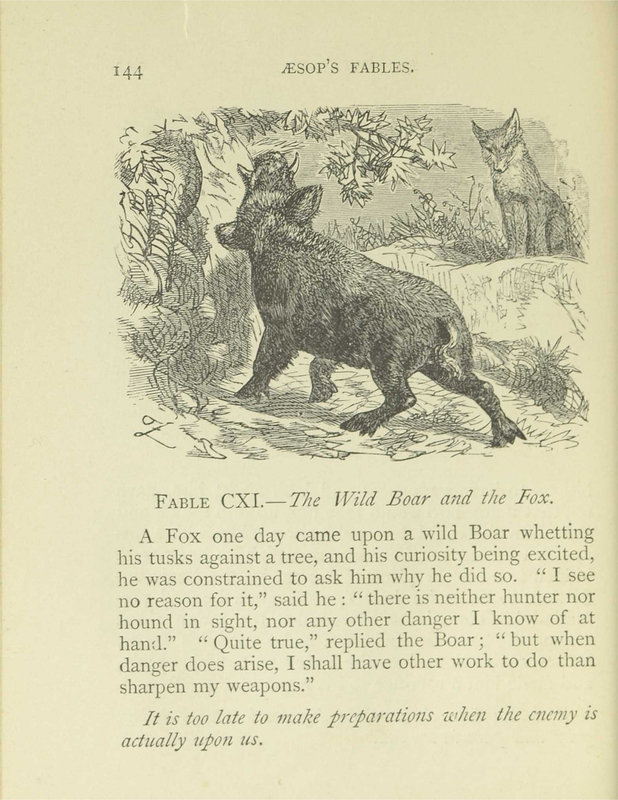
On the left side of the page, a boar sharpens its tusks on a tree. A fox looks on from the right side of the image on an elevated plane, they face each other.
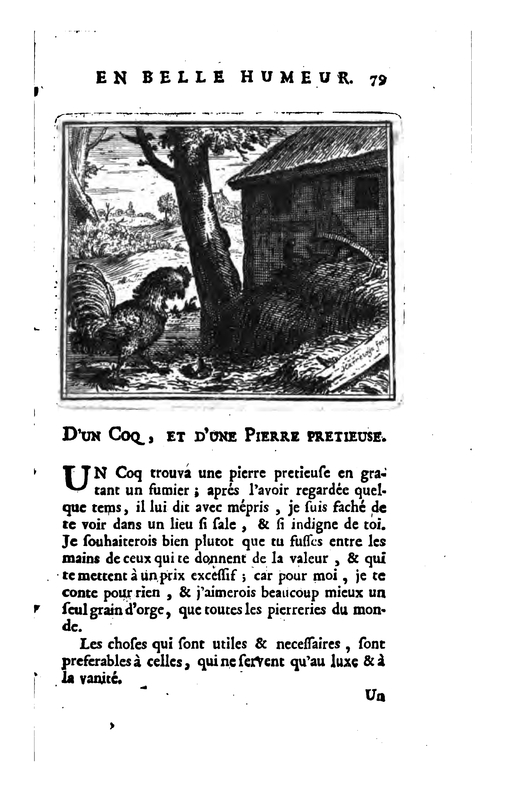
The image depicts a cock in a farmyard who has found a precious jewel while scratching in the farmyard. The cock has no use for a precious jewel and would prefer a grain of barley.
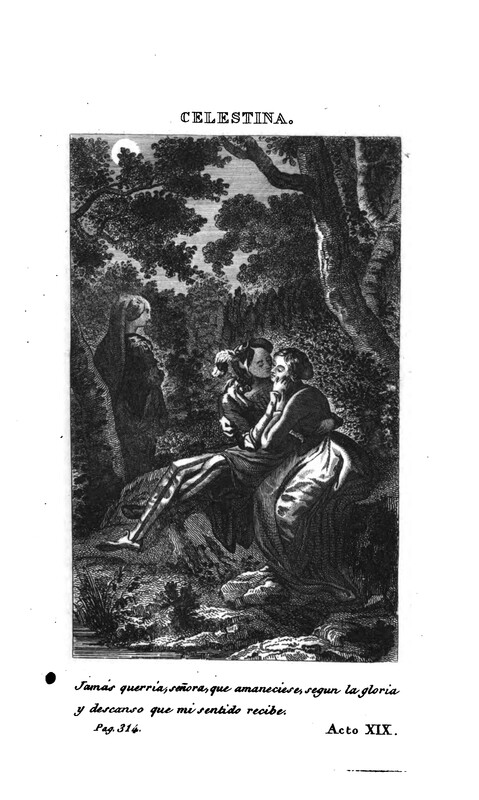
The lovers Calisto and Melibea embrace in her garden. There is another woman in the background and to the left, but it is difficult to identify who she is (likely Melibea's servant Lucrecia). Shortly after their embrace, Calisto hears Sosia yelling on the other side of the wall and ascends the ladder to see the cause of the commotion. As he descends the ladder on the other side of the wall, he falls and dies.
In this image we see Gulliver interacting with two beggars on Brobdingnag. The beggars came to the royal kitchens to asks for food. We see Gulliver recoiling from the giants with his hands blocking his face. The giant on the right is missing teeth, while the giant on the left has a bandage covering his eye. Both giants are looking up, as though they are on their knees looking up at another giant and asking for food. The same image appears in the 1843 Krabbe edition.
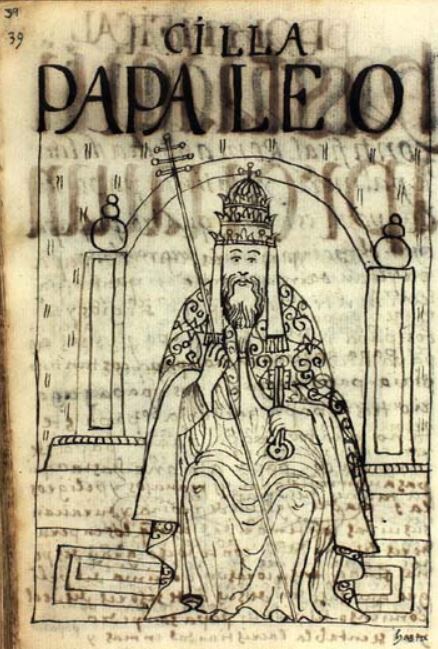
This illustration depicts Pope Leo III sitting on his pontifical throne. He is illustrated wearing the papal tiara and a long staff that has three horizontal bars at the top, which symbolizes pontifical power. Felipe Guaman Poma de Ayala spends this section of his manuscript listing off approximately the first 200 popes, and Pope Leo III was one of the few that was illustrated.
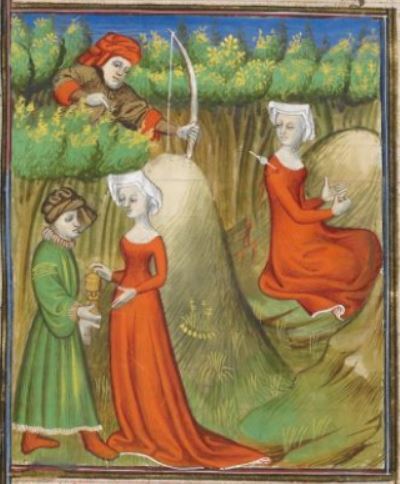
When Cephalus was told that his wife (Procris) would abandon him in exchange for money and treasures, Cephalus began testing his wife. Cephalus would disguise himself and offer her gold and treasures in exchange for her love. This is depicted in the foreground of the image, with Cephalus kneeling and presenting treasures to Procris. Procris rejected the disguised Cephalus multiple times, however, she eventually accepted his offers. Procris regretted what she had done to her husband. To punish herself, Procris went to live in the woods. Cephalus had been hunting one day and had mistaken his wife for an animal and shot her. Cephalus is illustrated in the background of the illustration holding a bow in his hands. Procris is on the right side of the image with an arrow protruding from her chest after being mistakenly shot by Cephalus.
This image is of an angel trumpeting. The angel is wearing a long dress and has large wings. She is flying over a city. The trumpet has a long banner hanging from it that the angel holds. It is the opening image of the story of Gulliver’s Travels, and presumably is signaling for people to come listen to the story. The same image appears in the 1839 Krabbe edition.
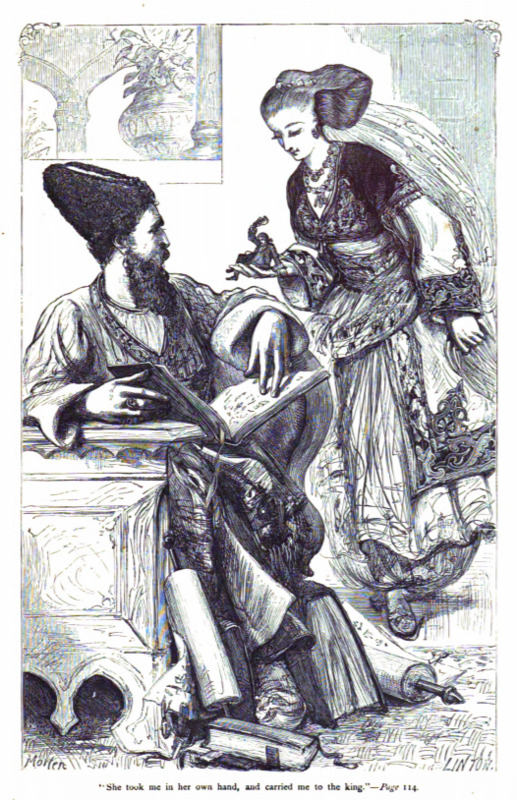
Here Gulliver meets the King of Brobdingnag. The Queen carried Gulliver to meet the King after the Queen brought Gulliver into her court. The King was seated in his study reading, when the Queen introduced Gulliver.
LIBERTAD LEALTAD SINGA CHAVIN MONZON ARANCAY TANTAMAYO MIRAFLORES PUNCHAO JIRCAN JACAS PUÑOS JULIO 1777 HUAMALIES LLATA HUANUCO Glorias a Tierra de ideales victoriosas amante de las innobles causas eximentes La primera chispa de raudales batallares, el constante luchador de gritos libertarios
Mr. Bowls sits in a chair at the kitchen table, reading “Fire and the Frying Pan” aloud to his assistant, who sits opposite him, holding onto a jug. Through the door in the background, Mrs. Firkin is entering, holding a candle in front of her.
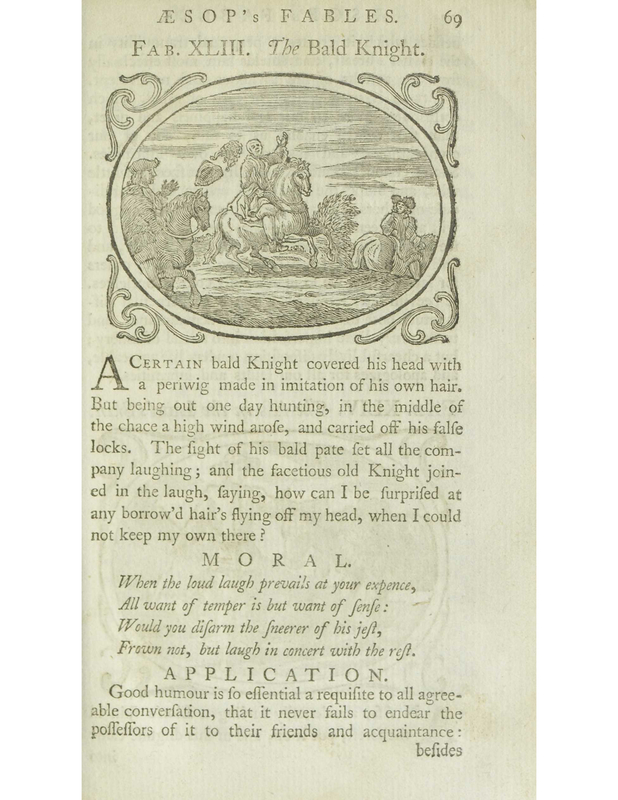
On the left stands a man on a horse, looking at a man on a horse in the middle, who is throwing his wig and hat, showing his bald head. On the right, a man on a horse going down a hill is stopped, turning back to look at the bald man in the middle. The middle man's horse is slightly up on its hind legs, appearing as if it is about to jump.
Here we see Gulliver speaking with Pedro de Mendez, the captain of the ship that found Gulliver in New Holland. Pedro de Mendez asked Gulliver to explain his situation, however Gulliver remained quiet, wanting to return to his boat and get away from other people. Pedro de Mendez gave Gulliver food and a bed on the ship. Gulliver would not get undressed, and simply lay on top of the bed. Gulliver had planned to jump ship and swim back to his boat, however a crew member found out about his plan, and Gulliver was chained in the cabin. The same image appears in both the 1839 and 1843 Krabbe editions.
This image is a depiction of a Yahoo and a Houyhnhnm (horse). The Yahoo is a form of human who lives in the Country of the Houyhnhnms and serve as a foil to the Houyhnhnms who are the epitome of virtue. The image is a part of Swift’s Biography which precedes Part One of Gulliver’s Travels. The purpose of this illustration in the biography is to provide context for the political atmosphere and insight into Swift’s satirical writings, as the Fourth part of the story serves as a commentary on the socio-political atmosphere of the eighteenth century. The same image appears in the 1843 Krabbe edition.
Here Gulliver shows the captain of the ship some of the things that he brought from Brobdingnag. In his hand, Gulliver holds a ring worn on the pinky finger of the queen of Brobdingnag. On the table are the comb made from the beard hair of the king of Brobdingnag, and stingers from the wasps on Brobdingnag. Gulliver tries to give the ring to the captain as thanks however the captain rejects him, asking instead for a tooth from one of Glumdalclitch’s servants. The same image appears in the 1839 Krabbe edition.
Mr. Bowls sits in a chair at the kitchen table, reading “Fire and the Frying Pan” aloud to his assistant, who sits opposite him, holding onto a jug and looking slightly spooked. Through the door in the background, Mrs. Firkin is entering, holding a candle in front of her.
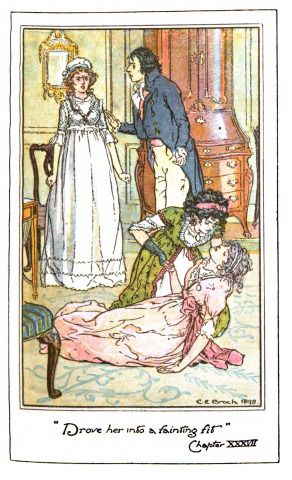
Here we see Mrs. Ferrars lying on the ground, held by her daughter, Fanny. Fanny and John Dashwood enjoyed Anne and Lucy Steele’s company, and invited them to stay for a few weeks with them in London. One day Anne announced that Lucy and Edward Ferrars were engaged. This shocked everyone, and Mrs. Ferrars fainted. Fanny became hysterical and told Lucy and Anne Steele that they had to leave immediately. Lucy Steele was not wealthy, and Mrs. Ferrars wanted Edward to marry a wealthy heiress, Miss Morton. After hearing the news, Mrs. Ferrars disowned Edward after he refused to break off the engagement. This scene appears in chapter 37 as indicated underneath the image. The characters are shown in the traditional regency style, with Mrs. Ferrars, Fanny, and Lucy wearing the regency style dress with an empire waist. Their hair is worn tied up, as was tradition for women after their “coming out” before the queen, signaling her entrance into society. Edward wears a waistcoat and tailcoat. The regency period dated to the early nineteenth century (1811-1820) when George, Prince of Wales, later George IV (r. 1820-1830), reigned as regent for his mentally ill father, King George III (r. 1760-1820). The regency period is associated with the rise of neoclassicism in art and fashion.
Gulliver’s master explained various aspects of the Yahoos that lived in the Country of the Houyhnhnms. He explained that the Yahoos had one who was the ruler. This ruler had a servant whose job it was to lick the feet of the ruler, seen here, and to bring female yahoos to him. The same image appears in the 1843 Krabbe edition.
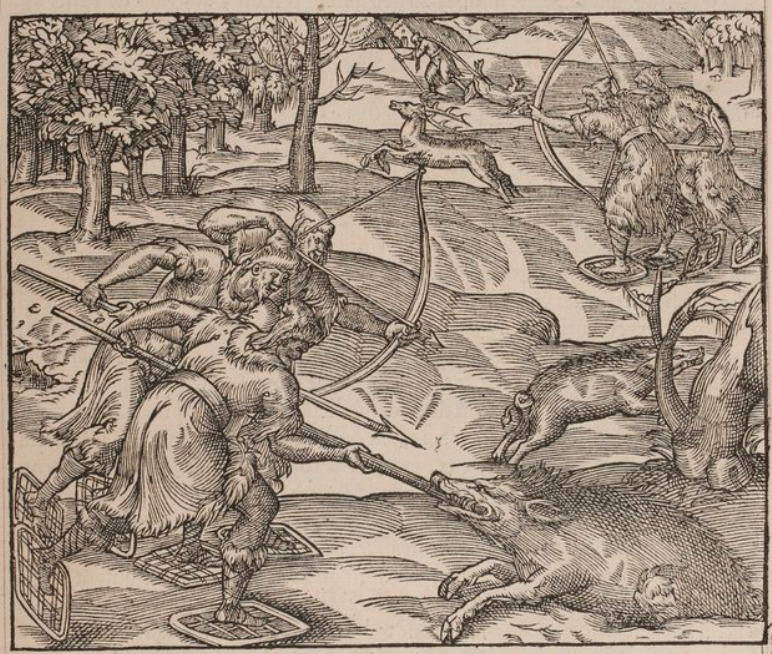
Indigenous people in present-day Canada hunt wild animals including boars and deer in the winter. They hunt in groups of two or three, with one member of each group using a bow and arrow and the other(s) wielding spears. All of the individuals wear furry tunics belted at the waist, caps, tall boots and snowshoes on their feet. This image is identical to one found on page 1011 of Paris, 1575 (l’Huillier).

![[Vanity Fair Chapter LVII Inhabited Initial]](https://cemvccol.ace-net.training/files/large/f8bf39ff061cac10ffe1ed9b913e5905e73b91b1.jpg)
![[George and Amelia]](https://cemvccol.ace-net.training/files/large/7e6da31526e97014a930747f89c5c7190f375e09.jpg)
![[Gulliver encountering beggars on Brobdingnag]](https://cemvccol.ace-net.training/files/large/5c08bd41968163f6a2759e8f64baf9a76caa7c11.jpg)
![[Angel trumpeting]](https://cemvccol.ace-net.training/files/large/d6d8d3ccae6c7ca75f83c8a60fd34ea24afd7b87.jpg)

![[Mr. Bowls Reading in the Kitchen]](https://cemvccol.ace-net.training/files/large/ba40832f184734df4cff097cb55001200230e048.jpg)
![[Animal in Farm House]](https://cemvccol.ace-net.training/files/large/c33633313539f5f5a90d7b4795f76ec1eee5b551.jpg)
![[Gulliver speaks with Captain Pedro de Mendez]](https://cemvccol.ace-net.training/files/large/aea242ca7fff707657409bf96e2a1229ba9a3870.jpg)
![[A Yahoo and Houyhnhnm]](https://cemvccol.ace-net.training/files/large/03e16fb74e3c771a8350fa8150222acfc07185a6.jpg)
![[Gulliver shows the captain of the ship who rescued him things he brought from Brobdingnag]](https://cemvccol.ace-net.training/files/large/b35eb57d518a16cb578e5568e189290476f80482.jpg)
![[Mr. Bowls Reading to his Assistant]](https://cemvccol.ace-net.training/files/large/e193c24f5aed2dffee83d60cc5f426dddb9fa24f.jpg)
![[a servant of the ruling Yahoo licks his feet]](https://cemvccol.ace-net.training/files/large/35d5344b9d4053c1d49fc4b04c39f7f3b04faf27.jpg)