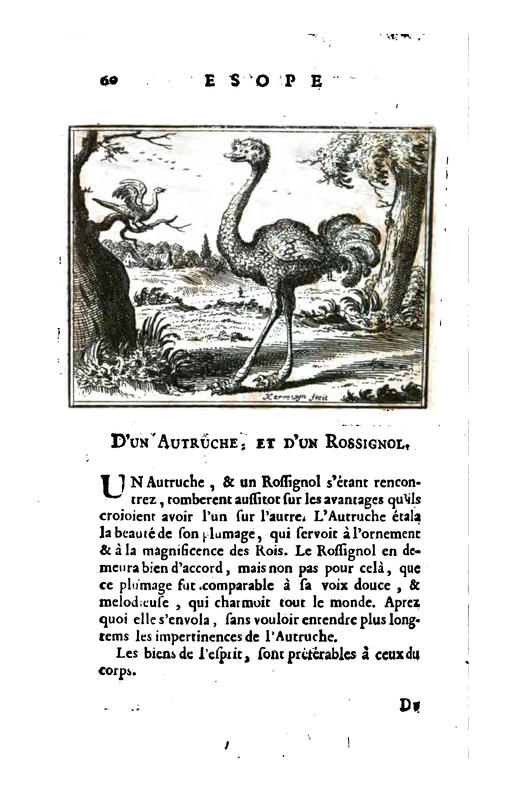
An ostrich, and a nightingale met, and fell in love at once on the advantages which they believed to have one on the other. The Ostrich and the Nightingale were in love with each other, and the beauty of their plumage, which served to adorn and magnify the kings, was the main reason for their love. The Nightingale agreed, but not for that reason, that this plumage could be compared to his sweet and melodious voice, which charmed everyone. After which she flew away, without wanting to hear any longer the impertinences of the Ostrich.
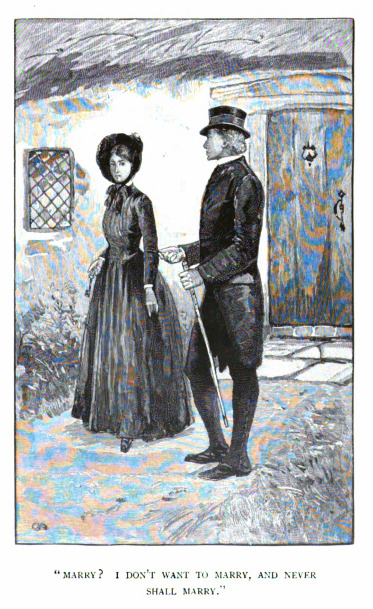
Here we see Mr. Rivers and Jane Eyre standing outside Moor House. Mr. Rivers tried to convince Jane to join him on a mission with the church to India, but she refused. He asked her to marry him before he left to go to India, but Jane refused, saying that she would never get married. He argued that missionary work was much more effective when a married couple went together, but Jane was uninterested.
Two European men stand in the foreground with a Tupinambá man, all three gesture as if having an argument. Beside the group another Tupinambá man runs with his hands over his head, pursued by a winged demon with horns, a curly tail, and talons for feet. The demon has one hand on the man's back holds a switch raised above his head. In the background, other fearsome creatures torment Tupinambá people. The creatures may be based on the spiritual beliefs of the Tupinambá. There is also a village in the background, and a European ship anchored near the coast on the left.
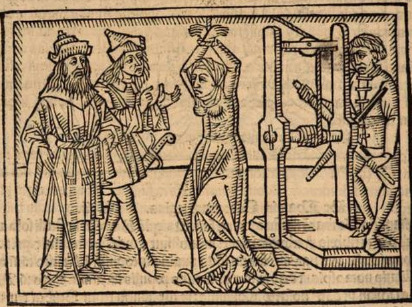
This engraving depicts the prostitute Leaena being tortured for information regarding a conspiracy. She is depicted with her hands bound by rope, which is attached to some form of torturing device that a man is controlling on the right side of the engraving. She is also depicted standing in a burning fire as another torturing method. Boccaccio explains that she is being tortured for being involved in a conspiracy to overthrow a tyrant. In order to avoid revealing information to those torturing her, she bites off her own tongue. The two figures on the left side are the ones attempting to get information regarding the conspiracy from Leaena.
The left panel depicts Celestina, who is in a seated position and is wearing nun-like attire. In her left hand, she is holding what looks like a paper of some sort (likely the charm/spell given to her by Melibea), while in her right she is holding what is likely meant to represent the girdle cord given to her by Melibea. In the right panel we see Melibea’s servant Lucrecia, who is wearing a veil and a robe. In her right hand she is holding flowers. Even as a servant her robe appears somewhat ornate, perhaps intended to demonstrate the wealth of Melibea’s family.The left panel is nearly identical to those found on pages 88 (where there are some added marks that extend her robe, which appear to have been added by hand at a later date) and 208 (where it is labeled ‘Elicia’). The right panel is nearly identical to the those found on pages 170 (where it is labeled ‘Lucresse’ instead of 'Lucrecia') and 216 (labeled ‘Alisa’).
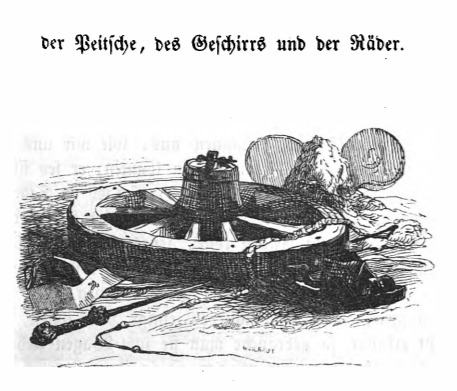
Here we see a pile with whips for horses, harnesses, and wheels for carriages. The Houyhnhnms asks about the horses in Europe and how they live. Gulliver explains that humans or yahoos govern the country and care for the horses or Houyhnhnms, and how humans use their horses, including the uses of whips and harnesses in controlling horses, and wheels on carriages. The same image appears in the 1839 Krabbe edition.
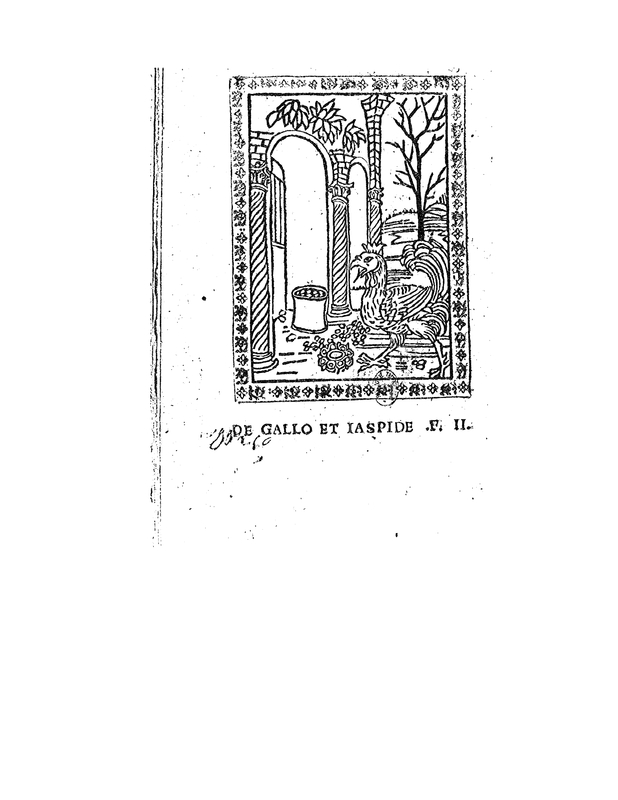
A cock who has stumbled upon a precious stone or jewl after diggin through a bag of grain. The setting seems to be on a path leading under a greek styled archway
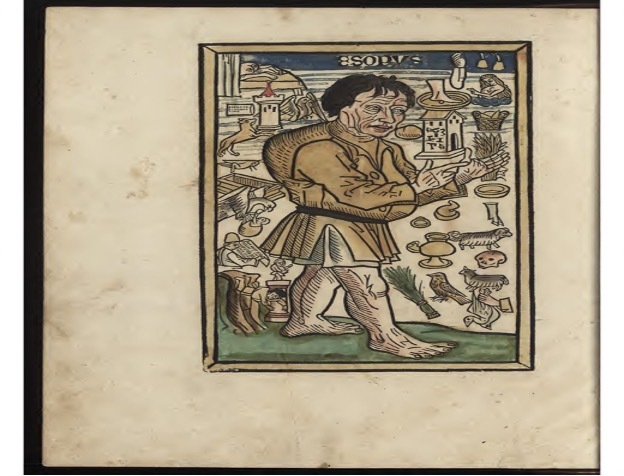
Depiction of Aesop, Greek storyteller. Aesop stands in middle of the engraving, surrounded by objects of significant life events. Importantly is the representation of his slavery, death by being thrown from a cliff, and mission for the King Croesus.
Here we see Gulliver sitting in front of the King of Brobdingnag’s cavalry. Gulliver is seated on a table with the back to the viewer. He faces four men riding horses, two of whom have spears. All the men have facial hair and wear pointed caps. There are several other rows of cavalry men in the background. The same image appears in the 1843 Krabbe edition.
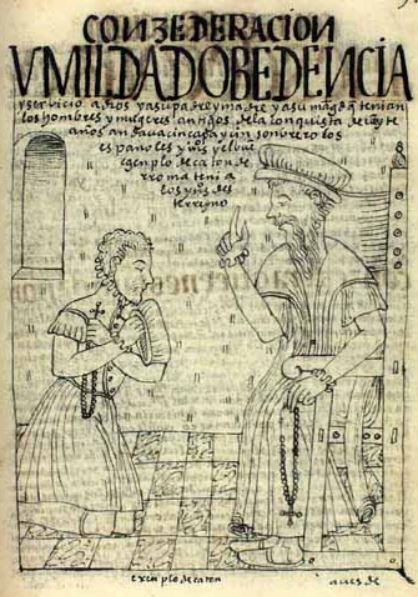
This image demonstrates a young man kneeling before his father to show his respect. The young man’s Spanish father is depicted sitting on a large chair on the right side of the image holding a rosary in his left hand and pointing to his son in an authoritative manner with his right. The son is holding a rosary in his left hand and his hat in his right as he looks to the ground in respect for his father. The author urges his Christian readers to have respect for their fathers, mothers, God, and to the king. The caption at the top of the image reads, “Que tenian los hombres y mugeres antigos de la conquista: de ueynte anos andaua cin capa y cin sonbrero los espanoles y indios y el buen egenplo de Caton de Roma tenia los yndios deste rreyno” [Among the men and women in the old time of the conquest, to the age of twenty, Spaniards and Indians wore no cape or hat, and the Indians of this kingdom kept the good example of Cajetan of Rome].
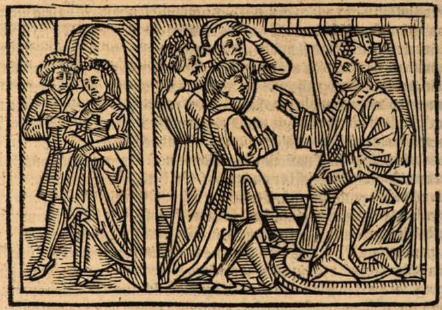
A man wearing a red robe and hat entrusts a bag of money to another man wearing a blue robe and hat that is sitting on a chair at a table in the seated mans house.
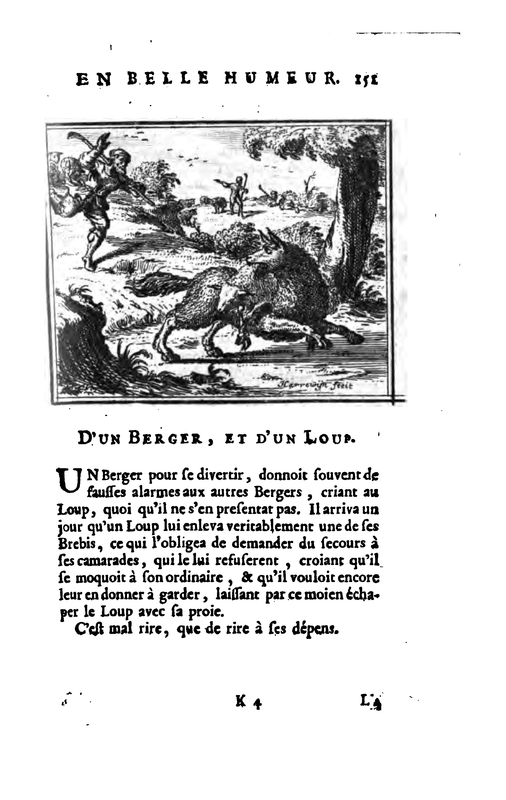
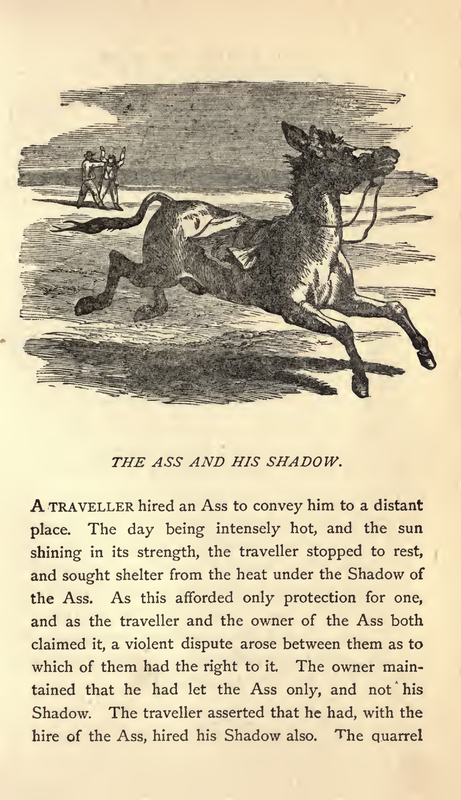
A young shephard found life in the pasture very dull. He thought up a plan to amuse himself. His master told him to call for help if a wolf attacks the flock, and the villagers would drive it away. So, though he had seen no wolf, he ran to the village crying Wolf! Wolf! The villagers ran to assist but found the boy laughing at the trick he had played on them. A few days later the boy again called to the villagers, and again came to help, only to be laughed at. Then one day a wolf really did come to kill the sheep, and the boy ran to the village shouted Wolf! Wolf! But the villagers did not run to help him, as they thought it was another trick. The wolf killed many of the sheep and got away.
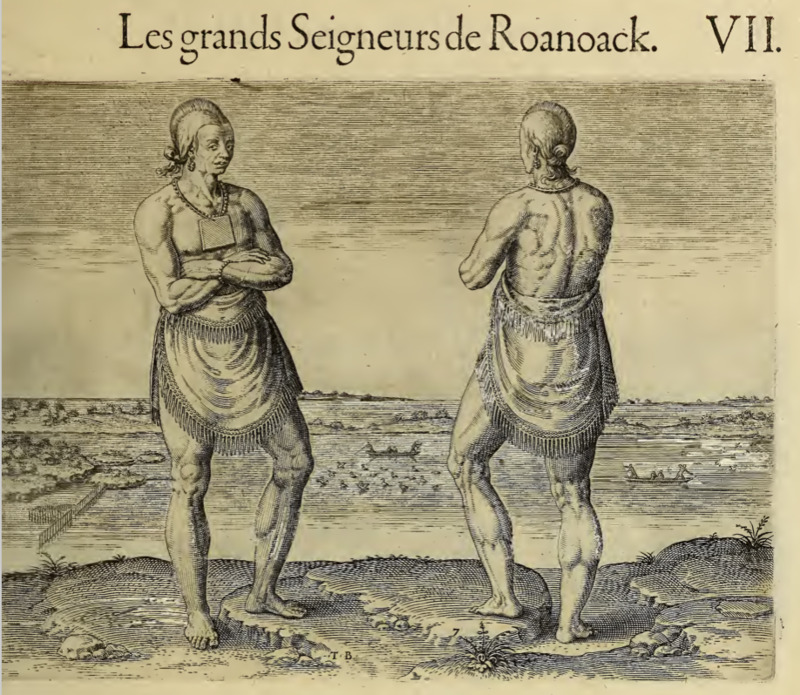
An Indigenous man, a chief, is pictured from the front and from behind standing on the bank of a river. A section of his hair is feathered in the middle of his head from his forehead to the nape of his neck, where the rest of his hair is gathered in a knot. He wears beaded earrings, a necklace with a large square pendant, and beaded bracelets around his wrists. He wears a fringed skirt draped around his waist and is barefoot and shirtless. In the background, other Indigenous people are seen in canoes, and there is a fishing apparatus in the water in the left part of the background.
This engraving depicts the tragic fate of a young virgin woman from Rome named Verginia. Boccaccio explains that one of the decemvirs, Appius Claudius, fell madly in love with Verginia. Despite already being betrothed to another man, Claudius devised a plan to have Verginia as his own. Claudius had gotten one of his freedmen (Marcus Claudius) to capture Verginia and claim her as a slave. Verginia’s father, Verginius, went to the trial and protested the sentence of his daughter becoming a slave. Appius Claudius, however, was the judge presiding over the case, and officially decreed Verginia to be a slave. This court trial is depicted on the right side of the engraving, with Claudius sitting on the chair with his finger pointing towards Verginia, Verginius, and Verginia’s betrothed, Icilius. After Claudius decrees Verginia to be enslaved, her father takes a knife and stabs her with it as his only way to save her. This is depicted on the left side of the engraving, which illustrates Verginius piercing his daughter’s chest.
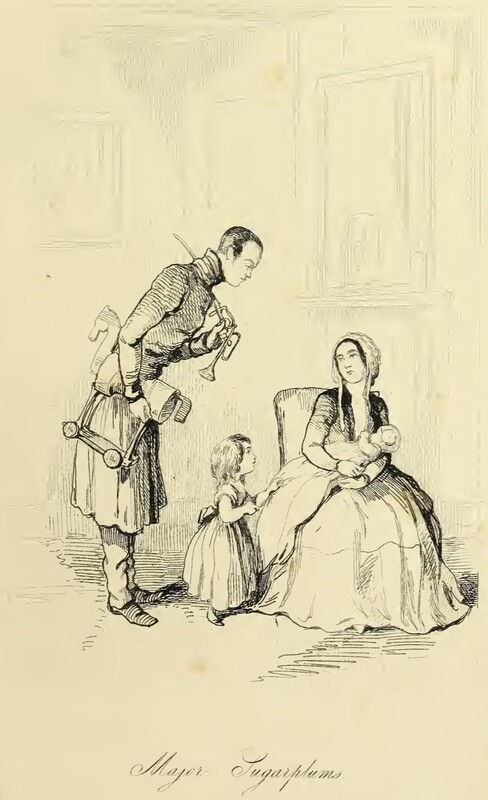
William Dobbin, carrying a toy sword, trumpet, and wooden horse on wheels, bows to Amelia Osborne. She is seated on a chair, holding her son Georgy, who is asleep. At her side is Mary Clapp, the landlord’s daughter, acting as the mistress of ceremonies to announce Dobbin. Below the illustration is printed in cursive its title, “Major Sugarplums”.
The Cid sits on his horse, preparing to go to Toledo for a Cortes. The Cortes has been convoked as a result of the actions of his two sons-in-law, the Counts of Carrion, who tortured his daughters and left them tied to trees in the mountains as revenge for their humiliation during the lion incident. They fortunately survived and were saved by a local man who found them. In response, the Cid has King Alfonso convoke a Cortes, which all the nobles are required to attend. The image shows Ximena comforting the Cid before he sets off and encouraging him to take vengeance on the Counts.
Here we see an image of a machine created by one of the professors from the Grand Academy on Balnibarbi. This machine had all the words in the language of Balnibarbi in different moods, tenses, and declensions written on blocks. These blocks were held together by wires on a frame, and students of the professor would rotate the handles, forming different arrangements of the words. They would then find sentence fragments and record them in this book. The goal of this experiment was to create a complete body of work that comprised all of the arts and sciences. The same image appears in the 1839 Krabbe edition.
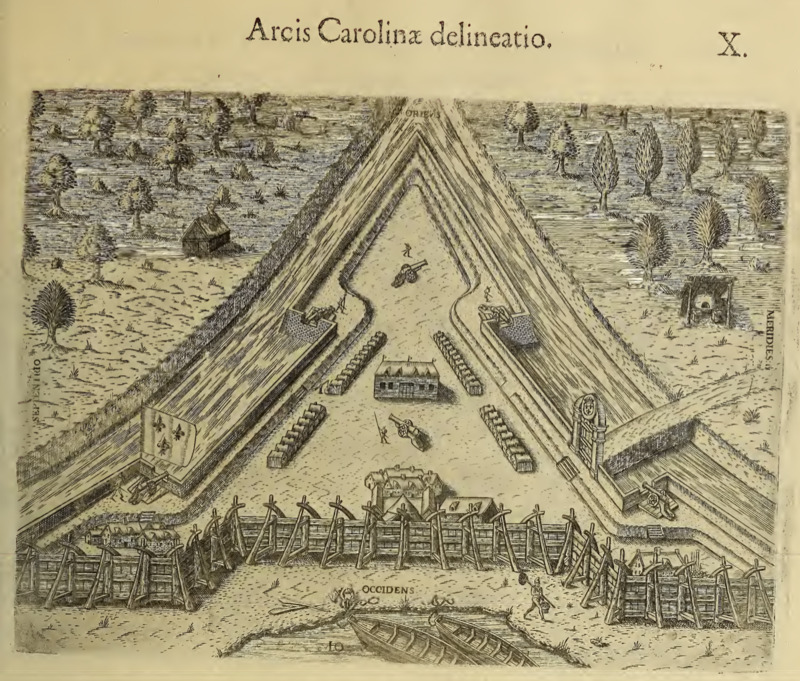
A fort, in the process of being built, is shown. The fort is situated on an island in the middle of a river and is triangular. A bridge on one side connects the island to the opposite riverbank. The front of the fort has a high wooden wall, and just inside the walls a trench runs all the way around the perimeter. Within the fort are cannons and various buildings. According to the caption, this is a depiction of Fort Caroline.
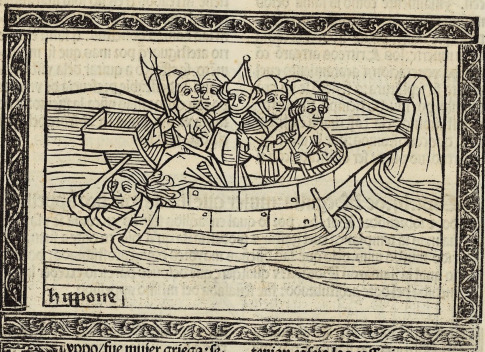
Boccaccio explains that a Greek woman named Hippo had been captured by enemies, and when she heard them speaking of defiling her chastity, she decided that an early death was far better than having her honour destroyed. This engraving depicts Hippo on a boat surrounded by the men who had captured her. Hippo is illustrated at the front of the boat with her body plunging into the water. She drowned and successfully saved her honour. Her name is engraved at the bottom left corner of the engraving.

![[A Tupinambá village full of mythological creatures]](https://cemvccol.ace-net.training/files/large/004d7fbef6fc756185d7fa82c4c2420c6c048338.jpg)

![[Act IV – Celestina and Lucrecia]](https://cemvccol.ace-net.training/files/large/1205426391e294077e55b80d129043e8959d255f.jpg)


![[Gulliver with the King of Brobdingnag’s cavalry]](https://cemvccol.ace-net.training/files/large/ed63462b7a61dc51e3d258305c1d15e7f1113d2e.jpg)
![Esopi Appologi siue Mythologi cum quibusdam carminum et fabularum additionibus Sebastiani Brant [The second admonition: Of entrusted money]](https://cemvccol.ace-net.training/files/large/319687ce47b1c53e3eba18a4395d22feac052e49.jpg)
![[The Cid prepares to leave for the Cortes]](https://cemvccol.ace-net.training/files/large/68ae19f2ddd5caec51d2bf4b758008fa25e868f9.jpg)
![[An invention from the Grand Academy of Lagado to revolutionize language]](https://cemvccol.ace-net.training/files/large/816aca6a570ff41e9ffe498b0e6a5271d11109d2.jpg)