Here Gulliver’s house is rescued by sailors after he was dropped into the ocean by an eagle. We see a rowboat with five men pulling in Gulliver’s house. In the background we see the large sailing ship that brought Gulliver back to England. Gulliver had a difficult time adjusting to interacting with humans his own size. The same image appears in the 1839 Krabbe edition.
This illustration is associated with the scene in which Calisto, while practicing his falconry, first encounters Melibea in her garden. Calisto is taken by her beauty, and from that moment on he calls her his goddess. Melibea is shown wearing a crown and an ornate robe, representing her high social standing. Calisto, although he too is wealthy and a member of the nobility, is shown in a far more humble attire - a simple hat and cloak.
Here we see a group of Houyhnhnms carrying a deceased Houyhnhnm. They carry the body towards a cave that will serve as a tomb. This image appears when Gulliver explains the lifecycle of the Houyhnhnms and their burial rites. The same image appears in both the 1839 and 1843 Krabbe editions.
Here we see Gulliver with representations of his travels. In the foreground we see Gulliver kneeling. A giant from Brobdingnag sits on top of a podium. The giant holds the floating island of Laputa over his head, with Gulliver’s ship in front of him. A Houyhnhnm and a yahoo are inside of the podium. In Gulliver’s hands is a Lilliputian. This image also appears in the 1843 Krabbe edition.
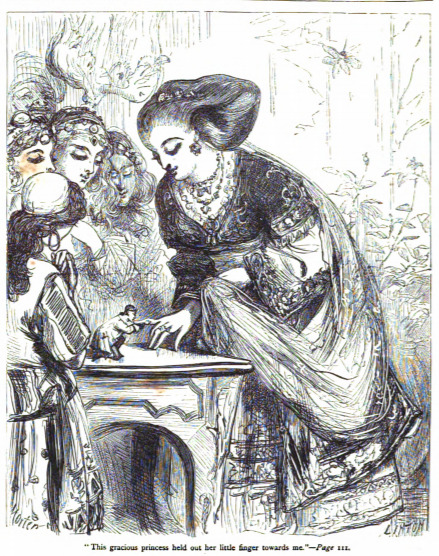
Here we see the Queen of Brobdingnag meeting Gulliver. He asked to kiss her foot, however, she held out her hand so that Gulliver could kiss her little finger. This happened after the Queen discovered Gulliver at one of his performances and she brought him back to her palace to live with, and entertain, her court.
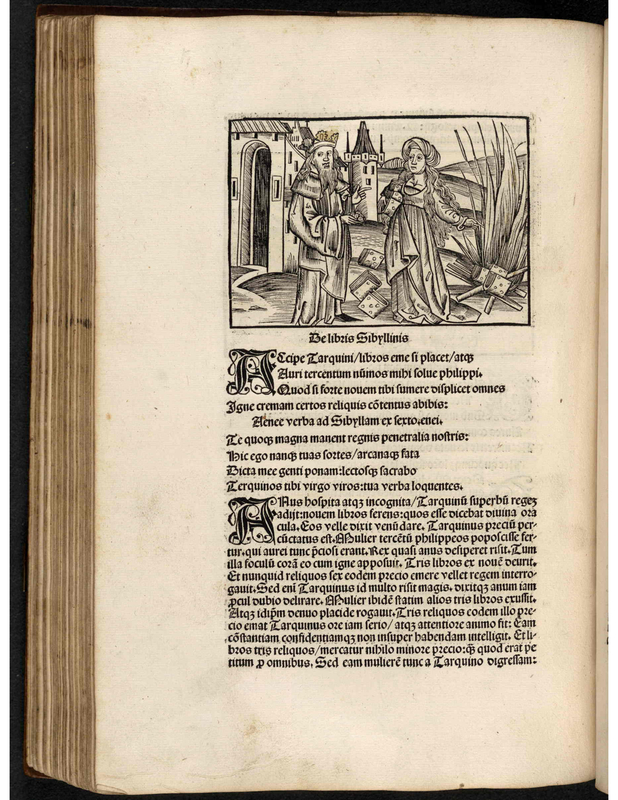
A man wearing a crown stands with a woman but is not looking at her. The woman points to a bonfire of books. The woman holds books and there are books scattered on the ground.
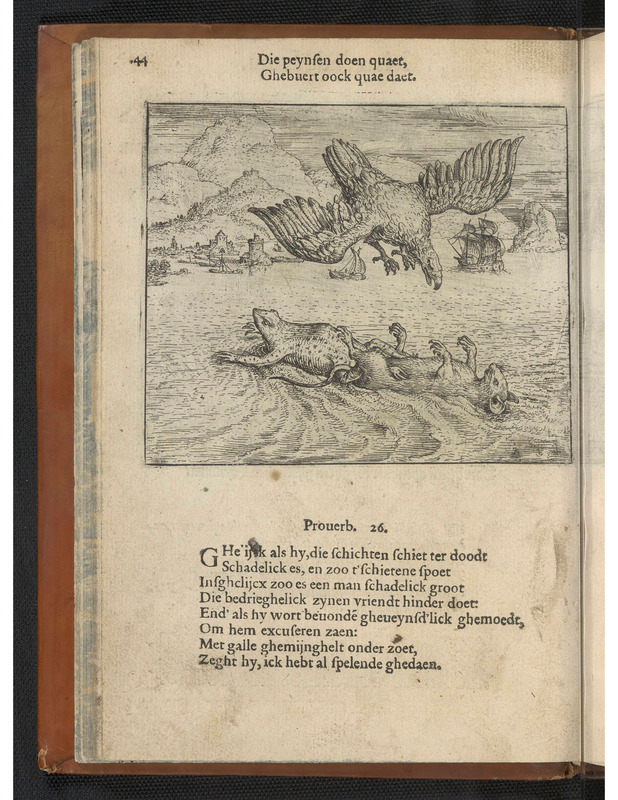
A frog, a mouse, and a hawk. A frog swims in a pond with a mouse tied to its back leg. The mouse floats stiffly on its back with its limbs in the air. A hawk drives for the sky reaching for the mouse.
When Pármeno awakes at Areusa’s house, he discovers that it is already noon. Areusa (rightmost figure) asks him to stay and talk, but he tells her that Calisto will already be upset with his lateness. He asks her to join him, Sempronio, and Elicia for dinner at Celestina’s house, and she happily agrees. When Pármeno arrives at Calisto’s house, he is greeted by Sempronio, who chides him for his lateness (presumably depicted by the two leftmost figures). Pármeno explains that he has joined Sempronio and Celestina in their scam, and that he fallen in love with Elicia. Their friendship rekindled, they enter Calisto’s bedroom, where they find Calisto (right-central figure) talking to himself in verse. They tell him the time of day, and he decides to go to Saint Mary Magdalene’s church to pray.[The figures in this illustration are used in multiple other illustrations throughout this edition.]
This image is of a large anchor with rope. Two large ships are visible in the background. The image appears at the beginning of a letter from Richard Tymp, Swift’s cousin. The anchor is also used to represent the letter “I”, as the first letter of the German word “ich” which is the first word of the chapter. The same image appears in the 1839 Krabbe edition.
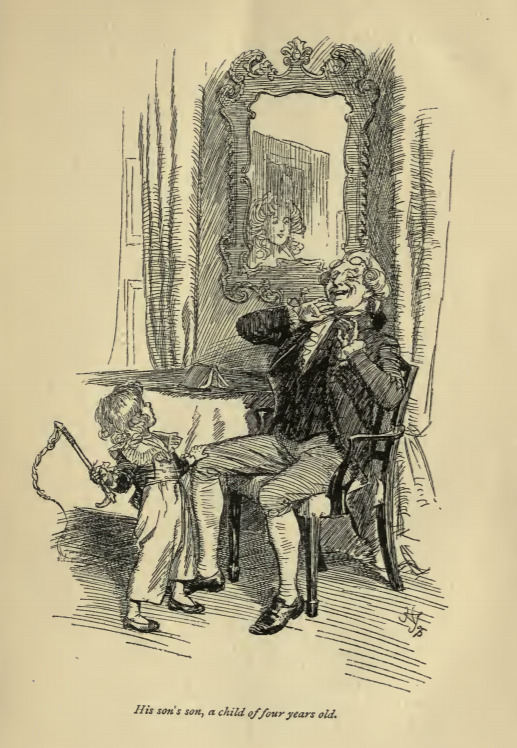
In this image we see Mr. Dashwood with his grandson. The novel opens with Mr. Dashwood’s death, and his leaving his estate to his son, John Dashwood, and his grandson. There was a caveat that John Dashwood was supposed to support his half-sisters, Elinor, Marianne, and Margaret, and his stepmother. This was a system called primogeniture in which all of the inheritance would go to the eldest son. It was the most common form of inheritance at this period. Here we see Mr. Dashwood playing with his grandson, and his mother, Fanny, is visible in the reflection of the mirror. This scene occurs in chapter 1. The characters are shown in the traditional regency style, as Mr. Dashwood and his grandson wear waistcoats and tailcoats with breeches and cravats. The regency period dated to the early nineteenth century (1811-1820) when George, Prince of Wales, later George IV (r. 1820-1830), reigned as regent for his mentally ill father, King George III (r. 1760-1820). The regency period is associated with the rise of neoclassicism in art and fashion.
William Dobbin sits slouched against the base of a tree, reading a book. In the far background are the buildings of Dr. Swishtail’s academy. Near the buildings are a few distant figures of boys playing games. Between Dobbin and the buildings, on the right side of the image, Cuff is holding George Osborne by the collar and threatening him.
In this scene Calisto appears very impatient and irritable. Soon after Celestina leaves his house (seen on the left side of the image), he tells Sempronio to pay her a visit and hasten her along in remedying his pain (his love for Melibea). Sempronio replies that he would rather keep Calisto company to distract him from Melibea. Calisto orders him to go and make Celestina suffer if she cannot make more progress, because his health depends on her. Later, Pármeno tries to convince his master that the deal will lead him to lose himself. He fails, however, and leaves Calisto to do as he pleases.Celestina is depicted in a robe and a veil. She is holding a pouch in her left hand, likely the 100 crows of gold given to her by Calisto. The three male figures are all wearing hats and cloaks. Pármeno appears to have an extremely long sword of some sort mounted on his belt, which is extending in front of Calisto's left leg.
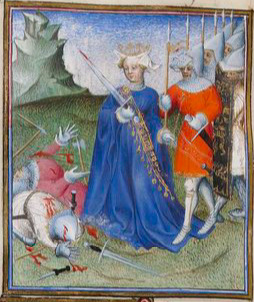
Though some resented her for it as a woman, Artemisia was very smart when it came to her army. After the death of her husband, she hardly used her army aside from protecting her land and maintaining relationships with allies. The image depicts Artemisia leading her army in a blue gown, holding a bloodied shield. They face the downed enemy soldiers.
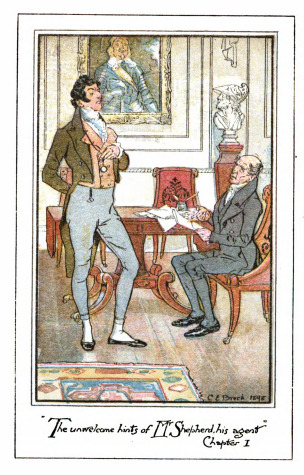
Here we see Sir Walter Elliot speaking with his agent, Mr. Shepherd. Sir Walter was a widower who was spendthrift. The novel opens with Sir Walter having to force Kellynch Estate because he could no longer afford to live there. Sir Walter was initially resistant to the idea of leaving Kellynch but after some convincing by his agent and finding suitable tenants in Admiral and Mrs. Croft, Sir Walter agreed to let Kellynch estate and move to Bath. This scene occurs in chapter 1 as noted underneath the title of this image. The characters are shown in the traditional regency style, with Sir Walter and Mr. Shepherd wearing waistcoats and tailcoats. The regency period dated to the early nineteenth century (1811-1820) when George, Prince of Wales, later George IV (r. 1820-1830), reigned as regent for his mentally ill father, King George III (r. 1760-1820). The regency period is associated with the rise of neoclassicism in art and fashion.
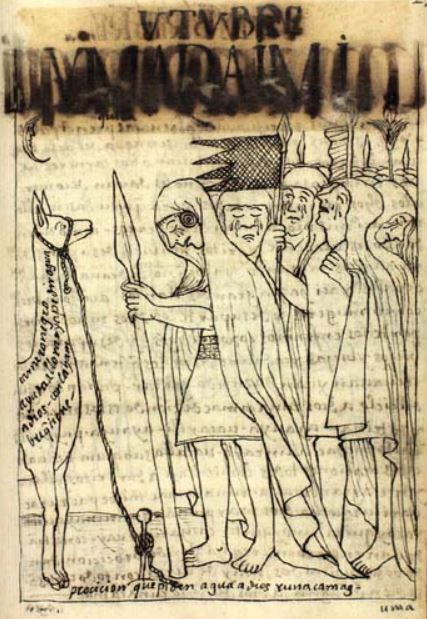
This chapter is dedicated to discussing the traditions and rituals of each month during the Inca Empire. The Incas tracked the months and years through the stars and their months consisted of thirty days. This image depicts the month of October, which was dedicated to making sacrifices to Runa Camac for rain for their crops. They would tie up llamas and starve them in order to make them weep. This is depicted on the left side of the image. The people would walk from hilltop to hilltop while weeping and crying and chanting to the god Runa Camac to provide them with rain. This is also depicted in the image as a crowd of people standing in front of the llama have tears running down their face. The caption on the image reads “carnero negro ayuda a llorar y a pidir agua a dios con la hambre que tiene, procicion que piden agua a dios runa camag.” This translates to “a black llama that is hungry assists in weeping and asking the gods for water, procession in which god Runa Camac is asked for rain.”
A woman in a powdered wig and frilled gown performs a curtsey. Opposite her is a man, also in a powdered wig, holding a triangular hat in his hand. The two are framed by a candle-holder in the shape of the letter G from “Good”.
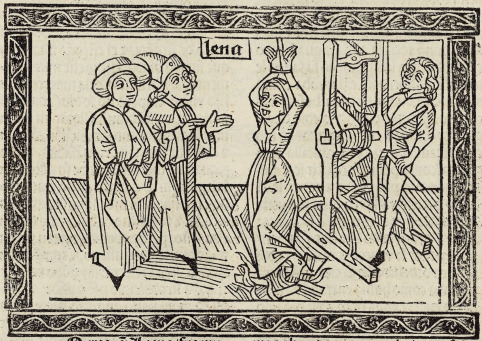
This engraving depicts the prostitute Leaena being tortured for information regarding a conspiracy. We know that the woman being tortured in this image is Leaena as her name, spelled as “Lena”, is engraved above her head. She is depicted with her hands bound by rope, which is attached to some sort of torturing device that a man is controlling on the right side of the engraving. She is also depicted standing in a burning fire as another torturing method. Boccaccio explains that she is being tortured for being involved in a conspiracy to overthrow a tyrant. In order to avoid revealing information to those torturing her, she bites off her own tongue. Her tongue is depicted sticking out of her mouth in this engraving. The two figures on the right-hand side are unknown by name, however, they are significant as they are the ones attempting to get information regarding the conspiracy from Leaena.
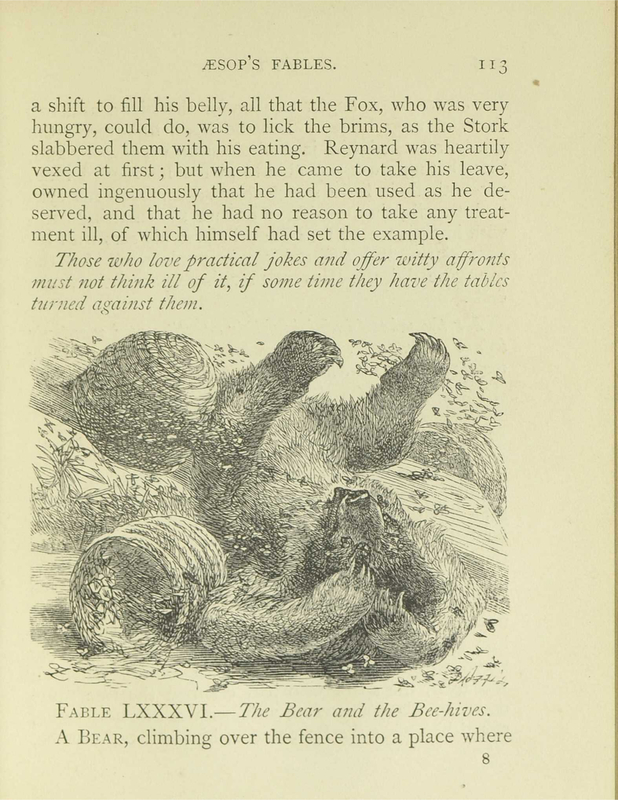
A bear rolled over on its back with its hind legs in the air covers its eyes against a swarm of bees. The beehive is split open on the left side of the page. The bear's lower back rests on top of a fence. Another beehive lies broken on the far right of the page.

![[Bust of Jane Waring]](https://cemvccol.ace-net.training/files/large/d5e643448dfb2de184a66bb15dc144868115dd05.jpg)
![[Gulliver’s house is rescued by sailors]](https://cemvccol.ace-net.training/files/large/7f3a738e1d209eb567a96d665b61198d14f45ae3.jpg)

![[Act I - Calisto First Meeting Melibea]](https://cemvccol.ace-net.training/files/large/6f94bb611b597b6abe8d9505f292f1a4006518ca.jpg)

![[Person Giving a Gift]](https://cemvccol.ace-net.training/files/large/8a7c91940d1b488680e33e3776e9b0cfbf035624.jpg)
![[the burial rites of the Houyhnhnms]](https://cemvccol.ace-net.training/files/large/202490f9a4a941ef4176588cf5c42321373e2482.jpg)
![[Representations of all of Gulliver’s travels]](https://cemvccol.ace-net.training/files/large/0f7ccc01c1a568a3ee2cc774025b51ea7bfa7946.jpg)
![[Act VIII – Sempronio, Pármeno, Calisto, and Areusa]](https://cemvccol.ace-net.training/files/large/37655d2f16b20e9d040c1c192a128c940549819c.jpg)
![[Ship’s anchor]](https://cemvccol.ace-net.training/files/large/b74ca7382b8e2f80011914fa8515efe26a1f5dfa.jpg)
![[Dobbin at School]](https://cemvccol.ace-net.training/files/large/45c4bc1aaaf92575da042b445d7e1ae20ed373bf.jpg)
![[Act II - Calisto’s Impatience]](https://cemvccol.ace-net.training/files/large/b52bc51cd7840f639a7ac71a0dbe83cb8e904467.jpg)

![[Vanity Fair Chapter LX Inhabited Initial]](https://cemvccol.ace-net.training/files/large/b63ef7ba69f496663227ff944735df47fab13a6e.jpg)