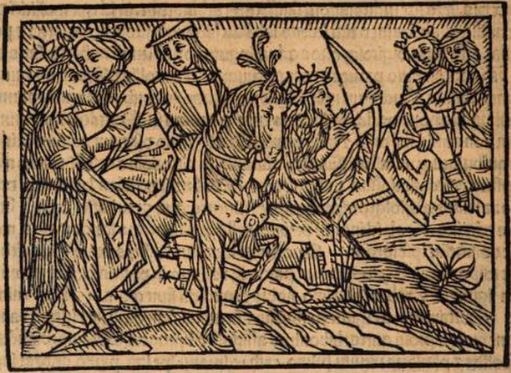
Hercules is depicted on the left side of the engraving holding his new wife Deianira in his arms as they attempt to cross the Evenus river. Hercules is illustrated with a wreath on his head and a bow and arrow by his legs. Deianira is illustrated wearing a crown while looking at her husband. A man named Nessus is depicted beside Deianira, holding his arm out to her as he offers to take her across the river on horseback. Boccaccio explains that Nessus was riding horseback, however, Nessus is known to be a centaur in Greek mythology. Boccaccio explains that Nessus betrayed Hercules’ trust and began to run away with Deianira after crossing the river. Hercules uses a poison infused arrow to shoot Nessus and rescue his wife. This is illustrated in the background on the right side of the engraving. Hercules’ bow is in hand, and his arrow is sticking out of Nessus’ chest.
Here we see Gulliver walking through the streets of Lisbon with Don Pedro. Gulliver had a difficult time readjusting to life in Europe as he was accustomed to the virtues of the Houyhnhnms. Gulliver hold a cloth with rue or tobacco to his nose so he cannot smell the city, which Gulliver could not stand. The same image appears in both the 1839 and 1843 Krabbe editions.
This is a bust of Voltaire, an influential philosopher writing at the same time as Swift. Voltaire promoted the translation of Gulliver’s Travels into other languages, first French, on the European Continent. The image is a part of Swift’s Biography which precedes Part One of Gulliver’s Travels. The purpose of this illustration in the biography is to provide context for the political atmosphere and insight into Swift’s satirical writings. The same image appears in the 1843 Krabbe edition.
The left panel depicts Elicia standing outside. She is wearing a robe and veil, with what appears to be a rosary hanging from her waist. In the right panel, we see Sosia pointing upward. He has a sword mounted on his belt.The entire image is nearly identical to the one found on page 105 (where the left panel is labeled ‘Celestina’ and the right is labeled ‘Pármeno’). The left panel is nearly identical to the panel found on the title page (where it is labeled 'Celestine' and has added colour), the one found at the end of the book (labeled 'Celestine'), and those found on pages 51, 82, 150, and 162 (labeled ‘Celestine’). The right panel is nearly identical to those found on pages 43 and 135 (where it is labeled ‘Pármeno’), and identical to those found on pages 190 and 235.
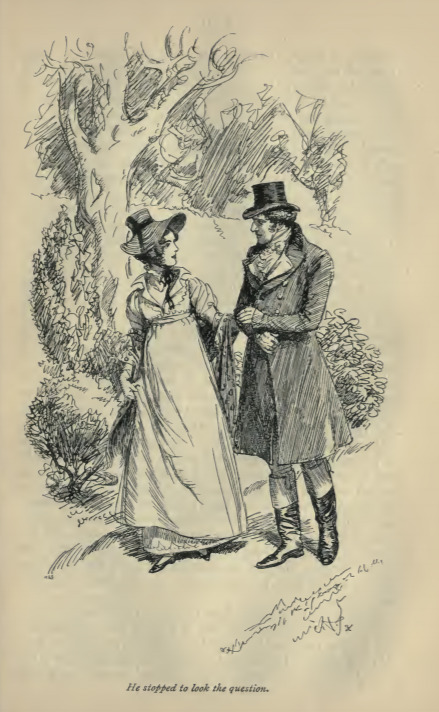
In this image Mr. Knightley tells Emma that he loves her. She was out on a walk in the gardens of Hartfield. She was upset because after finding out that Harriet loved Mr. Knightley, she came to the realization that she herself loved him. Mr. Knightley confesses that he had loved her for a long time and was jealous of Frank Churchill because he thought that Emma loved him. Emma responded that her love for Frank Churchill was not real, and that she had always loved him. This scene occurs in chapter 49. The characters are shown in the traditional regency style. Emma wears a regency style dress with an empire waist and a bonnet. Mr. Knightley wears a tailcoat and an overcoat with a cravat. The regency period dated to the early nineteenth century (1811-1820) when George, Prince of Wales, later George IV (r. 1820-1830), reigned as regent for his mentally ill father, King George III (r. 1760-1820). The regency period is associated with the rise of neoclassicism in art and fashion.
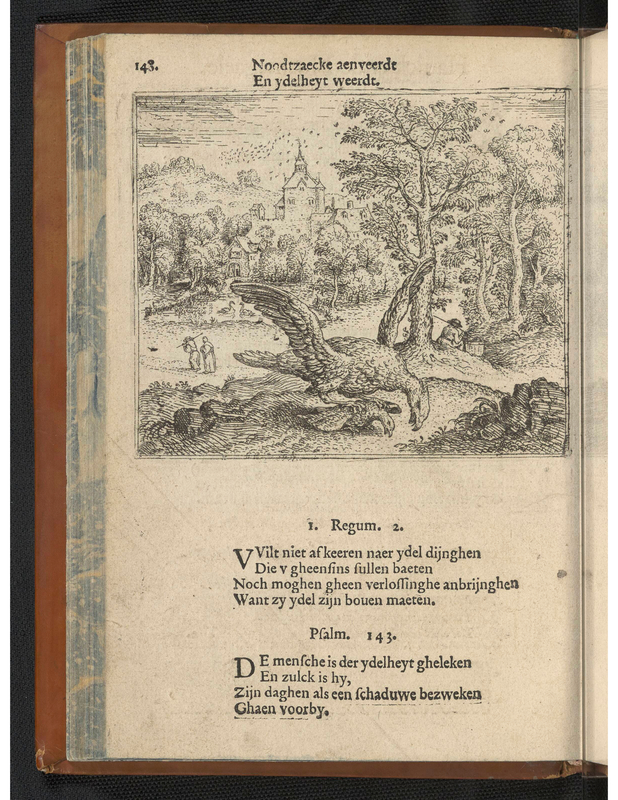
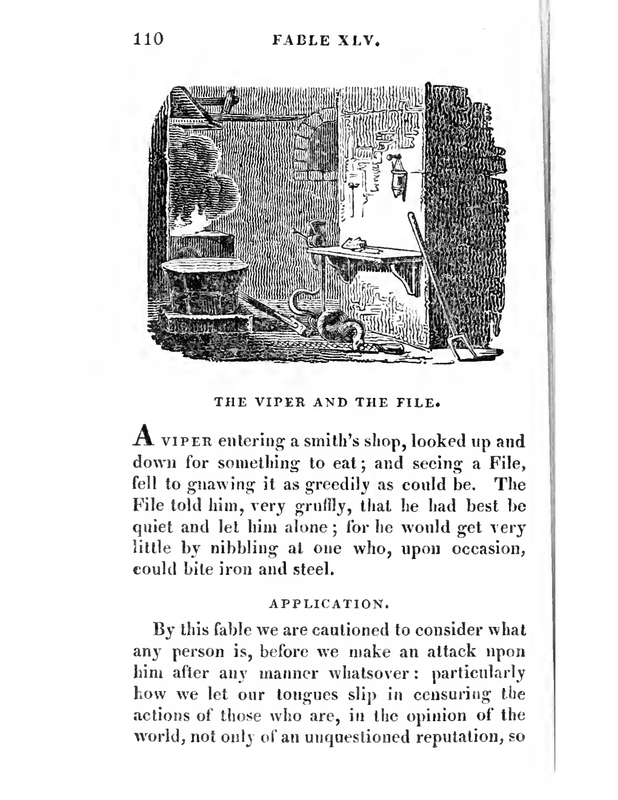
A setting of the inside of a smith's shop. There is a protruding wall on the right. On this wall is a hanging lantern, hammer, and shelf. A pitchfork is leaning against this shelf. A viper is in the centre on the floor and is coiled up, biting a file. To the left is a wooden cylinder for working on and a bench behind this. There is a fire and smoke on top. On the far back wall, there is a window surrounded in bricks in a semicircle shape.
A boy with short curls and a girl with long ringlets and oversized ribbons walk towards each other on tiptoes, both smiling. Between and above them is a large letter T, from “The”.
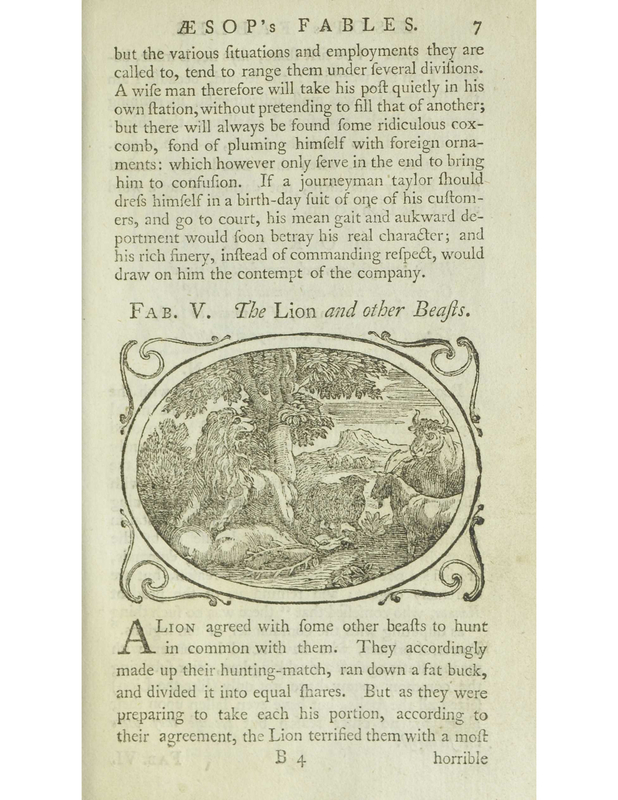
There is a lion standing on top of a buck. It appears that he has ownership of the slayed corpse. The lions mouth is open, as it were sending out a roar. There are three other beasts beside the lion. The three other beasts are staring at the lion with discontent. There are trees and plains in the background of the picture.
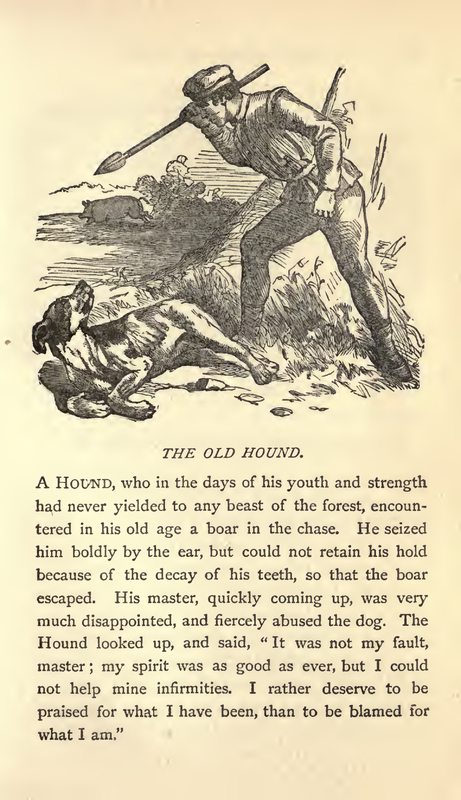
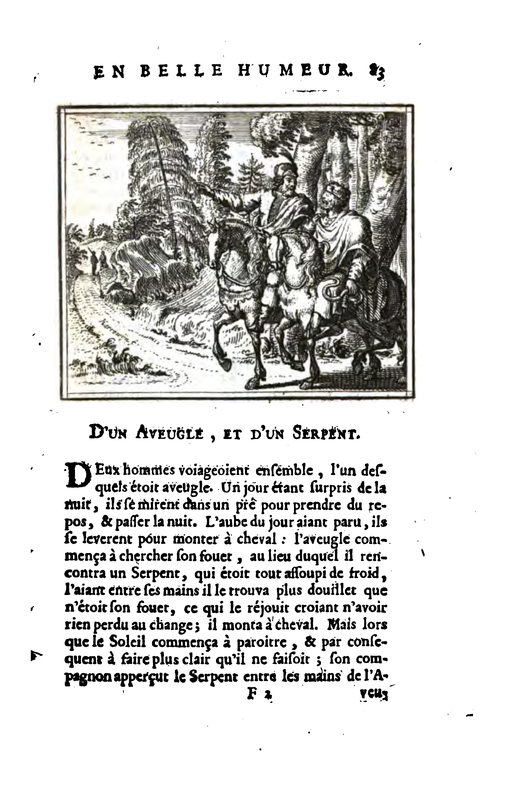
Two men were sailing together, one of whom was blind. One day, surprised by the night, they went to a meadow to rest and spend the night. When the day dawned, they got up to ride; the blind man began to look for his horse, at the place of which he met a Snake, which was all drowsy with cold, and which had to be rid of him.
Here we see three giant wasps attacking Gulliver after he was given a piece of sweet cake. Two wasps are flying around Gulliver’s head, while a third is lying, dead, on its back in front of Gulliver. Gulliver stands, waving his sword, defending himself from the wasps. The same image appears in the 1843 Krabbe edition.
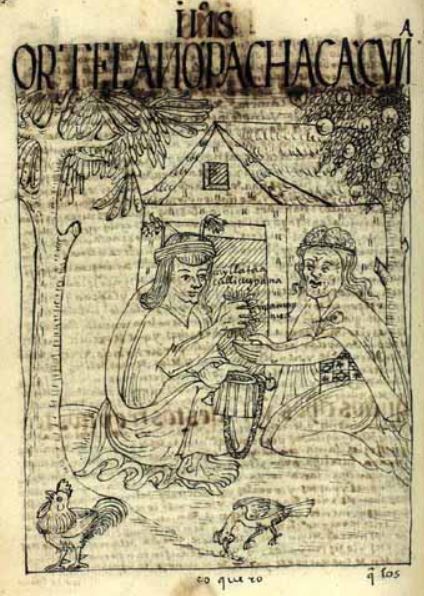
This image depicts native Peruvian horticulturalists tending to their garden. The man and woman are depicted sitting in front of a small house. There is a coca tree on the left side of the image and a fruit tree on the right. The man is depicted sharing his coca leaves with the woman. They are both depicted wearing a traditional unku [tunic] with shawls wrapped over their shoulders. There are two chickens walking around their property. There is dialogue written between the man and woman which reads, “cayllata acullicuy, pana” [sister, chew this coca]. The woman replies, “apomoy, tura” [give it, brother].
This illustration depicts Verginia being cast out of a temple dedicated to Patricia Pudicitia due to being married to a plebeian man. She is illustrated being physically pushed out by someone who is standing behind her with their hands on her back. Verginia thought this was unjust as, despite being married to a plebeian, she was a noblewoman herself. In response to being kicked out of the temple, Verginia created her own temple for plebeian women, consecrated to Plebeia Pudicitia. She is depicted in the background of the image in front of the small altar of her new site.
Gulliver’s master explained various aspects of the Yahoos that lived in the Country of the Houyhnhnms. He explained that the Yahoos had one who was the ruler. This ruler had a servant whose job it was to lick the feet of the ruler, seen here, and to bring female yahoos to him. The same image appears in the 1839 Krabbe edition.
The Cid stands with a cross around his neck, holding his sword and shield and wearing a helmet. A man and a horse are seen behind him, the horse presumably being his horse Babieca.
Here we see a scientist from the Grand Academy on Balnibarbi who was working to use spider’s webs to make clothing. Gulliver walks into his studio that is covered in cobwebs, and the scientist tells Gulliver not to disturb them. The scientist was attempting to domesticate spiders and use their webs in a similar manner to silkworms. He even went as far as to attempt to alter the spider’s webs through feeding them certain foods so that the webs they spun were colourful. In this image we see the scientist’s laboratory, whose walls are covered in cobwebs. On the table we see an apparatus used to wrap the webs into thread. The scientist wears a robe with images of insects on it. The same image appears in the 1843 Krabbe edition.
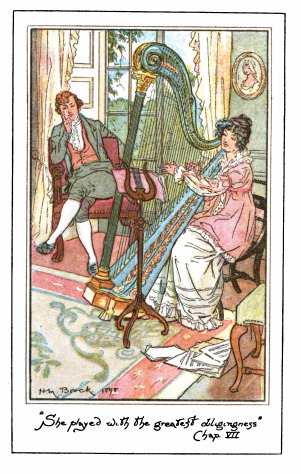
Here we see Mary Crawford playing her harp at the parsonage near Mansfield Park. Miss Crawford arrived at the parsonage near Mansfield after her sister and her husband, Dr. And Mrs. Grant, moved in. Miss Crawford and her brother, Henry Crawford, quickly became close friends with the Sir Thomas’ children, Thomas, Edmund, Maria, and Julia, and their cousin, Fanny. Miss Crawford had her harp brought from her home in Northamptonshire. Playing music was seen as a noble pastime for upper class women in this era, and women were expected to be skilled in some form of artistic endeavor, typically either music or drawing. In this image, Miss Crawford sits playing her harp with her music in a folder on a stand in front of her. Edmund sits next to Miss Crawford playing the harp, listening intently. Edmund fell in love with Miss Crawford and intended to marry her. This scene occurs in chapter 7 as noted underneath the title of this image. The characters are shown in the traditional regency style. Mary Crawford wears the regency style dress with an empire waist. Her hair is worn tied up, as was tradition for women after their “coming out” before the queen, signaling her entrance into society. Edmund wears a waistcoat and tailcoat, and knickers that stop at the knee. The regency period dated to the early nineteenth century (1811-1820) when George, Prince of Wales, later George IV (r. 1820-1830), reigned as regent for his mentally ill father, King George III (r. 1760-1820). The regency period is associated with the rise of neoclassicism in art and fashion.
Here we see a phrenology bust. The image appears at the beginning of the eighth chapter, in which Gulliver and his master discuss various aspects of the lives of the Yahoos on the Country of the Houyhnhnms, including exercise and education if their children. The same image appears in the 1843 Krabbe edition.
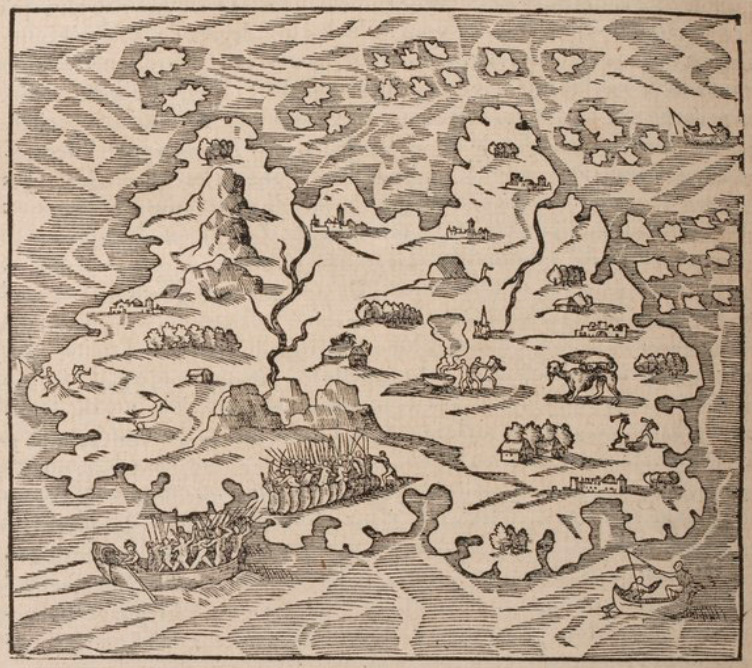
An aerial view of an island is shown, identified as Ile de la Trinité by the author (today known as the island Trinidad, of Trinidad and Tobago). Near the ‘bottom’ of the island there are two groups of Indigenous people engaged in conflict. One group stands on land defending themselves with spears, bows and arrows and shields, while the other group attacks from a rowboat or canoe on the water, also with bows and arrows and spears. Two pairs of people fish from canoes in the bottom and top right corners. Across the island, another pair of individuals fish on the left side, two others spar together on the right, and others cook around a large pot in the middle. There are several structures scattered over the island. This image is identical to one found on page 961 verso of Paris, 1575 (l’Huillier).
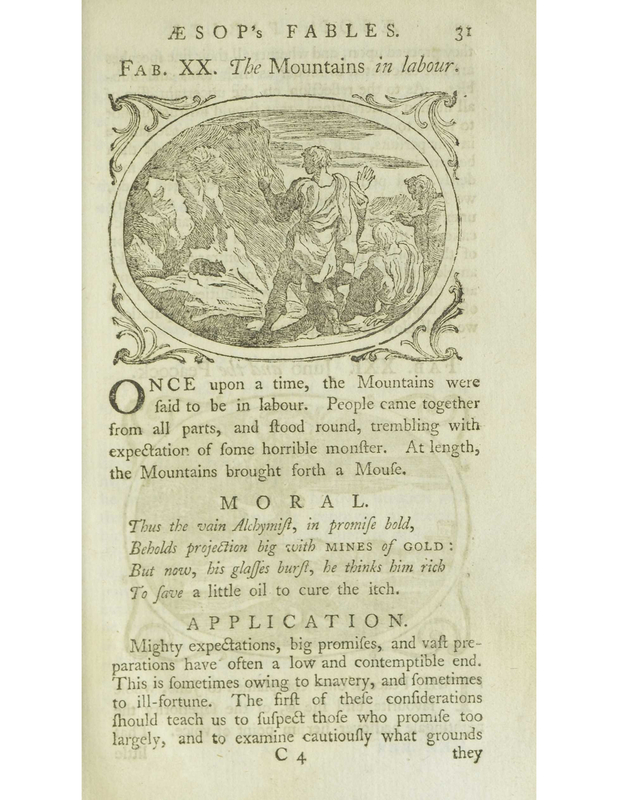
There are three persons, gathered in a semi circle, peering at the mountains. There is a mouse to the left side of the people on the mountains. The persons have their arms up in assumed dismay or surprise. The persons all appear to be of the male gender.
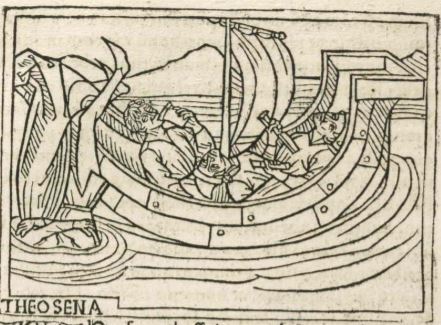
This engraving depicts Theoxena, her husband Poris, and her nephews and child killing themselves. Theoxena and her husband, Poris, are depicted jumping from the ship head-first into the sea to drown themselves. They are illustrated holding each other as they die as a couple. Theoxena’s name, written as “Theosena”, is engraved at the bottom left-hand corner of the image to identify her. The figures on the ship are her nephews and her son, who are also killing themselves. Theoxena had given them a choice between stabbing themselves with knives, or to drink a poison. There are two boys who had stabbed themselves and one child is depicted drinking the poison from a cup. Boccaccio explains that Theoxena and her family killed themselves to avoid dying at the hands of king Philip of Macedon.

![[Gulliver walks through Lisbon with Captain Pedro de Mendez]](https://cemvccol.ace-net.training/files/large/f330eebd5e878e0659664d17747740b4ea644550.jpg)
![[Bust of Voltaire]](https://cemvccol.ace-net.training/files/large/314602903f9ce3d91ecbe3ef1eb0b385ddc123f7.jpg)
![[Act XVII – Elicia and Sosia]](https://cemvccol.ace-net.training/files/large/9a72f39a81f8aef58ec1a222a971ce8e197a1887.jpg)
![[Vanity Fair Vol. I Chapter XXXIV Inhabited Initial]](https://cemvccol.ace-net.training/files/large/6f519e0fc26c633f237932277633cc889e898f4a.jpg)
![[Giant wasps attack Gulliver Brobdingnag]](https://cemvccol.ace-net.training/files/large/4538f7235320886eca2000ffa8f824347e0fc3c7.jpg)
![[Verginia Being Cast Out of the Patricia Pudicitia Temple]](https://cemvccol.ace-net.training/files/large/f2c33a9d8e5800681f259d52c4a579d7ceaadf59.jpg)
![[a servant of the ruling Yahoo licks his feet]](https://cemvccol.ace-net.training/files/large/9602611c30f932a7d7381dcd64535f88766f23a6.jpg)
![[The Cid ready for battle]](https://cemvccol.ace-net.training/files/large/c344a2c0f1899c34f9e99d2e9199a563c0d25875.jpg)
![[A scientist from The Grand Academy on Balnibarbi works with spider’s webs]](https://cemvccol.ace-net.training/files/large/c0734f77179550cb66c49857ebd7c68b1d010a6f.jpg)
![[phrenology bust]](https://cemvccol.ace-net.training/files/large/533b15bf4e0d3283ad7073229b0cd88c73ecf26f.jpg)