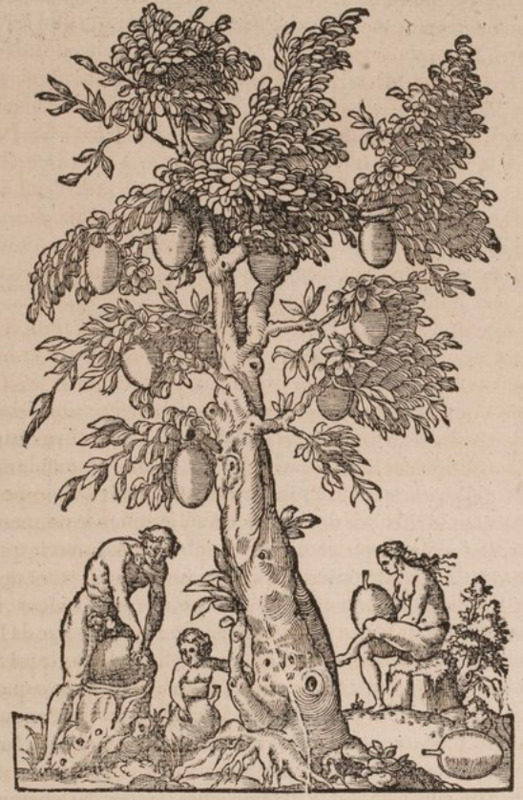
Three Indigenous Brazilians, a man, woman, and child, are shown under a tall tree with large fruit, possibly a calabash tree. The woman sits on a tree stump holding one of the fruits from the tree while the child stands nearby, also holding a large fruit. The man has placed one of the fruits on a nearby stump and stands bent over it. This image is identical to one found on page 953 of Paris, 1575 (l’Huillier), and in Thevet’s Les Singularitez de la France Antarctique (page 105 of Paris, 1557 and page 105 of Paris, 1558).
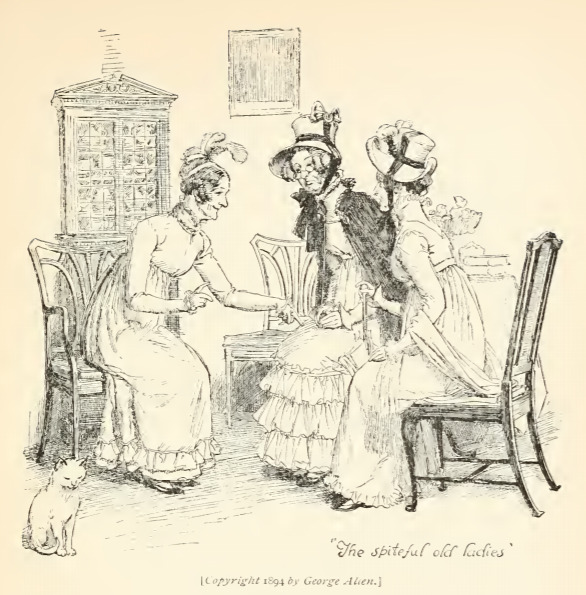
In this image elderly ladies of Meryton discuss Lydia’s circumstance. The scandal was the talk of the town, spread by the elderly ladies, whom Austen describes as ‘spiteful’. This scene occurs in chapter 50. The characters are shown in the traditional regency style. The ladies wear regency dresses with empire waistlines and bonnets. The regency period dated to the early nineteenth century (1811-1820) when George, Prince of Wales, later George IV (r. 1820-1830), reigned as regent for his mentally ill father, King George III (r. 1760-1820). The regency period is associated with the rise of neoclassicism in art and fashion.
Here we see Gulliver’s master holding Gulliver’s hand between his hoofs. Gulliver explains the difference between his body and his hands to those of females of his species. He explains that although he has nails on his hands and feet, the skin on his hands and feet were too soft to walk on without protection. The same image appears in the 1843 Krabbe edition.
Here Gulliver is caught by a monkey who belonged to a clerk of the kitchen in the court of Brobdingnag. Gulliver was left in his box while Glumdalclitch went out and left the windows open. The monkey got loose and found Gulliver’s box and reached in the window and picked up Gulliver. The monkey held Gulliver as though he were a baby about to suckle and Gulliver pulls away from it, which is seen in this image. The monkey was startled by a noise and climbed out the window, taking Gulliver with him. Rocks were thrown to try and get the monkey down, however someone had to go up to the roof to get the monkey down with Gulliver. The same image appears in the 1843 Krabbe edition.
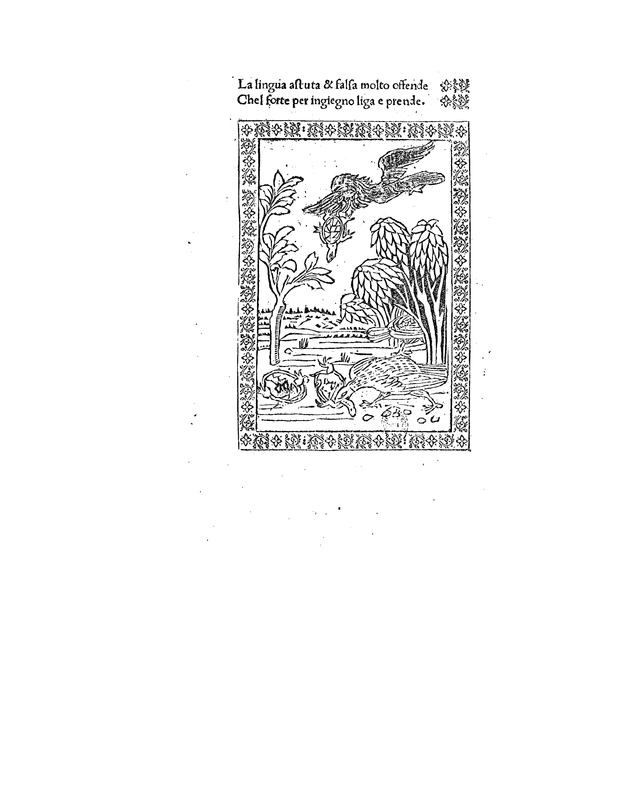
At the top of the image there is an eagle flying while dangling a tortoise. At the bottom of the image we see the tortoise with its shell split being eaten by the eagle on the ground.
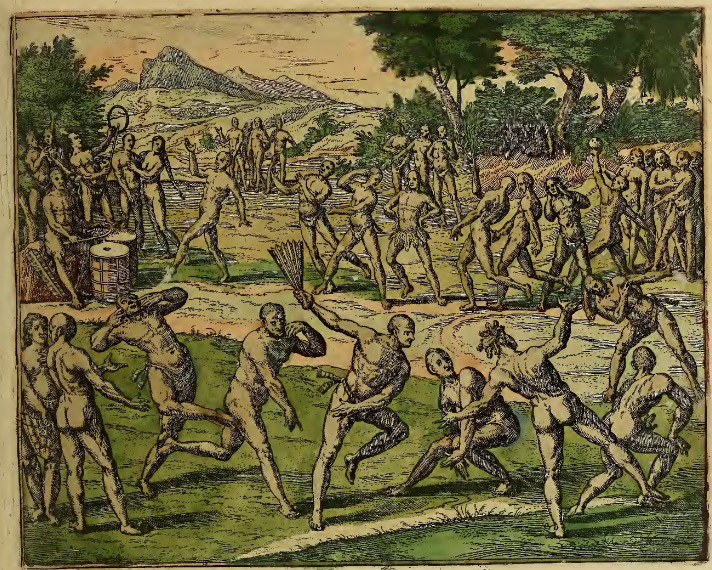
A group of Indigenous people in Nicaragua participate in festivities. Many dance and leap across the ground together. Several people on the left play musical instruments, including drums, a horn, and tambourines or rattles. Most individuals are nude, with some wearing loincloths, feathered skirts, or feathered headdresses. One man holds a fan of feathers in the air as he dances. This image is identical to one found on page 159 of Frankfurt, 1595, but colored.
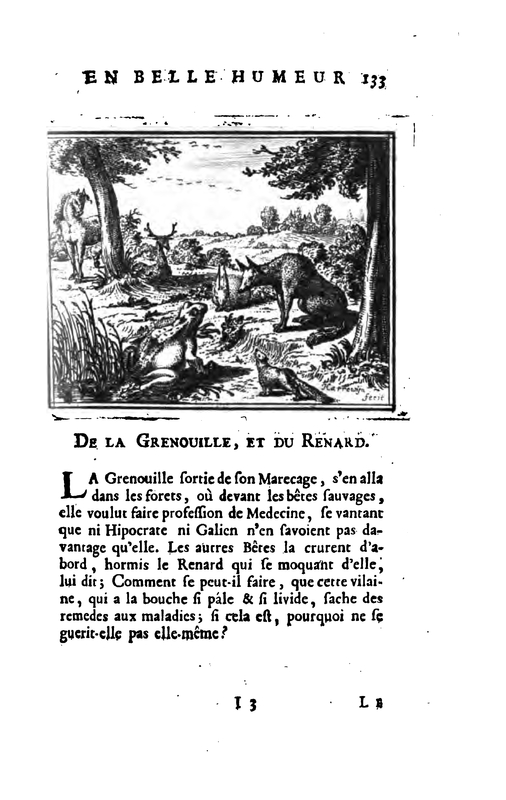
A frog makes a proclamation to all the animals that he was a physician and able to heal all diseases. A fox asked him: How can you pretend to be able to heal others, when you are unable to heal your own lame gait and wrinkled skin? this is a caution against hypocrisy.
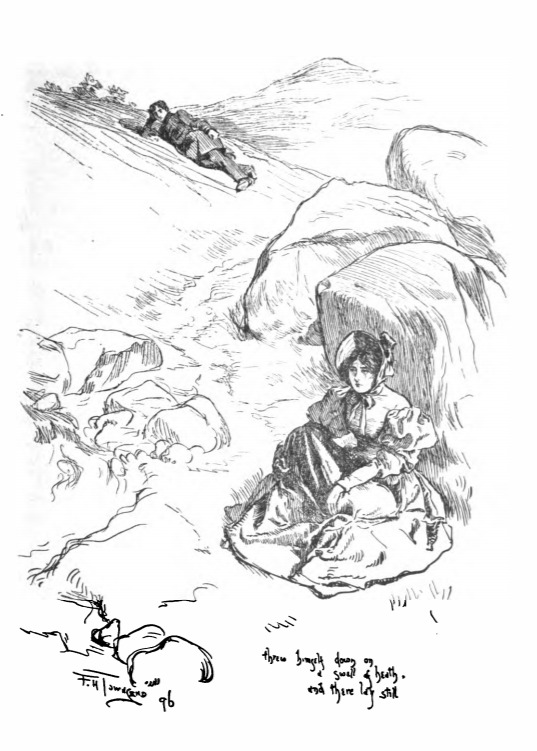
Mr. Rivers was planning on going to India as a missionary the year after Jane arrived at Moor House. He asked Jane to come with him and marry him. Jane said she would go with him to India, but she refused to marry him. When she initially rejected him, he went and laid down in the grass near Jane, waiting for her to change her mind. He asked Jane several times, but she rejected him every time. When she returned to Mr. Rochester, Mr. Rivers left for India and died there. Jane and Mr. Rivers continued their correspondence until his death.
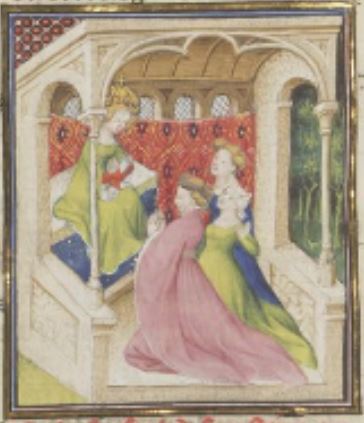
Faustina Augusta, the wife of Emperor Marcus Aurelius Antoninus, is depicted sitting on the left side of the image wearing a crown as she looks down to three kneeling women. Faustina was highly regarded by the people of Rome, including her husband, who had her deified when she died. After she was deified, her female followers and priestesses were known as “Faustinians.” This image depicts three women kneeling to Faustina to demonstrate her significance to the people of Rome and to women.
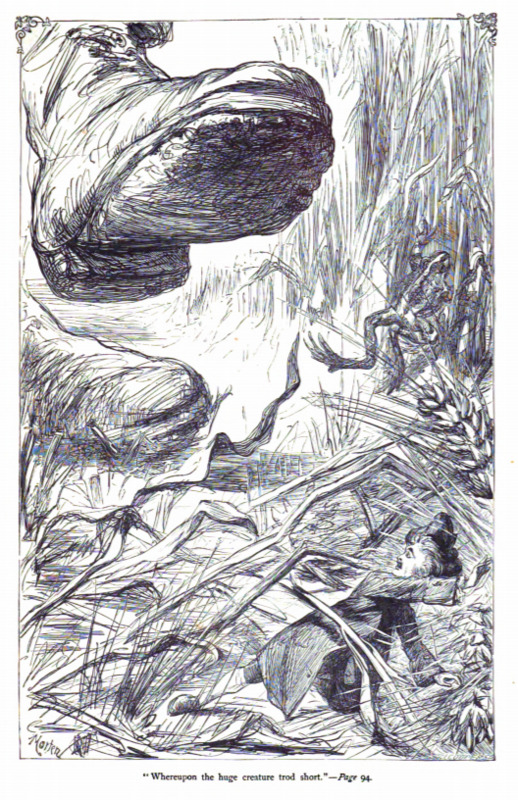
After being stranded on Brobdingnag, Gulliver runs through the wheat field where the giant farmer is working. Not wanting to be discovered, he dodges out of the way of the giant’s foot, fearing he would be stepped on.
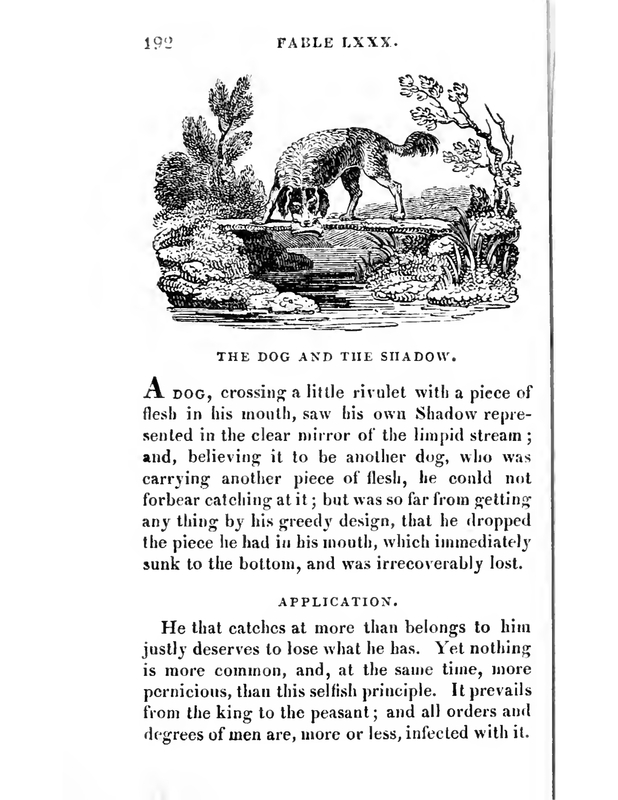
In the middle of the image there is a dog sniffing the ground, with its tail up in the air. On both the left and right sides of the image there are many different trees, bushes, plants, and rocks.
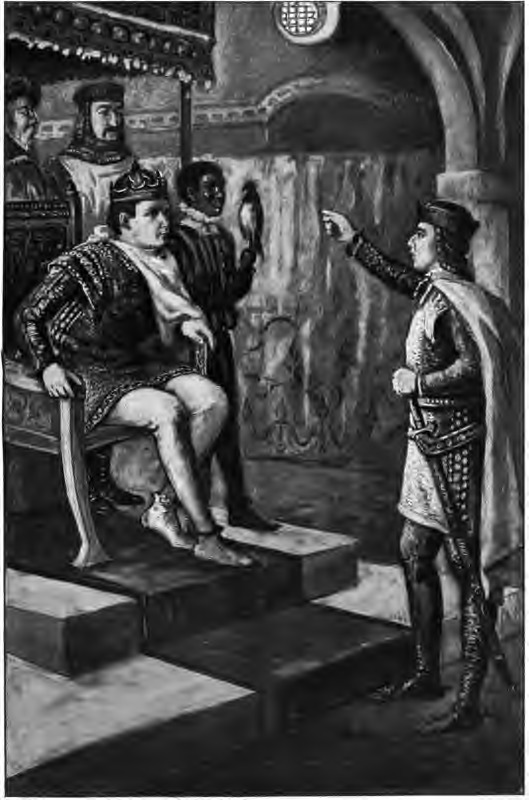
Alvar Fanez reports back to King Alfonso that the Cid has defeated two kings who had been sent by the King of Valencia to fight him. He brings with him a portion of the Cid’s spoils, which the Cid instructed him to give to the king. Alfonso is pleased with the news and restores the property and safety of all the knights travelling with the Cid, but stops short of lifting the Cid’s banishment just yet.
Here we see the Grand Academy of Lagado in Balnibarbi. Here scholars gather to work on problems and innovate. Gulliver visits the academy and sees first-hand the experiment that the scholars are working on. The same image appears in the 1839 Krabbe edition.
After successfully convincing Melibea to forfeit her girdle cord, Celestina returns home. While Celestina is gone, Sempronio remains in her house to spend time with his beloved Elicia. Thus, Celestina returns home to find him waiting. She claims to have good news regarding Melibea, and they depart for Calisto’s house to inform him of what has transpired (they can be seen arriving to the right of the image). In the meantime, Calisto is kept company by Pármeno while he remains immersed in despondent sadness (to the left of the image). To the right, Celestina can be seen wearing a robe and a veil. At her side, Sempronio is depicted wearing a hat and a sword mounted on his belt. Calisto, the leftmost figure, is also depicted wearing a hat. His facial expression and body language express a deep sadness. Pármeno is wearing a hat as well, and it appears as though he is trying to convince Calisto to calm himself.The entire image is identical to the one found on page 29 of the text.
A person is poking someone's eyes out with a knife while a priest like figure is standing over them. The priest like figure is speaking with another person who is almost fully undressed.
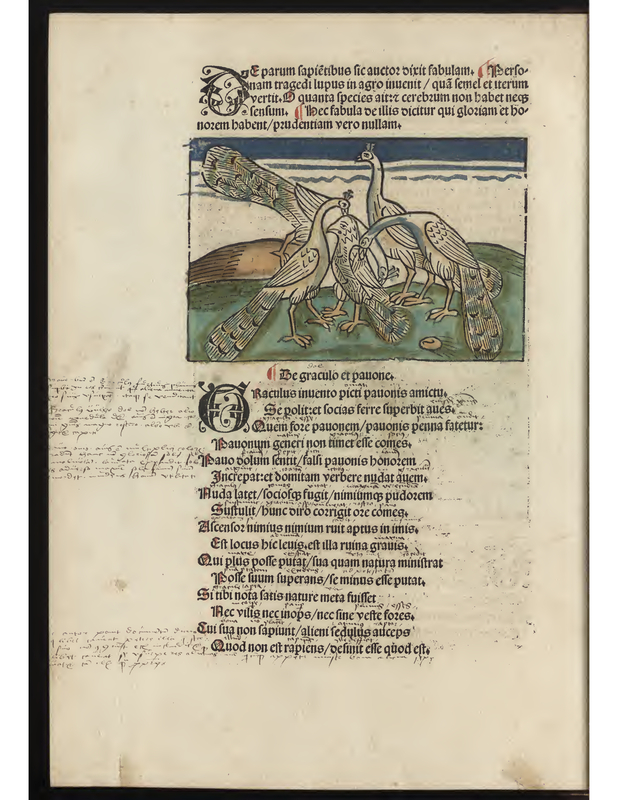
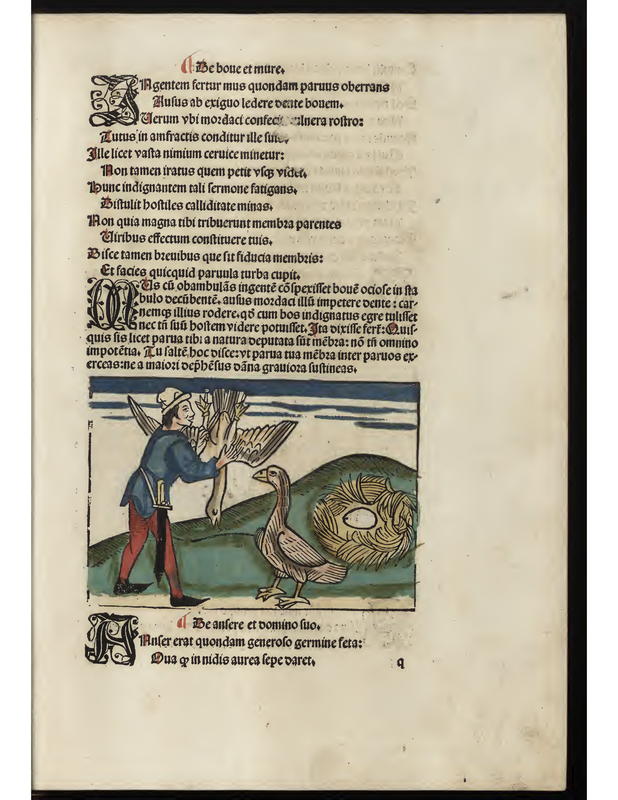
A man with a sword is holding a goose upside down while talking to another goose. The second goose is guarding a goose egg tucked away in a nest egg behind him.
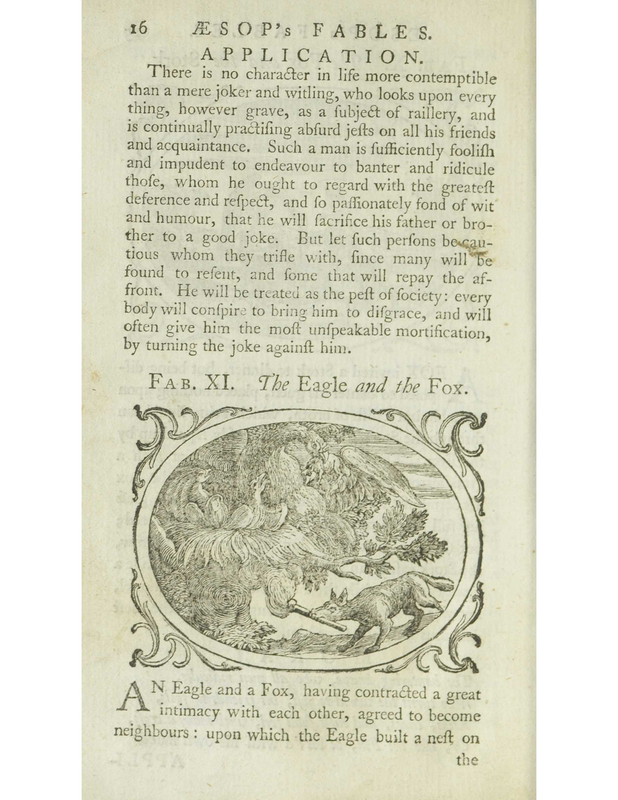
There is an eagle with a baby fox in its mouth flying to the nest, where there are baby eagles. A fox with a fire stick in its mouth is at the base of the tree, where the eagle’s nest is. In the eagle’s nest, is the eagle’s babies. The nest and the tree is on fire due to the stick in the fox’s mouth. The fox appears to be angry
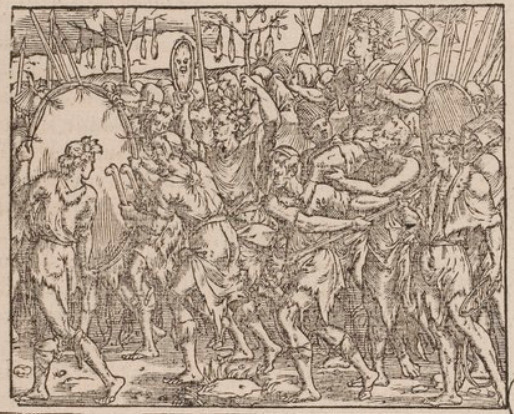
An Indigenous group from Newfoundland (as identified by the author) prepare to go to war. The group marches in a procession with large drums made from animal skins stretched over a wooden frame and bones as drumsticks. One man is carried on the shoulders of several others and holds a ceremonial weapon or other object. Most members of the group are barefoot and wear tunics, several have capes tied around their necks, and others wear headdresses of feathers or leaves. This image is identical to one found on page 1013 of Paris, 1575 (l’Huillier), and in Thevet’s Les Singularitez de la France Antarctique (page 164 of Paris, 1557 and page 164 of Paris, 1558).
An ornately decorated title page. Two figures playing musical instruments appear atop the pedestals on either side of the illustration. The male figure on the left is playing the panpipes (or syrinx), and his horns and goat’s legs indicate that this is possibly a representation of the Greek deity Pan. The figure on the right is female and also has the legs of a goat, but it is difficult to ascertain her identity from this illustration alone. Above these pedestals, we see two helmets and two shields, the latter of which bear the coats of arms of Lang (to whom the edition is dedicated) and Wirsung. In the centre of the image, we see the title of the work. It appears to be either framed by an opening, or placed upon an altar of some sort.
This image depicts one of the battles between King Sancho of Castile and his brothers. This one is likely from the battle against Alfonso of Leon, and it shows the Cid single-handedly rescuing Sancho from being captured by thirteen Leonese knights. Sancho is fighting his brothers because his father left them each portions of his kingdom when he died, and Sancho is trying to consolidate these portions all under his own rule. In the image, the Cid is holding a man by his neck and is about to strike him with his sword.

![[Gulliver’s master examines his hand]](https://cemvccol.ace-net.training/files/large/a3d47dc1c53d881f95868ca1ce644d02055458cb.jpg)
![[Gulliver is caught by the kitchen monkey on Brobdingnag]](https://cemvccol.ace-net.training/files/large/b051335f4006d280eaf650823e1e707bfe7c8e99.jpg)
![[Grand Academy of Lagado]](https://cemvccol.ace-net.training/files/large/456afc37eda8a5ddb3255ef091c8b4e112507cc0.jpg)
![[Act V] Celestina sprekende teghen haer zelven.](https://cemvccol.ace-net.training/files/large/16350395bac77eaa9371e72c235c80b599bf1e1d.jpg)
![[Person Poking out Eyes]](https://cemvccol.ace-net.training/files/large/43f7b68a82b7b0084b792e2e8305b7f2c49906f0.jpg)


![[Title Page]](https://cemvccol.ace-net.training/files/large/940a9ddb0578a83c99a90a38604970751208c7b9.jpg)
![[“King Sancho makes war against his brethren”]](https://cemvccol.ace-net.training/files/large/dc53ed2cd819c17964f5f6cd274fb351cc1791a1.jpg)