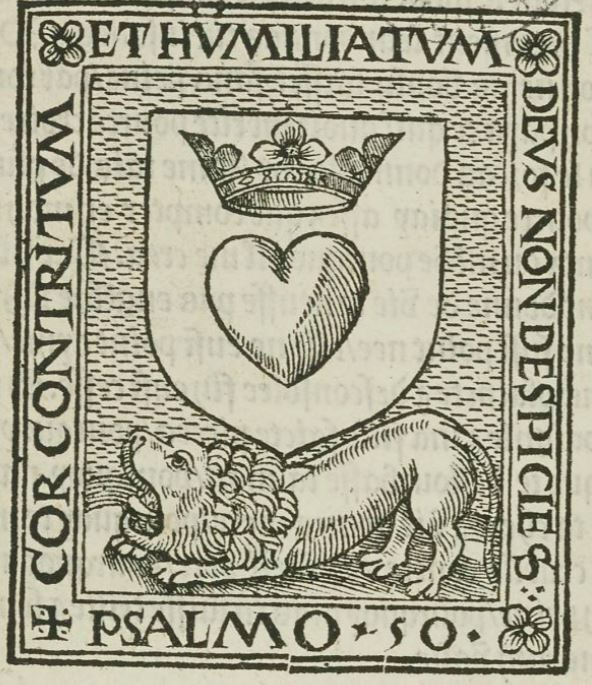
The center of this end-page illustration features a crown suspended above a heart, both of which are placed on a shield or crest. A lion is on the ground beneath them, resting on its front legs while its back legs remain upright. This image is surrounded by a border that contains a Biblical quote (given in the title of the illustration). It is odd that this is quoted as being from Psalm 50, since in reality it is Psalm 51:17. It is possible that the artist may have been working from a different rendition of the Bible, although the early editions that I have consulted also place this in Psalm 51.
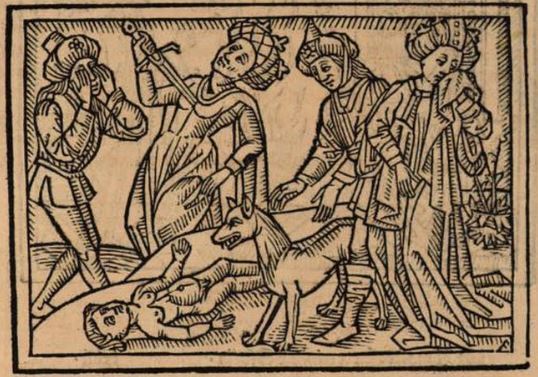
Queen Jocasta of Thebes is depicted on the right side of the engraving rubbing the tears away from her eyes with her dress. She is crying because her husband exposed their child into the wilderness. This was due to a prophecy that foretold the baby would grow up to kill his father and marry his mother. Her child, Oedipus, is depicted lying on the ground after being exposed. There is a person approaching the baby as he takes him in and raises him as his own. Oedipus ends up fulfilling the prophecy by killing his father later in life, and marrying his mother, Jocasta. When Jocasta and Oedipus find out they are mother and son, Oedipus gouges out his eyes and Jocasta kills herself. This scene is depicted on the left side of the engraving. Jocasta kills herself by piercing her chest with a sword and Oedipus’s hands are illustrated in front of his eyes as he gouges them out.
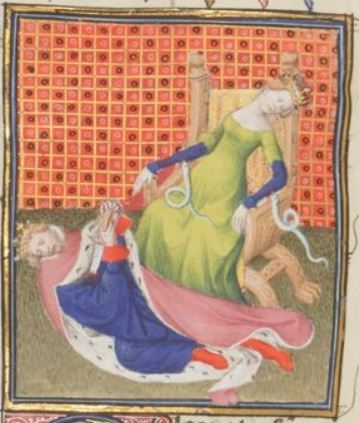
This illumination depicts the Roman general Mark Antony and his wife, Queen Cleopatra of Egypt, killing themselves. After fleeing a battle with Octavian, Mark Antony stabbed himself to avoid dying at the hands of his enemies. He is illustrated lying on the ground with a knife in his chest. Boccaccio believes that Cleopatra killed herself by cutting her wrists and putting asps in the wounds to poison herself. She is illustrated sitting in a chair with her head fallen over to the side. The asps are depicted by her wrists.
Gulliver’s master explained various aspects of the Yahoos that lived in the Country of the Houyhnhnms. He explained that the Yahoos would eat anything, including herbs, berries, roots, and the flesh of other animals, seen here. He also said that they would kiss each other, seen in the background, a concept that disgusted him. The same image appears in the 1839 Krabbe edition.
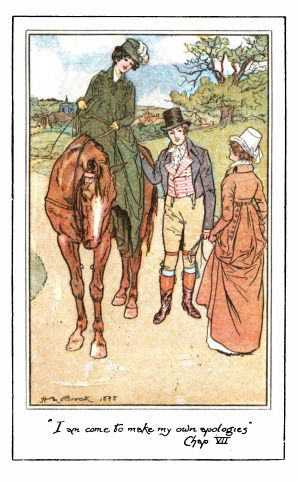
Here we see Fanny speaking with Edmund and Miss Crawford. Miss Crawford had never ridden on horseback before, and Edmund offered to teach her. Fanny typically used Edmund’s horse to ride for her daily exercise after her grey pony died. Edmund was flirting with Miss Crawford and offered up his horse for Miss Crawford to use because it was very gentle. Miss Crawford used the horse for several days in a row, keeping Fanny from exercising. Fanny had a weak constitution, and not exercising took a toll on her health. Edmund, enthralled with Miss Crawford did not realize this until the end of a week when Fanny had not ridden, and apologized profusely. In this image, Fanny meets Edmund and Miss Crawford outside the stables, coming out to ride herself. This scene occurs in chapter 7 as noted underneath the title of this image. The characters are shown in the traditional regency style. Fanny and Mary Crawford wear a regency riding costume, called a riding habit. This outfit drew on the military trimmings. She wears an overskirt to protect her everyday skirt from the elements. Their hair is worn tied up, with a riding hat to protect her face from the sun. Miss Crawford wears a riding costume. Edmund wears a waistcoat and tailcoat, and tall riding boots. He also has a top hat. The regency period dated to the early nineteenth century (1811-1820) when George, Prince of Wales, later George IV (r. 1820-1830), reigned as regent for his mentally ill father, King George III (r. 1760-1820). The regency period is associated with the rise of neoclassicism in art and fashion.
Here we see a yahoo eating a rat. Gulliver’s master explains that many yahoos live in huts near the Houyhnhnms’ house, but the rest live in fields, where they forage for herbs and berries and hunt for rats and mice. The same image appears in the 1843 Krabbe edition.
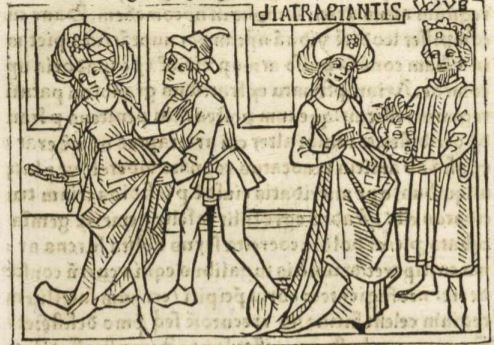
This engraving depicts the queen of the Galatians standing on the right side of the image holding a decapitated head. This woman’s name is unknown; however, she is the wife of King Drigiagon (whose name is engraved above her head). After being taken as a captive by Roman enemies, the Galatian woman was defiled by a Roman centurion. This is depicted on the left side of the engraving as the queen is bound by a chain on her right hand while the centurion is putting his hand up her dress. She is illustrated looking away and fighting back as he forces himself onto her. To seek her vengeance, once she was freed through ransom, she ordered her servant to decapitate the man who raped her. The Galatian woman is holding the severed head as she presents it to her husband to prove that she was defiled by this man. Boccaccio explains that she wrote on this woman to highlight her daring and courageous nature.
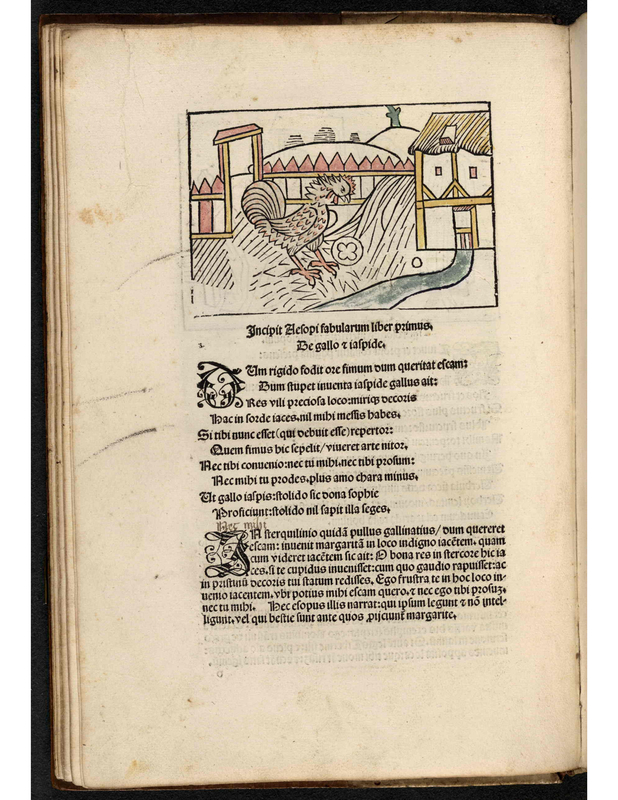
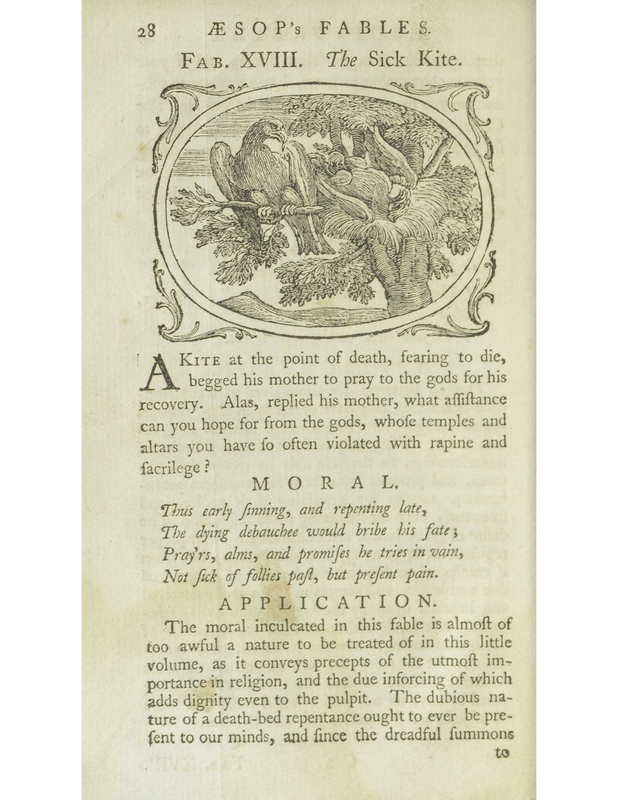
There are two birds in a branch of a tree. One bird is looking at the other bird. One bird is lying down in the branches, and the other is seated upright. The bird that is lying down in the tree branch is inside a nest. The other bird is outside of the nest. One bird looks worse than the other bird. There is foliage on the tree.
Here we see a Lilliputian dining table. There are various fruits and vegetables on the table, and a painting of two cherubs on the wall, next to a mirror. Steam emerges from one of the bottles along the right hand side. We also see a face in the bottom right corner. This image appears in the appendix to Gulliver’s travels in Lilliput. The same image appears in the 1839 Krabbe edition.
Here we see two pigs sleeping. Gulliver’s master explained various aspects of the Yahoos that lived in the Country of the Houyhnhnms. He told Gulliver that the yahoos lived in filth, which Gulliver related to living like swine in Europe. The same image appears in both the 1839 and 1843 Krabbe editions.
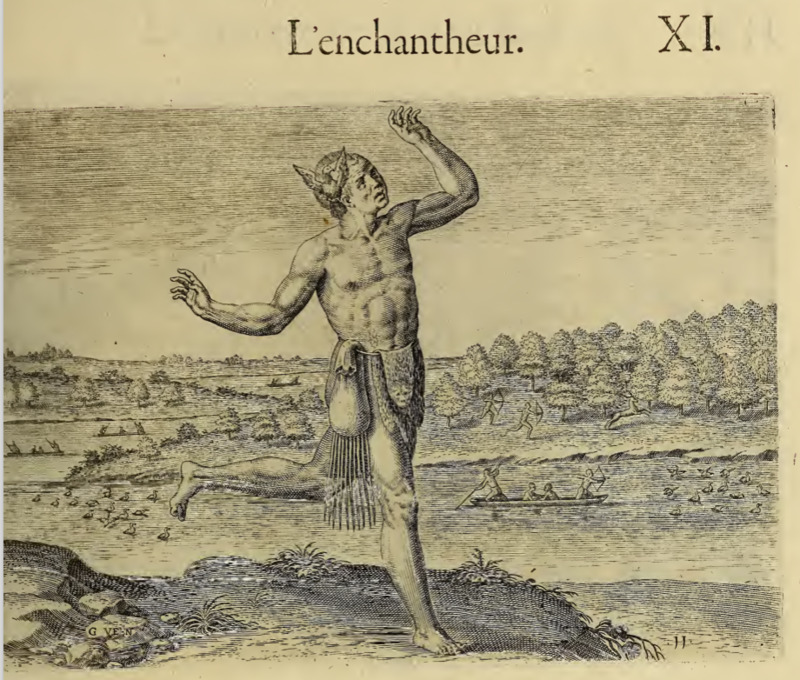
An Indigenous man, called an enchanter by the author, is shown standing on the bank of a river. He wears a black bird in his short hair as a symbol of his position. His only clothing is a hide tied around his waist, and a satchel hangs at his side. Behind him, other Indigenous people are seen in a canoe, hunting water birds with a bow and arrow.
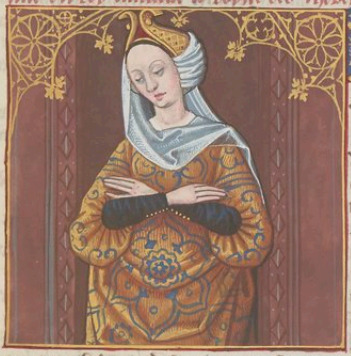
This illuminated image depicts a portrait of queen Niobe of Thebes. Niobe is famous for having committed hubris against the goddess Latona. Niobe had claimed she was more worthy of praise than the goddess, as she had more children than Latona. As punishment for speaking against a goddess, all of Niobe’s children were killed.
A group of Tupinambá people are ceremonially executing a male captive. The man is restrained by a rope tied around his waist, with each end of the rope held by one of the Tupinambá. A Tupinambá man in front of the captive holds a decorative club above his head, poised to swing. Most of the men in the group wear necklaces and feathered headdresses and adornments tied around their waists, and some hold bows and shields. The women also wear necklaces. A fire burns in front of the captive man.
Berenice, the queen of Cappadocia, is illustrated on the right side of the image standing on a chariot which is being drawn by horses as she holds a lance in her right hand. She is wearing a crown and royal garb to signify her royal status. She is depicted plunging the lance into a man’s neck as he stands behind one of the horses with his arm in the air with a shocked expression on his face. There is a shepherd on the left side of the illustration watching the scene unfold. Boccaccio explains that her brother, Mithridates had her sons killed. Caeneus, a servant and the one who committed the crime is the person Berenice chased down and killed while in the chariot. However, this illustration depicts a man wearing a crown and royal clothing as the one Berenice is killing. The man in the illustration could possibly be her brother, Mithridates, however, Boccaccio explains that the one Berenice kills is in fact Caeneus.
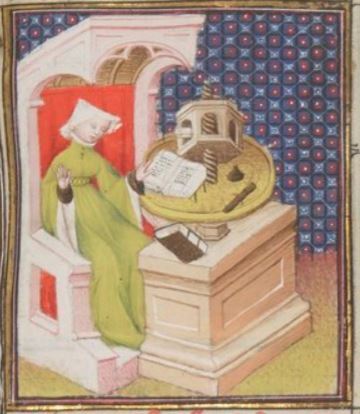
This illumination depicts a woman named Cornificia sitting down as she looks at a book. Cornificia is famous for her poetry and writing abilities. She is said to have written many Heliconian verses which were highly esteemed. Boccaccio explains that she is worthy of praise as poetry and writing was not something women excelled in or pursued during Cornificia’s time.


![[Yahoos eating]](https://cemvccol.ace-net.training/files/large/2ee41294d2e9c15e6d40b8b7d8663d27baafa4da.jpg)
![[a yahoo eats a rat]](https://cemvccol.ace-net.training/files/large/27c33ef29451d3143514b552e55b8b6309e1a002.jpg)

![[Becky Carrying the Coal-Scuttle]](https://cemvccol.ace-net.training/files/large/4d022f936dcfc1d1b89ad111482b618a234005ad.jpg)
![[A Lilliputian dinner table]](https://cemvccol.ace-net.training/files/large/3c22abbd154683211d47bba45af5b6e654b96fbf.jpg)
![[two pigs sleeping]](https://cemvccol.ace-net.training/files/large/2d20dc0531df26800ab1d7bbd17652407d27584c.jpg)
![[A captive man is executed by the Tupinambá]](https://cemvccol.ace-net.training/files/large/56e98d93314d4f7863b29ce8965fb1c90e975c24.jpg)

![[Berenice Avenging her Sons’ Deaths]](https://cemvccol.ace-net.training/files/large/34db988f3f360d3f018201e6da42d0438ac9cea9.jpg)