In chapter five, Gulliver explains several aspects of society in England. Here we see a stack of books that have records of past court cases. The image appears when Gulliver explains the rule of precedent to his Master. The rule of precedent is when a judge or lawyers refer to the outcome of a past court case to determine what should be done in a similar situation. The same image appears in the 1843 Krabbe edition.
Here we see a knife used to castrate male horses and make them tamer. Gulliver’s master was shocked that humans would ride horses, so Gulliver explained how horses were trained from a young age and bred for human use. The same image appears in the 1839 Krabbe edition.
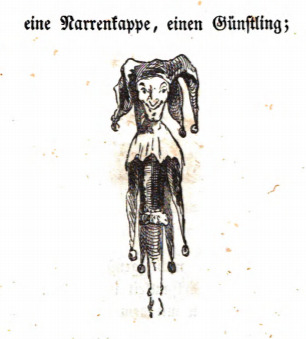
Here we see a court jester, referred to in the eighteenth century as a cap and bell. This is the code word for the King’s favourite. This image comes in a description of a conspiracy found by a professor from the Grand Academy on Balnibarbi. This idea is representing code word for terms in the conspiracy that Swift is satirizing. The professor advises that those named in the conspiracy papers be closely monitored at all times, naming specifically while they were using the bathroom, as this is when men were most thoughtful. This conspiracy is thought to be an allusion to the trial of Francis Atterbury, the bishop of Rochester for allegedly plotting with the Jacobites. Atterbury was charged with treason in 1722 and was exiled to France. The same image appears in the 1843 Krabbe edition.
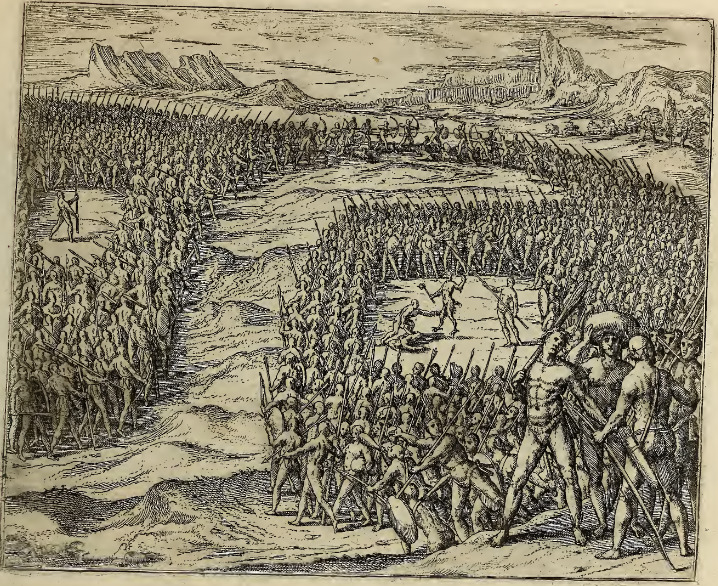
Two large groups of Indigenous people have massed in anticipation of war, with fighting breaking out at the far side of the groups. In a clearing at the center of the group on the right, a man holds up an idol – a figure with the head of a bird and talons for feet – that has been attached to the long pole held by the man (similar to a puppet). In front of the idol, a warrior kills another person while reaching out towards the idol. There is a gap in the center of the group on the left as well, where an individual holds a long pole. Most of the warriors are armed with spears, bows and arrows, clubs, and shields.
This illustration depicts a woman named Dripetrua, the daughter of king Mithridates VI of Pontus. Boccaccio explains that she was born with two sets of teeth, however, this image depicts Dripetrua with what appears to be three faces. She is depicted putting food into the two mouths on each side of her face.
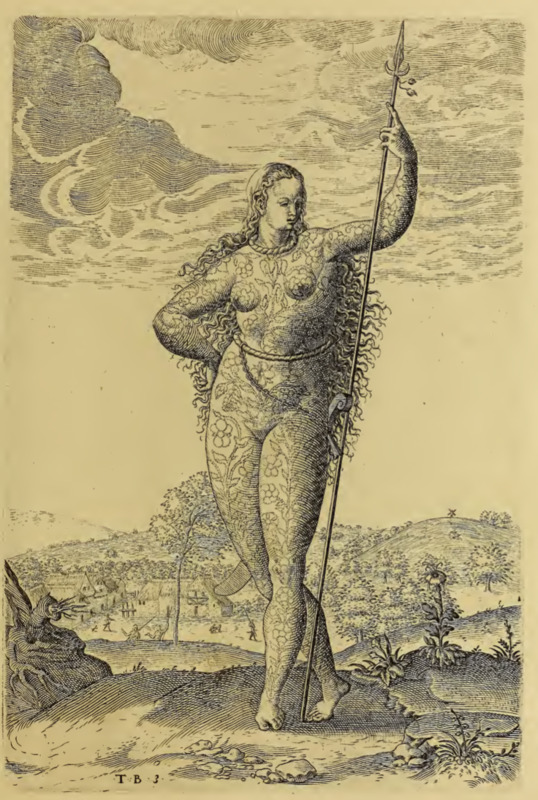
A young Indigenous woman is shown from the front. She carries a spear in her left hand. Her hair is long, she wears a twisted cord around her neck, and a sword with a curved blade hangs another cord around her waist. She is nude, and her body is covered in painted designs. The Picts were an Indigenous group who lived in Britain long before the author’s time. Images of Picts were included in this book so that readers could compare their customs to those of the Indigenous people living in Virginia.
In a Tupinambá village, a large wooden frame has been set up over a bonfire, and several human body parts have been set upon the frame to roast over the fire. A group of men, women and children stand around the fire eating various human body parts, including legs, arms, ribs, and hands. Behind the fire a bearded European man stands with his hands in the air, perhaps in dismay or distress.
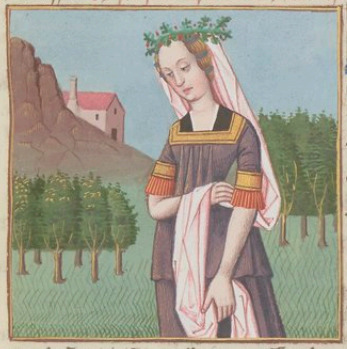
This illuminated image depicts Hypermnestra, queen of The Argives and priestess to the temple of Juno. There is a wreath around her head and a shawl which hangs from the wreath. Boccaccio explains that Hypermnestra is famous for having defied her father’s order to kill her husband. After her husband had defeated her father, Hypermnestra became queen and a priestess, which is also another reason she is so renown.
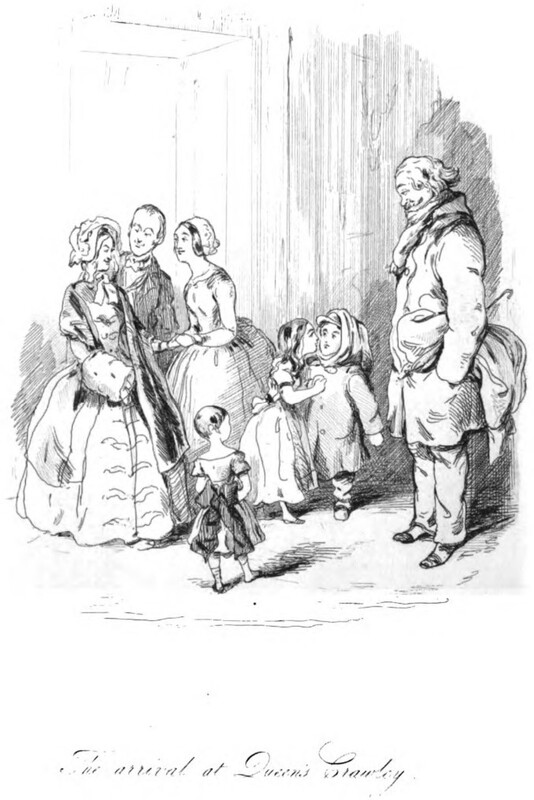
Matilda Crawley greets her cousin, the younger Rawdon Crawley, while her brother Pitt Binky hangs back and watches. To their side is Mr. Rawdon Crawley, watching his son. In the background, Sir Pitt and Lady Jane are greeting Rebecca Crawley, who has just arrived at Queen’s Crawley with her husband and son. Below the illustration is printed in cursive its title, “The arrival at Queen’s Crawley.”
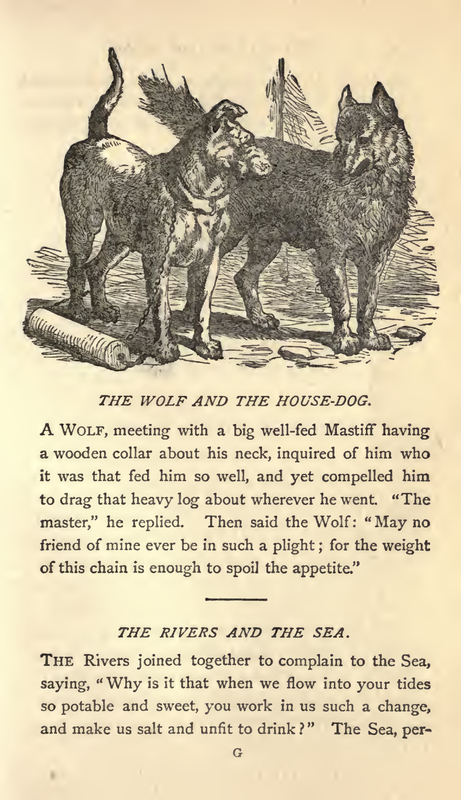
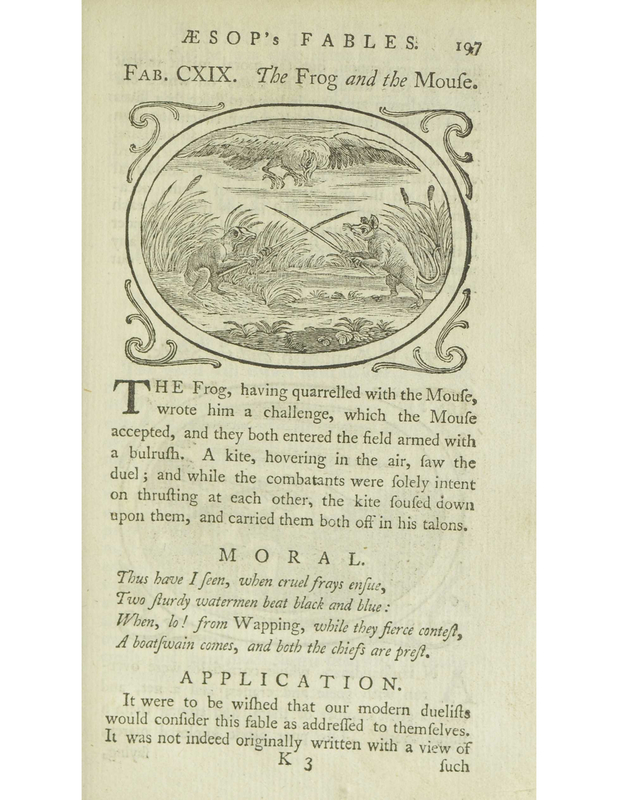
A frog stands on its hind legs across from a mouse standing on its hind legs. Both animals are holding a bulrush plant as if they were swords, and their weapons are locked together. Above them flies a kite (bird of prey), with its wings spread out and head looking down on the frog and mouse. The animals are surrounded by other bulrush plants, and are in a swamp.
The left panel depicts Calisto dressed in regal attire. He has a falcon perched on his left arm, an obvious representation of his interest in falconry. He is also wearing a large chain, which is presumably the chain that he gives to Celestina as payment for her services. The right panel depicts Celestina, who is in a seated position and seems to be wearing nun-like attire. In her left hand she is holding what appears to be a piece of paper, likely the charm/spell given to her by Melibea, while in her right she is holding what is likely the girdle cord given to her by Melibea. The left panel is identical to the one found on page 170, and is nearly identical to those found on pages 135 (where a decorative panel is added and the label is changed to ‘Sepronio’ [which appears to a typo]), 216 (labeled ‘Pleberio’), and 244 (where a decorative panel is added and the label is changed to ‘Pleberio’). The right panel is nearly identical to those found on pages 61 and 208 (which lack the marks that extend her robe).
Here scholars on Lilliput debate philosophy. Gulliver says that they do not have the same approach to philosophy as Europeans. He says that Lilliputians do not use Aristotelian categories, but is instead based on infallible principles, and imagining oneself as a member of another class. Thus, here we see two well-dressed men acting as servants to the third. This image comes in the appendix to Gulliver’s travels to Lilliput. The same image appears in the 1839 Krabbe edition.
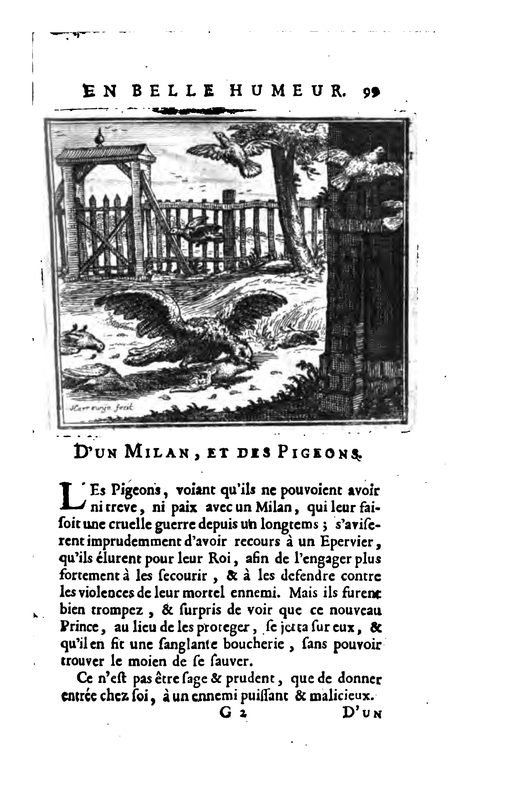
The image depicts a hawk killing many pigeons. Fearing for their safety, after seeing a red kite fly overhead, the pigeons invite a hawk in the farm in return for the hawk’s protection. Once admitted the hawk turns on the pigeons and does more damage to them in one day than the kite would have been able to do.
In this image we see Gulliver kissing the little finger of the queen of Brobdingnag. The queen wears rings on her ring and pinky finger of her left hand. Gulliver stands on the edge of a table, leaning forward to kiss her finger. This takes place after the King and Queen of Brobdingnag purchase Gulliver from the Farmer who found him, and Glumdalclitch accompanied him to the royal palace. The same image appears in the 1843 Krabbe edition.
An unburning fireplace, with the kettle fallen onto the coals. On the mantle is a clock with two figures. A pair of slippers are abandoned in front of it, and on the wall to the side, the poker-holder is decorated with the letter T from “There”.
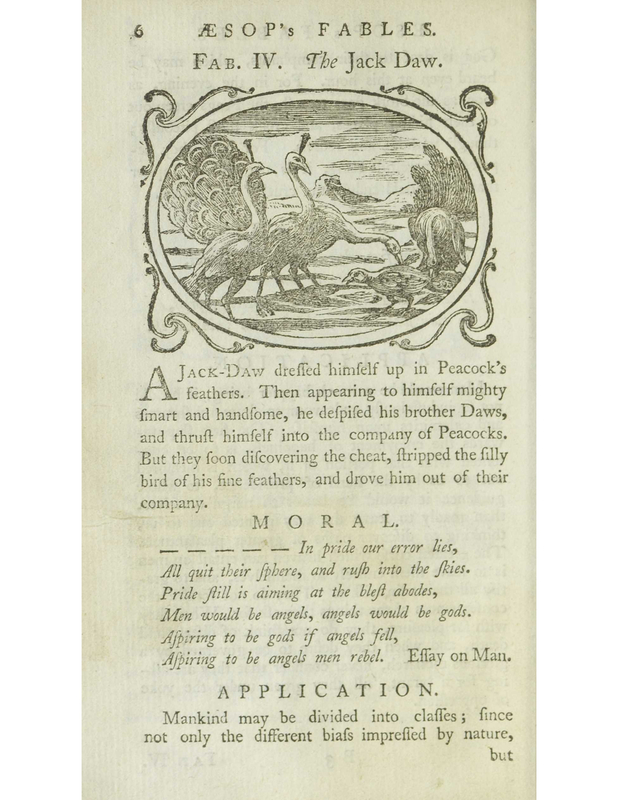
There are a 3 Peacocks and a Jack Daw in the same area. One of the peacocks plumage appears to be opened. There appears to be a feathered object to the right of the photo, near the rear of the jackdaw. The jackdaw has the feathered piece behind him as though it were a peacock. The peacocks are looking at the jackdaw and appear to be unhappy.
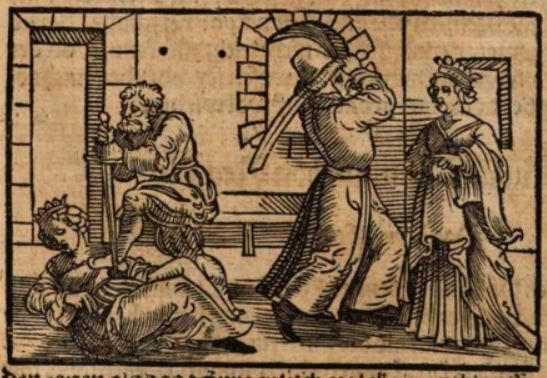
This engraving depicts a young servant girl getting stabbed in the chest with a sword by a man standing above her. This young servant girl is disguised to look exactly like Harmonia, the daughter of Gelon (brother to the king of Syracuse). Boccaccio explains that there was a rebellion in Syracuse against nobility, and before the murderers could get to Harmonia, her nurse disguised this young woman to look like Harmonia. The real Harmonia is depicted on the right side of the engraving. There is a man swinging a sword above his head which appears to be heading in Harmonia’s direction, however, Boccaccio explains that Harmonia hid from the murderers until they killed the look-alike servant.
Pauline, the maid, stands in the kitchen looking at her lover, Regulus Van Cutsum. He is sitting on the table, drinking a flagon of beer, and still dressed in the military uniform from the battle which he was ordered by his colonel to flee, though he tells the tale as though he were the only survivor.

![[English legal records]](https://cemvccol.ace-net.training/files/large/f29343bba4a67221aa8da08e3cf92b6fe3ecc186.jpg)


![[A knife used to castrate male horses]](https://cemvccol.ace-net.training/files/large/7ea0a891b3c45794b2010136d7daeac8f9b30f43.jpg)
![[Dripetrua Eating Food with her Two Sets of Teeth]](https://cemvccol.ace-net.training/files/large/7d00d28b80b755cebc19a867cde57a28fa98f16d.jpg)

![[The Tupinambá engage in cannibalism while a European man looks on]](https://cemvccol.ace-net.training/files/large/a2450bfca141c1ad75035b2733199d008369d25d.jpg)

![[Act VI – Calisto and Celestina]](https://cemvccol.ace-net.training/files/large/3571b66e413e20a343a978f81ced52167de5c357.jpg)

![[Scholars on Lilliput debate philosophy]](https://cemvccol.ace-net.training/files/large/321cc954224bd86726e3a5ab729bc0e6cfc55757.jpg)
![[Gulliver kisses the little finger of the queen of Brobdingnag]](https://cemvccol.ace-net.training/files/large/16dfc75826de9e8e672cd686fb06c1826b27df62.jpg)
![[Vanity Fair Chapter LXI Inhabited Initial]](https://cemvccol.ace-net.training/files/large/3ff6487884cedef5396f8eb91c9cf72d4080b0ed.jpg)
![[Regulus and Pauline in the Kitchen]](https://cemvccol.ace-net.training/files/large/bf6390aba4547b87759bf92c9abc70ebf3a4b905.jpg)