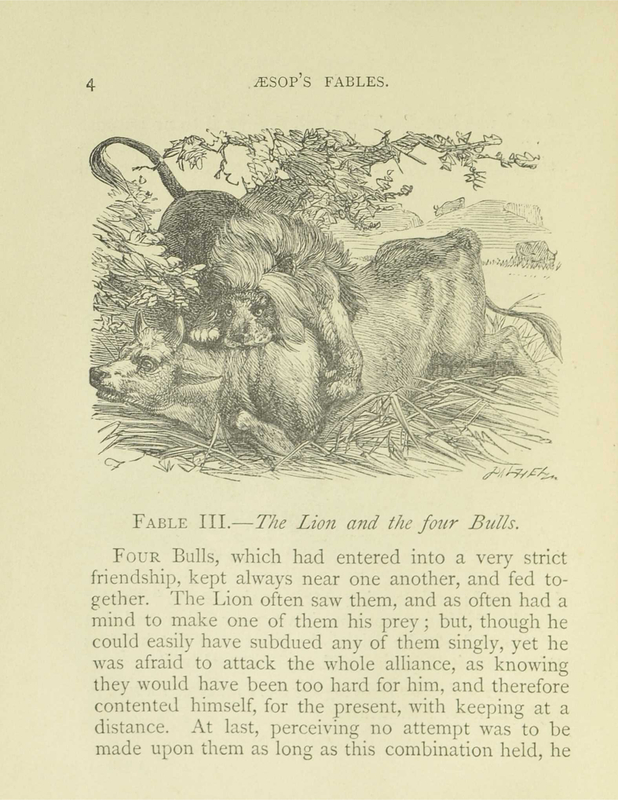
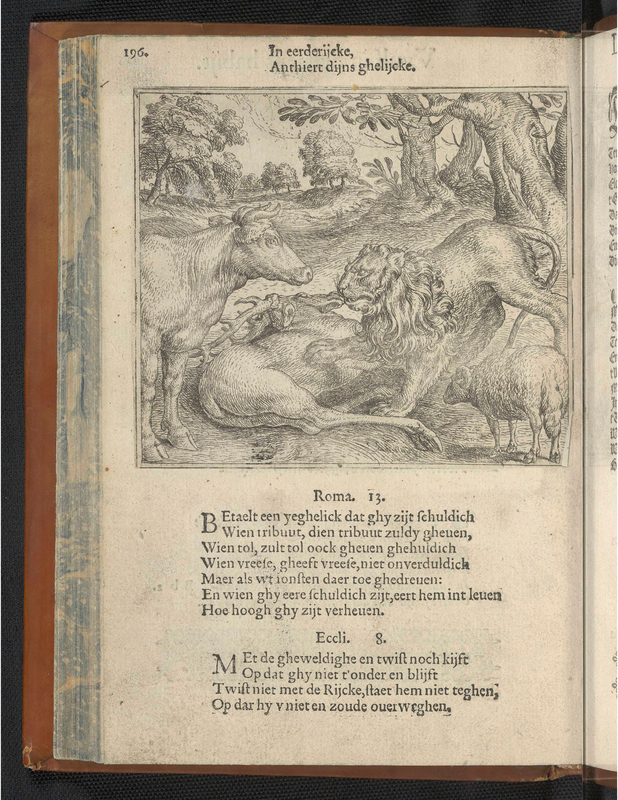
Four Bulls, which had entered into a very strict friendship, kept always near one another, and fed together. The Lion often saw them, and as often had a mind to make one of them his prey; but, though he could easily have subdued any of them singly, yet he was afraid to attack the whole alliance, as knowing they would have been too hard for him, and therefore contented. himself for the present, with keeping at a distance.
Three Indigenous men stand in the foreground beside a tall leafy tobacco plant. Two of the men hold tobacco leaves rolled up, one is lighting the end of the roll of leaves and the other has already lit his and is smoking. The third man reaches for a leaf from the plant. Two of the men carry bows, and the one on the left wears a necklace, in the middle a cape, and to the right a round feathered adornment. In the background closer to the village, several structures of which can be seen, another man carrying a bow smokes from a rolled leaf. This image is identical to one on page 927 of Paris, 1575 (Chaudière).
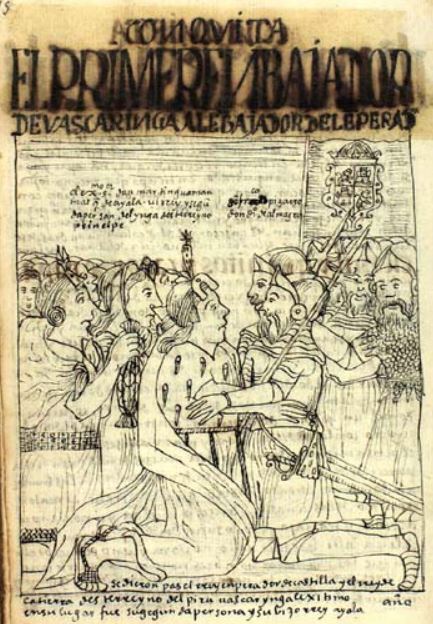
This chapter focuses on discussing the arrival of Spaniards and the Spanish conquest of Peru. This image depicts the Spaniards on the right side of the image and the indigenous people of Peru on the left side. The conquistadors Don Francisco Pizarro and Don Diego de Almagro are depicted kneeling as they embrace Huascar Inca, the ruler of the Inca Empire. They are doing this as a sign of peace and friendship. They are differentiated through their clothing as the Spaniards are wearing metal armor and carrying the flag of Castile, and the Peruvians are wearing traditional garbs with no armor. The caption written on the left side of the image reads “el excelenticimo senor don Martin Guaman Malqui de Ayala virrey y segunda person del ynga deste reyno principe” [the excellent lord Don Martin Guaman Malqui de Ayala, viceroy and second in command of the Inca in this kingdom]. The caption at the bottom of the image reads “se dieron pas el rrey enperador de castilla y el rrey de la tierra deste rreyno del piru uascar ynga, lexítimo en su lugar fue su segunda persona y su bizorrey ayala” [the sign of peace was exchanged between the king-emperor of Castile and the king of the land of this kingdom of Peru, Huascar Inca, in his place went his second-in-command and vicery, Ayala].
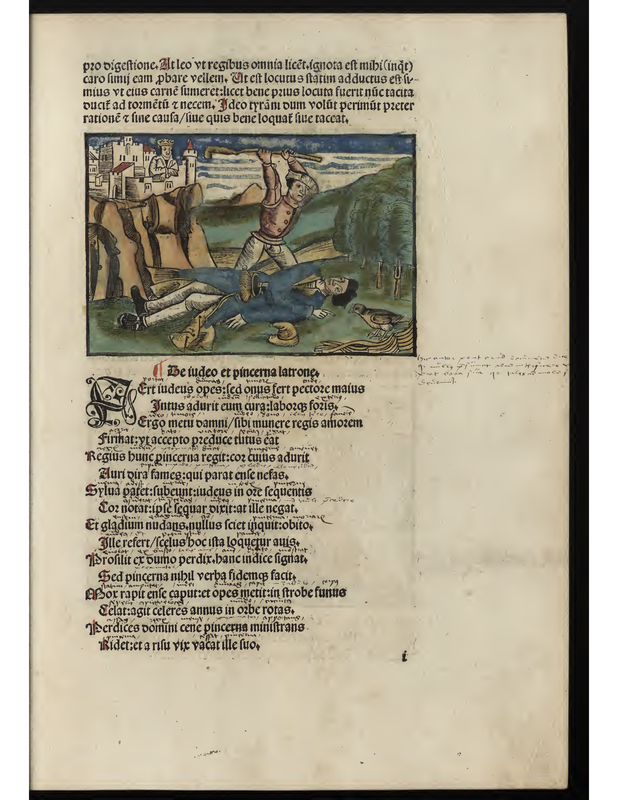
On the upper left of the image there is a large white castle sitting on a hill. The right of the image there are two men, one standing above the other swinging an axe, and the other lying on the ground. In the background there are trees and green grass.
A tall man is seated on a chair, holding his hat in his hands. A young girl, also holding a hat, leans against his side with one arm on his leg. In the top right of the image is the letter B, from “Becky”.
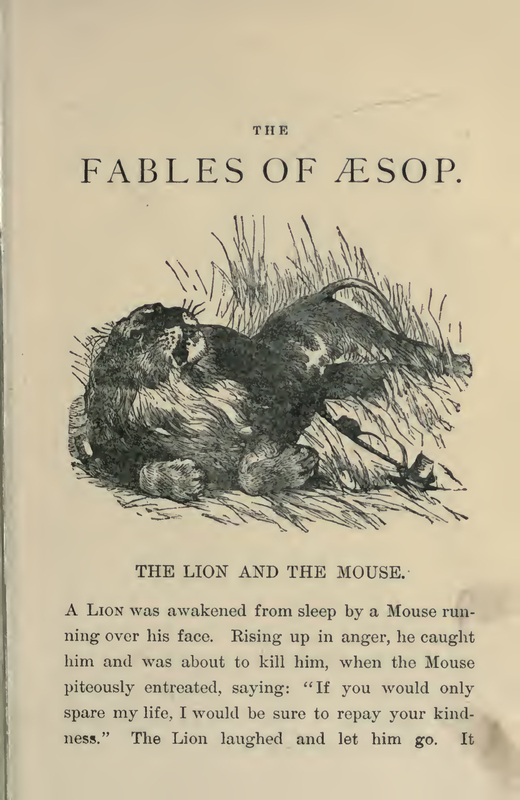
A lion lies on its side on the ground among the grass. It is stuck in a trap, and rope binds it to the ground. The lion is looking upwards, its ears bent down and looking helpless. On the right side, it is visible that a mouse is on the rope tying the lion down, making its way through the rope.
This image is illustrated in a chapter that discusses and criticizes the government and society in Spanish conquered Peru. This image depicts the Corregidor [Magistrate] named Gregorio Lopez de Puga giving a poor indigenous man a peso in alms. The indigenous man has his hands together in prayer as he accepts the alms. The author explains that this Corregidor replaced a previous Corregidor who had treated the indigenous peoples of Peru horribly and stole money from the provinces. Due to the horrible things the previous Corregidor had done, Corregidor Gregorio Lopez focused on treating the indigenous peoples with respect and treated them well. The caption at the bottom of the image reads, “probincias” [in the provinces].
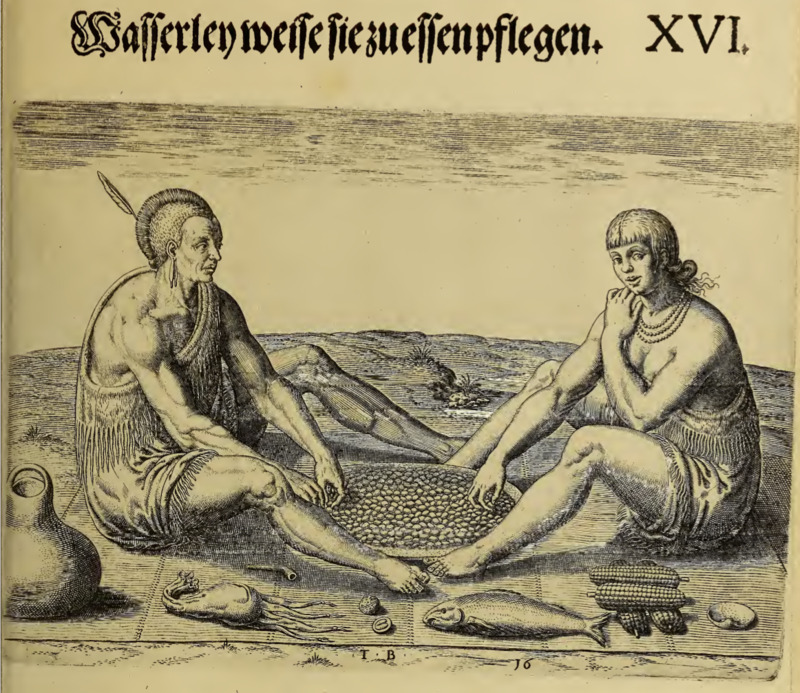
Two Indigenous people are shown sharing a meal. A man sits on the left, and a woman on the right. They sit on a mat on the ground. A large dish with food is between them, and around them are a jug, a pipe, some nuts, a fish, some cobs of corn, and other objects. The man wears a fringed garment draped around his body and over one shoulder and a single feather in his hair. The woman wears a similar fringed garment draped over one shoulder and two strands of beads around her neck.
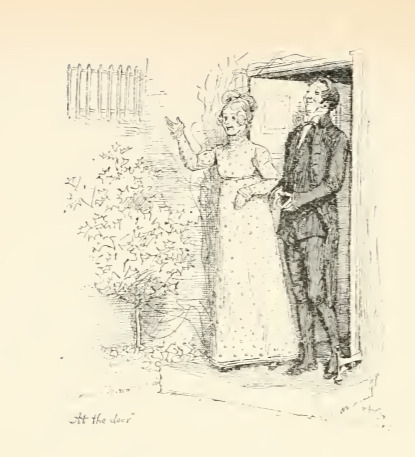
In this image Charlotte and Mr. Collins wave from the door of their home. Lizzy promised to come visit, and so she accompanied Sir William Lucas and Maria Lucas to the Parsonage near Rosings. This scene occurs in chapter 28. The characters are shown in the traditional regency style. Charlotte wears a regency style dress with an empire waistline. Mr. Collins wears a waistcoat and tailcoat. The regency period dated to the early nineteenth century (1811-1820) when George, Prince of Wales, later George IV (r. 1820-1830), reigned as regent for his mentally ill father, King George III (r. 1760-1820). The regency period is associated with the rise of neoclassicism in art and fashion.
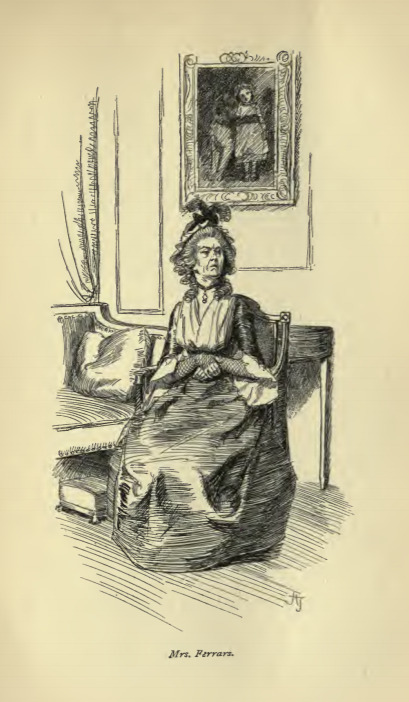
In this image we see Edward Ferrars’ and Fanny Dashwood’s mother, Mrs. Ferrars. Elinor had never met Mrs. Ferrars, but had heard that she was rather disagreeable. When Mrs. Ferrars learned that Edward was engaged to Lucy Steele despite her hopes he would marry someone wealthy, she disowned him. Elinor met Mrs. Ferrars at a dinner with John and Fanny Dashwood at their home in London. This scene occurs in chapter 33. The characters are shown in the traditional regency style, as Mrs. Ferrars wears regency style dresses with an empire waistline and wears a bonnet. The regency period dated to the early nineteenth century (1811-1820) when George, Prince of Wales, later George IV (r. 1820-1830), reigned as regent for his mentally ill father, King George III (r. 1760-1820). The regency period is associated with the rise of neoclassicism in art and fashion.
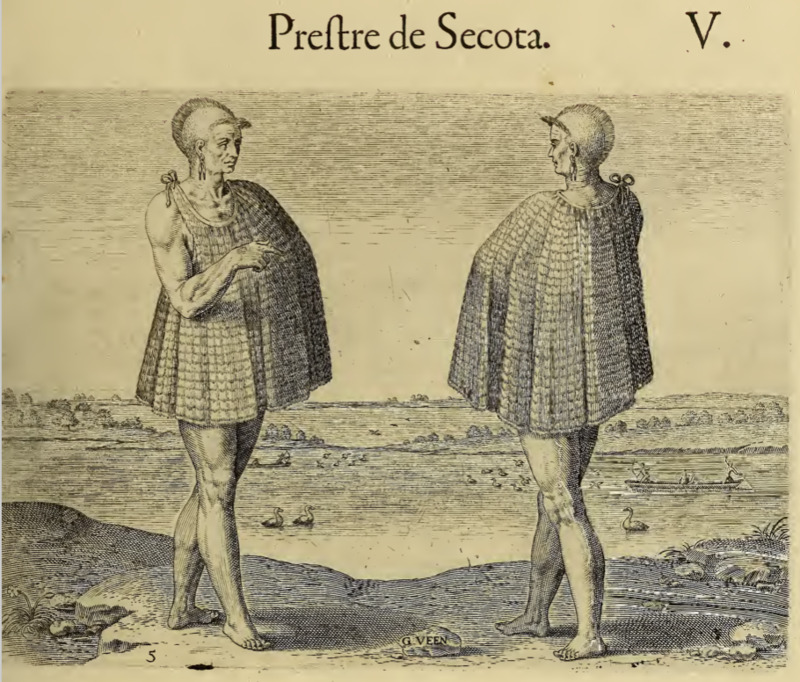
An Indigenous man (a shaman/priest/religious man) is shown standing on the bank of a river, from the front and from behind. He wears a cape-like garment, is barefoot, and wears no other adornment. In the river behind him, other Indigenous people are shown in canoes.
Here we see Gulliver with his family after returning from Lilliput and Blefuscu. He holds his daughter in his arms and his son stands in front of him looking up. Gulliver’s wife hugs him from behind.
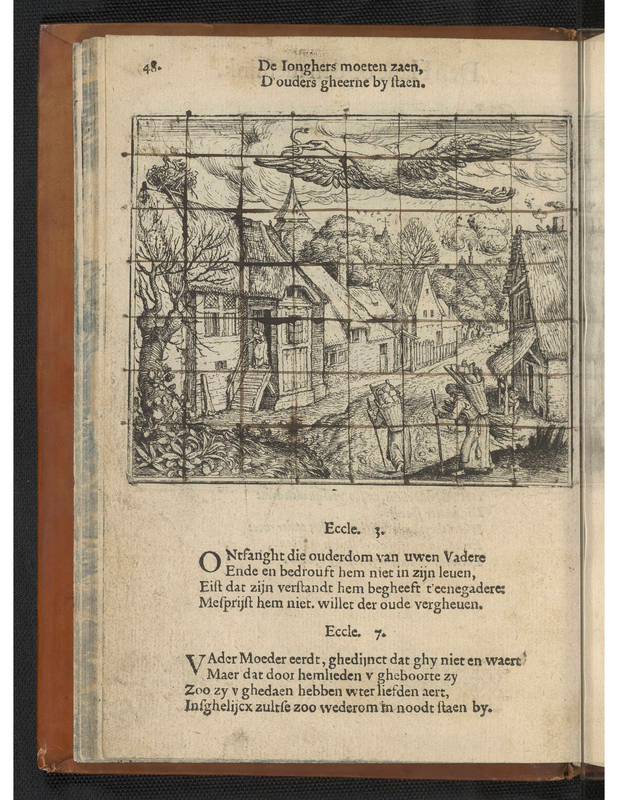
Two people with straw baskets of food on their backs walk across a town towards a house where a woman emerges. A stork flies over the town with a snake in its beak. The trees in the images are bare. Smoke rises from the chimneys of the houses in the town.
Here we see the scientist nicknamed the ‘universal artist’ from the Grand Academy on Balnibarbi. This man oversaw fifty other scientists all working on several different hypotheses, including condensing air into a tangible substance, softening marble to use it as pillows, petrifying hooves of living horses, and sowing the land with chaff to make it more virtuous. Gulliver encountered him in the wing of speculative learning. This man is likely an allusion to Sir Robert Boyle, a scientist who conducted experiments in several aspects of the natural world and was also a theologian. In this image, the scientist is depicted with a particularly large head, likely to indicate his intelligence. The same image appears in the 1839 Krabbe edition.
On the right side of the image is a tree, which has a crow perched at the top holding an object in its mouth. To the left of the tree is a fox looking up at the crow.
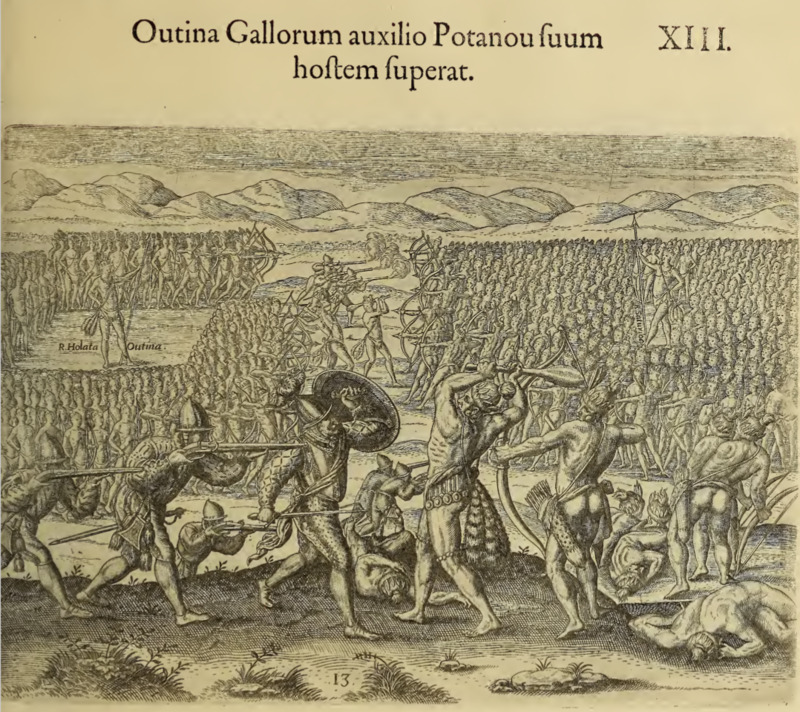
A battle is shown between two groups of Indigenous people. The groups are armed with bows and arrows, clubs, and spears. The group on the left stands in a square formation with a gap in the middle. The French colonists fight on the side of Chief Outina (pictured in the middle of the group on the left). In the foreground, colonists shoot at Indigenous men on the opposing side with rifles.
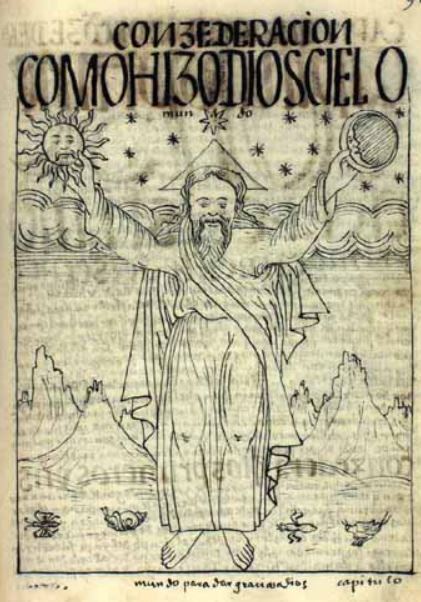
This is the first image in the last chapter of the book. The author uses this chapter to address his Christian readers. For this image, the author urges his readers to consider their service to God, the creator of all things. This image depicts God standing in the centre of the image holding a sun with his right hand and the moon with his left with stars surrounding his head. He is wearing a triangular halo which symbolizes the Holy Trinity. He is also depicted bearded and wraped in cloaks. On the ground by God’s feet are a butterfly, a snail, an ant, and a cricket. These are to symbolize God’s creation of all things in the world. The mountainous Andean landscape is visible in the background. The caption at the bottom of the image reads, “mundo para dar gracias a Dios” [the world, for giving thanks to God].
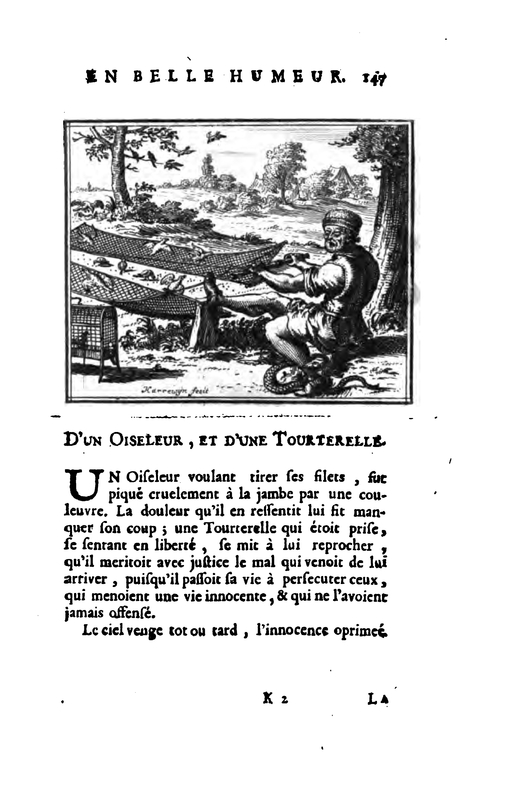
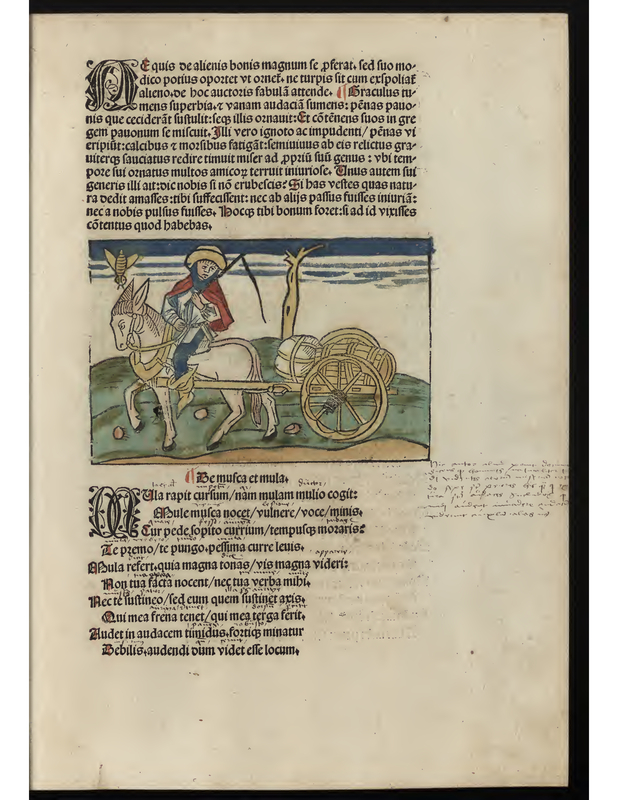
A bird catcher spread his nets and tied his domesticated pigeons to them. He watched from a distance and a dove approached to try and free them, but became entangled as well. The bird catcher ran back and grabbed them. As he did so, he reproached the domesticated pigeons because they should have warned their own kind of the trap. But, the domesticated pigeons replied: We are more concerned with preventing our master's displeasure than with pleasing our kindred.
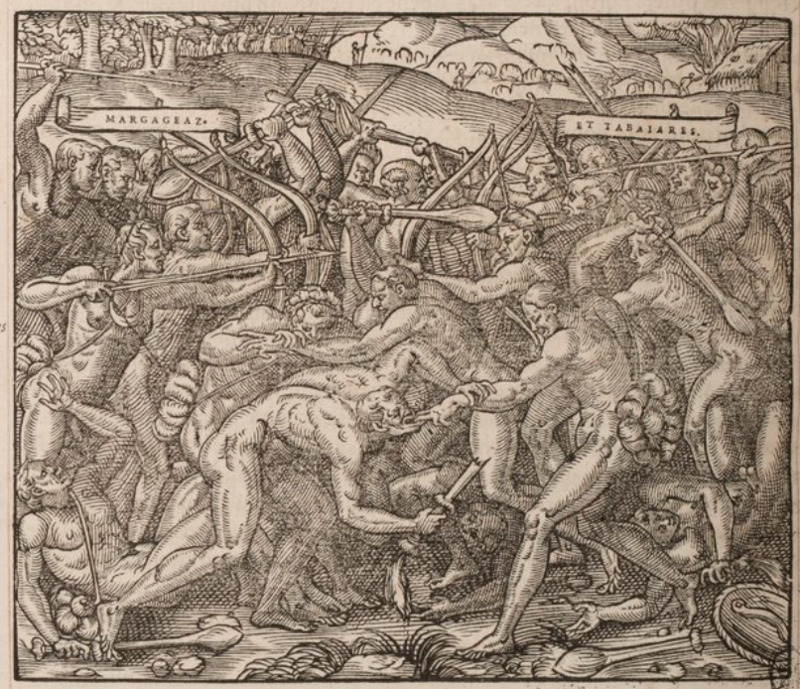
Two groups of Indigenous people (the Margageaz and the Tabaiares, according to the author) are shown engaged in combat. Both groups are comprised of men wielding an assortment of clubs, bows and arrows, shields and spears. Some also use their teeth as weapons, biting the hands and arms of their enemies. Members of both groups wear necklaces and round feathered adornments hanging at their backs. In the background, a group of combatants stands on a hill and to the right a structure appears to be on fire. This image is identical to one found on page 942 verso of Paris, 1575 (l’Huillier).

![Portrait de l’herbe Petu[n] ou Angoulmoisine.](https://cemvccol.ace-net.training/files/large/c4f9a030c8c43a176018999bb3973d8c636e1cfa.jpg)
![[Vanity Fair Volume II. Chapter XX Inhabited Initial, B]](https://cemvccol.ace-net.training/files/large/f16f6840844d16e6bec095caad2978b634dd3cc7.jpg)
![Coreg[id]or, Licinciado Gregorio Lopes de Puga fue Cristianicimo y Gran Letrado, Amigo de Dios](https://cemvccol.ace-net.training/files/large/6b63c8d8015699c54613f664325e79a5cc7a4260.jpg)
![[Vanity Fair Chapter III Historiated Initial]](https://cemvccol.ace-net.training/files/large/ff9fd1f87d7b0956139a2d75e1231009980e94e2.jpg)
![[Person Fishing at a River]](https://cemvccol.ace-net.training/files/large/0539be3a01aea21a21235a7f7b9853e1c945073e.jpg)
![[Gulliver is reunited with his family]](https://cemvccol.ace-net.training/files/large/1c878b7b1107cdd5a69d56cc2c07f1c6923662d5.jpg)
![[A scientist named the universal artist from the Grand Academy of Lagado]](https://cemvccol.ace-net.training/files/large/489d19d2fafd27a96c3d21bba7a6f5b102f07fda.jpg)
![[The Crow and a Fox]](https://cemvccol.ace-net.training/files/large/84ecfaff5557c2803b035c28fd01a0e3e6f33a57.jpg)