The left panel depicts Celestina’s prostitute Areusa wearing a veil and a robe. To the right, we see Celestina’s other prostitute Elicia, who is also wearing a veil and a robe. In her right hand, she is holding a flower. Both figures are placed outside.The entire image is identical to the one found on page 306. The left panel is identical to those found on pages 173 and 317, and is nearly identical to those found on pages 12, 208 and 271 (where it is labeled ‘Melibea’), page 84 (labeled ‘Lucrecia’), and page 350 (labeled ‘Alisa’). The right panel is nearly identical to those found on pages 84 (where it is labeled ‘Celestine’), 235 (labeled ‘Lucrece’), and 299 (labeled ‘Alisa’).
In this image we see Gulliver being examined by three scholars from Brobdingnag. The scholars were invited by the king to examine Gulliver’s ‘physical form’. They came to the conclusion that he did not conform to the ‘usual course of nature’, as he was significantly smaller than any other creature on Brobdingnag. They also questioned him regarding his diet and his education. There are three giants crowded around Gulliver who is standing on a table. They each wear elaborate hats and have beards. The giant on the left holds a magnifying glass to his left eye. His hat has what looks like a tree and an insect on top. The centre giant’s face is somewhat in shadow, and his hat has an image of a compass and a globe. The man on the right has depictions of scientific instruments on his hat. Gulliver is seated on a table that is elaborately carved and looks up at the giants. The same image appears in the 1839 Krabbe edition.
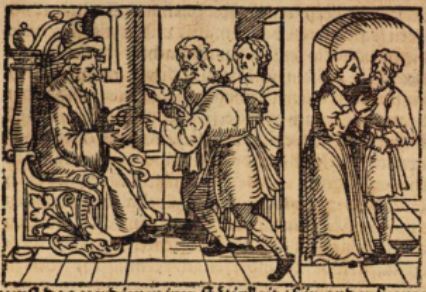
This engraving depicts the tragic fate of a young virgin woman from Rome named Verginia. Boccaccio explains that one of the decemvirs, Appius Claudius, fell madly in love with Verginia. Despite already being betrothed to another man, Appius Claudius devised a plan to have Verginia as his own. Appius Claudius had gotten one of his freedmen (Marcus Claudius) to capture Verginia and claim her as a slave. Verginia’s father, Verginius, went to the trial and protested the sentence of his daughter becoming a slave. Appius Claudius, however, was the judge presiding over the case, and officially decreed Verginia to be a slave. This court trial is depicted on the left side of the engraving, with Appius Claudius sitting on the chair pointing towards Verginia, Verginius, and Verginia’s betrothed, Icilius. After Claudius decrees Verginia to be enslaved, her father takes a knife and stabs her with it as his only way to save her. This is depicted on the right side of the engraving, which illustrates Verginius piercing his daughter’s chest.
There are two men in the outdoors, one of them is swinging an axe back aiming the ground towards him while the other man is throwing a stone to the ground while his other hand holds the axe down in front of him. There are 4 standing trees in the background with three stumps next to them with a broken tree laying on the ground nearby.
Here we see Gulliver making himself new shoes after his worn out during his time on the Country of the Houyhnhnms. Gulliver made his shoes out of wood and leather. The leather was made of the skins of yahoos and dried in the sun, seen behind Gulliver. The same image appears in the 1839 Krabbe edition.
This image depicts the first encounter Calisto (figure to the left) has with Melibea (figure to the right). While practicing his falconry, Calisto follows his bird (top-left corner) into Melibea’s garden, where he first lays eyes upon her. He is struck by her beauty and instantly falls in love. In addition to these figures, there is a horse behind Melibea.[The entire illustration is identical to the one found on page 18 of the text.]
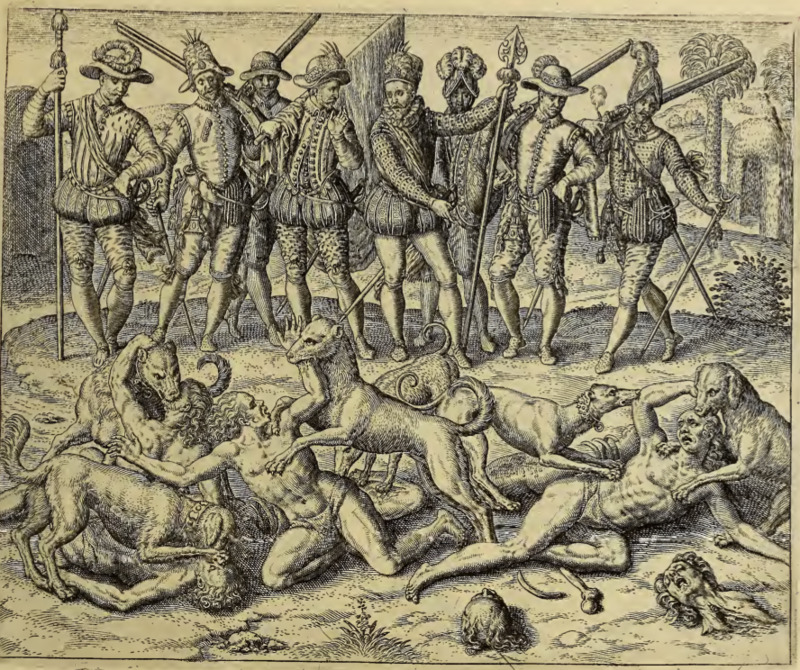
Spanish colonists punish Indigenous men for engaging in sex with other men. Several Indigenous men on the ground try to fend off hunting dogs which have been unleashed on them. The dogs bite at the surviving men; several men have already been dismembered and killed by the dogs. A group of Spaniards stand nearby, watching the vicious attack. The men are finely dressed, and carry muskets, swords, spears, and a flag or banner. In the background, at least two dwellings are visible.
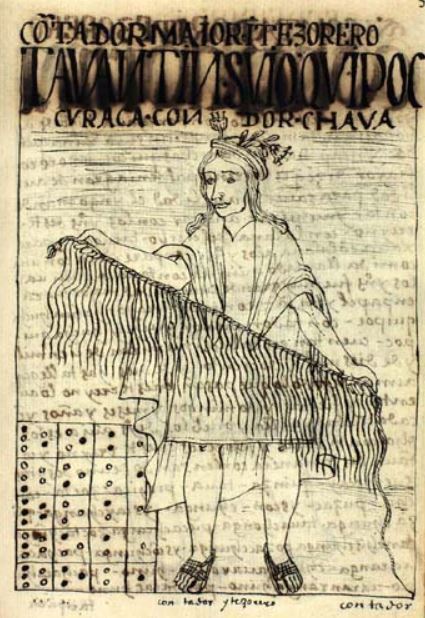
This chapter discusses the system of administrative officials in the Inca Empire. This image depicts Condor Chaua, the royal accountant, treasurer and quipu interpreter of the Inca Empire. This official was tasked with counting and tracking the number of citizens in the empire, as well as keeping track of food. They would use devices such as counting boards and quipus to keep track. Condor Chaua is depicted standing in the centre of the image holding a quipu with both of his hands with an Inca counting board at the bottom left corner beside his feet. The caption at the bottom of the image reads “contador y tezorero” [accountant and treasurer].
Gulliver spent much of his time on Brobdingnag reading about history and philosophy in the royal library. In this image we see him turning the page of one of the books, all of which were much larger than he was. In order to read these books Gulliver had to climb a ladder to be able to see the writing better.
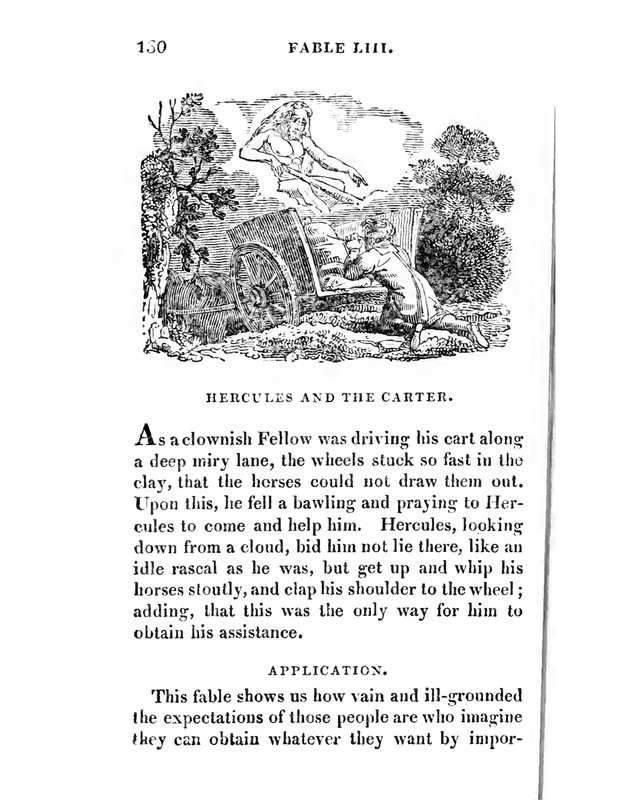
A man kneels, resting his elbows on the rear end of a cart, hands clasped. In the cart there are several sacks. The cart has two wheels and seems to be pulled by horses which can be seen in the background. The wheels appear to be stucks in the ground. From the clouds in the sky, a shirtless Hercules with long hair points at the man kneeling next to the cart.
This illumination depicts Arachne holding a shuttle in her left hand as she sits at a loom and weaves. Arachne was a famous weaver who competed against the goddess Minerva in a weaving competition. When she lost the competition, Arachne hung herself.
Jones, a reader of the story, is seated in an armchair with his legs crossed and feet on an open-backed chair. He is holding his copy of the serial in his right hand and holding a pencil to underline a phrase in it with his left. In the background is a table or cabinet upon which some objects are set.
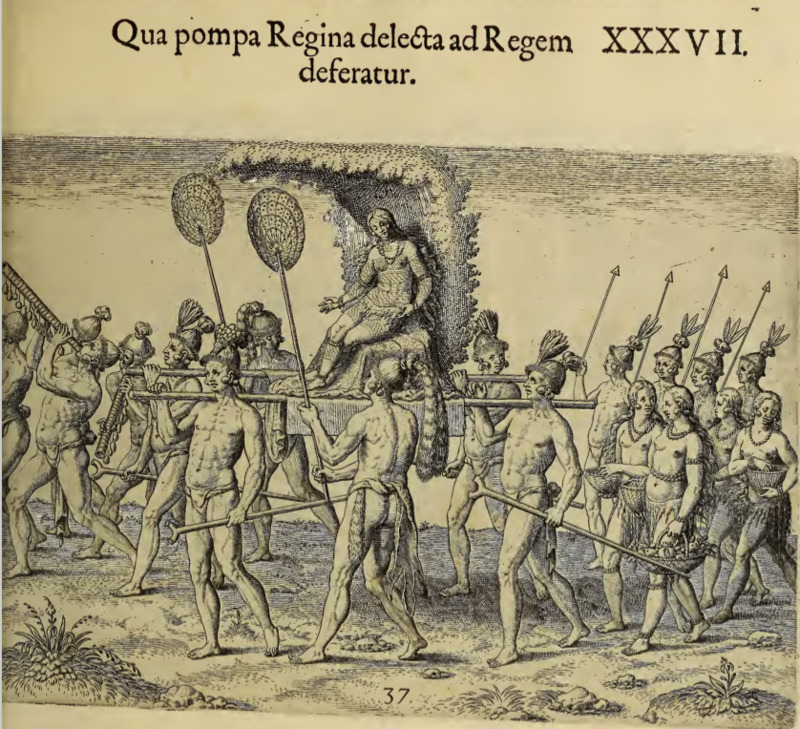
The chosen queen is carried on a litter by four men. Her body is decorated with paint or tattoos, and she wears strands of beads around her neck, arms and legs. Several men in front of the procession play large instruments, and a man walks on either side of the litter each waving a fan beside the queen. Behind the procession several women and men, the women carrying baskets and the men spears.
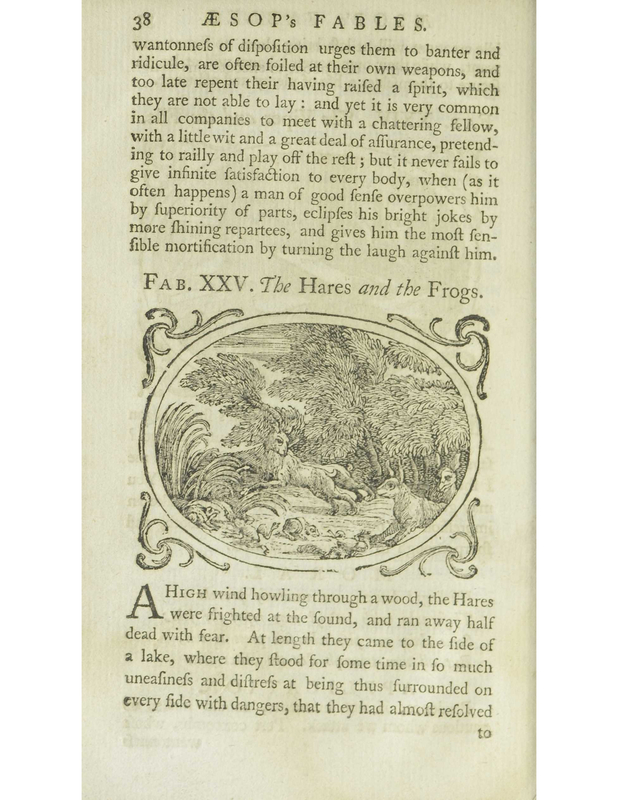
A group of four hares hop around in a grassy, wooded area, near a bog. Frogs jump around near the bottom of the image. Three of the hares are jumping towards the bushes while one is facing outward.
El Cid is the one on the far right and he is sitting on his horse. He has a helmet on and chainmail. He has a shield and a sword, he is pointing his sword at his soldiers. The four soldiers that are most visible are wearing helmets and they are carrying swords and shields. The one on the far left is wearing chainmail and the one next to him is wearing a tunic with chainmail under. The one on the far right is wearing a tunic with chainmail under, and the one next to him is wearing chainmail only. There are horses and other soldiers distinguishable in the background. In front of the soldiers there is a shield and a spear with a flag on it. They are on the ground in front of them.
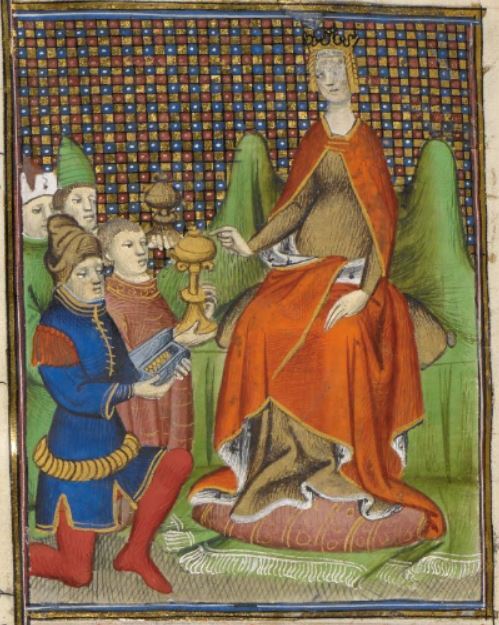
This illumination depicts Queen Joanna of Jerusalem and Sicily sitting on a throne with her subjects surrounding her. She is depicted wearing a crown to demonstrate her royal status. Her subjects appear to be handing her gifts. Boccaccio explains that Joanna was a praiseworthy subject to write on as she was an impressive and fierce ruler which was not common for women during her time.
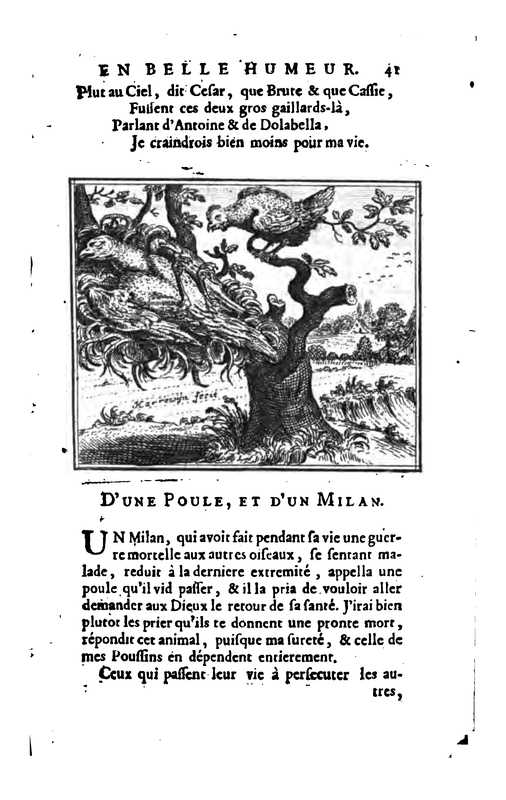
A kite whos life was in mortal war with other birds, felt sick reduced to his last bit of life. So, he calls a Hen for help and explains his issue, and how he wants to pray to the gods for his health back. However the Hen refuses, saying she would rather pray for a good death, as her fury and that of her chicks depend on it entirely.
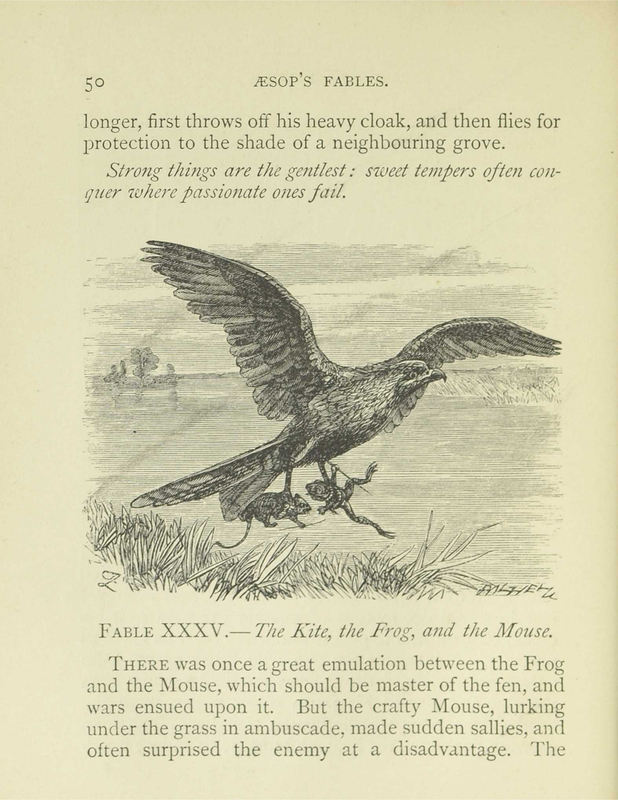
A bird (called “the kite”) flies near the ground gliding with its wings outstretched. Clutched in its left talon is a small frog that appears to be flailing to become free. Clutched in its right talon is a small mouse that also appear to be attempted to free itself. Both the frog and the mouse have very small projectiles or weapons in hand. Below them, the grassy fields and off in the distance a patch of tall trees behind a large body of water.
This image depicts an indigenous notary of a town council in Spanish colonial Peru. He is depicted sitting at a table writing a document. There is a container of ink with a feathered plum on the table as well as a rosary and a book. He is dressed in traditional clothing and is wearing a head piece that has three flowers in it. There is a bookshelf in the background that has many books stacked messily on the shelves. The author explains that even the smallest of towns should have a town notary. The document that the notary is writing in the image reads, “en el nombre de la santícima trinidad hago el testamento de don pedro” [in the name of the Holy Trinity, I draw up the last will and testament of Don Pedro]. The caption at the bottom of the image reads, “en este rreyno” [in this kingdom].
Here we see a set of cups used by the Houyhnhnms. This image appears when Gulliver explains how the Houyhnhnms use the hollow part of their pastern and hoof on their forefeet similarly to hands. Gulliver says they use this part of their bodies to do things like thread needles, milk cows, reap oats, and operate tools, including cups. These cups are made of wood and clay and are baked in the sun. The same image appears in the 1843 Krabbe edition.
![[Act XV – Areusa and Elicia]](https://cemvccol.ace-net.training/files/large/18052b27d191840e6dc20d29a067e40a20f2598c.jpg)
![[Scholars from Brobdingnag examine Gulliver]](https://cemvccol.ace-net.training/files/large/319744d6790bded24b4b6aded888405f3d368bda.jpg)
![[Cutting Down Trees]](https://cemvccol.ace-net.training/files/large/c13850503fad35989b00cc2b7d1691dcf805b63a.jpg)
![[Gulliver makes himself new shoes]](https://cemvccol.ace-net.training/files/large/58d9793ea8083e611238014e79941ee040174298.jpg)
![[Title Page – Calisto Encounters Melibea]](https://cemvccol.ace-net.training/files/large/341f183df8f66e18734ce5771959389ecd452149.jpg)
![[Gulliver turns the page of a book on Brobdingnag]](https://cemvccol.ace-net.training/files/large/5d3e900aaa9fd70086fe7b77e76a1cba034d12ec.jpg)
![[Arachne Weaving]](https://cemvccol.ace-net.training/files/large/1f51f5302c01cc06c48ad939735b3da115d46c49.jpg)
![[Jones Reading this Book at his Club]](https://cemvccol.ace-net.training/files/large/277bcb1c444584b10630ac6e2218a39b84ef98be.jpg)
![[The Cid ordering his troops]](https://cemvccol.ace-net.training/files/large/e7abb9e68b4dbf0897975c7c40639614ce0fb86e.jpg)
![Escrivano de Cabildo Nombrado de Sv M[agesta]d, Quilcay Camayoc](https://cemvccol.ace-net.training/files/large/463c420b84131cd7429a20ada0e6b25e507e200c.jpg)
![[cups used by Houyhnhnms]](https://cemvccol.ace-net.training/files/large/81ea3797db8db57a450c3558578d1424b815c69f.jpg)