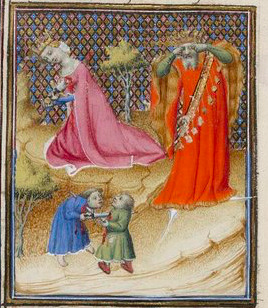
Jocasta and Oedipus were married and had four children before finding out they were in a mother-and-son marriage. Upon finding out the truth, Oedipus could not live with it and gouged out his eyes, blinding himself. This is represented in the top right of the image, where Oedipus wears a red cloak and gouges both eyes. Below him is Eteocles and Polynices, the sons he and Jocasta had, mutually killing each other in battle. Jocasta, in the pink gown, could not live with the reality that her sons killed each other and that her husband was her son, so she killed herself, represented in the top left of the image.
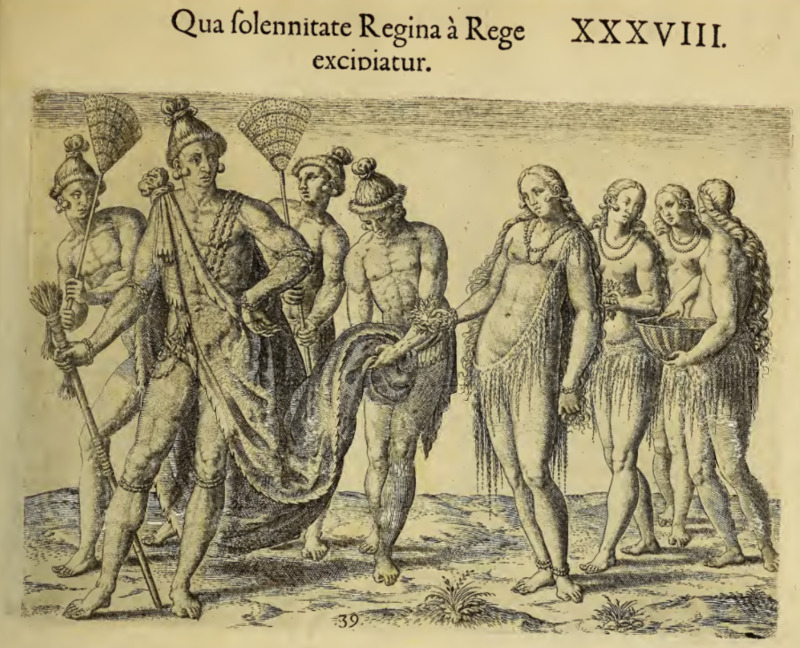
The king and queen sit on wooden chairs, elevated above the ground on a platform of logs. Groups of men sit on benches set perpendicular to the left and right sides of the platform. A group of women dance in a circle, inside the three-sided rectangle formed by the platform and benches. Some of the women hold hands as they dance. They wear ropes tied around their waists, from which discs hang.
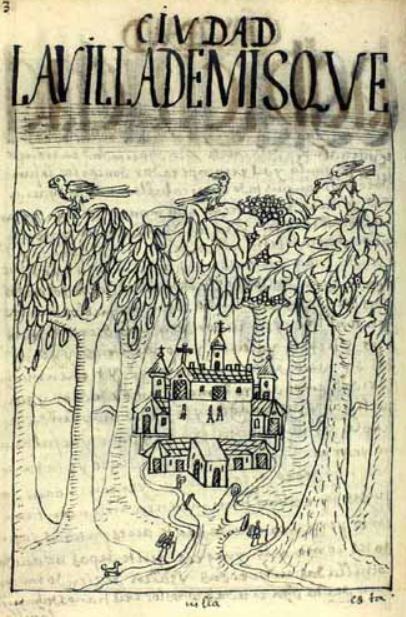
This image is depicted in the author’s chapter where he discusses cities, towns, villages, and provinces in colonial South America. This image depicts the town of Mizque in modern day Bolivia. The city is arranged in a cluster of buildings that forms a square in the centre where three people are depicted walking. There are large coca and fruit trees illustrated surrounding the city where large birds are sitting atop of them. Two long winding paths are illustrated leading into the city where travelers with walking sticks are depicted walking towards the town. There is also a small dog walking behind one of the people on the path on the left side of the image. The author explains that very few people lived in this small city as many dangerous animals lived close by. The caption at the bottom of the image reads “ciudad” [city].
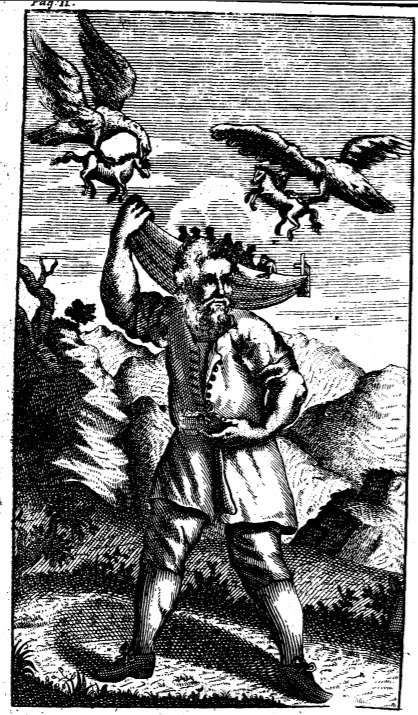
This image shows several elements of the story of Gulliver’s Travels. The central figure is one of the giants from Brobdingnag, who holds a ship, likely representing Gulliver’s ship. Two eagles – reflecting the eagles who took Gulliver from Brobdingnag – are holding the horses from the land of the Houyhnhnms. The image in this edition is the same as that in the 1728 German von Wiering edition.
Two girls kneel next to a toy chest, the lid of which is engraved with “FINIS.” It contains assorted items, including a set of dolls in the forms of Dobbin, Amelia, and Georgy, and on the ground beside it ones of Jos, Becky, and a gremlin or devil.
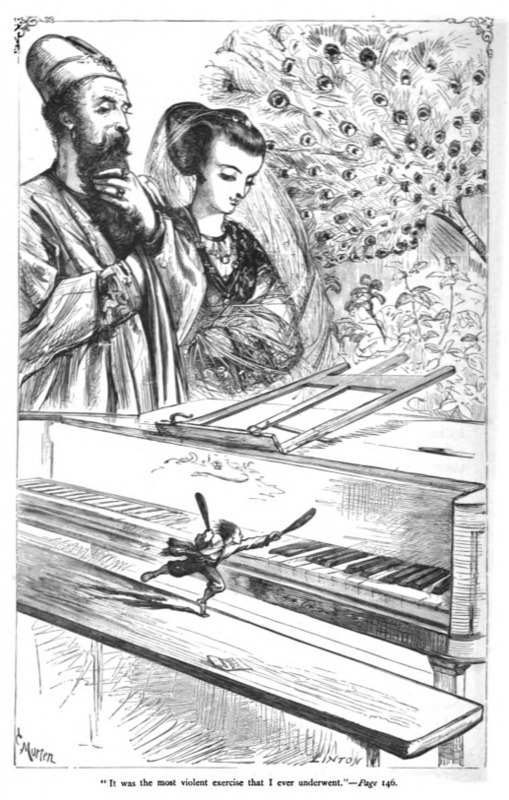
Here we see Gulliver playing the piano for the King and Queen of Brobdingnag. Because of the size of the piano, Gulliver used sticks to reach the keys, running up and down the bench. The King and Queen thoroughly enjoyed Gulliver’s music as it was quite different to the music of the giants.
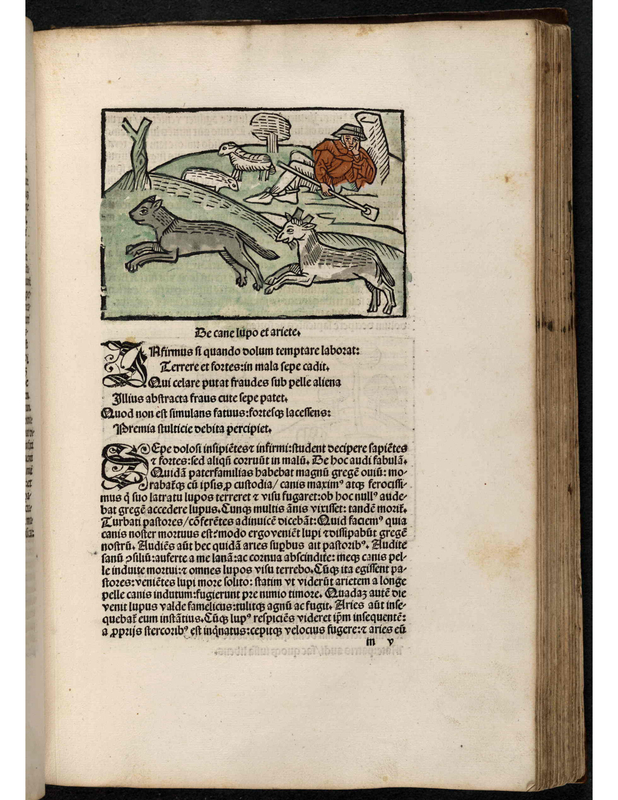
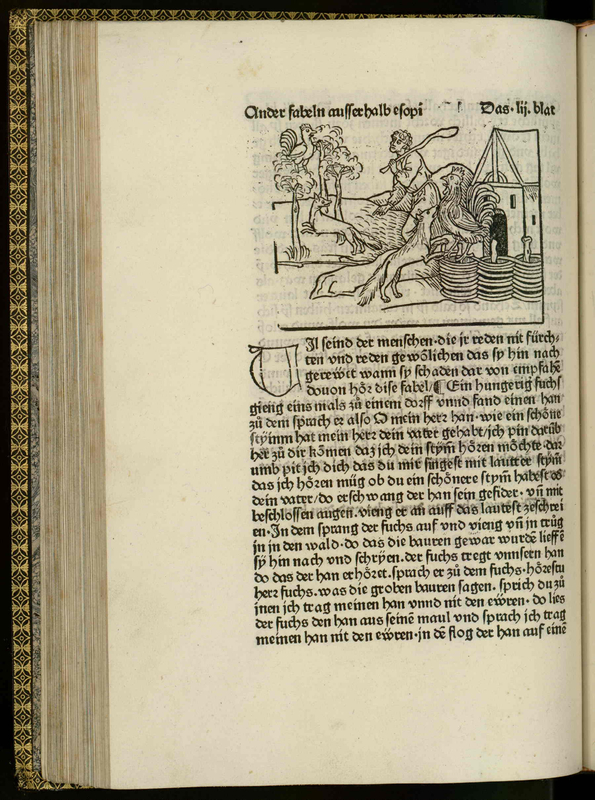
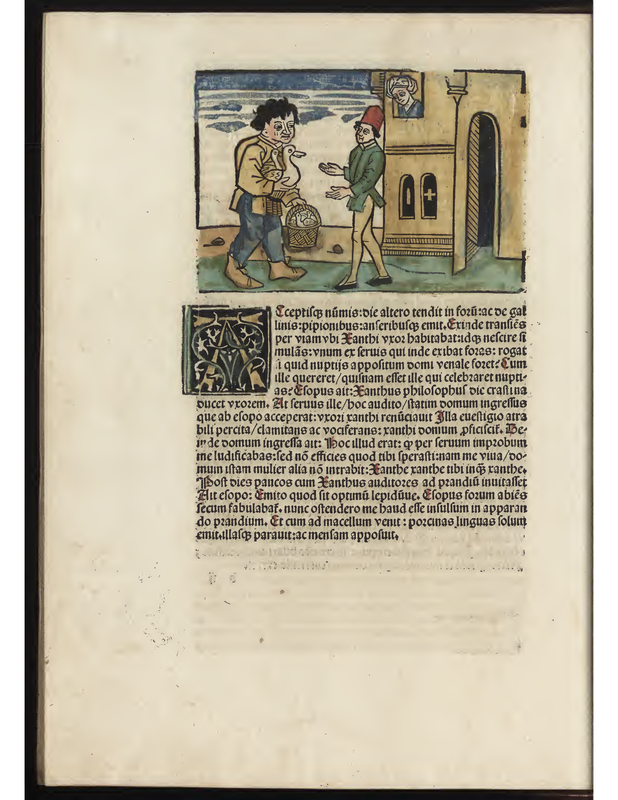
On the left side of the image, there is a rooster on the top of tree and a fox being chased away by a human with a wooden stick. On the right side of the image, there is a wolf about to attack a rooster. Behind them there is a barn.
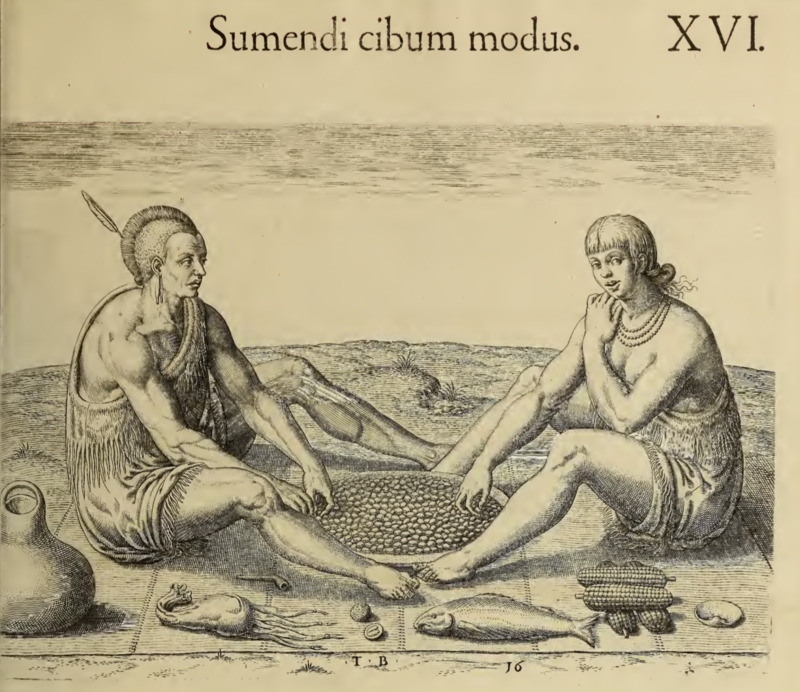
Two Indigenous people are shown sharing a meal. A man sits on the left, and a woman on the right. They sit on a mat on the ground. A large dish with food is between them, and around them are a jug, a pipe, some nuts, a fish, some cobs of corn, and other objects. The man wears a fringed garment draped around his body and over one shoulder and a single feather in his hair. The woman wears a similar fringed garment draped over one shoulder and two strands of beads around her neck.
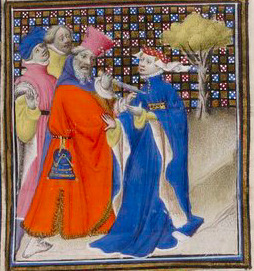
Verginius, in the red cloak, stabs his daughter Verginia in the chest. He knew that the only way she could be free and not captured or a slave was to be dead, so he did what he felt was right. Verginia in the blue gown is stabbed to the right of the image.
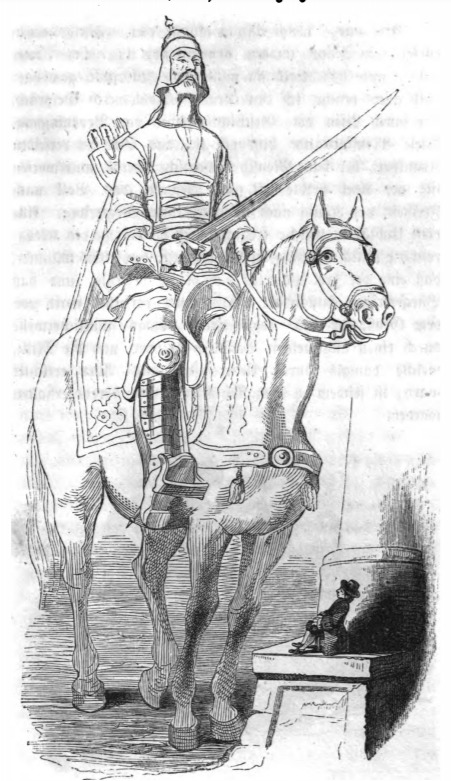
In this image we see Gulliver sitting on a base of a column, looking up at a member of the cavalry on Brobdingnag. The cavalry rides a horse and holds a sword. He wears military attire and helmet. Gulliver tells the reader that when measuring the horse and its rider together they stand over one hundred feet tall. The same image appears in the 1843 Krabbe edition.
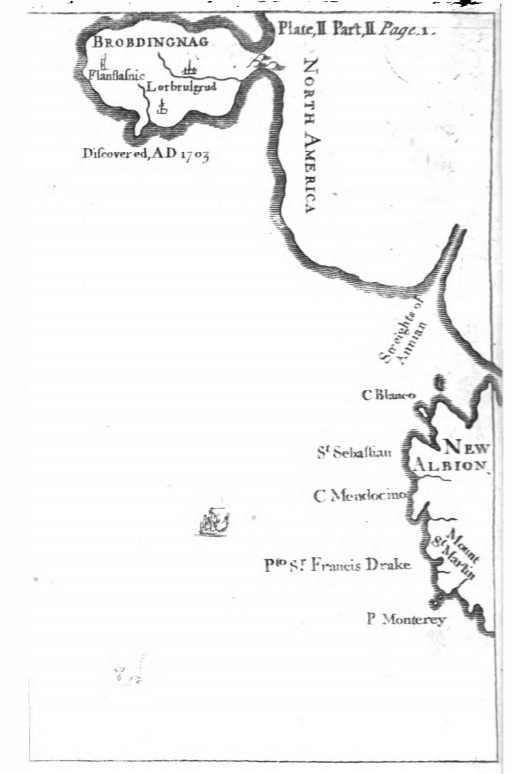
The image depicts the fictional land of Brobdingnag, off of North America. The cities of Flagnlamic and Lorbrulgrud are shown in Brobdingnag. Underneath Brobdingnag reads “Discovered AD. 1703”. The bottom half of the map includes New Albion. A ‘man-of-war ship is shown off the coast of New England, and a dolphin is near the bottom of the image. The same map is featured in several other editions of the text, including those in other languages, such as German.
Shortly after Celestina leaves Calisto, Calisto grows impatient and sends Sempronio to visit her house and hurry her along in her progress. When Sempronio departs, Pármeno tries to dissuade Calisto from procuring Celestina’s services. [In this illustration, a male figure is pictured on a horse, while another male figure helps him place his foot in the stirrup. While the figure on the horse looks the same as that used to depict Calisto, we can infer from the narrative that it is likely meant to represent Sempronio. Because the figures for Calisto and Sempronio resemble one another, this is likely an oversight in printing/engraving. The second figure is likely another of Calisto’s servants.]
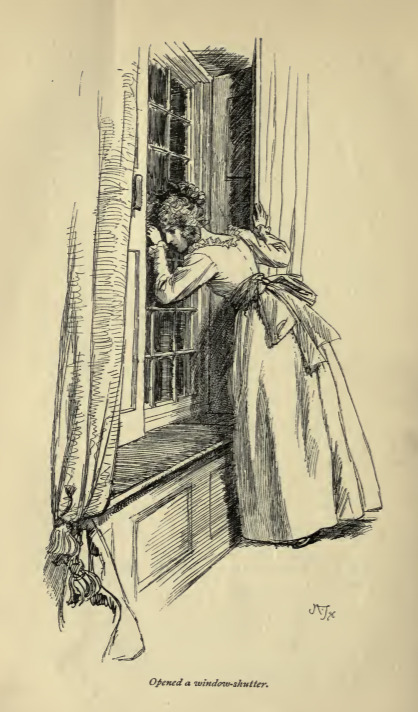
In this image Elinor looks out the window at Cleveland. Marianne was very ill and Colonel Brandon rode to Barton Cottage to bring her mother back to Cleveland. Elinor expected Colonel Brandon and her mother that night and opened the window upon hearing a carriage. The carriage she heard, however, was not her mother and Colonel Brandon, but rather was Willoughby. He heard of Marianne’s illness, and he had come to tell her that he had truly cared for Marianne and the letter he sent to her in London was written by his wife who was jealous. This scene occurs in chapter 43. The characters are shown in the traditional regency style. Elinor wears a regency style dress with an empire waistline, and a sash tied around her waist. The regency period dated to the early nineteenth century (1811-1820) when George, Prince of Wales, later George IV (r. 1820-1830), reigned as regent for his mentally ill father, King George III (r. 1760-1820). The regency period is associated with the rise of neoclassicism in art and fashion.
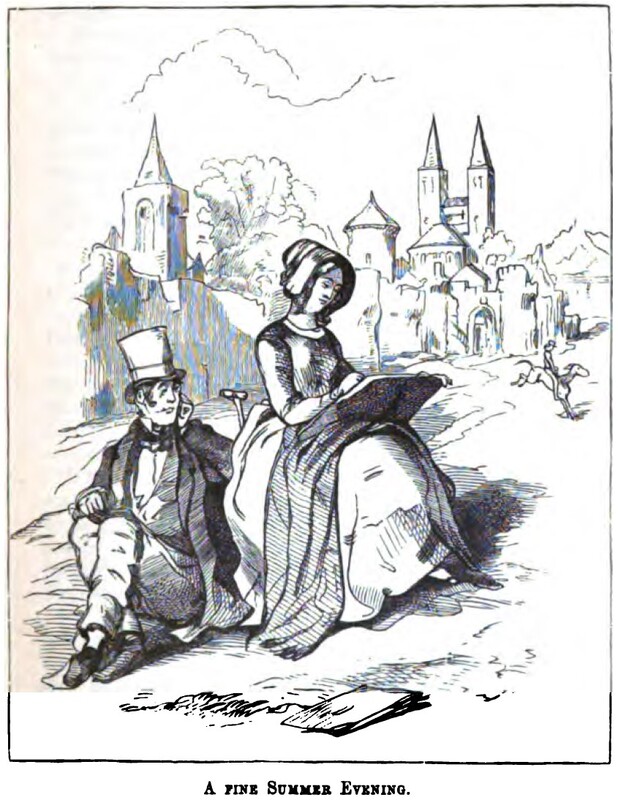
Amelia Osborne sits on a stool on the beach, drawing in her sketchbook. William Dobbin sits on the sand next to her, watching her with an expression of bliss. Another sketchbook or stack of papers lies on the sand in front of them. Further down the shore, a boy is riding a kicking donkey. In the background is a castle and tower on a cliff. Below the illustration is printed its title, “A Fine Summer Evening.”.
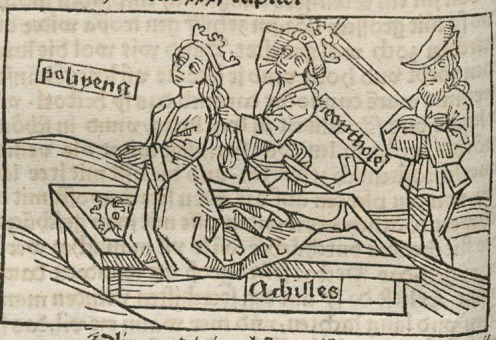
This engraving depicts Polyxena, the daughter of king Priam of Troy, getting executed on top of Achilles’ tomb. Polyxena is illustrated kneeling on the tomb of Achilles with her hands crossed while looking up to the sky as she accepts her fate. Her name is engraved beside her body to identify her. Achilles’ name is engraved on the side of his tomb. The man about to execute Polyxena is Neoptolemus, the son of Achilles. His name is engraved below his sword. Polyxena had lured Achilles into the temple of Apollo, where Paris shot Achilles with his arrow. She had done this through her mother’s instructions. Neoptolemus is the one to execute her as she is the one who is partly responsible for killing his father. Boccaccio explains that he wrote on Polyxena due to her fearlessness before her execution.
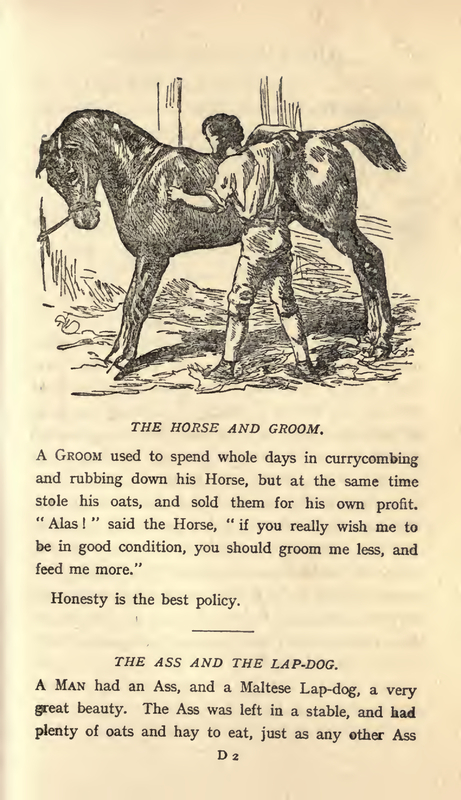
There is a bird up in a tree and a bird on the ground. A rabbit is facing the bird on the ground. An eagle is hovering above the rabbit as if it is going to attack.
A group of Indigenous Canadians (identified as such by the author) attacks the village of another group. The attackers arrive by canoe, bearing spears, bows and arrows, and torches. Some of them set fires along the shore and in the village. A few individuals on the right flee the fire by running and crawling away in an attempt to avoid the smoke.
Three people belonging to the Tupinambá Indigenous group are shown; a man, woman and child (possibly a family unit). The man stands in front holding a bow in his right hand and arrows in his left. He wears a necklace and an adornment on his chin and is otherwise nude. The woman stands behind him with one hand on his shoulder and a baby in her other arm. Her hair is long, and she is nude. There is a hammock behind the group.
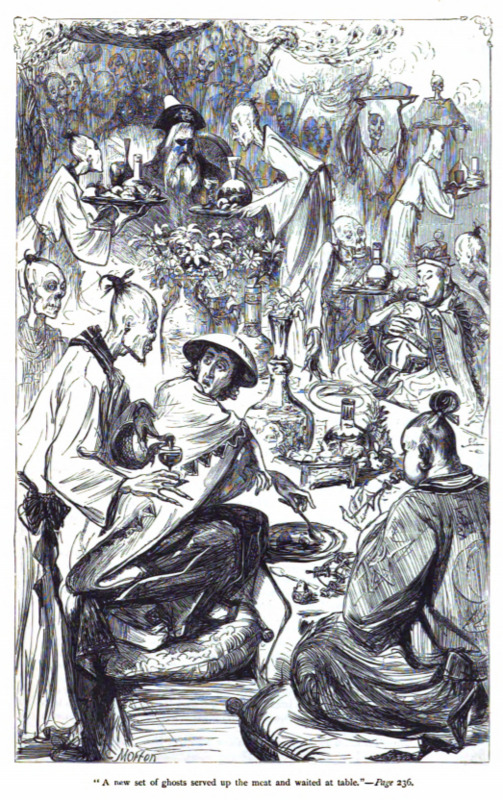
Gulliver learned soon after his arrival on Glubbdubdrib that the king of the island was a necromancer. All the king’s servants were ghosts. Here we see Gulliver dining with the King and his court and being served by ghosts.
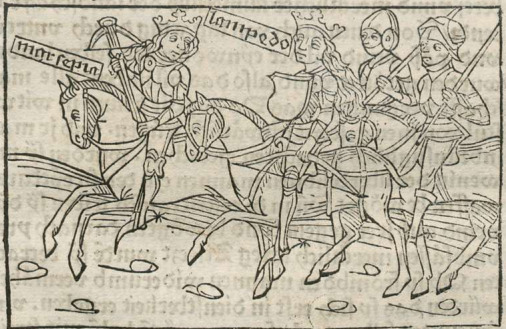
This engraving depicts the queens of the Amazons, Martesia and Lampedo. The Amazons, as described by Boccaccio, were a group of widows who decided to take up arms and fight to avenge their husbands’ deaths. They began dedicating their lives to training in riding horse-back, archery, and other military skills. The Amazons elected Lampedo and Martesia to be their queens. Lampedo is depicted with a bow and arrow in her left hand as she rides her horse, with her name engraved beside her head. Martesia is illustrated looking back at Lampedo with a sword in her hand. Her name is engraved to the left of her sword. The women riding behind them are other Amazon women.
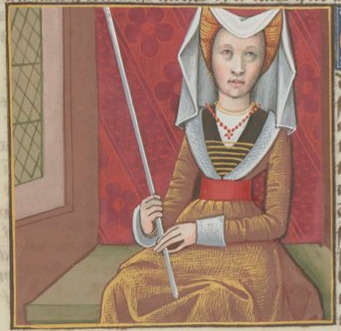
This illumination depicts a portrait of Constance, who was the empress of Rome and queen of Sicily. She is illustrated sitting down and holding a staff in her hands. Constance was forced to be a nun at a young age as a prophecy foretold that she would somehow cause the destruction of Sicily. Her father, William, put her in a convent to prevent the prophecy from happening. At an older age, Constance was married to emperor Henry and bore a son at the age of fifty-five. Her son, Frederick, grows up to be the one to fulfill the prophecy that King William was fearful of.


![[Finis]](https://cemvccol.ace-net.training/files/large/f97a1c587f499cf213349d44e660fc3905fdda91.jpg)
![[Act II (Second Illustration) – Sempronio (?) Sitting on a Horse as He Prepares to Visit Celestina]](https://cemvccol.ace-net.training/files/large/5b3de6ff75e1413e05b0c1bd1416cde62a69e744.jpg)
![[Eagle hovers over rabbit]](https://cemvccol.ace-net.training/files/large/34783269c652a0f6060947d6d676ef841bf5d7eb.jpg)
![[Conflict between Indigenous Canadian groups]](https://cemvccol.ace-net.training/files/large/1365feebeedf902987d5a8933086ab8f420dc25a.jpg)
![[A Tupinambá man, woman and child]](https://cemvccol.ace-net.training/files/large/3a309dbc8510126b65460c0ad32f742469daf040.jpg)