Two figures are depicted on a backdrop of the letter C from “Cuff”. The figure on the left is a boy with a toy sword and tall newspaper hat, riding a rocking horse, representing Cuff. This figure is bearing down on the other, representing William Dobbin, who has a triangular newspaper hat with a plume and a wooden sword raised to block his opponent.
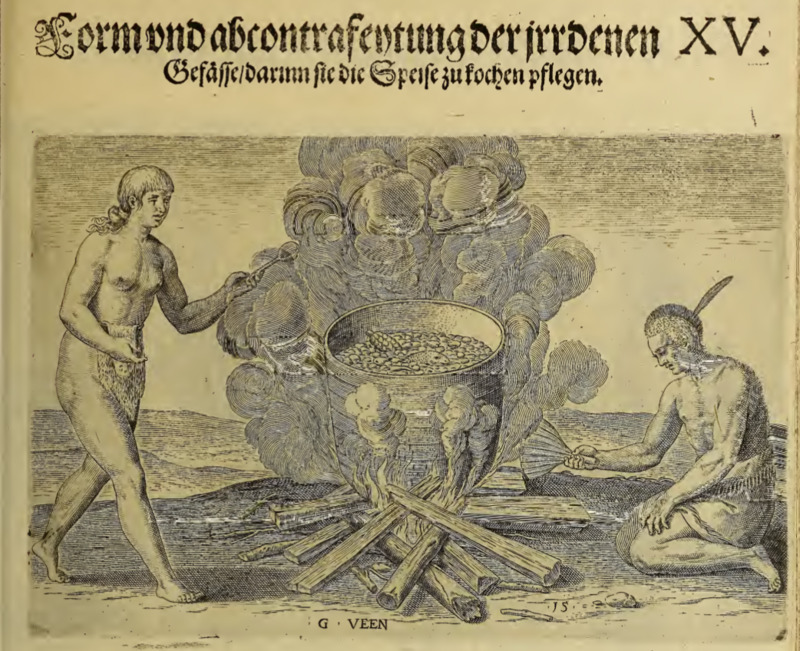
An Indigenous man and woman cook food in a large earthen pot over a fire. The woman holds a ladle, and the man kneels on the ground and fans the flames under the pot. Inside the pot a fish is identifiable, amongst other foods. Both individuals wear a fringed garment tied around their waist, and the man has a single feather in his hair.
Three people belonging to the Tupinambá Indigenous group are shown; a man, woman and child (possibly a family unit). The man stands in front holding a bow in his right hand and arrows in his left. He wears a necklace and an adornment on his chin and is otherwise nude. The woman stands behind him with one hand on his shoulder and a baby in her other arm. Her hair is long, and she is nude. There is a hammock behind the group.
Major William Dobbin leans back against the rail of the ship, smoking a cigar. Next to him is a cannon. Joseph Sedley is seated in front of Dobbin, smoking his hookah. The two are headed from St. Helena to England. In the background, the horizon is flat and the sky cloudy.
Here we see a group of Houyhnhnms carrying a deceased Houyhnhnm. They carry the body towards a cave that will serve as a tomb. This image appears when Gulliver explains the lifecycle of the Houyhnhnms and their burial rites. The same image appears in the 1843 Krabbe edition.
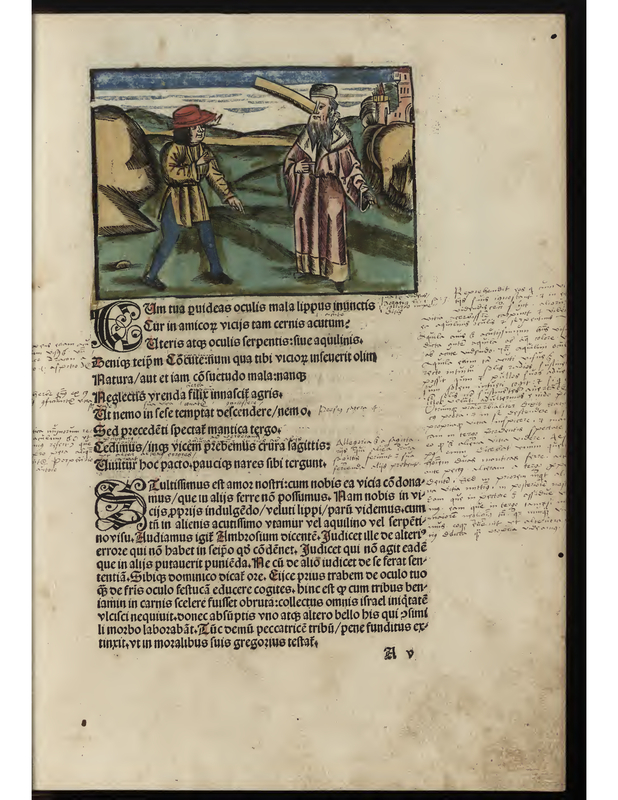
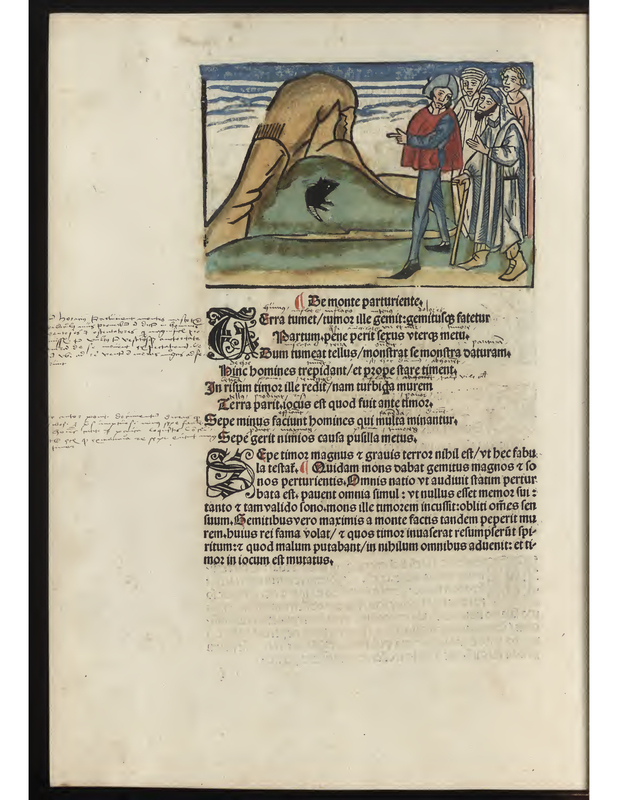
A man in a red hat talks to an old man with a long white beard and a wooden beam in his eye. The man with the beam in his eye is wearing a long robe. There is a castle in the background and what appears to be piles of hay beside them.
A group of Indigenous people are in the process of burying the body of a deceased man. The body has been bound with rope about the arms and wrists and has been placed into the grave in a kneeling position. Two men kneel on either side of the grave each gripping one of the deceased man’s arms and holding a basket over his head. Two different men shovel dirt into the grave, and a third stands at the head of the grave holding a rattle or ornament and wearing a feathered headdress. Three women, one with a child by her side, crouch around the grave with their hands over their faces in distress, and there are bows and a club on the ground near their feet, perhaps to be buried with the deceased. This image is identical to one found on page 926 of Paris, 1575 (Chaudière), and in Thevet’s Les Singularitez de la France Antarctique (page 82 verso of Paris, 1557 and page 82 verso of Paris, 1558).
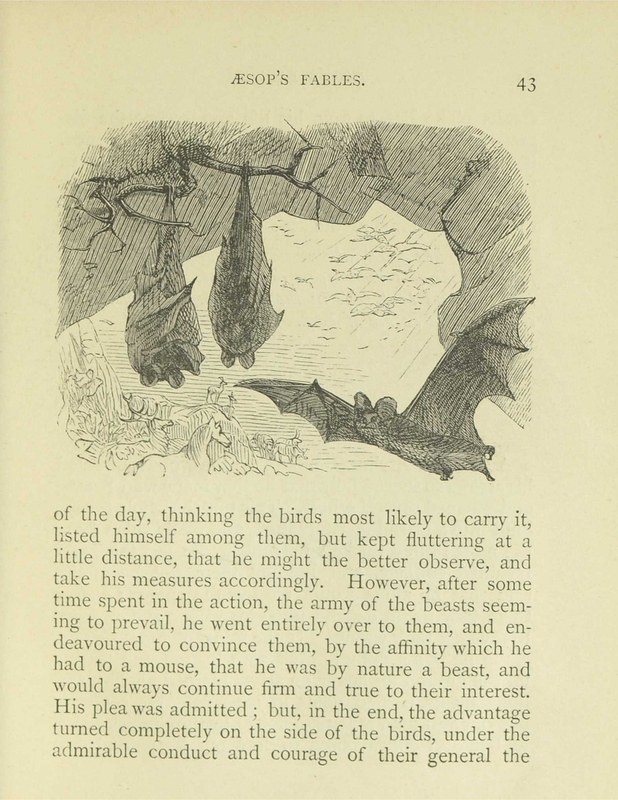
In the foreground we three bats in a shallow cave, the one farthest to the right still with its wings outstretched. In the background, the sun shines in the sky with the outline of birds flying. On the ground are the “Beasts” possibly horses, deer and goats among others.
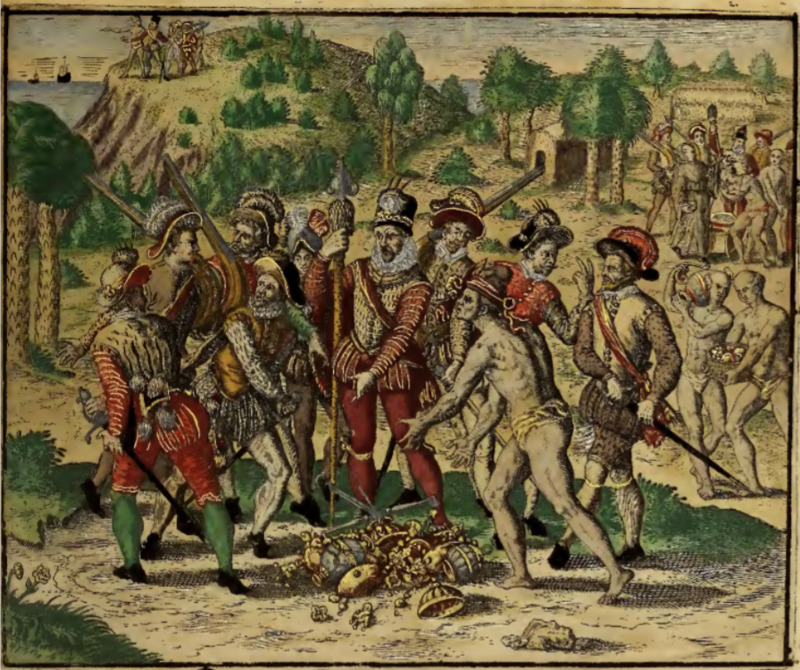
An Indigenous man stands amongst a group of Spaniards, gesturing emphatically at a pile of gold treasure on the ground in front of them. The Indigenous man has guided the Spaniards to the treasure to satisfy their greed. The Spanish men, finely dressed and bearing muskets, swords, and spears, converse amongst themselves. Two Indigenous men bearing more treasure approach from the right. In the background, a Spanish priest baptizes an Indigenous person while several other Spaniards and Indigenous people look on. There is also a single dwelling in the background. In the distance, on a hilltop, an Indigenous person indicates to a group of Spaniards the nearness of the ocean. This image is identical to one found on page 189 of Frankfurt, 1594, but colored.
Here we see Gulliver and the Governor of Glubbbdubdrub, who was a necromancer. After speaking with Alexander the Great, the Carthaginian General, Hannibal appeared. Hannibal assured Gulliver he did not have any vinegar with him when he crossed the Alps. The Roman historian Livy wrote that Hannibal softened the rock of the Alps by pouring vinegar over them and letting them soften in the sun, making their demolition much easier. The same image appears in the 1843 Krabbe edition.
Gulliver explains to the reader the relationships between husbands and wives on Laputa. He tells us that the women frequently have affairs and are given more freedom than he is used to. Their husbands are oblivious to their actions because they are too focused on their studies that they do not notice, and their Flappers are not there to alert them. The men can become so wrapped up in his studies that his wife could be in the same room with him and have her lover there and he would not notice. This is the situation shown in this image. The scholar is shown sitting at his desk with a problem in front of him, wearing the typical clothing with astronomical and musical motifs. His wife is next to the desk in the arms of another man, who wears dark clothes rather than the usual pattern, but the scholar does not notice. The same image appears in the 1843 Krabbe edition.
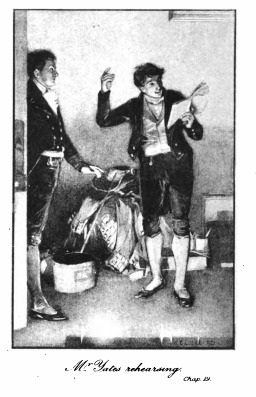
Here we see Tom Bertram’s friend, Mr. Yates, rehearsing the play, “Lover’s Vows”. While the senior, Sir Thomas Bertram was away on business in Antigua, the children decided to put on a play to entertain themselves. They were inspired by Mr. Yates, who had seen a play at another stately house. Edmund resisted, knowing that Sir Thomas would not approve, but eventually relented and agreed to participate in the play so that his brother would not invite anyone else. Those involved in the play were Tom, Edmund, Maria, and Julia Bertram, Mary and Henry Crawford, Mrs. Grant, Mr. Yates, and Mr. Rushworth. They asked Fanny to participate, but she refused. In this image we see Tom Bertram with Mr. Yates. This scene occurs in chapter 29 as noted underneath the title of this image. The characters are shown in the traditional regency style, with Tom and Mr. Yates wearing waistcoats and tailcoats and knickers that stop at the knee. The regency period dated to the early nineteenth century (1811-1820) when George, Prince of Wales, later George IV (r. 1820-1830), reigned as regent for his mentally ill father, King George III (r. 1760-1820). The regency period is associated with the rise of neoclassicism in art and fashion. The same image appears as an insert between pages 178 and 179 for the Dent 1893, 1894, 1895, 1896, and 1897 editions of Mansfield Park.
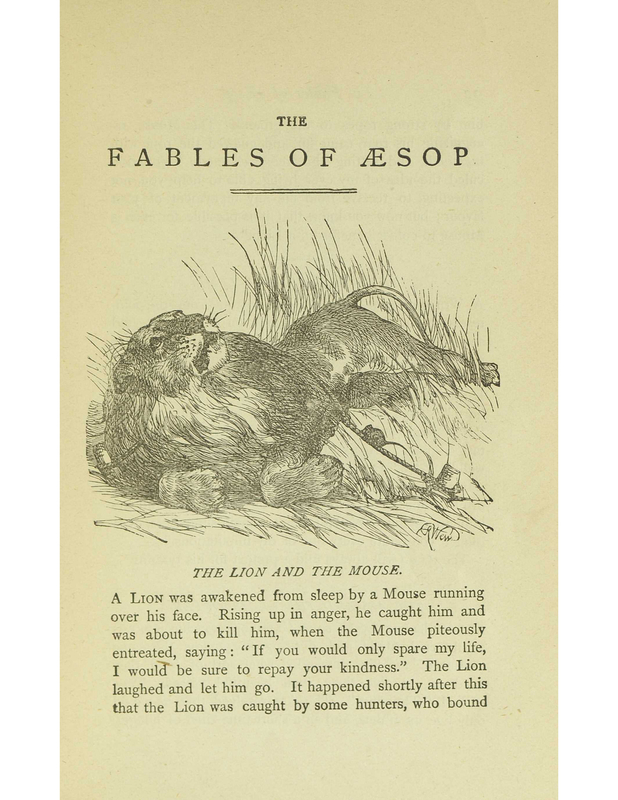
A lion is lying on its side in the grass. Its ears are bent backwards, and it is looking skywards. The lion is tied up by rope having been caught in a trap. A little mouse is walking up a piece of rope in the lower left corner.
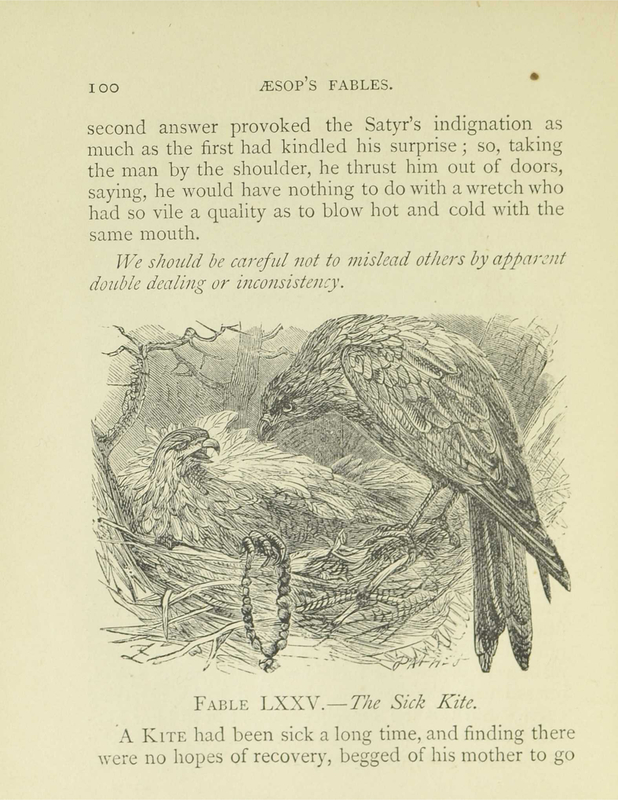
Two birds sit in a nest buried the branches of a forest. One bird, laying feeble in the nest holding a rosary in his claw. The other bird sitting on the edge of the nest leaning in to the resting bird.
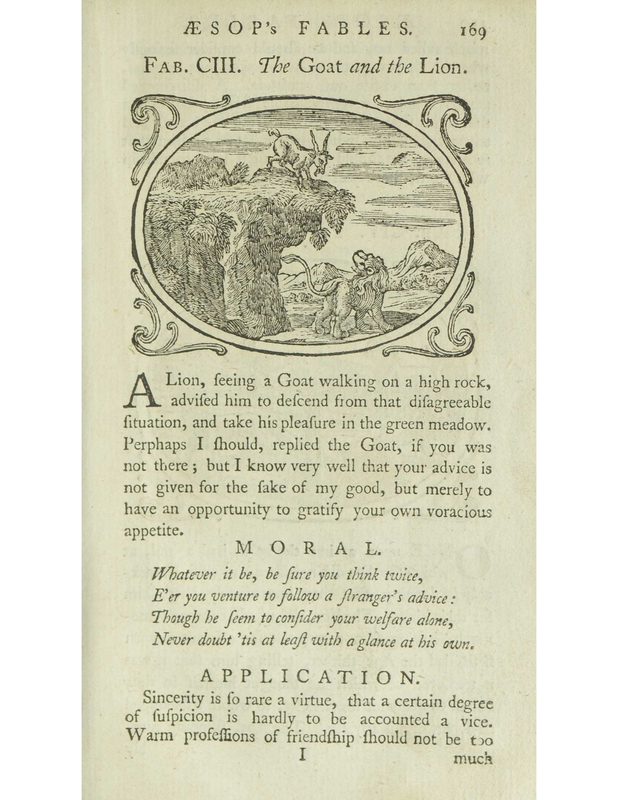
A goat stands near the edge of a cliff, and looks down on a lion. The lion is standing at the bottom of the cliff, looking up towards the goat. There are clouds in the sky above and mountains in the horizon.
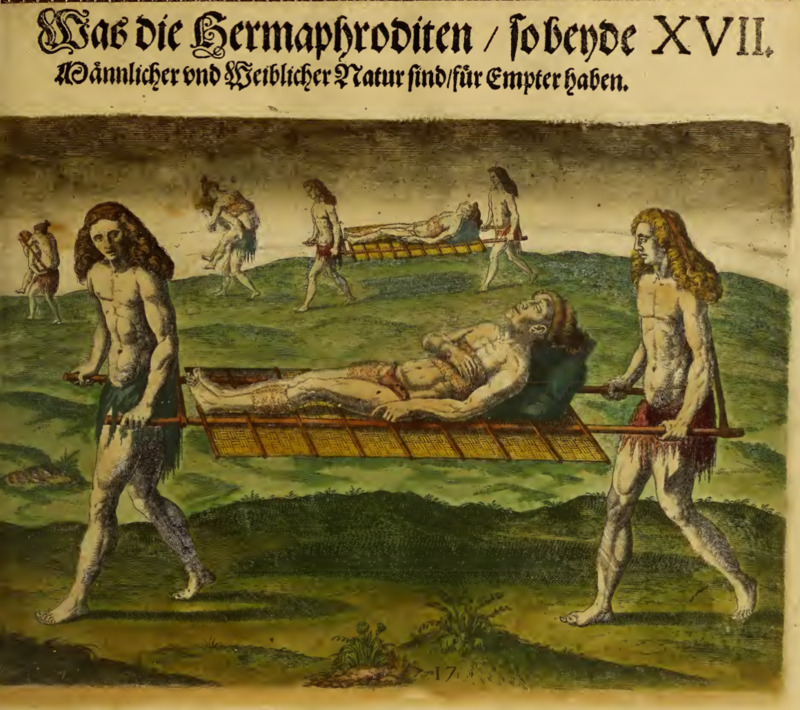
In this image two pairs of Indigenous people (one pair in the foreground of the image and one in the background) carry stretchers between them with another individual on it. In the background, two people each carry another individual on their back. In the foreground, the stretcher bearers wear their long hair unbound and grass skirts around their waists, with no other clothing or decoration. The original caption of the image indicates that the individuals carrying the stretchers and carrying others on their backs are hermaphrodites (today known as intersex individuals). This illustration is identical to the one found on page 69 of Frankfurt 1591, but colored.
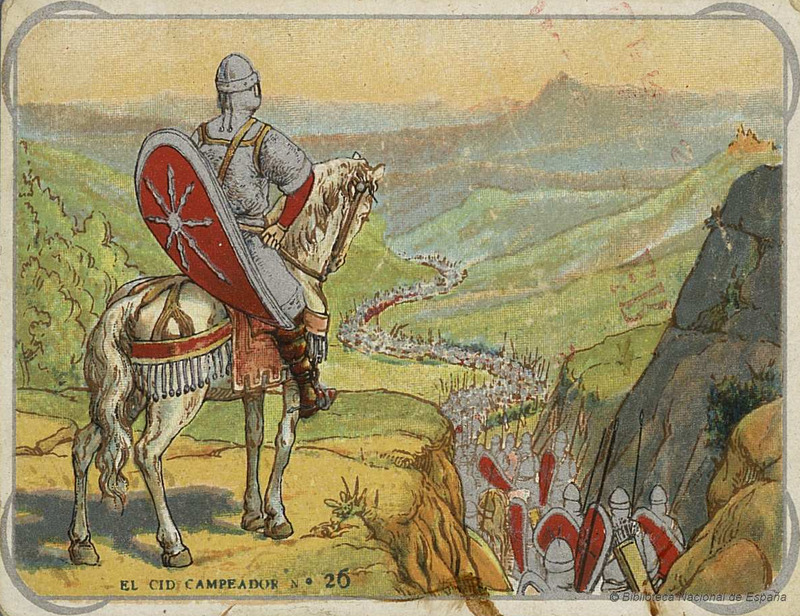
In this image EL Cid is overlooking his army walking in formation. El Cid is wearing chainmail and has a red and grey shield on his back. He is riding a white horse. His soldiers are all wearing chainmail and they are carrying shields and spears. There are mountains in the distance and on the left side there are trees. Green fields lay in front of El Cid. On of his soldiers is also carrying a quiver with arrows inside.
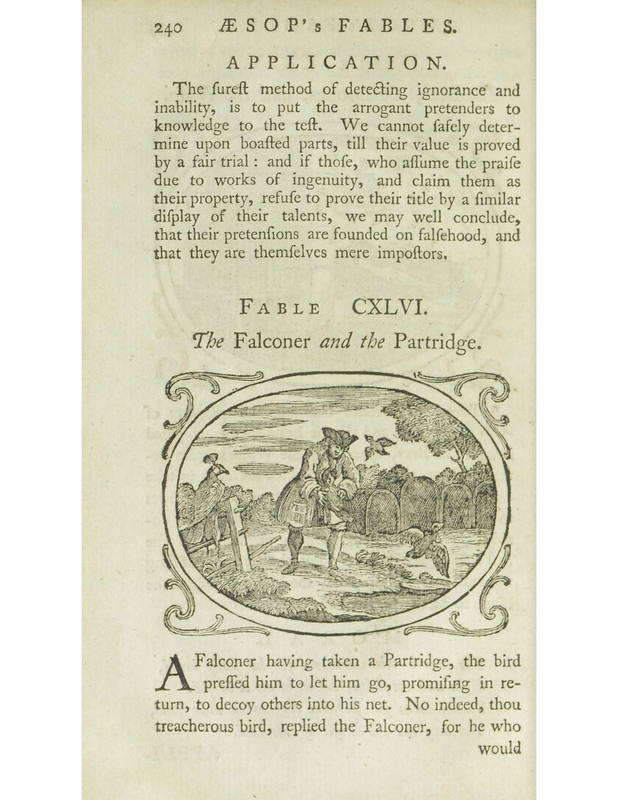
The scene is taken place outside, the Falconer is holding a partridge while another partridge is sitting on a broken fence looking towards him. The are 2 other birds flying around in the area. And another fence surrounding a tree and other plants in the background. The Falconer is trying to take the partridge but another bird presses him to let it go, promising to decoy other into his nest in return, but the Falconer declines.
In the left of the image, Miss Jemima is standing in front of and looking out of a window. Miss Pinkerton, wearing a feathered turban, is in the foreground. She is seated at her desk with feet on a raised footrest, and writing with a quill in her right hand.

![[Vanity Fair Chapter V Historiated Initial]](https://cemvccol.ace-net.training/files/large/e1d2e074cf095fe9dfef0361e3c5074d5023d767.jpg)

![[A Tupinambá man, woman and child]](https://cemvccol.ace-net.training/files/large/eeab23c07b545f09dd81af1ec3f80aedefc86935.jpg)
![[Dobbin and Jos on the Boat]](https://cemvccol.ace-net.training/files/large/e6c90f9cf65b73675931f0401bb04fab209e9e47.jpg)
![[a burial procession for the Houyhnhnms]](https://cemvccol.ace-net.training/files/large/24b0a7585a9b60194f55f7c9cd03e22429af80ec.jpg)

![Ceremonies com[m]e ils enterrent les trespassez.](https://cemvccol.ace-net.training/files/large/0992687835789e091c417b9d194c7bc6b397e490.jpg)
![[Gulliver and the Governor of Glubbdubdrib speak with Hannibal]](https://cemvccol.ace-net.training/files/large/1e9dcb070822cf6fcb21d137ac05cb6384442435.jpg)
![[a Laputan woman has an affair, while her husband is too wrapped up in his studies to notice]](https://cemvccol.ace-net.training/files/large/ce24aaad91082b32dece691801baadcabd73e15d.jpg)
![[Rebecca as Philomèle]](https://cemvccol.ace-net.training/files/large/ed804cf011bdc6ccf3285907286c914bdda09d0b.jpg)
![[Miss Pinkerton and Miss Jemima]](https://cemvccol.ace-net.training/files/large/2e7deb9cec32bcec7c01c38cf7ee2d371a07de56.jpg)