Here we see cherubs blowing the winds in the four directions of the compass. This image comes at the beginning of chapter seven, when Gulliver leaves Balnibarbi and arrives at Luggnagg. He travelled to Luggnagg to find a ship to take him to Japan, then back to England, however, upon his arrival there was not a ship ready, so Gulliver took a short trip to Glubbdubdrib.The same image appears in the 1843 Krabbe edition.
Here we see Gulliver who has passed out at the feet of his master after hearing that he must leave the Country of the Houyhnhnms. The Council of the Houyhnhnms told his master that Gulliver either had to live with the yahoos or return to Europe but could not live with the Houyhnhnms any longer. Gulliver was shocked by this, and decided he had to leave rather than live with the yahoos. The same image appears in the 1839 Krabbe edition.
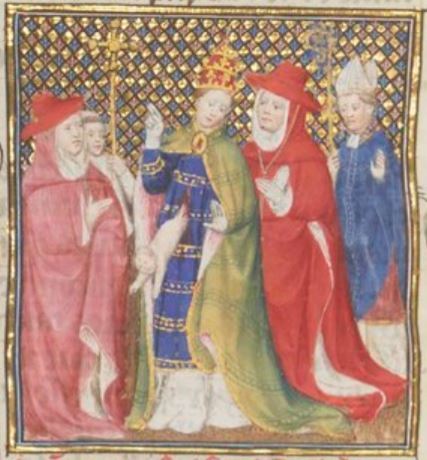
A maiden named Joan had disguised herself as a man in order to follow her lover to England while he attended school. Joan had excelled in academics and became incredibly knowledgeable while attending school. Continuing to dress as a man, Joan went to Rome and was elected to succeed as Pope, known as Pope John. No one had known she was a woman, however, she ended up having a love affair which resulted in pregnancy. This illumination depicts Joan, dressed as Pope John, standing in the centre of the image as she gives birth to a child. The child is depicted coming out from her stomach. The birth happened during a public procession which revealed her identity as a woman. There are people surrounding Joan who look shocked at what they are witnessing. According to Boccaccio, Pope John (Joan), was thrown into a dungeon to die as punishment for posing as a male while holding the title of Pope.
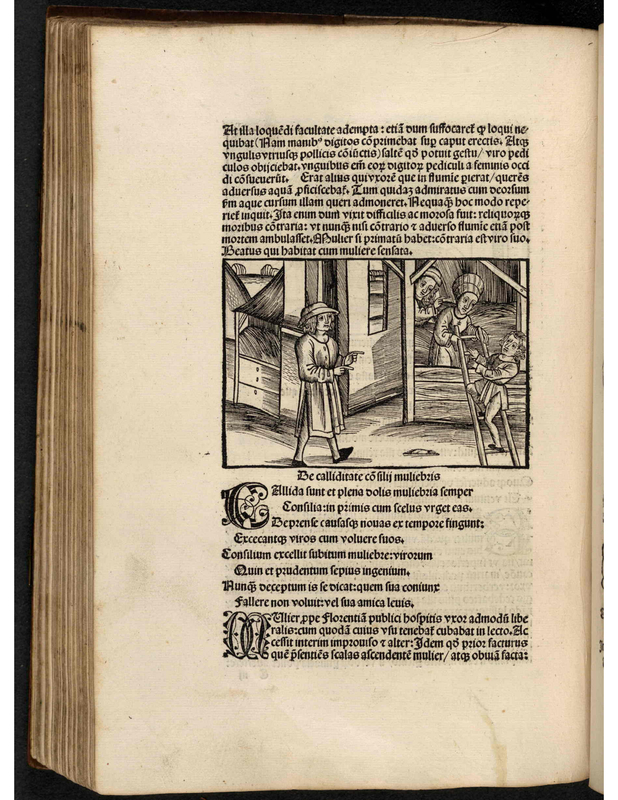
Two men talking while standing outside a barn with the doors open. With animals inside there are three visible bulls inside eating hay inside of the barn. One of the men outside is wearing a large hat as he glances behind him talking to the other man.
The left panel depicts Celestina’s prostitute Areusa, who is wearing a veil and a robe. To the right, we see Centurio wearing a hat and holding a long item of some sort, perhaps a cane/walking stick. Both figures are placed outside.The left panel is identical to those found on pages 173, 287, and 306, and is nearly identical to those found on pages 12, 208 and 271 (where it is labeled ‘Melibea’), page 84 (labeled ‘Lucrecia’), and page 350 (labeled ‘Alisa’). The right panel is nearly identical to those found on pages 12, 60, 122, 225, and 235 (where it is labeled ‘Calisto’).
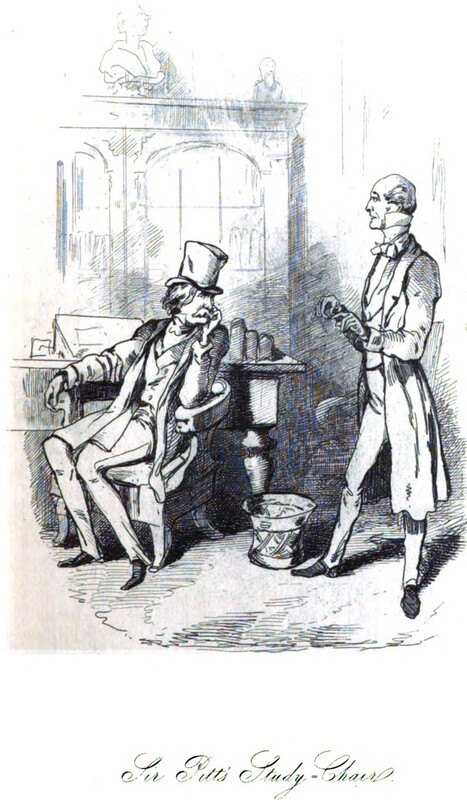
Rawdon Crawley sits in the chair at his brother’s desk with his chin on his hand, looking gloomy. His brother, Sir Pitt Crawley, stands next to him, trimming his nails as they talk. Rawdon wishes for Pitt and Jane to take care of his son once he leaves. Behind the desk is a cabinet with glass doors, and between the two men in the trash bin. Below the illustration is printed in cursive its title, “Sir Pitt’s Study-Chair”.
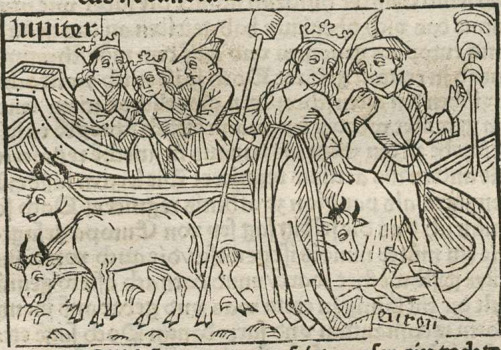
This engraving illustrates the beautiful Europa being kidnapped by Jupiter. Europa is depicted in the foreground of the engraving with a crown on her head and a long staff in her right hand. The creator engraved her name by her feet in order to be identified. Boccaccio explains that Europa was following her father's heard of cattle to the shores of Phoenicia because a panderer had convinced her to do so. The panderer is depicted with his arm linked around Europa’s left arm while guiding her to the shore. The cattle are clustered around Europa’s feet. The background of the engraving depicts the kidnapping. The panderer lead Europa to a ship which carried the god Jupiter. Jupiter’s name is engraved above his head. Jupiter’s arms are depicted around the waist of Europa as he is lifting her onto the ship to take her to Crete.
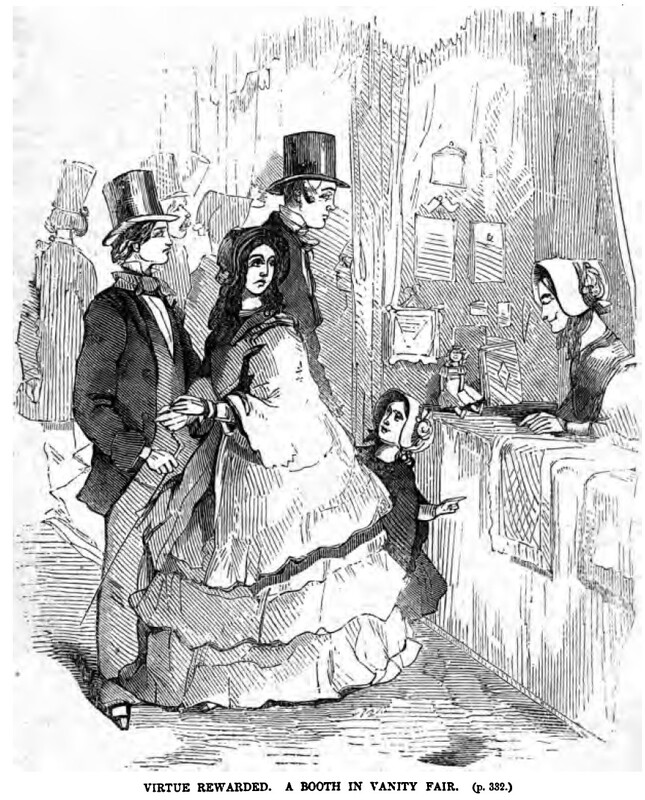
Rebecca Crawley sits behind the counter of a stall at the fair in London, selling items for charity. In front of the booth, Amelia Dobbin, holding onto the arm of her son George, is turning away upon seeing her. Behind them, William Dobbin is reaching out to pick up Janey, their daughter, who is looking up at him in puzzlement. Below the illustration is printed its title and location in the story, “VIRTUE REWARDED. A BOOTH IN VANITY FAIR. (p. 332.)”.
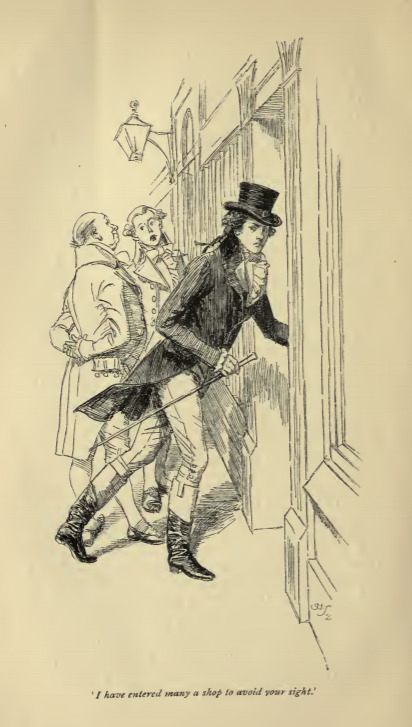
In this image Willoughby enters a shop in London to avoid seeing Marianne and Elinor. He knew how much he hurt Marianne and wanted to avoid hurting her further. He also knew that meeting would cause a scene which he also wanted to avoid. This scene occurs in chapter 44. The characters are shown in the traditional regency style. Willoughby wears a waistcoat and tailcoat with a cravat and wears a top hat in his hand he carries a walking stick. The regency period dated to the early nineteenth century (1811-1820) when George, Prince of Wales, later George IV (r. 1820-1830), reigned as regent for his mentally ill father, King George III (r. 1760-1820). The regency period is associated with the rise of neoclassicism in art and fashion.
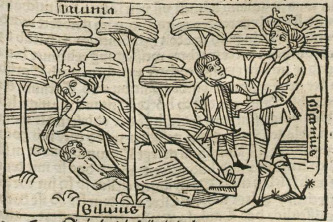
This engraving depicts Lavinia, wife of Aeneas and queen of Laurentum, hiding in the forest with her baby in fear of her step-son, Ascanius. Lavinia had given birth to a son who she named Silvius. Boccaccio explains that after Aeneas died, Lavinia fled to the forest as she was afraid that her step-son would kill her. Lavinia was wrong, and Ascanius voluntarily gave the kingdom of Laurentum back to her and helped raise Silvius. Lavinia’s name is engraved at the top of the image, and Silvius’ name is engraved below his body at the bottom of the engraving. Ascanius is pictured on the right-hand side of the engraving with his hand touching a young Silvius’ face with brotherly affection.
In this image we see Gulliver standing on a ladder, reading texts on Brobdingnag. The texts are written on scrolls, in a calligraphic style. Gulliver compares the writing style to that of Chinese script. Gulliver was given access to the royal library, and he read the texts while climbing on a ladder to see the text. Gulliver tells us that there are relatively few texts in the library. The same image appears in the 1843 Krabbe edition.
Here we see Gulliver pulling enemy ships back to Blefuscu during the war between Lilliput and Blefuscu. Gulliver waded in the water to reach the ships and he attached ropes with hooks to the ships and tied them together to pull them to shore. The Blefuscudians shot arrows at him, and worried for his eyes he pulled out a pair of glasses to protect his eyes, that he had hidden while the Lilliputians took an inventory of his belongings.
When Celestina (central figure) returns home, she finds Sempronio (rightmost figure) waiting there with Elicia. She tells him that she has good news, but she makes him wait until they are with Calisto. They go to Calisto’s house together, and Pármeno (leftmost figure) sees them as they approach. He tells Calisto of their arrival, and Calisto orders him to open the door.[This illustration is identical to the one found on page 34 of the text: [Act I (Third Illustration) – Celestina and Sempronio Talking as Crito Descends the Staircase].
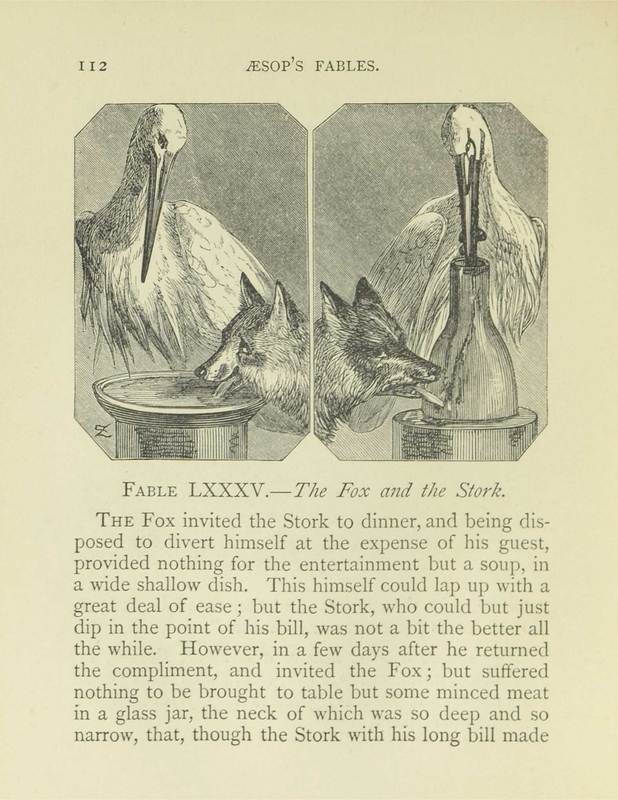
The image is shaped into two tall octagonal panels side by side. The left panel shows a large stork standing behind a fox, looking down upon it with annoyance. The fox’s head is visible in the bottom right corner lapping up a bowl of soup from a wide shallow dish, its eyes craned up to look at the stork. The right panel shows the same crane and fox, however now the crane is eating minced meat out of a long, tall cylindrical container and the fox is seen in the bottom left corner licking the side of the container for drips of food. The fox looks displeased at this, whereas the stork is satisfied.
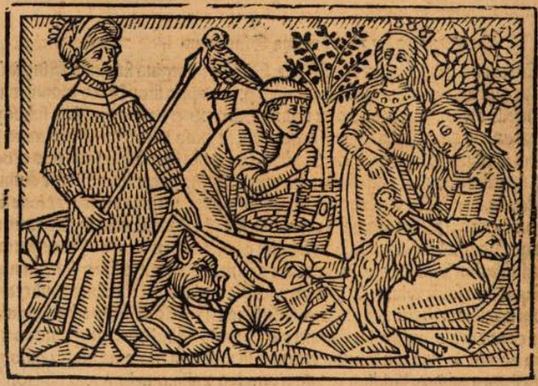
This engraving illustrates Minerva, also known as Pallas, standing on the left side of the engraving suited in armor, holding a lance in her right hand and a shield (with a depiction of Medusa on the front) in her left. Boccaccio explains that Minerva had discovered wool work and weaving. There is a woman in the right corner of the engraving shearing a sheep to signify this discovery. The woman standing beside her has fabric in her hand to signify the art of weaving that Minerva had given to the world. The man in the centre of the engraving is depicted with a millstone in his hand, pressing down into a bucket of olives. Minerva had taught the world of men to do this so that they can extract and use oil from the olives. An olive tree stands in the background to further the significance. There is an owl resting on a tree stump next to Minerva, which Boccaccio explains, represents her wisdom.
![[cherubs blowing the winds in the four directions of the compass]](https://cemvccol.ace-net.training/files/large/4f1048af312fb9e7e2f5659bb37d6a94c208bb75.jpg)
![[Gulliver passes out after hearing he must leave the Country of the Houyhnhnms]](https://cemvccol.ace-net.training/files/large/2077050b11dc9cc8b6d14ce528dcdb6d0cc31f76.jpg)

![[Two men near the barn]](https://cemvccol.ace-net.training/files/large/5499cb2010f78c168c60690a68c89b1520893824.jpg)
![[Act XVIII – Areusa and Centurio]](https://cemvccol.ace-net.training/files/large/acec3c95269acda1ee5454386e3dc82febed452d.jpg)
![[Gulliver examines the scrolls on Brobdingnag]](https://cemvccol.ace-net.training/files/large/8c31ffb5a903882199b1205989680773677e64bd.jpg)
![[Gulliver pulls ships back to Blefuscu]](https://cemvccol.ace-net.training/files/large/fb933f5f3179ae57aa0df81b9d579ff27f281791.jpg)
![[Act V – Pármeno Opening the Door for Celestina and Sempronio]](https://cemvccol.ace-net.training/files/large/f782c7f2b890318d8b1f80fdc1ef5ed78b41265d.jpg)