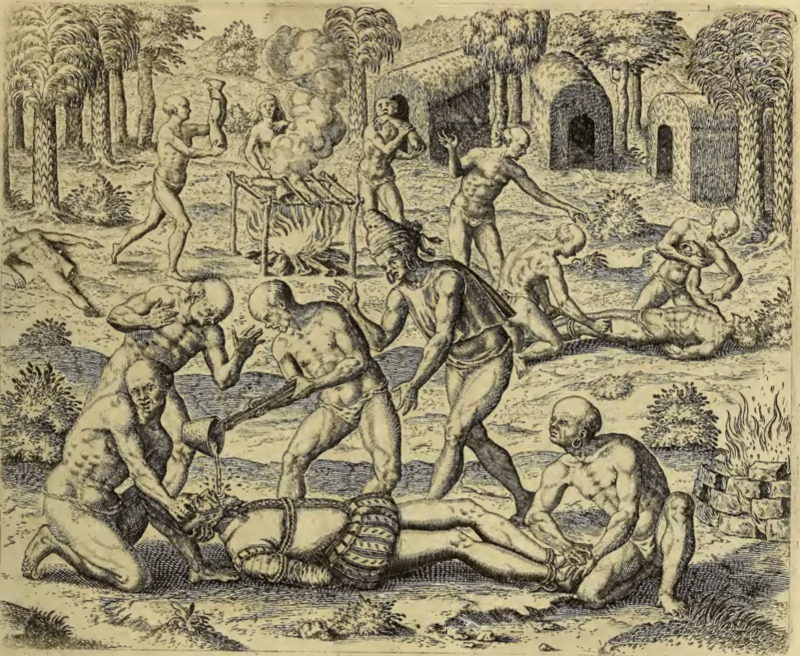
A Spanish man lies on his back on the ground, bound by ropes and restrained by Indigenous men who hold his head and feet. Another Indigenous man pours melted gold into the Spaniard’s mouth, while two other Indigenous men watch. To the right, two Indigenous men dismember the body of a second Spaniard. In the background, another body lies on the ground, this one missing a leg. Nearby, several Indigenous people stand around a fire with a wooden frame set over it for roasting limbs, and one of the men begins to eat a dismembered arm. There are several dwellings in the background.
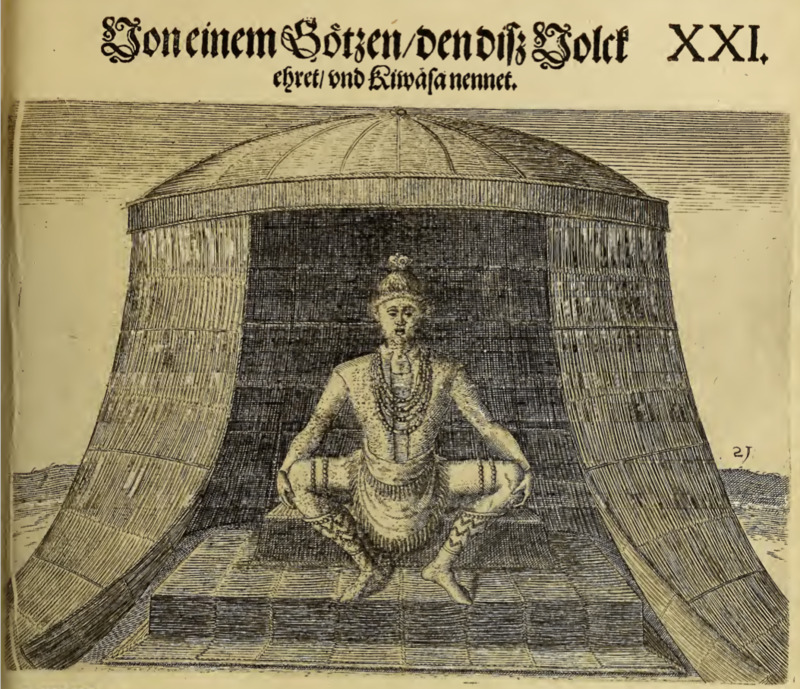
An idol carved of wood is pictured. It is shaped like a human man in a seated position and sits inside a hut-like structure. The idol bears a hat, strands of beads around its neck, a fringed skirt around its waist, strands of beads around each of its thighs, and decorated cuffs around each of its calves .
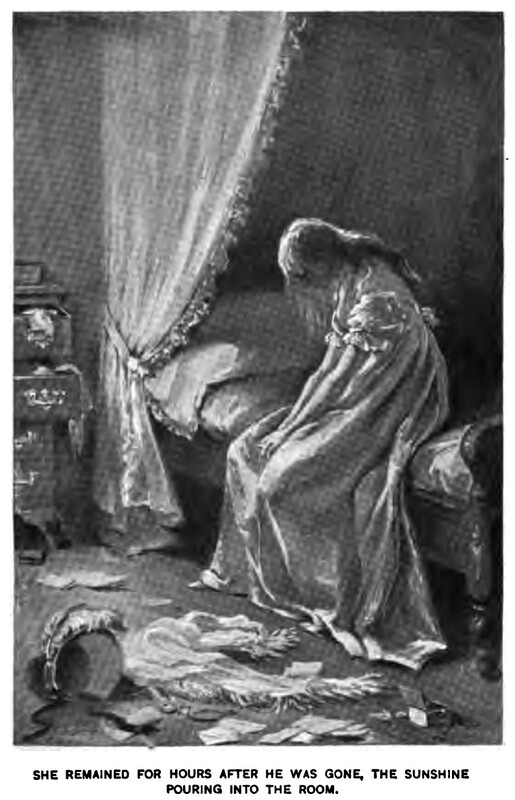
The image depicts a scene from page 181 in Chapter XIX, in which Rebecca Crawley is left alone after Rawdon leaves her. She is shown sitting on the edge of the canopy bed with her head down, clothes and papers strewn across the floor and hanging out of the open drawers of the dresser next to the bed.
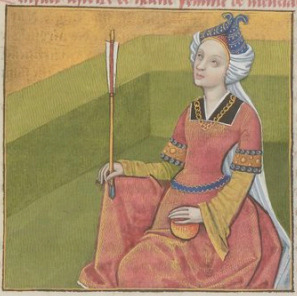
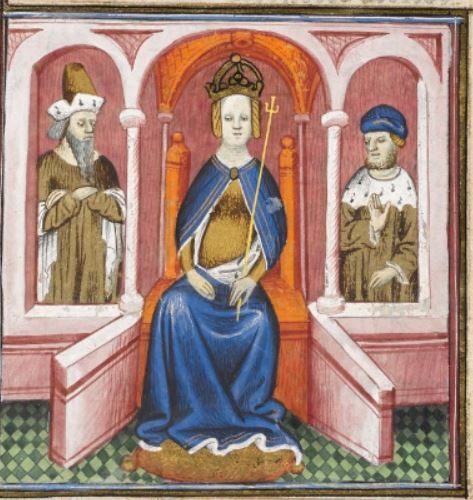
This illumination depicts a portrait of Helen, wife of king Menelaus of Lacedaemon (Sparta). She is illustrated sitting while holding a scepter in her right hand. Boccaccio explains that Helen was renowned for her incomparable beauty. She is the reason the Trojan War began, as she was either taken, or went willingly with Paris of Troy to Troy.
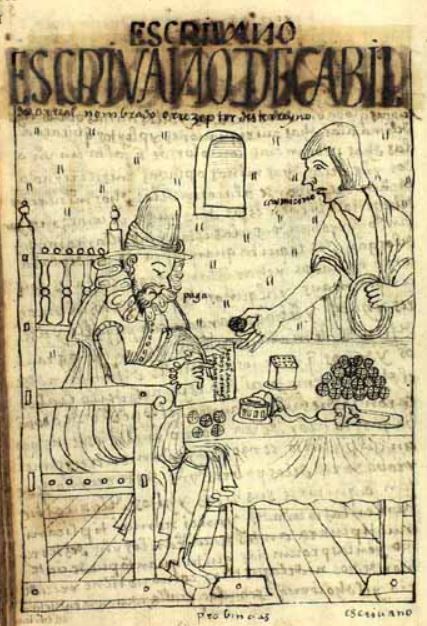
This image is illustrated in a chapter that discusses and criticizes the government and society in Spanish conquered Peru. This image depicts a Spanish notary sitting at a table on the left side of the image writing on a piece of paper. The piece of paper reads, “don diego de mendoza, corregidor desta prouin” [Don Diego de Mendoza, magistrate of this province]. The author criticizes these government officials as they would take financial advantage of the indigenous peoples by taking more tribute from them than required. There is an indigenous man on the right side of the image handing money to the notary. There is dialogue written by their mouths. The notary says, “paga” [pay me]. The indigenous man says, “caymi, cino” [here you have it, sir].
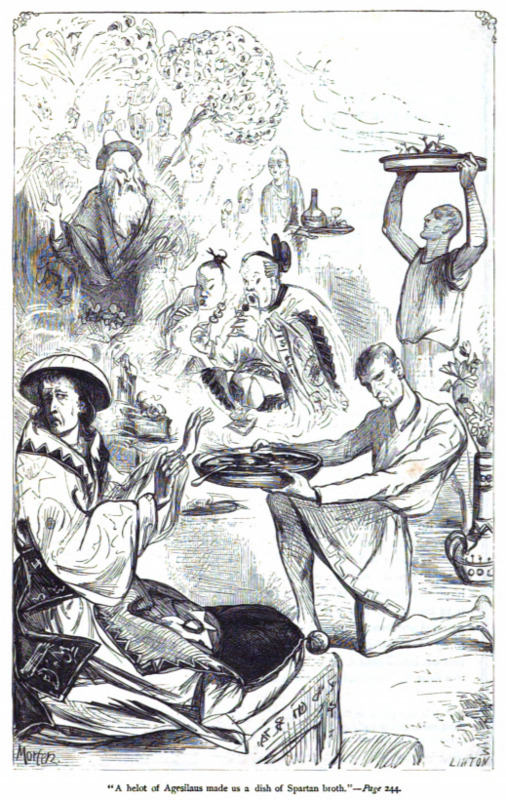
While Gulliver was in Glubbdubdrib he met with several ghosts from history. Here we see Gulliver dining with several Roman emperors. He asked to be fed by the cooks of the emperors and was given Spartan broth, which Gulliver did not enjoy, and only ate one bite.
Rebecca Crawley dressed up as the Marquise Philomèle to sing “The Rose Upon My Balcony” in the final section of the nightingale charade performance at Gaunt House.
In this image we see Gulliver kissing the little finger of the queen of Brobdingnag. The queen wears rings on her ring and pinky finger of her left hand. Gulliver stands on the edge of a table, leaning forward to kiss her finger. This takes place after the King and Queen of Brobdingnag purchase Gulliver from the Farmer who found him, and Glumdalclitch accompanied him to the royal palace. The same image appears in the 1839 Krabbe edition.
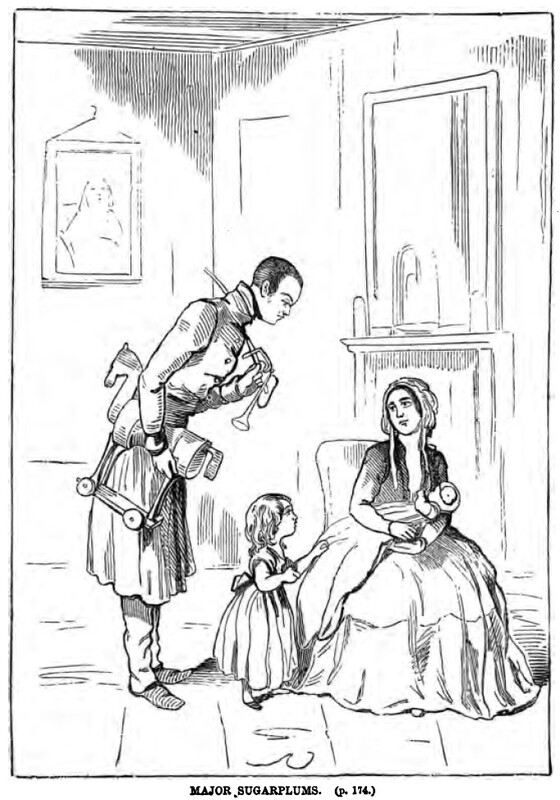
William Dobbin, carrying a toy sword, trumpet, and wooden horse on wheels, bows to Amelia Osborne. She is seated on a chair, holding her son Georgy, who is asleep. At her side is Mary Clapp, the landlord’s daughter, acting as the mistress of ceremonies to announce Dobbin, whom she calls Major Sugarplums. Below the illustration is printed its title and location in the story, “MAJOR SUGARPLUMS. (p. 174.)”.
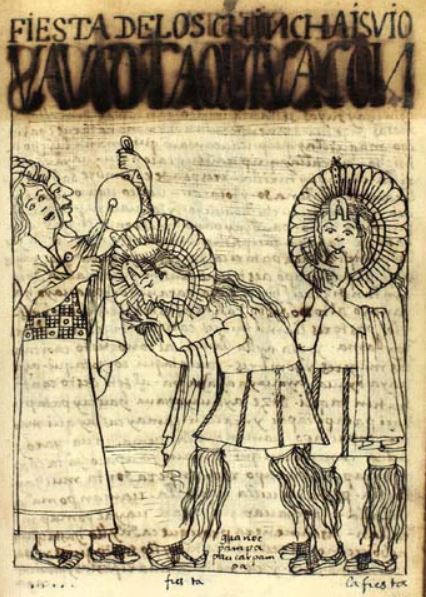
This chapter is dedicated to discussing the various celebrations and festivals that would be held in the Inca Empire. This image depicts a festival being held in the Chinchaysuyo region of the Inca Empire. There are four women illustrated in the image performing a uaucu taqui [song and dance]. The woman in the centre of the image and the woman on the right side of the image are depicted wearing feathered head garbs and blowing into what appears to be a musical instrument of sorts. The two women on the left side of the image are depicted playing a hand drum. The caption at the bottom of the image reads “guanoc pampa paucar pampa” [celebrations].
Two men in robes are speaking to each other while looking at a small statue of a man on a podium. One man has a red robe with a crown. The other man is wearing a blue robe and is gesturing to the statue.
This illumination depicts Opis, also known as Ops, sitting on a throne in the centre of the image holding a scepter and wearing a crown. Her two brothers, Saturn (who is also her husband) and Titan are standing behind her. Saturn and Titan appear to be looking down towards Opis’ stomach, as she is pregnant with Saturn’s children. Once the children, Jupiter, Neptune, and Pluto are born, Saturn and Titan attempt to kill them, which is why they are looking ominously at her stomach.
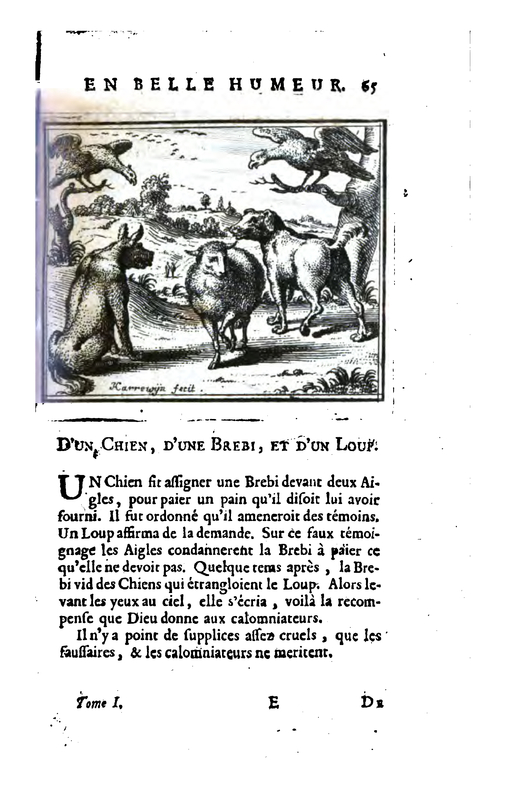
In the center of the image there is a sheep running towards the perspective of the image. There is a dog to the left of the sheep running away from the perspective of the image. There is a wolf staring at the scenario. There are trees on either side of the image and eagles sitting on them ready for take-off. There are birds in the background and a vast empty field behind the animals. here is a text written in the image Karrewyn fecit.
During his time on Balnibarbi Gulliver visited the Grand Academy of Lagado and the scholars who worked there. At the Academy Gulliver met a philosopher who believed he cracked a code about an ongoing political conspiracy. In this code a flock of geese represented the senate.
This image is a depiction of Gulliver interacting with the scientists and philosophers on Laputa. The object that the characters surround is an invention which the Laputans thought would reimagine their language. There are squares which would be turned by handles, which can be seen on the front side of the table. On each of the squares is a symbol representing a phrase in the Laputan language. The scientist stands in front of the table with his invention, explaining it to Gulliver who stands to the left side of the image. Students are surrounding the invention, listening to the scientist, waiting to operate it. A map of the island of Balnibarbi is on the wall behind the students. The same map, which shows how the island moves, is included in several other editions of Gulliver’s Travels. A picture above the map depicts a child playing with branches and a man on horseback. Underneath this internal image is the phrase “jüng gebogen, recht gezogen”. This image is the same as that in the 1762 German edition.
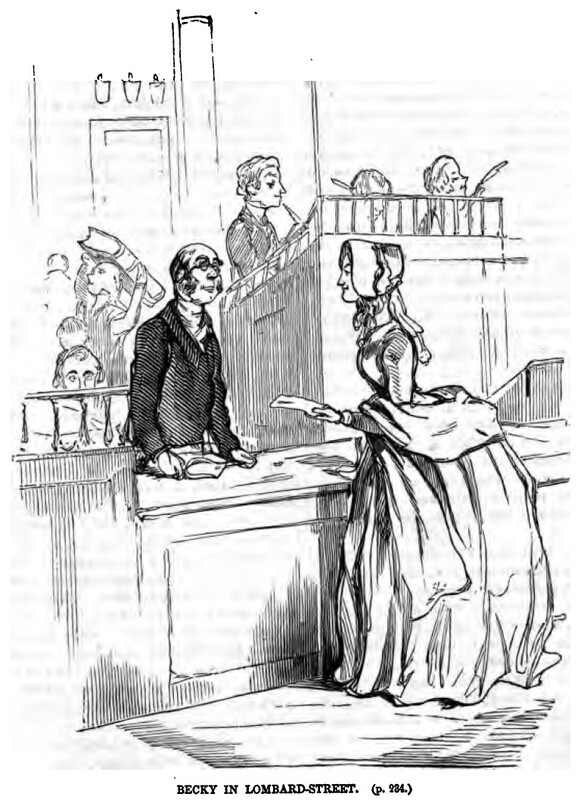
Rebecca Crawley stands at the desk of Messrs. Jones and Robinson’s bank. She is holding out a document which Lord Steyne sent to her, entitling her to a large sum of money from his account. On the other side of the desk is a bank official, holding a coin shovel. In the background are other employees of the bank, both seated and standing, holding quills and books. Below the illustration is printed its title and location in the story, “BECKY IN LOMBARD-STREET. (p. 234.)”.
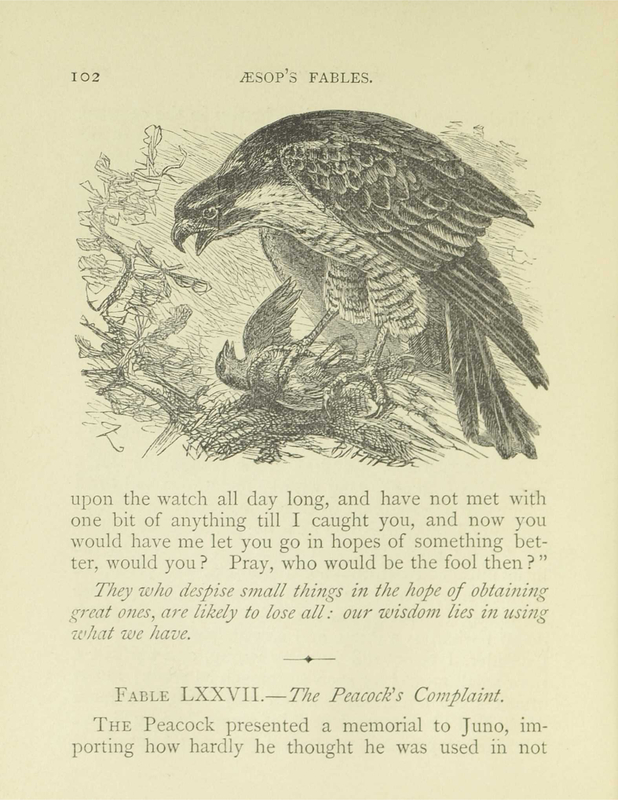
On a branch, a large hawk pins a small nightingale down with its sharp talons. The small bird gestures up towards the hawk with a wing, the hawk watched it intently.
Lord Steyne leans back in his chair, looking pleased. On the other end of the table are the Reverend Mr. Trail and Father Mole, in the midst of a debate which Lord Steyne started. The table between them is set with several plates and many cups and pitchers.
Here we see the Emperor of Lilliput addressing Gulliver. The Emperor stands on a podium with his arms outstretched towards Gulliver. A page holds the Emperor’s robe, and the Emperor wears a turban with a large feather. Other officials surround the Emperor. The same image appears in both the 1839 and 1843 Krabbe editions.
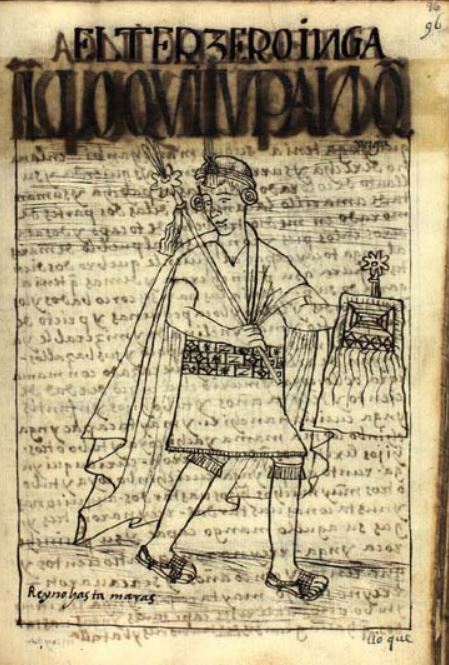
This illustration depicts the third Inca King, Lloque Yupanqui Inca. He is depicted holding a shield in his left hand and a long mantle in his right hand. His shirt has three embroidered striped in the centre of it. There are words written at the bottom of the image near his right foot which reads, “Reyno hasta Maras” which translates to “King until Maras”, which could suggest he was the king of a large area up until the town of Maras, which is near Cusco.
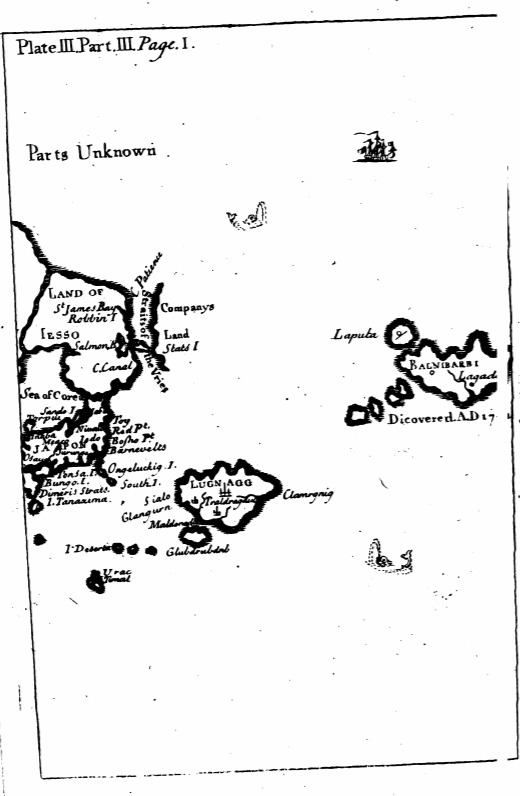
Here we see a map of the various countries Gulliver visited in the third part of the book. These include Laputa, Balnibarbi, Luggnagg, Glubbdubdrib, and Japan, among others. Underneath Balnibarbi we see “Discovered AD 17...” with the rest of the date obscured. We also see several ships drawn on the water.
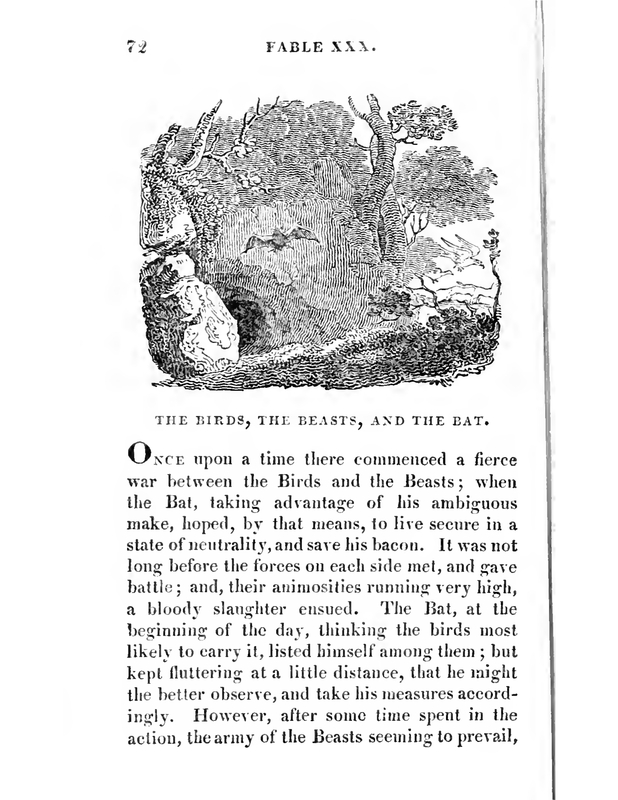
There is a small cave-like hole in a large rock in the bottom left of the image. A large rock in the foreground blocks the view of half of the hole that lies behind it in the middle ground. A bat in the air is above and slightly to the right of the hole. To the right in the background is two white birds flying above two animals on the ground. The rest of the background is covered in trees.

![[Becky as Philomèle]](https://cemvccol.ace-net.training/files/large/216fea14791fb7dcd08863c60f14364865a2d56b.jpg)
![[Gulliver kisses the finger of the Queen of Brobdingnag]](https://cemvccol.ace-net.training/files/large/5e4ea98976df5ba56975ebba7b61c2a24a0eb7c1.jpg)
![Esopi Appologi siue Mythologi cum quibusdam carminum et fabularum additionibus Sebastiani Brant. [Two men looking at statue on podium]](https://cemvccol.ace-net.training/files/large/c20b453d0c790e610c7d9eb2dd73751555243a09.jpg)
![[A flock of geese]](https://cemvccol.ace-net.training/files/large/0ace81977b331189a045f15878407d27a8844d92.jpg)
![[Gulliver and the scientists on Laputa]](https://cemvccol.ace-net.training/files/large/e8e469d409f72b3beb755d9cf8de0c69d82c4010.jpg)
![[The Boys’ Table]](https://cemvccol.ace-net.training/files/large/d49b483a4cd9306158660abd97f4c99f0f1ef9b0.jpg)
![[the Emperor of Lilliput addresses Gulliver]](https://cemvccol.ace-net.training/files/large/8ad6ca528a388f4b09012b388eed6f50957d5dc7.jpg)