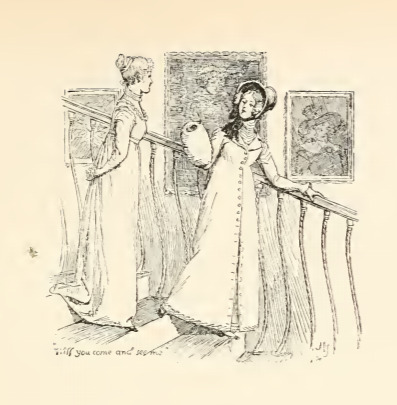
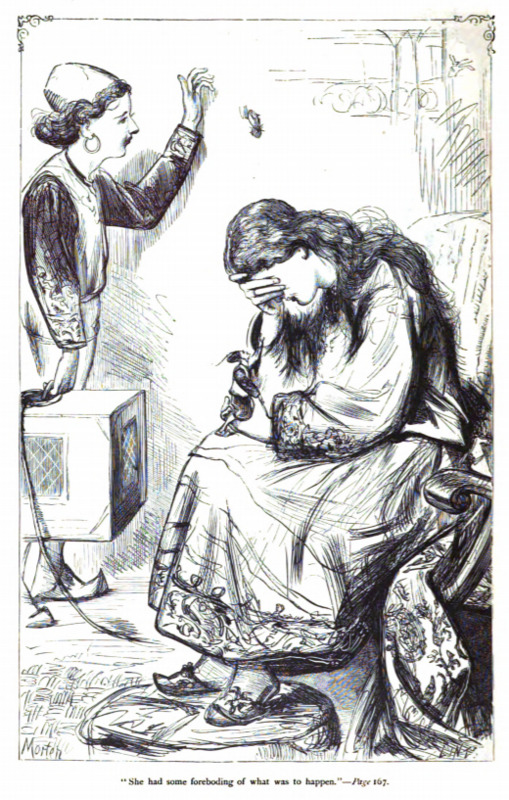
In this image Charlotte Lucas leaves Meryton after her marriage to Mr. Collins. She walks down the stairs of Longbourn speaking to Lizzy, who walks behind her. Charlotte asks Lizzy if she will come visit her at Rosings. Lizzy replies that she would come once Charlotte had gotten settled. This scene occurs in chapter 26. The characters are shown in the traditional regency style. Charlotte and Lizzy wear regency style dresses with empire waistlines. Charlotte wears a coat, bonnet, and carries a muff. The regency period dated to the early nineteenth century (1811-1820) when George, Prince of Wales, later George IV (r. 1820-1830), reigned as regent for his mentally ill father, King George III (r. 1760-1820). The regency period is associated with the rise of neoclassicism in art and fashion.
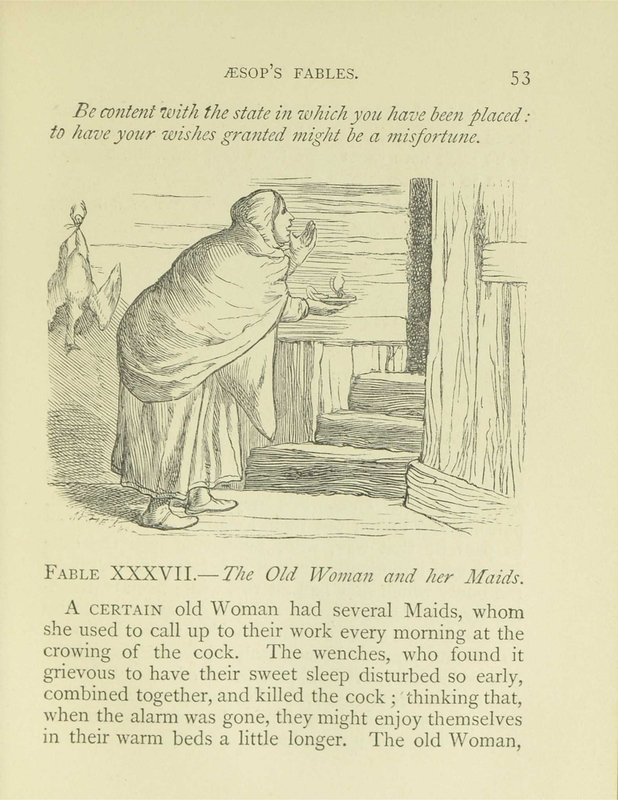
An old, hunched woman with a lit candle in her right hand appears to be calling to someone at the top of the stairs on the right as she has her left hand beside her mouth. Farthest to the right there is a large wooden wall that continues to the wooden staircase the woman stands at the base of. To the left of the woman, on the wall there is a bird hanging upside down with its feet tied together and is presumably dead.
While walking home, Celestina (leftmost figure) sees Sempronio (right-central figure) and Pármeno (rightmost figure), who are going to check on Calisto (left-central figure) at Saint Mary Magdalene’s church. The two servants enter first, and Celestina follows closely behind. She tells Calisto that she has good news, and the four of them go to Calisto’s house for privacy. Once there, Celestina tells him that Melibea is passionately in love with him and has agreed to meet at midnight. Calisto is overjoyed, but Sempronio and Pármeno express suspicion at Melibea’s sudden change of heart.
Most of the author’s images have titles, but the damage at the top of this page has ruined the header. This image depicts an indigenous Christian woman kneeling and praying before a crucifix. She is holding a rosary in her hands. There is a pile of bones in front of the crucifix with a skull on the top of the pile. There is a window in the top right corner with the dove of the holy spirit flying through it. The woman is dressed in traditional clothing with a long dress that is embroidered at the waist and has a cloak draped over her shoulders. This image is in a section of the book where the author aims to highlight the Christianity of the indigenous commoners in Spanish colonial Peru. The caption at the bottom of the image reads, “cristiana” [Christian].
At the Council of the Houyhnhnms, the council discussed the possibility of exterminating yahoos. Some of the reasons for the possible extermination of the yahoos were that they drank directly from cow’s udders, trample on oats and wheat, and would kill and eat their cats. The same image appears in the 1839 Krabbe edition.
After arriving on Balnibarbi, Gulliver sees the floating island of Laputa for the first time. Gulliver first noticed it after it blocked the sun, causing him to look up and see the island. He shields his eyes as the bottom was reflecting from the water below and was very bright. The island floats and would move around, hovering over Balnibarbi. In this image we see Gulliver looking up at the island, which was semi-circular with a city on top, and the underside was totally flat. We also see Gulliver’s boat in the water next to him. The same image appears in the 1843 Krabbe edition.
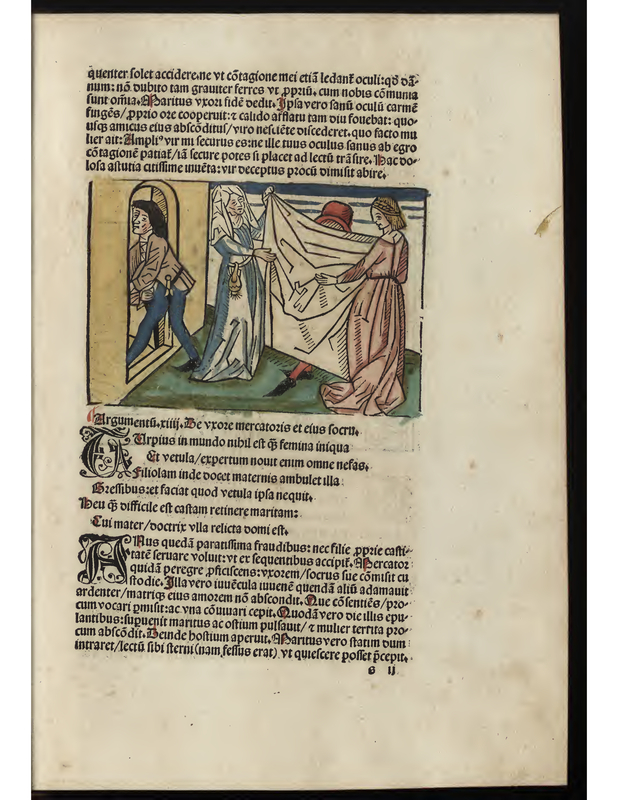
Two women hold a white sheet in front of someone wearing a red hat so only their hat and below their ankles are in view. A man is also walking into a building beside the women
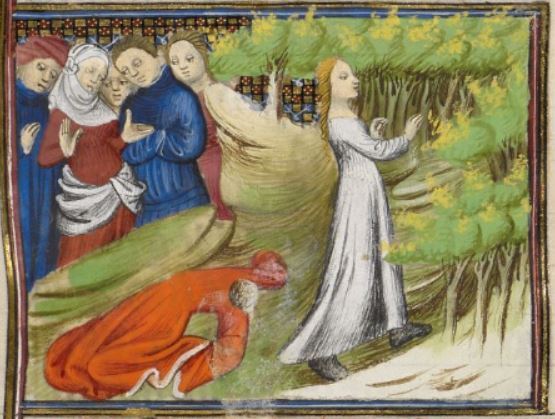
This illumination depicts a woman named Sulpicia leaving her home to find her exiled husband. Her husband, Lentulus Cruscellio, had evaded proscription and fled to Sicily to live in exile. Sulpicia was incredibly devoted to her husband and left the comfort of home to follow him into exile. There are people on the left side of the image watching Sulpicia leave. Sulpicia is depicted throwing away a red robe as she leaves behind her life to go with her husband.
Here we see a Lilliputian dining table. There are various fruits and vegetables on the table, and a painting of two cherubs on the wall, next to a mirror. Steam emerges from one of the bottles along the right hand side. We also see a face in the bottom right corner. This image appears in the appendix to Gulliver’s travels in Lilliput. The same image appears in the 1843 Krabbe edition.
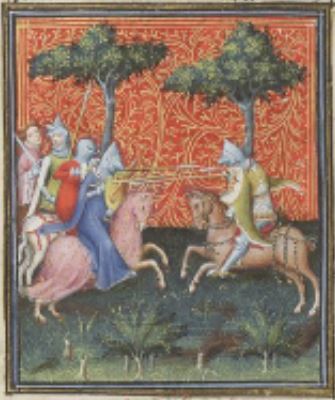
Queens Orithya and Antiope are on the left side of the image depicted riding horses with helmets on. They are differentiated as Amazon women as they are illustrated wearing dresses. They are holding long spears as they ride towards the figure on the right side of the image. The figure on the right side of the image riding a horse towards the queens is Hercules. One of Hercules’ twelve labours was to retrieve the royal girdle from the queens. Two of the queens’ unidentified companions are depicted standing behind them.
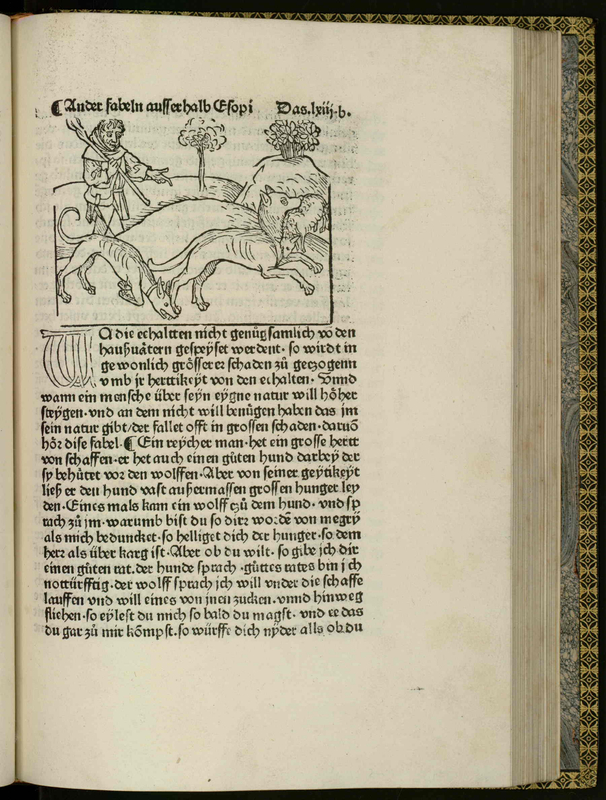
On the left side, there is a shepherd guiding a dog to chase the wolf. On the right side, there is a wolf with a sheep in its mouth running away. Behind them are hills with trees on them.
Here Glumdalclitch cries as she is separated from Gulliver. Glumdalclitch and Gulliver accompanied the King and Queen of Brobdingnag on their travels across the country. During their travels both Glumdalclitch and Gulliver became ill, Glumdalclitch more so than Gulliver. When they stopped near the ocean, Gulliver asked to be taken to the shore for a visit. Glumdalclitch was too sick to take him, so a page took Gulliver. While at the shore an eagle picked up Gulliver’s house and carried it out over the ocean, away from Brobdingnag.
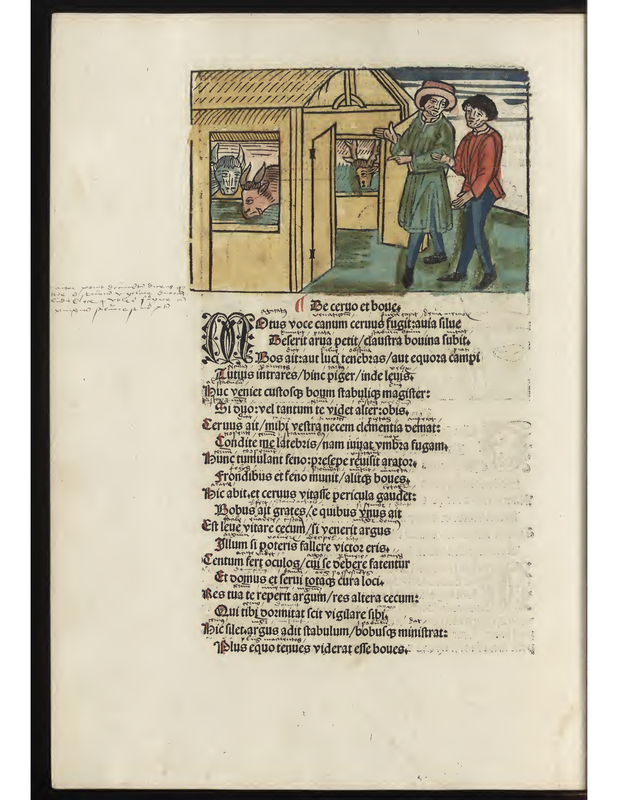
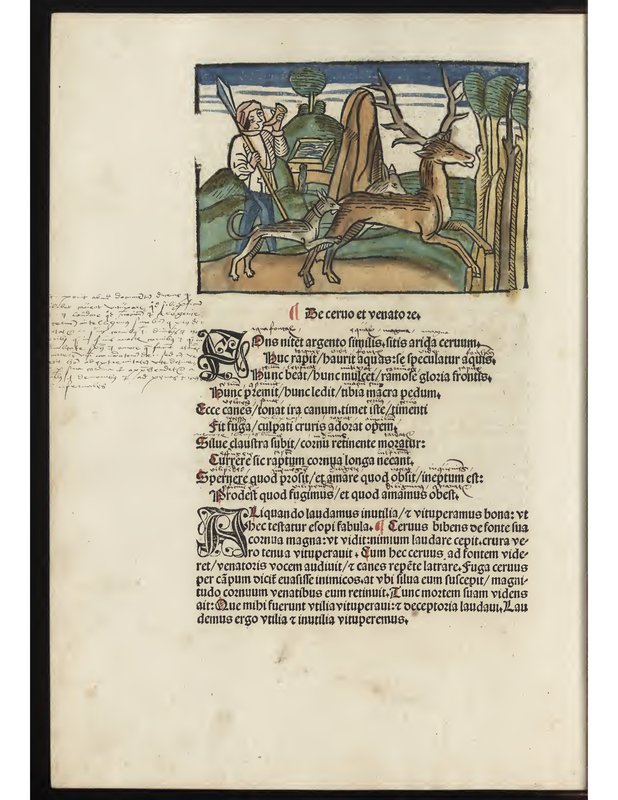
The hunter is blowing from a small horn. The hunter is holding his weapon which is a spear that is as tall as him or even taller. There is a large deer with huge antlers passing by the hunter along with two baby deer following right behind. In the background there are trees and many hills.
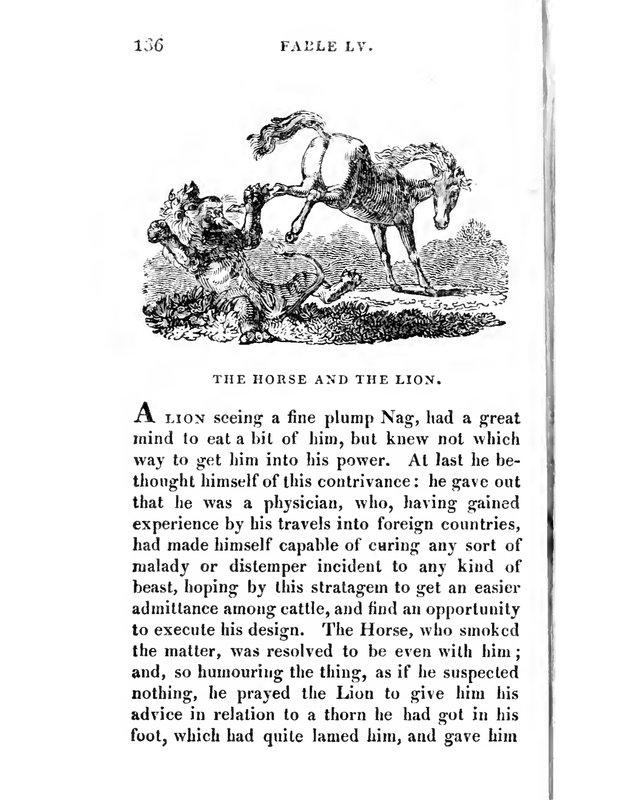
On the right-hand side of the image a horse looks towards the lion on the left-hand side of the image. The horse's front two hooves are on the ground as it kicks in the air at the lion with its back two hooves. The lion sits on the ground with limbs splayed, leaning back to attempt to avoid the horse's hooves.
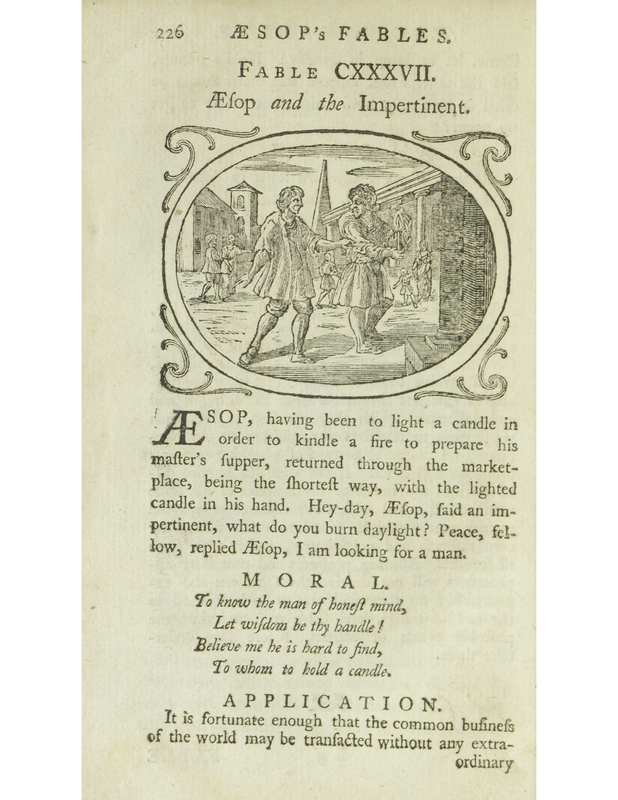
The scene is taken place outside, there is multiple people and children in the background walking through the market-place with multiple buildings surrounding them. Aesop is holding a lit candle to kindle a fire to prepare his master's supper, while an impertinent grabs Aesop by his sleeve and asks 'what do you burn daylight?'.
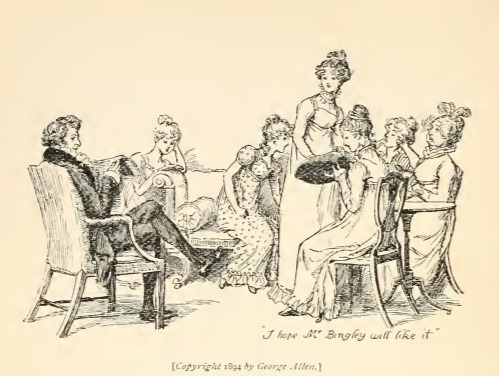
In this image Mr. Bennet sits with his five daughters and wife. Mr. Bennet was one of the first people to call on Mr. Bingley after his arrival at Netherfield Park. Jane holds her hat that she was trimming and remarks that she hopes that Mr. Bingley will like it, thinking the whole family would go with Mr. Bennet to visit Mr. Bingley. Mr. Bennet responds that he will go alone, disappointing his wife and daughters. This scene occurs in chapter 2. The characters are shown in the traditional regency style. Mr. Bennet wears a waistcoat and tailcoat and a cravat. Mrs. Bennet and her daughters wear regency style dresses with empire waistlines. Mrs. Bennet has a feather in her hair. The regency period dated to the early nineteenth century (1811-1820) when George, Prince of Wales, later George IV (r. 1820-1830), reigned as regent for his mentally ill father, King George III (r. 1760-1820). The regency period is associated with the rise of neoclassicism in art and fashion.
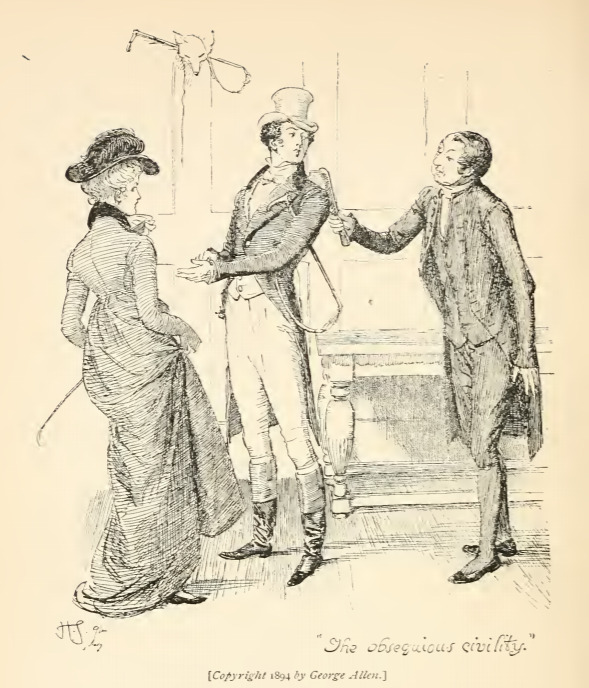
In this image Mr. Collins congratulates Elizabeth and Mr. Darcy on their engagement. Mr. and Mrs. Collins came to Longbourn to express their congratulations to the couple, and also to avoid Lady Catherine de Bourgh who was furious at the match because she wanted Mr. Darcy to marry her daughter. Although neither Elizabeth nor Mr. Darcy liked Mr. Collins, Elizabeth was pleased that he tolerated Mr. Collins’ foolishness well. In this image Elizabeth and Darcy prepare to go horseback riding, and Mr. Collins brushes Mr. Darcy’s shoulders. This scene occurs in chapter 60. The characters are shown in the traditional regency style. Elizabeth wears a regency dress with an empire waist. She wears a bonnet and holds a whip. Mr. Darcy and Mr. Collins wear waistcoats and tailcoats. Mr. Darcy wears a top hat and carries a whip. The regency period dated to the early nineteenth century (1811-1820) when George, Prince of Wales, later George IV (r. 1820-1830), reigned as regent for his mentally ill father, King George III (r. 1760-1820). The regency period is associated with the rise of neoclassicism in art and fashion.
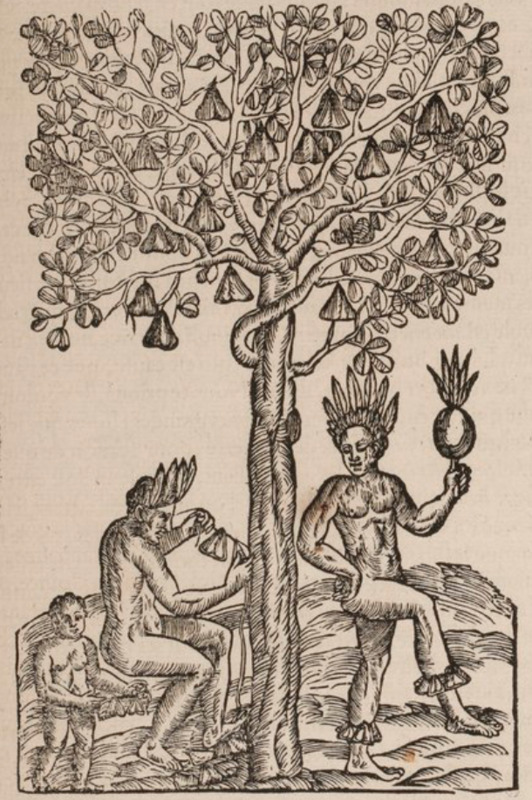
Two Indigenous men and a child stand around an ahouai tree (as named by the author, today known as thevetia ahouai). The man on the left threads the items harvested from the tree (dried fruit or nuts) onto a string to make a leg rattle, like those worn by the man on the right. The man on the right dances with one hand on his hip, wearing leg rattles and holding a maraca or religious item in the other hand. Both men wear feathered headdresses. This image is identical to one found on page 922 of Paris 1575 (l’Huillier), and in Thevet’s Les Singularitez de la France Antarctique (page 66 verso of Paris 1557, page 66 verso of Paris 1558).
Here we see Gulliver and the Sorrel Nag building a boat that Gulliver would use to leave the Country of the Houyhnhnms. The Council of the Houyhnhnms told his master that Gulliver either had to live with the yahoos or return to Europe but could not live with the Houyhnhnms any longer. Gulliver was shocked by this, and decided he had to leave rather than live with the yahoos. Gulliver was given two months to build a boat to leave the country. The same image appears in the 1843 Krabbe edition.
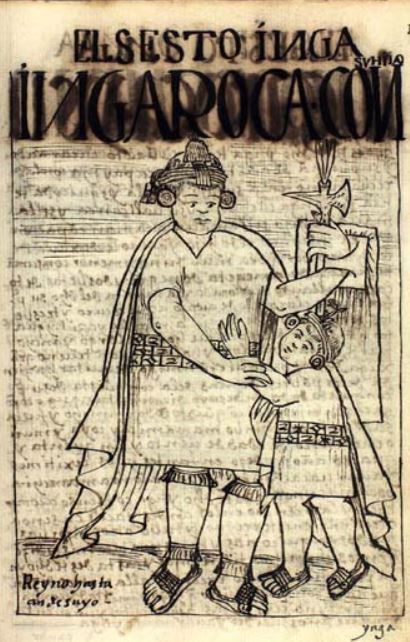
This illustration depicts the sixth king of the Inca Empire, Inca Roca. He is pictured looking down at his son and holding him with his right hand and holding a shield and ax in his left hand. The author describes him as a wide and long man. His son’s name is Guaman Capac Inca. There are words written at the bottom of the image which reads, “Reynó hasta Ande Suyo” which translates to “King up to the Andes region.”

![[Act XI – Celestina Talks with Calisto and Sempronio Talks with Pármeno]](https://cemvccol.ace-net.training/files/large/824700487c39baf0466f072d33b2e1eede1314ad.jpg)
![[A Native Christian Woman Praying Before a Crucifix]](https://cemvccol.ace-net.training/files/large/e2458af879f4befcf8ce54f9ba74a2c31beb0efc.jpg)
![[a yahoo kills its cat while another drinks from the udder of a cow]](https://cemvccol.ace-net.training/files/large/24823669730a05663ef7dd49b72ea49314934b0c.jpg)
![[Gulliver sees Laputa for the first time]](https://cemvccol.ace-net.training/files/large/ce59df3c00c378c73b77469cb07e82a613fd2521.jpg)

![[a dining table from Lilliput]](https://cemvccol.ace-net.training/files/large/6b270052c74ded94c5220985d0260bd9e7e688d4.jpg)
![[Gulliver builds a boat to leave the Country of the Houyhnhnms]](https://cemvccol.ace-net.training/files/large/7f6786e1154c07c32f119baf36c684d07c91ce3f.jpg)