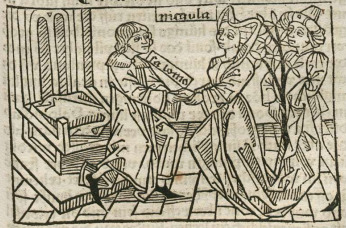
This engraving depicts Nicaula, the queen of Ethiopia, on the right side of the engraving shaking hands with king Solomon of Jerusalem. We know that these figures are Nicaula and Solomon as their names are engraved beside their heads. Nicaula, as Boccaccio explains, was incredibly wise and wanted to hear and listen to the wisdom and intellect of Solomon. She had traveled from Ethiopia to Jerusalem to meet him. This engraving depicts their first meeting. Behind Nicaula is presumably one of her servants, who is carrying a balsam tree. The tree was one of many gifts that Nicaula had given to Solomon.
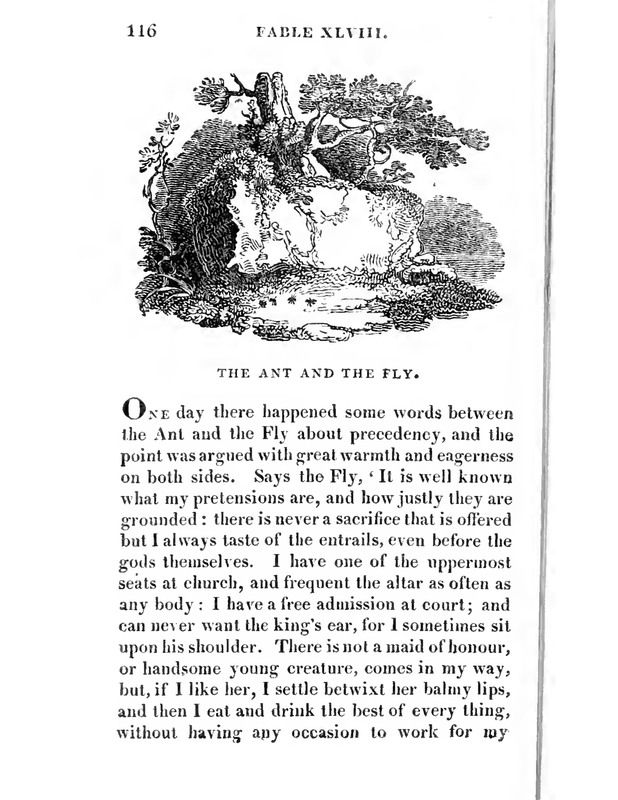
There is a large white space in the middle of the image. There are many plant forms around it, but most of the image is indiscernible. On the ground there are four insects of unknown species.
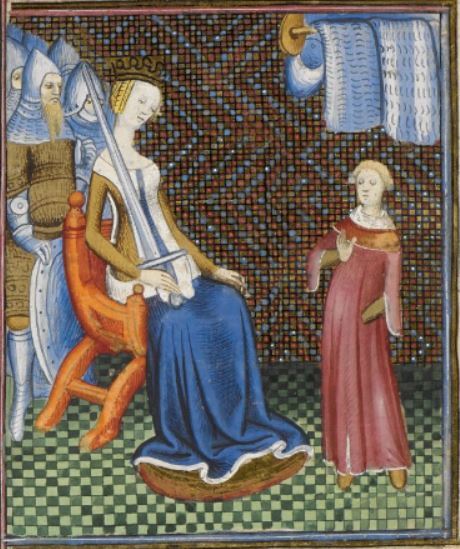
This illumination depicts Queen Semiramis of the Assyrians sitting on her throne on the left side of the image. She is depicted holding a sword, as she had illustrious military skills. There are armed men standing behind her. Her son, Ninyas, is pictured standing in front of her.
Four Indigenous Brazilian men pick and gather fruit from a tree. One man has climbed the tree to pick fruit and drop it down into the arms of another man on the ground. Two other men at the base of the tree gather the fruit and put it into a basket for transport.
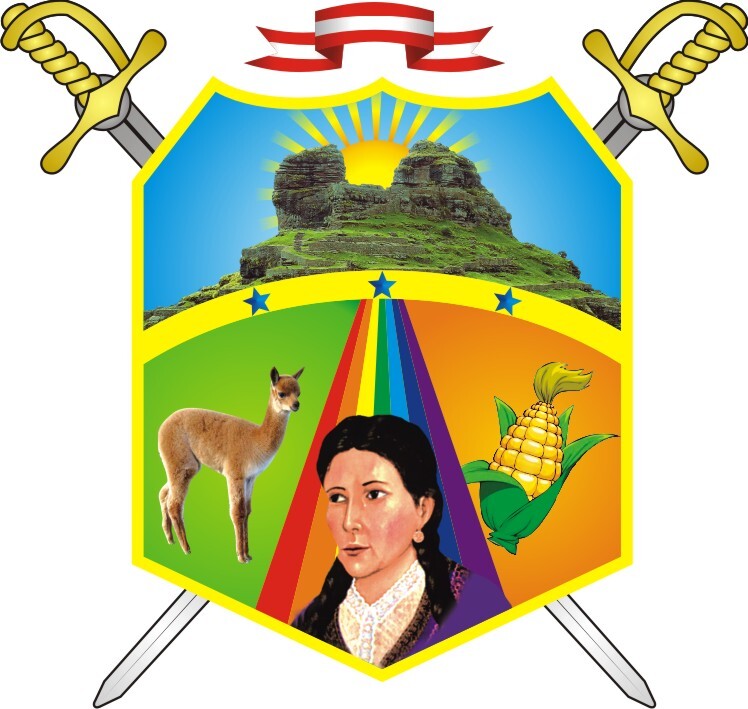
LIBERTAD LEALTAD SINGA CHAVIN MONZON ARANCAY TANTAMAYO MIRAFLORES PUNCHAO JIRCAN JACAS PUÑOS JULIO 1777 HUAMALIES LLATA HUANUCO Glorias a Tierra de ideales victoriosas amante de las innobles causas eximentes La primera chispa de raudales batallares, el constante luchador de gritos libertarios
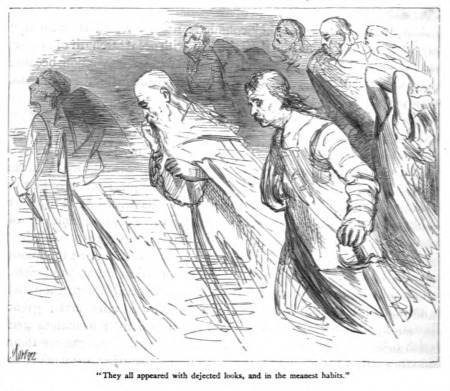
While Gulliver was in Glubbdubdrib he met with several ghosts from history. Here Gulliver meets with the servants of princes and nobles. To Gulliver’s surprise, many of these men were erased from history, and called traitors. Many of these men died in disgrace or in poverty.
Lady Jane Crawley, in a bonnet and shawl, stands between the doors of the bailiff’s as the young janitor opens the inner door to let her through. She has come to pay Rawdon’s bills after he wrote to her and his brother when Rebecca said that she would not come.
In this image we see two giants looking at Gulliver. The giant in the front wears circular glasses with shoulder length hair and a beard. He also has hoop earrings with beads on the bottom. The second giant stands behind the left shoulder of the first. He wears a cap and has a large grin. Gulliver stands on the table at shoulder height, leaning back from the giants. The same image appears in the 1839 Krabbe edition.
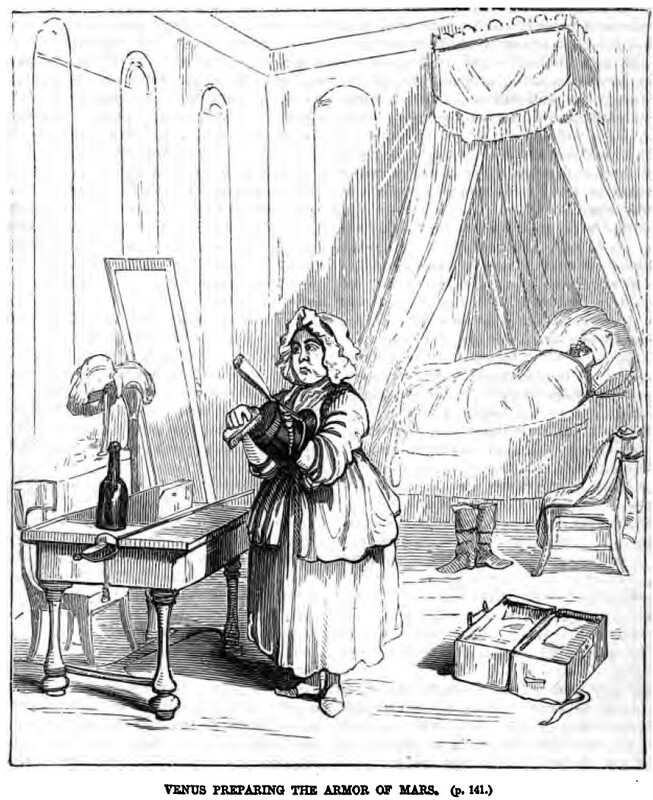
Peggy O’Dowd stands in her bedroom, brushing her husband’s cap. His sword lies on the table in front of her, along with a bottle and a large mirror. She has already packed his travelling-valise, which lies open on the ground next to her. Major O’Dowd himself is sleeping in the background, with his boots next to the bed and his coat thrown over a chair. Below the illustration is printed its title and location in the story, “VENUS PREPARING THE ARMOR OF MARS. (p. 141.)”.
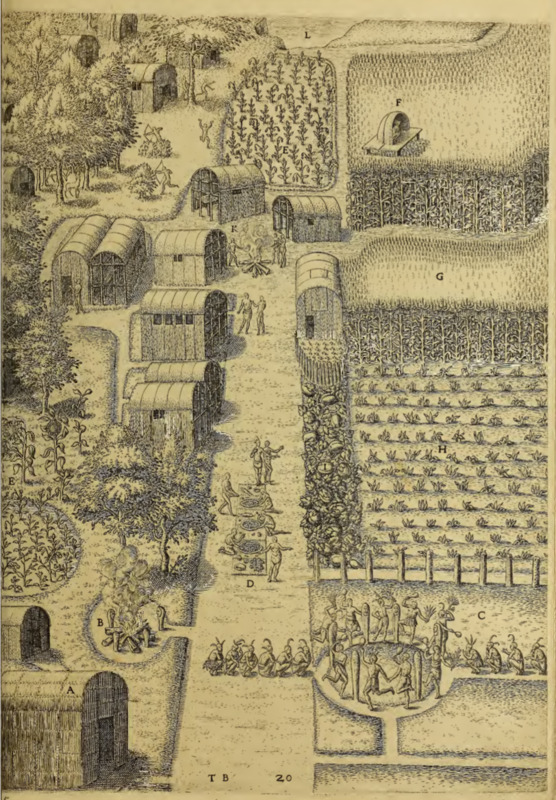
The Indigenous town of Secota is pictured. Multiple structures are grouped along a flattened path. There are cultivated fields all around the structures where corn and other crops are seen in varying stages of growth. There are several bonfires, and in the centre of the village several individuals are grouped around a meal. There is a dance circle where a ceremony is taking place, several people sit and others dance. Elsewhere a few individuals hunt or practice with bows and arrows.
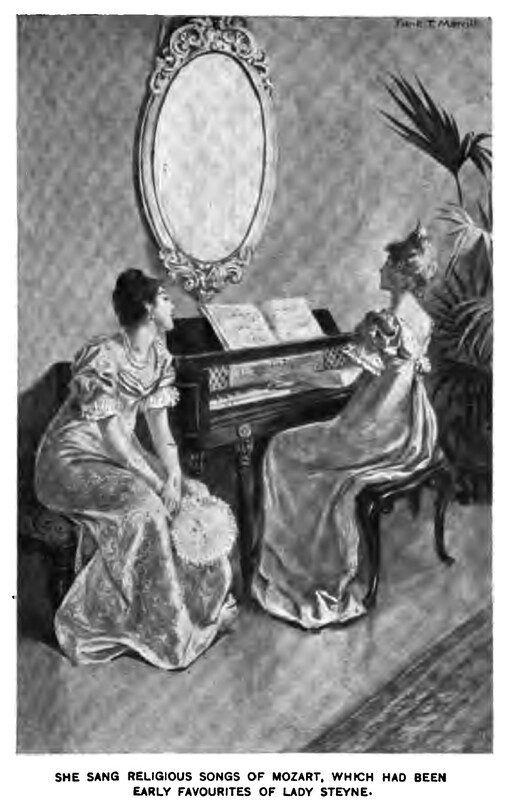
The image depicts a scene from page 136 in which Rebecca Crawley sings at the ball at Gaunt House. Becky is shown seated at the piano, singing and playing a song from the music book open in front of her. Lady Steyne sits beside her, hands clasped in her lap as she leans towards the singer. A large oval mirror hangs above the piano and a large plant is on its far side.
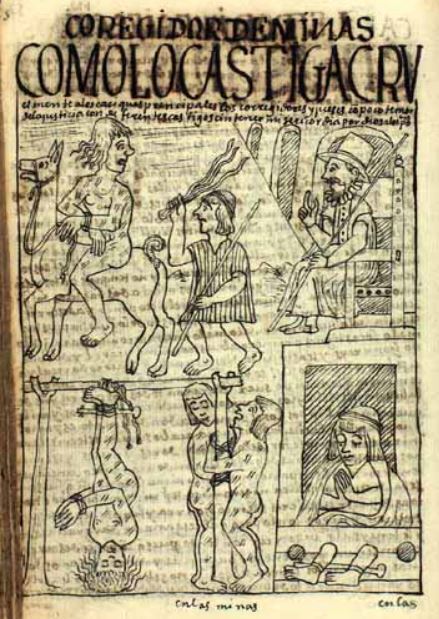
This image is illustrated in a chapter that discusses and criticizes the government and society in Spanish conquered Peru. This image depicts a royal magistrate on the top right corner of the image sitting on a chair as he orders the abuse of indigenous nobles. There is an indigenous man riding on the back of a llama on the top left side of the image getting whipped on the back by another man. There is a nobleman tied by his feet hanging upside town on a post with his hands shackled. Beside him are two naked men standing upright with their arms tied to a post. The bottom right corner depicts a man with his feet in stocks and his hands together in prayer. There is a caption at the bottom of the image which reads, “en las minas” [in the mines].
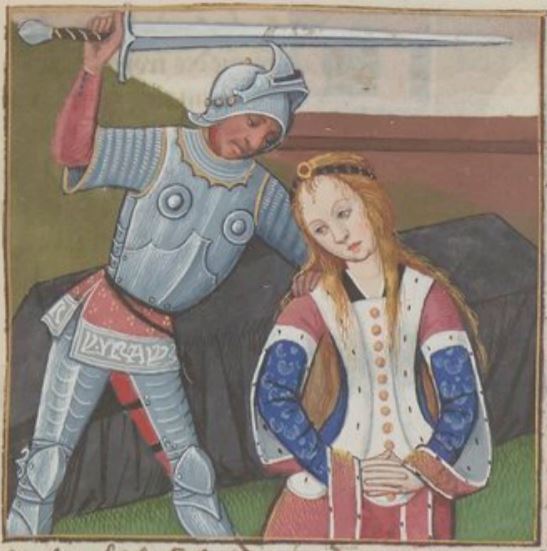
This illumination depicts Polyxena, the daughter of king Priam of Troy, getting executed in front of Achilles’ tomb. Polyxena is illustrated kneeling with her hands crossed while looking down to the ground as she accepts her fate. The man executing Polyxena is Neoptolemus, the son of Achilles. Polyxena had lured Achilles into the temple of Apollo, where Paris shot and killed Achilles with his arrow. Neoptolemus is the person executing her as she is the one who is partly responsible for killing his father. She had done this through her mother’s instructions. Boccaccio explains that he wrote on Polyxena due to her fearlessness before her execution.
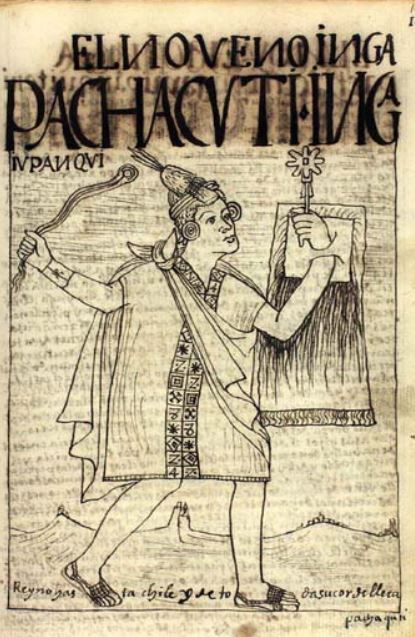
This illustration depicts the ninth king of the Inca Empire, Pachacuta Yupanqui. The author has depicted him holding a shield in his left hand and a sling in his right hand while wearing traditional royal garb. There is writing at the bottom of the image which reads, “Reynó hasta Chile y de toda su cordellera” which translates to “King up to Chile and all of its mountain range.” This is to demonstrate this king’s expansion of his kingdom.
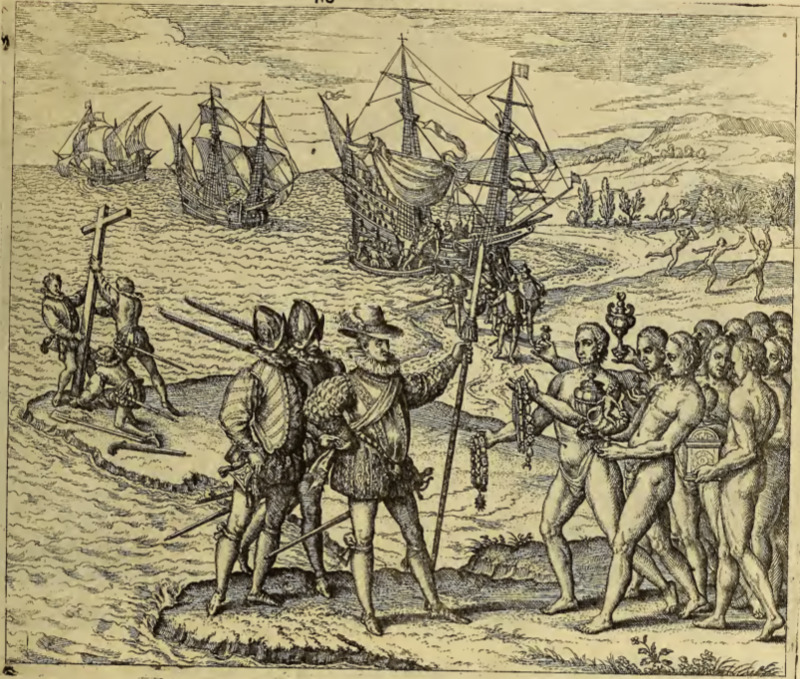
Christopher Columbus is shown standing on the shore of Hispaniola upon his first arrival there. A man, likely Columbus, stands arrogantly in front of two other Spaniards with his spear planted into the ground and one hand on his hip as he gazes at the people in front of him. A group of the island’s Indigenous inhabitants have approached him to offer gifts of jewelry and other treasures. On a spit of land behind Columbus, three Spaniards erect a large cross. Large Spanish ships are anchored along the coast in the background, with Spaniards coming ashore in rowboats. Several Indigenous people flee from the ships.
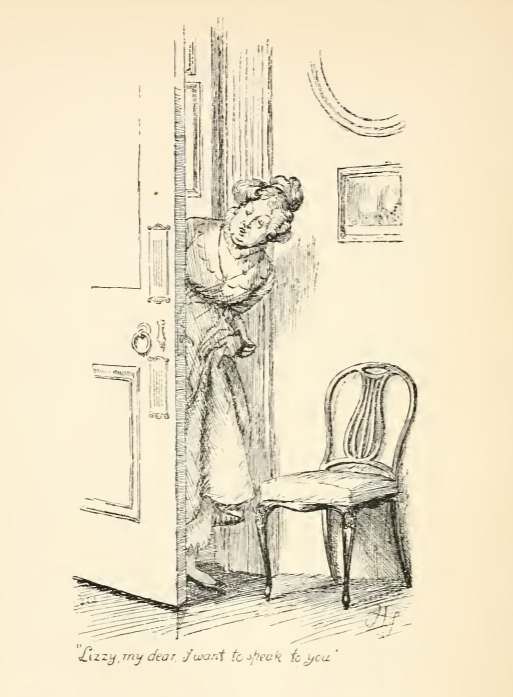
In this image Mrs. Bennet calls Lizzy out of the drawing room, leaving Jane and Mr. Bingley alone. The day after the dinner with Mr. Bingley and Mr. Darcy, Mr. Bingley returned alone. Mrs. Bennet heard of his coming and frantically told Jane to get herself ready. Jane and Lizzy were in the drawing room together when Mr. Bingley arrived, and once he had settled, Mrs. Bennet called Lizzy out of the room, leaving Jane and Mr. Bingley alone, and then Mr. Bingley proposed. This scene occurs in chapter 55. The characters are shown in the traditional regency style. Mrs. Bennet wears a regency dress with an empire waistline. She holds up her skirts as she leans through the doorway into the drawing room. The regency period dated to the early nineteenth century (1811-1820) when George, Prince of Wales, later George IV (r. 1820-1830), reigned as regent for his mentally ill father, King George III (r. 1760-1820). The regency period is associated with the rise of neoclassicism in art and fashion.
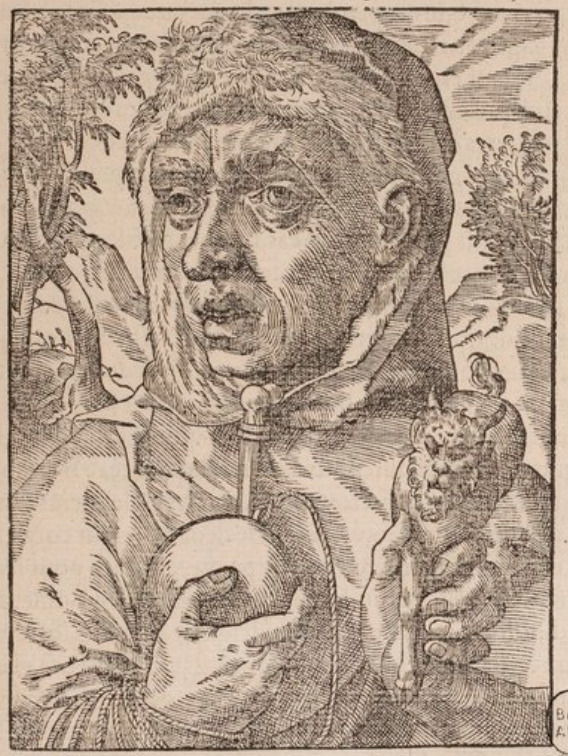
An Indigenous South American man of large stature holds an animal in one hand and an object in the other. He wears a long-sleeved garment with a hood. This image comes from a chapter entitled ‘D’une Isle, où les hommes sont grands de dix à douze pieds', (Of an island, where the men are tall at 10 to 12 feet), referring to an island in the region of Patagonia, South America. A Spanish expedition in 1520 led by Ferdinand Magellan explored the South American coast of Patagonia (today Argentina and Chile) and encountered a group of Indigenous people, likely the Teheulche. The Spaniards described the Teheulche as giants, but later travelers disputed this description, saying the Teheulche were of average build. This image is identical to one found on page 905 of Paris 1575 (l’Huillier).
One fox is climbing up the trunk of a tree trying to reach the grapes above him. The grapes are twirled around vines from the branches of the trunk, many leaves are coming from the trees.
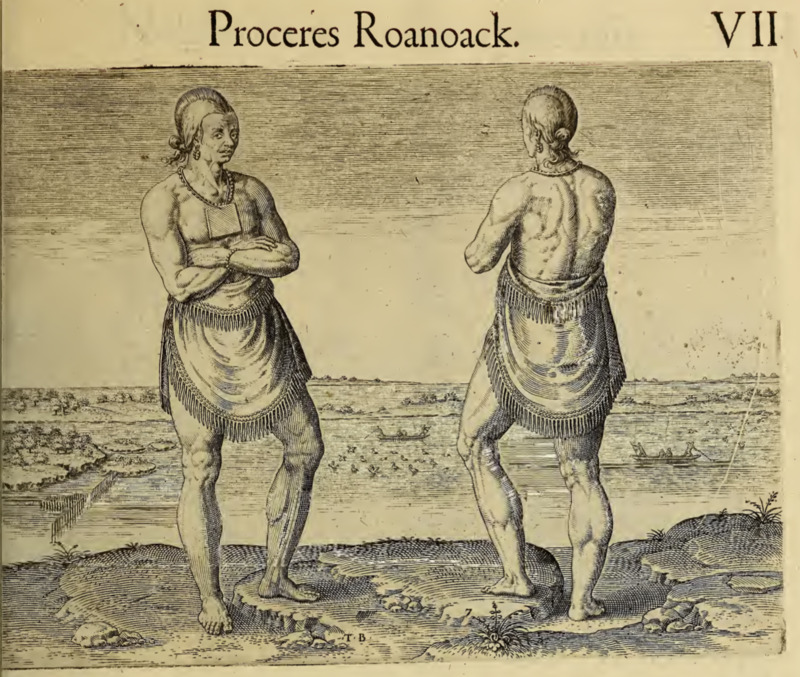
An Indigenous man, a chief, is pictured from the front and from behind standing on the bank of a river. A section of his hair is feathered in the middle of his head from his forehead to the nape of his neck, where the rest of his hair is gathered in a knot. He wears beaded earrings, a necklace with a large square pendant, and beaded bracelets around his wrists. He wears a fringed skirt draped around his waist and is barefoot and shirtless. In the background, other Indigenous people are seen in canoes, and there is a fishing apparatus in the water in the left part of the background.
Here we see a politician bribing a voter. The politician is on the right and hands the man on the left a piece of paper that reads “vote … B”, and a small bag of money. In this chapter Gulliver talks with the king of Brobdingnag about English traditions. Gulliver tells the king about diplomacy, religion, the justice system, the arts, the financial system, and the nobility, then debated these issues with the king. This image comes when Gulliver is discussing the corrupt political atmosphere and the election of officials. The same image appears in the 1839 Krabbe edition.
The left panel depicts Calisto wearing a hat and holding a long item of some sort, perhaps a cane or walking stick. To the right, we see Melibea’s servant Lucrecia (here spelled ‘Lucrece’) sporting a veil and a long robe, and holding a flower in her right hand. Both figures are placed outside.The left panel is identical to those found on pages 12, 60, 122, and 225, and nearly identical to the one found on page 317 (where it is labeled ‘Centurio’). The right panel is nearly identical to those found on pages 84 (where it is labeled ‘Celestine’), 287 (labeled ‘Elicia’), 299 (labeled ‘Alisa’), and 306 (labeled ‘Elicia’).

![[Indigenous Brazilian men pick fruit from a tree]](https://cemvccol.ace-net.training/files/large/f635eab0be7c31539ad993b23684fc933e4471b3.jpg)
![[Lady Jane Arrives at the Bailiff’s]](https://cemvccol.ace-net.training/files/large/d56b1e21b1d4fd176749d47182fad618f58b39b9.jpg)
![[Two giants from Brobdingnag speak with Gulliver]](https://cemvccol.ace-net.training/files/large/1858d14f2d8661b393ee00ac7555cbf041fdb81e.jpg)
![[The Fox and the Grapes]](https://cemvccol.ace-net.training/files/large/230f5523bc92951836ef0cdef44fdc1ac2145c9b.jpg)

![[European politicians bribing voters]](https://cemvccol.ace-net.training/files/large/121f6c6d9edee7197b07cd46c0c6a18aa7fa6cd9.jpg)
![[Act XII – Calisto and Lucrece (Lucrecia)]](https://cemvccol.ace-net.training/files/large/5d08296432630b5ccbaf5c607fb0e4925638672c.jpg)