This illustration is interesting, seeing as no characters embrace during the seventeenth act. Areusa does manipulate Sosia into revealing when and where Calisto meets with Melibea, but Sosia does not describe in any detail the nature of their encounters.
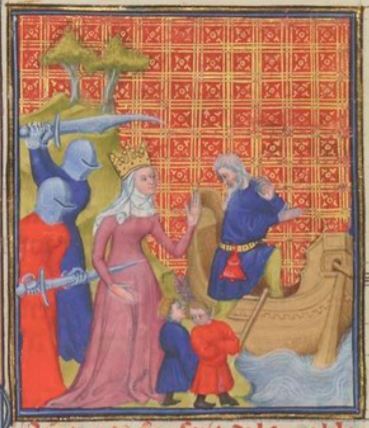
This illuminated image depicts a woman named Hypsipyle saying goodbye to her father, King Thaos of Lemnos, as he sails away on a boat. Hypsipyle is illustrated standing by the shore with her twin boys as she waves goodbye to Thaos. Hypsipyle warned her father of an attack that the women of Lemnos had planned. The women had planned to kill every man of the city to eliminate the patriarchy. Hypsipyle, unable to allow her father to die, told him of this plan and helped him escape by means of this boat. There are two women wearing helmets and holding swords on the left side of the image to represent the women of Lemnos who are killing all the men.
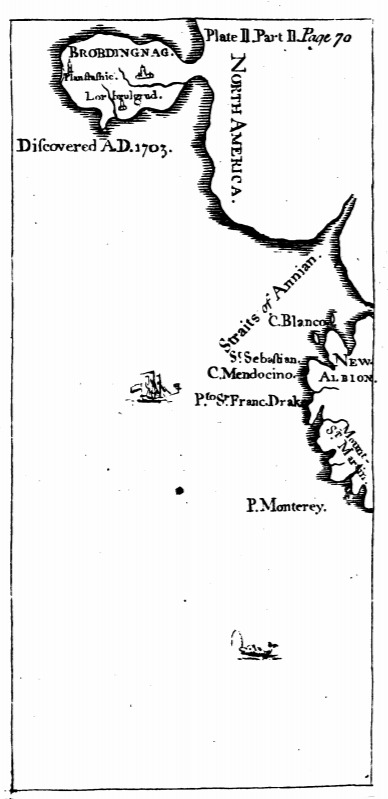
The image depicts the fictional land of Brobdingnag, off of North America. The cities of Flagnlamic and Lorbrulgrud are shown in Brobdingnag. Underneath Brobdingnag reads “Discovered AD. 1703”. The bottom half of the map includes New Albion. A ‘man-of-war ship is shown off the coast of New England, and a dolphin is near the bottom of the image. The same map is featured in several other editions of the text, including those in other languages.
There is a man down on one knee outside. He is pulling out a dead tree from the ground. There is an ant crawling on his right leg. There is a bird in a tree on the right side. There is a bird in a tree on the left side.
Joseph Sedley sits on the roof of the cabin on the boat from England to Belgium. Beside him on the bench are a cup and bottle of beer. He is dressed in his military coat, holding a long pipe, and looks very comfortable and relaxed.
In this image we see Gulliver who has freed his left arm from the Lilliputians' ties, attempting to stop the arrows of the Lilliputians. He is surrounded on all sides by the Lilliputians who are firing arrows at him. We see the shower of arrows in the air going towards Gulliver’s arm which is defending his face. Gulliver’s right hand and legs remain tied up. Gulliver’s hat lies behind his head, with a Lilliputian hiding behind it. The same image appears in the 1843 Krabbe edition.
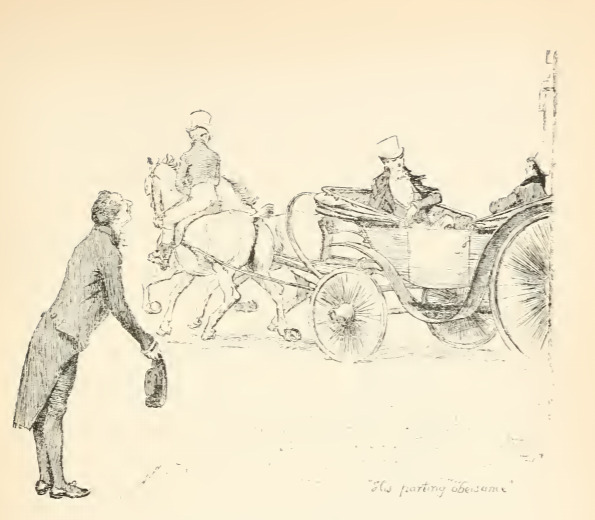
In this image Mr. Collins waves goodbye to Mr. Darcy and Colonel Fitzwilliam. A few days after Elizabeth rejected Mr. Darcy’s proposal he left Rosings with Colonel Fitzwilliam. Out of respect, Mr. Collins decided to see them off, and here we see him waving goodbye to the two men. This scene occurs in chapter 37. The characters are shown in the traditional regency style. The men wear waistcoats and tailcoats with breeches. Mr. Darcy and Colonel Fitzwilliam wear top hats. Mr. Collins holds cap in his hand, waving to the carriage. The regency period dated to the early nineteenth century (1811-1820) when George, Prince of Wales, later George IV (r. 1820-1830), reigned as regent for his mentally ill father, King George III (r. 1760-1820). The regency period is associated with the rise of neoclassicism in art and fashion.
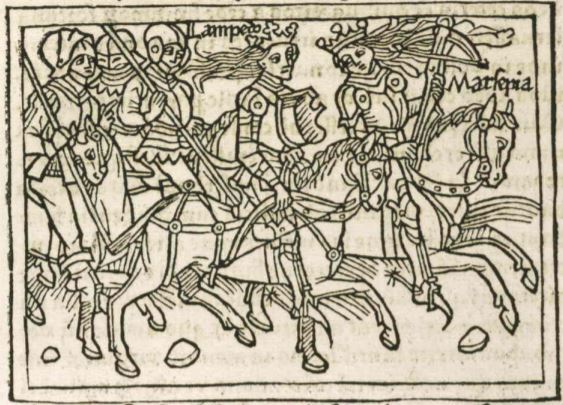
This engraving depicts the queens of the Amazons, Martesia and Lampedo. The Amazons, as described by Boccaccio, were a group of widows who decided to take up arms and fight to avenge their husbands’ deaths. They began dedicating their lives to training in riding horse-back, archery, and other military skills. The Amazons elected Lampedo and Martesia to be their queens. Lampedo is depicted with a bow and arrow in her right hand as she rides her horse, with her name engraved above her head. Martesia is illustrated looking at Lampedo with a sword in her hand. Her name is engraved to the right of her sword. The women riding behind them are other Amazon women.
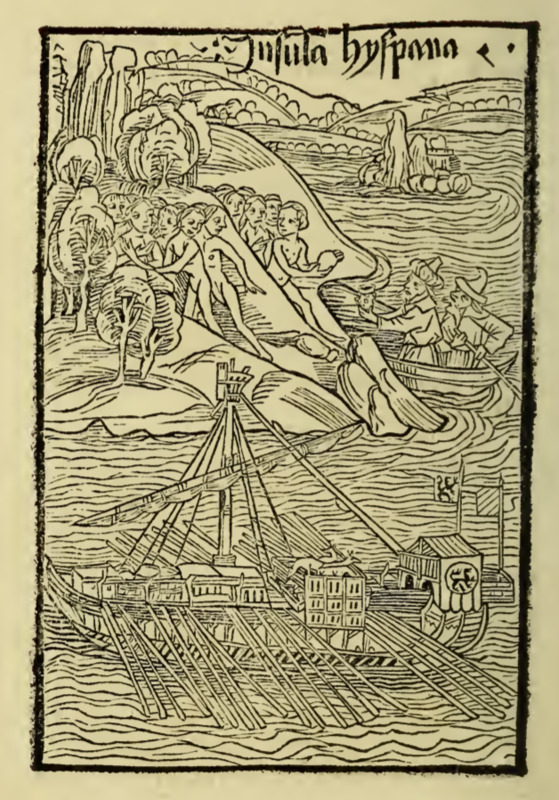
Christopher Columbus is shown arriving at one of the islands he came across on his first voyage to the West Indies. A large multi-oared boat sits in the foreground (not an accurate representation of the type of ship Columbus sailed on to cross the Atlantic) and closer to shore Columbus is shown with another man in a small rowboat. A group of Indigenous people stands on the shore, appearing nervous or timid as they watch Columbus approach. Columbus’s arms are outstretched, offering an object to the Indigenous people.
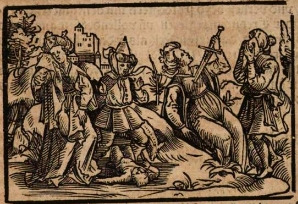
Queen Jocasta of Thebes is depicted on the left side of the engraving rubbing the tears away from her eyes with her dress. She is crying because her husband exposed their child into the wilderness. This was due to a prophecy that foretold the baby would grow up to kill his father and marry his mother. Her child, Oedipus, is depicted lying on the ground after being exposed. There is a person approaching the baby as they take him in and raise him as their own. Oedipus ends up fulfilling the prophecy by killing his father later in life, and marrying his mother, Jocasta. When Jocasta and Oedipus find out they are mother and son, Oedipus gouges out his eyes and Jocasta kills herself. This scene is depicted on the right side of the engraving. Jocasta kills herself by piercing her chest with a sword and Oedipus’s hands are illustrated in front of his eyes as he gouges them out. The city of Thebes is illustrated in the background of the engraving on the left side.
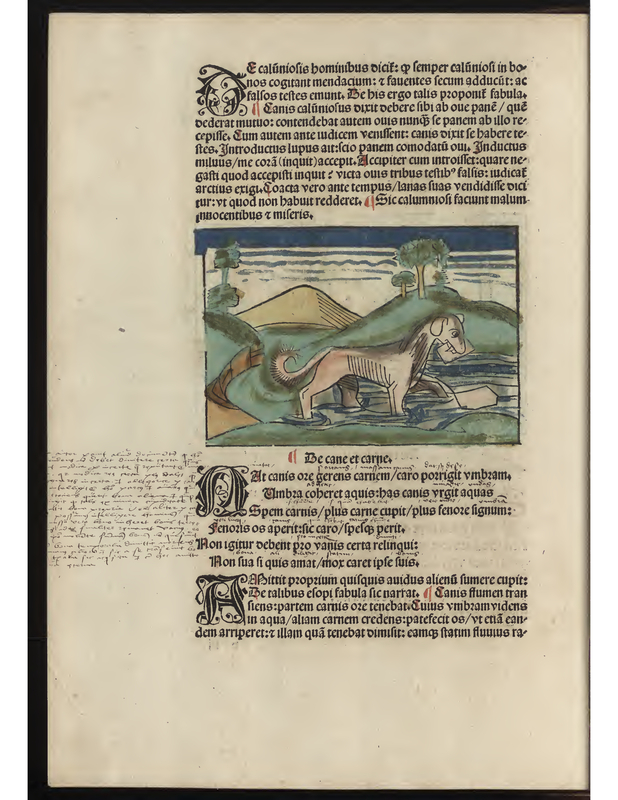
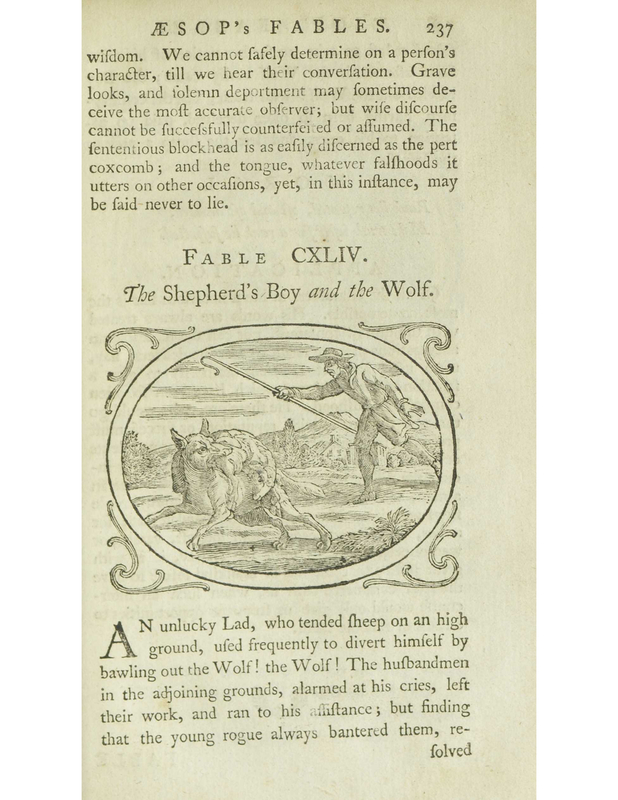
The scene is taken place outside, there is a large mountain in the background along with some houses and large trees and other plants. There is Shepard with a shepherds crook pointing towards a wolf running away with a sheep in its mouth. The Shepard is bawling out the wolf for help as the wolf runs away with one of its sheep.
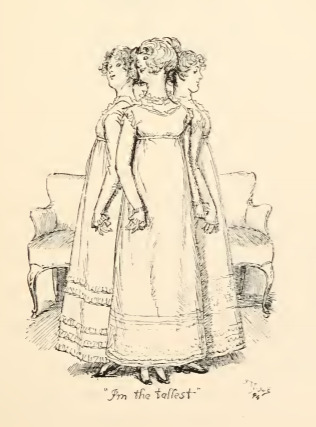
In this image Lydia measures herself against her sisters, Kitty and Mary. This was how the three youngest girls entertained themselves while Mr. Bennet visited Mr. Bingley. This scene occurs in chapter 2. The characters are shown in the traditional regency style. Kitty, Lydia, and Mary wear regency style dresses with empire waistlines. The regency period dated to the early nineteenth century (1811-1820) when George, Prince of Wales, later George IV (r. 1820-1830), reigned as regent for his mentally ill father, King George III (r. 1760-1820). The regency period is associated with the rise of neoclassicism in art and fashion.
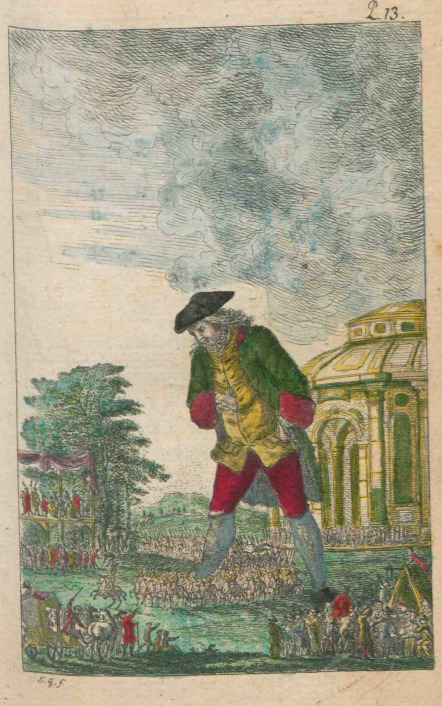
This image is a depiction of a Lilliputian celebratory procession. Gulliver stands in the centre surrounded by several of the Lilliputians, who are one-twelfth of his size. In the bottom left corner there is a carriage, presumably that of the Lilliputian king, surrounded by several others. In the bottom right corner is a tent, again with Lilliputians surrounding it. On the left side in the middle is a raised, covered stage, with Lilliputians both on the stage and underneath it. Behind Gulliver is a royal building. A cavalier army rides on horseback under Gulliver’s legs, as a military procession. The image is coloured, however the same image appears in the 1762 German edition, however the 1762 German edition is not coloured.
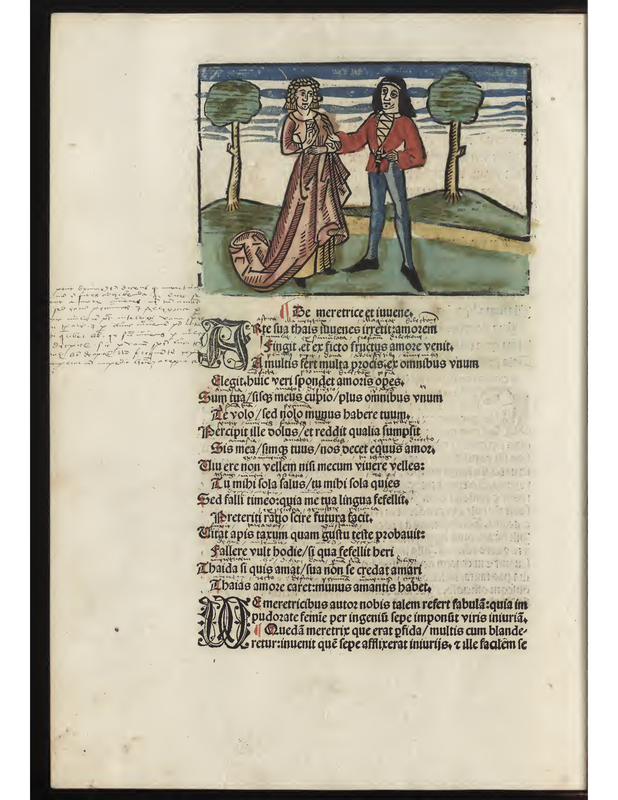
A man and a woman standing in the grass, near a road. The man is dressed well and is grasping the woman near her waist. The woman is dressed in a pink gown and seems to be restraining the man’s hold.
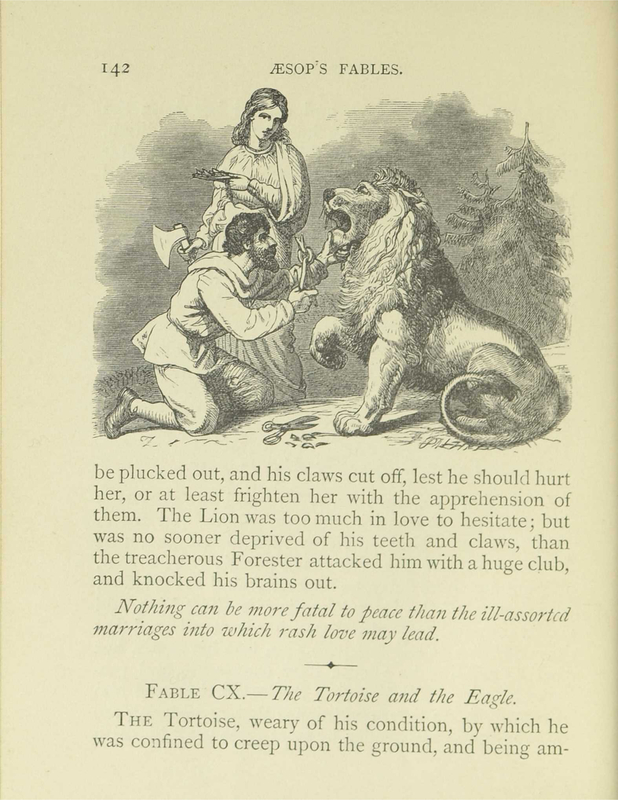
A man kneeling with calipers in hand looks into a lion's mouth and pulls out its teeth to the left of the page. A woman stands behind him, holding an axe in one hand and some of the lion's teeth in the other. The lion to the right of the page looks at the woman in pain. Clippers lie on the ground and all of the lion's claws have been shorn.
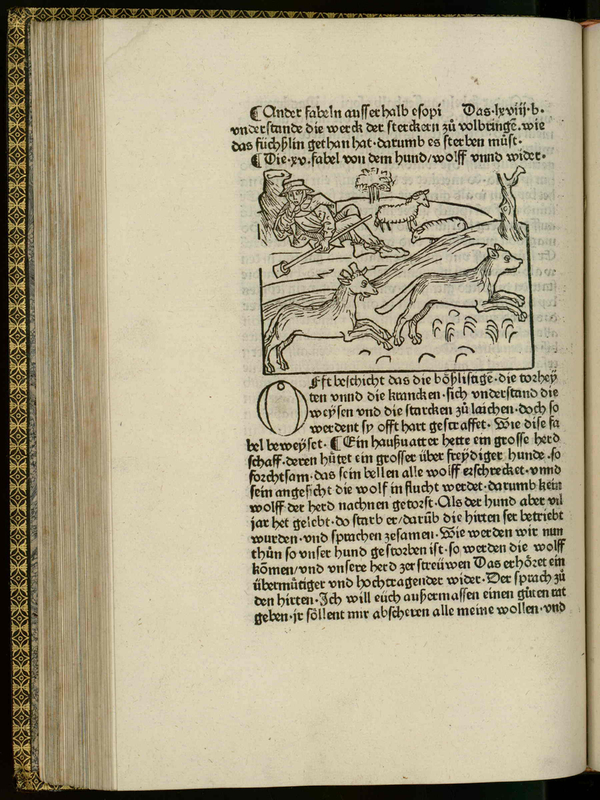
In the lower part of the image, a goat is chasing a wolf. On the upper half of the image, a shepherd is leaning against a tree trunk and on their right side there is two sheep.
Don Sancho and his sister Urraca are speaking to each other in this image. The king is sitting on his throne wearing white robes with a cloak covering the right side of his body. He has a beard and on top of his head stands his crown. At the foot of his throne there is a dark coloured carpet. Behind his throne there is a coat of arms with a lion as a symbol. The wall around the coat of arms is finely crafted with different symbols on it. His sister Urraca standing before him is wearing a dress with a belt tied around her waist. Her hair is covered and on top of the cover is her crown. Her dress is white but what is under her dress seems to be of a darker colour.
Here we see busts of Nero, Henry VIII, and Charles IX, all of whom were very unpopular rulers. Nero was the Roman Emperor from 54-68 CE. He marked the last of the Julio-Claudian Dynasty. According to Roman historians, Nero was famous for his extravagance and corruption, and many thought he “fiddled while Rome burned” during the fire in 64 CE. While this is likely a myth, Nero did take civic land that was destroyed during the fire to build a new imperial palace. Henry VIII was the King of England from 1509-1547. Like Nero, he was widely thought to be a tyrant, as he was married six times, divorcing two wives, and beheading two more. Henry VIII split with the Catholic Church in the 1530s as he tried to get his first marriage to Catherine of Aragon annulled, creating the Church of England in the process. Charles IX was the King of France from 1560-1574. During his reign, religious wars broke out between Catholics and Protestants, and allowed the St Bartholomew’s Day Massacre in August 1572, where thousands of French Protestants were killed (between 5 000 to 30 000 according to modern estimates). All three of these rulers were thought to be tyrannical and immoral. The image appears in an appendix to Gulliver’s travels to Lilliput, which follows the conclusion of Gulliver’s trip to Brobdingnag. Gulliver’s description of the Lilliputian education is very negative, saying that what is taught is simply superfluous, and not anything of substance, as his bias makes him think that the European model for education is the correct model. He says that the teachers will blindly follow the emperor of Lilliput even if they are a tyrant, as many believed Nero, Henry VIII, and Charles IX to be. He also tells the reader that the Lilliputian teachers pay no attention to important dates, focusing more greatly on the character of the ruler. This method meant that students learned to judge historical figures, rather than the facts surrounding them. The same image appears in the 1843 Krabbe edition.

![[Act XVII – Calisto and Melibea (?) Locked in Embrace]](https://cemvccol.ace-net.training/files/large/1212eb9808e8b50e8816135bd0318b1c1556e1b7.jpg)
![[Man Pulls Up Tree]](https://cemvccol.ace-net.training/files/large/27b5c39a07664959fa5043c15a59c09101641473.jpg)
![[Joseph on the Cabin Roof]](https://cemvccol.ace-net.training/files/large/2e58496c110faa227624d35f4879ba5b2082a9f8.jpg)
![[The Lilliputians attack Gulliver]](https://cemvccol.ace-net.training/files/large/ce2079482ae8387fba1f45213cc2d0ab619e4372.jpg)

![[The queen Urraca speaking with her brother the king Sancho]](https://cemvccol.ace-net.training/files/large/71ccdbafe6e2290249a30517d0f63d3cb4ac291f.jpg)
![[Busts of Nero, Henry VIII, and Charles IX]](https://cemvccol.ace-net.training/files/large/d744f6a2164c1e549849a957dc09dbc9182b30b8.jpg)