Joseph Sedley, in his dressing gown, stands at his dresser with one hand pressed to his temple, looking pained. In the background to his left is a table with a washbasin and a bottle on it.
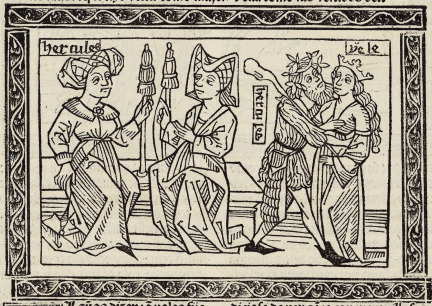
This engraving depicts the marriage between Iole, daughter of King Eurytus of Aetolia, and Hercules. The right side of the engraving illustrates Hercules wrapped around Iole with a look of pure affection on his face. Iole is pictured not reciprocating the embrace. We know that these figures are Iole and Hercules as their names are engraved beside their bodies. Boccaccio explains that Iole is not in love with Hercules because he killed her father after he did not give Hercules permission to marry Iole. In order to seek her revenge on her husband for the murder of her father, Iole allowed Hercules to fall madly in love with her. By doing this, Iole was able to convince Hercules to do whatever she asked. She stripped him of his pride by getting him to dress as a woman and spin wool, which is depicted on the left side of the engraving. As Hercules is unrecognizable in women’s clothing, the creator engraved Hercules’ name above his head to differentiate between him and Iole.
Here we see a lamp with a tall base. In the background we see a neoclassical building with a large dome. This image appears at the beginning of the eleventh chapter, in which Gulliver returns home to England. This architectural style was popular in England in the eighteenth century, thus reminiscent of Gulliver’s return home. The lamp represents Japan, where Gulliver traveled from Luggnagg, and was able to return home. The same image appears in the 1839 Krabbe edition.
A coach labelled “OMNIBUS” drives along a narrow road away from London, passing a stone marked with an X. One of the passengers is leaning out from the back with his arm outstretched, while two others can be seen seated inside. The coachman is seated above the carriage, holding his crop. Near the tip of the crop, in the sky, is the letter S from “So”.
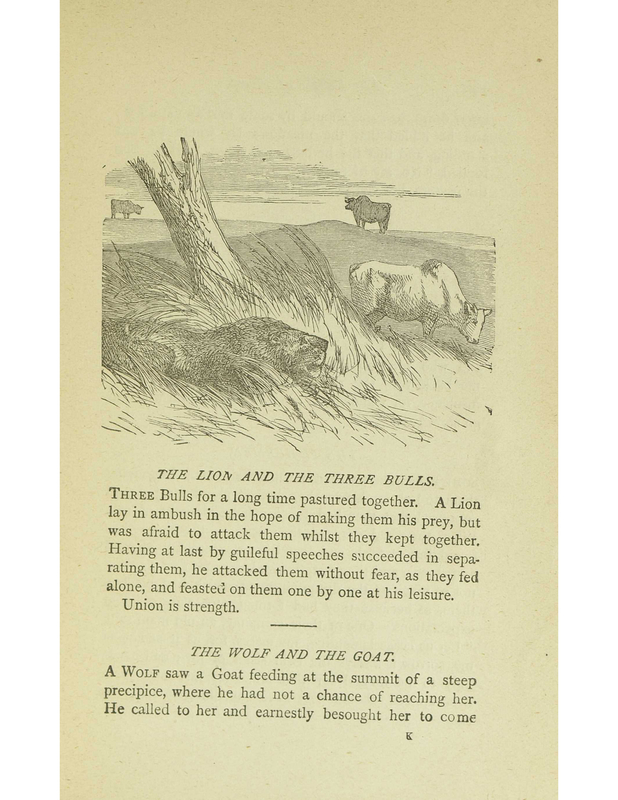
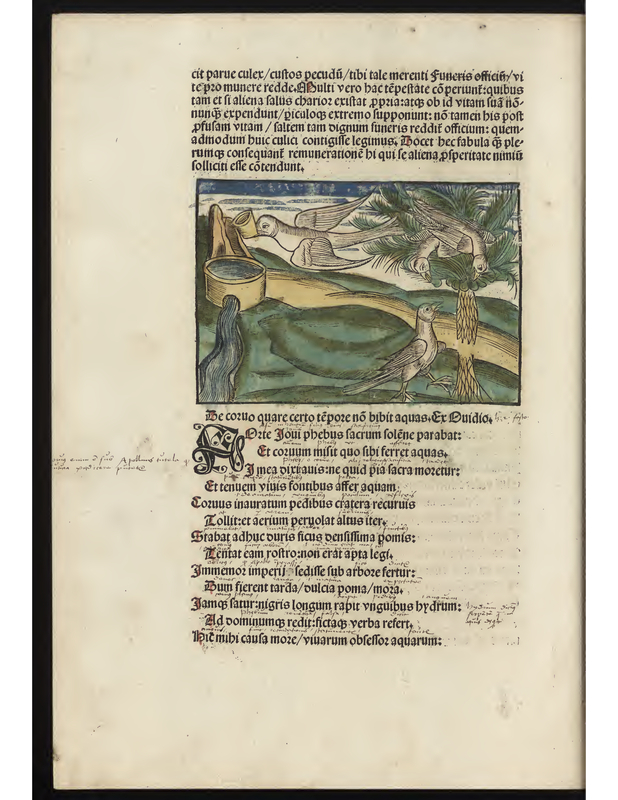
In the foreground, a lion is hiding in the tall grass behind a tree. He is lying as flat as he can on his stomach and looking behind the tall grass. In the background three bulls are eating grass off the ground. The background is divided in three grounds, each of them with a bull on a distant hill.
This image shows El Cid with his wife Jimena. Jimena is sitting on a stool and is holding El Cid’s hands. She is wearing a dress and her head is covered. El Cid is wearing a tunic. He has medium length hair and a beard. They seem to be in an empty room except the coat of arms on the wall and a stool right under it. On the left of the image there is a window and tree branches are visible outside.
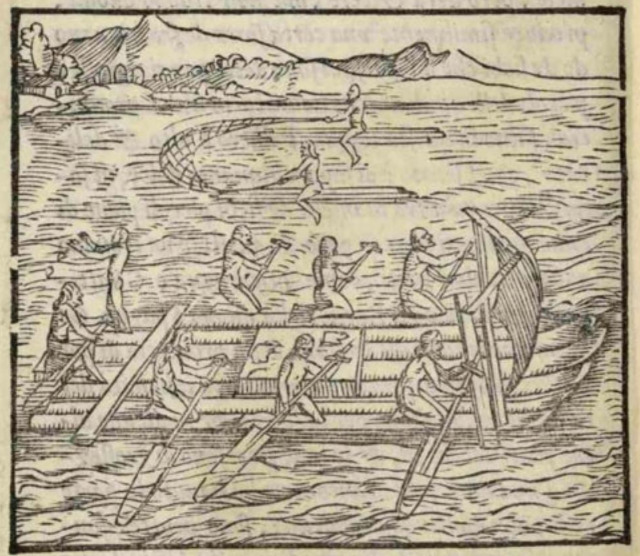
Eight Indigenous people sail near the coast on a large wooden raft. The raft has a single small sail at the fore end and a raised platform in the middle. Around the edges, six of the passengers row with large oars (three on each side). At the rear, one person sits on a raised bench with a smaller oar, and another person throws something into the water. In the background two people sit in the water on long, narrow wooden rafts. They hold a net between them to catch fish.
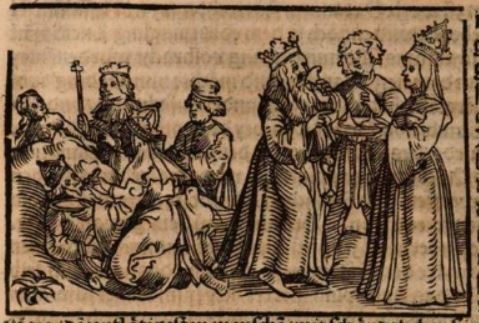
This engraving depicts multiple events. The right side of the engraving depicts Agrippina poisoning her husband Claudius with mushrooms. Agrippina is illustrated wearing a crown and holding a plate of mushrooms as she presents them to Claudius. Agrippina’s son, Nero, is depicted standing in between Agrippina and Claudius as he watches his stepfather eat the poisonous mushrooms. Agrippina poisoned Claudius to obtain power for herself and make her son emperor. The left side of the engraving in the foreground depicts Agrippina kneeling as she gives Claudius more poison (the mushrooms did not kill him). The background of the engraving depicts Nero as emperor, looking at his mother’s dead, naked body. He began to resent her after becoming the emperor, and after having her murdered, he observed her dead body and judged it before cremating it. Nero is depicted wearing a crown and holding a scepter, with a man beside him holding a cremation urn.
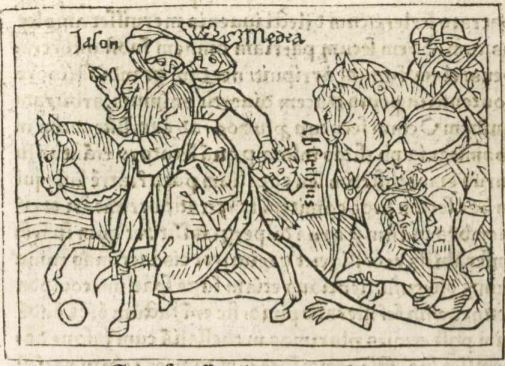
Jason of Thessaly and Medea of Colchis are illustrated riding on a horse together as they flee from Medea’s father, King Aeetes. Boccaccio explained that Medea betrayed her father by helping Jason on his task to find the Golden Fleece. Jason is seated at the front of the horse and Medea is riding behind him. We know that this is Jason and Medea as their names are engraved beside their heads in order to identify them. Medea is depicted holding a severed head in her left hand, which is the head of her brother, Aegialeus (his name is also engraved beside his head). Medea had dismembered her own brother and scattered his limbs around the road behind her and Jason in order to distract her father from pursuing them. King Aeetes is illustrated on the right-hand side of the engraving as he is picking up his son’s limbs.
The image is divided into two squares, one on top of the other. In the top square four Indigenous people are shown. They are all nude, the three in the foreground appear to be walking back and forth and have their hands clasped in front of them as if in prayer. The person in the background is only shown from the waist up with their hands raised and the bottom half of their body hidden behind a hill. The bottom square shows five boats of colonial explorers.
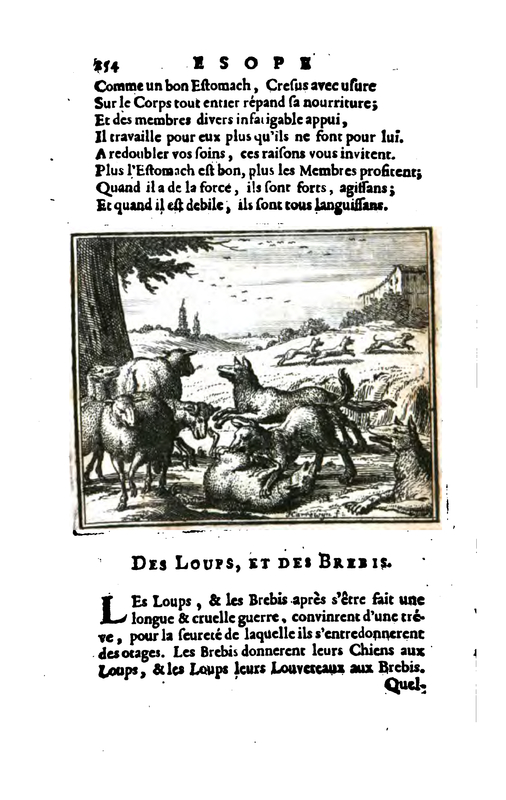
A group of wolves appear to be attacking a group of sheet. One wolf in the front of the image has a sheep on the ground and appears to be biting its back leg. Some wolves in the distance appear to be running away.
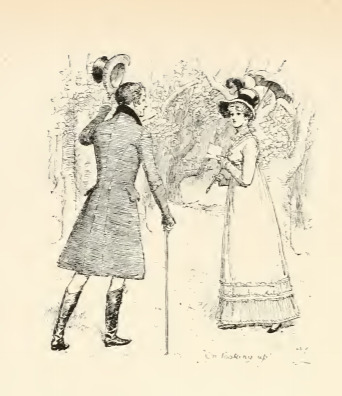
In this image Mr. Darcy encounters Lizzy while out on a walk in the countryside near Rosings. The two met frequently while she was out on her walk. She often went out alone, and started to think Mr. Darcy was trying to meet her intentionally. This scene occurs in chapter 33. The characters are shown in the traditional regency style. Lizzy wears the regency style dress with an empire waistline. She wears a bonnet and holds a parasol, both to protect her from the sun. Mr. Darcy wears a waistcoat and tailcoat with breeches. He raises his top hat to Lizzy and uses a walking stick. The regency period dated to the early nineteenth century (1811-1820) when George, Prince of Wales, later George IV (r. 1820-1830), reigned as regent for his mentally ill father, King George III (r. 1760-1820). The regency period is associated with the rise of neoclassicism in art and fashion.
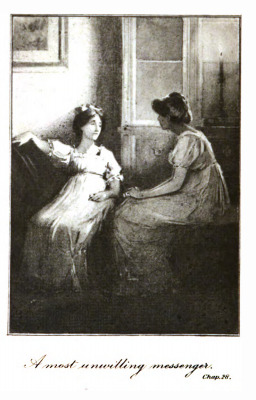
Here we see Catherine slouching on a couch while Eleanor consoles her. While staying at Northanger Abbey, Catherine had begun to fear she was overstaying her welcome. Soon, both General and Henry Tilney had to go out of town, leaving the two girls home alone. One night, a messenger arrived unexpectedly, with a note from Eleanor's father, General Tilney, bringing news that he remembered an engagement and Catherine was to leave Northanger Abbey immediately. Both girls are horrified, unable to imagine why the General might have thrown Catherine out so suddenly. Catherine was to leave the following morning, and the General would not supply transportation, leaving Catherine to “ride the post”. This scene occurs in chapter 28 as noted underneath the title of this image. The characters are shown in the traditional regency style, with Catherine and Eleanor wearing the regency style dress with an empire waist. Their hair is worn tied up, as was tradition for women after their “coming out” before the queen, signaling her entrance into society. The regency period dated to the early nineteenth century (1811-1820) when George, Prince of Wales, later George IV (r. 1820-1830), reigned as regent for his mentally ill father, King George III (r. 1760-1820). The regency period is associated with the rise of neoclassicism in art and fashion. The same image appears as an insert between pages 210 and 211 for the Dent 1893, 1894, 1895, 1896, and 1897 editions of Northanger Abbey.
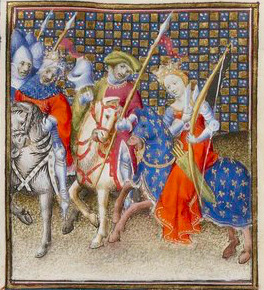
When her husband, Mithridates, was involved in a long war with the Romans, Hypsicratea missed him so much that it was unbearable. She was known for her love of her husband, and eventually she decided that she must accompany him in war. She felt that only she could truly serve him, so she went to join him. In the image, she is seen to the far right on a horse carrying armor. To the left are other male soldiers on horses, and among them is Mithridates – he is on the grey horse and wears a red cloak with a crown.
There are two cats in a room. One cat is hanging from a bar on the ceiling from his feet. Two mice are sitting on that bar. The other cat is on the ground, it has a mouse in its mouth, there is another mouse beside him.
Amelia Osborne, wearing a bonnet, is shaking hands with Peggy O’Dowd, who has just entered the sitting room in a riding-habit, eager to meet the newest addition to the officers’s ladies. Through the doorway behind Mrs. O’Dowd are two officers of the regiment.
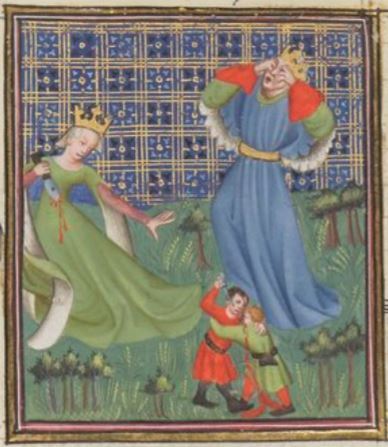
This illumination depicts the story of Jocasta and Oedipus. Jocasta is depicted on the left side of the image stabbing herself in the chest, while her husband Oedipus is on the right side gouging his eyes out. Jocasta and Oedipus are harming themselves because they found out that they are in fact mother and son. The two smaller figures in the centre of the image are Eteocles and Polynices, the sons of Jocasta and Oedipus. They kill each other in war, which is why they are depicted stabbing one another in this illustration.

![[Joseph Hungover]](https://cemvccol.ace-net.training/files/large/c65358fb4b4a3fd83678226d962d828d92024d50.jpg)
![[a lamp in front of a neoclassical building]](https://cemvccol.ace-net.training/files/large/1633340549e90ba642078105cb16b8f1bf22d5ba.jpg)
![[Vanity Fair Vol. II Chapter XLI Historiated Initial]](https://cemvccol.ace-net.training/files/large/36c6e395c4b6410e30cb53e423e6b37a1cad752d.jpg)

![[Jimena and El Cid]](https://cemvccol.ace-net.training/files/large/350a4c22b3ab981de96b0134403007373bb00ed5.jpg)

![[Indigenous people and the arrival of explorers by boat]](https://cemvccol.ace-net.training/files/large/2c10a672f332fbd1edb5ed7abee01b44a055e89e.jpg)
![[The Narrator and his Tools]](https://cemvccol.ace-net.training/files/large/7209eeaeb5a402e80b91cc7c31b68b0940f8656f.jpg)
![[Cats hunt mice]](https://cemvccol.ace-net.training/files/large/a5fd01cd8366e5c54b72f0c2169b3ef338c68bef.jpg)
![[Amelia and Mrs. O’Dowd]](https://cemvccol.ace-net.training/files/large/174ff8b64a01c8b0e61ddc9b0af118bbd19e58d8.jpg)