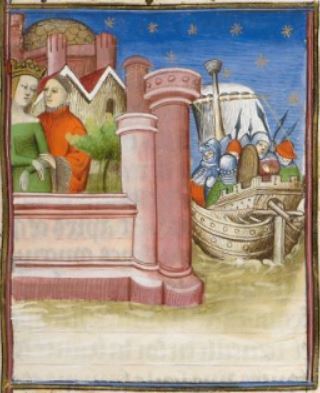
Helen, the queen of Sparta, is illustrated standing on the left side of the image as Paris, the prince of Troy, is touching her arm lovingly. Helen is wearing a crown to signify her royal status. There is a ship on the right side of the image sailing away from Sparta, which symbolizes the beginning of what would become the Trojan War, as the war is caused by Helen going to Troy with Paris.
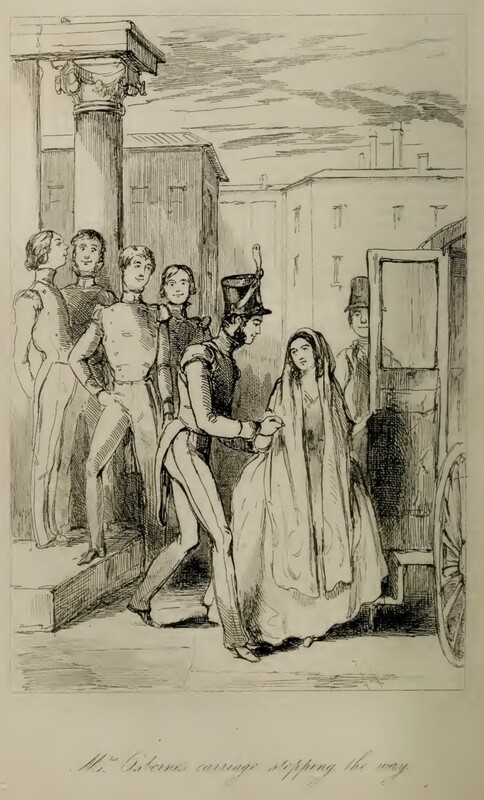
William Dobbin hands Amelia Osborne into her carriage as she leaves the ball. Behind the carriage door, the footman can be seen, and to the left of Dobbin, on the stair four young men are talking and smiling. In contrast to the others in the image, Amelia looks quite tired and sad. Below the illustration is printed in cursive its title, “Mrs. Osborne’s carriage stopping the way.”
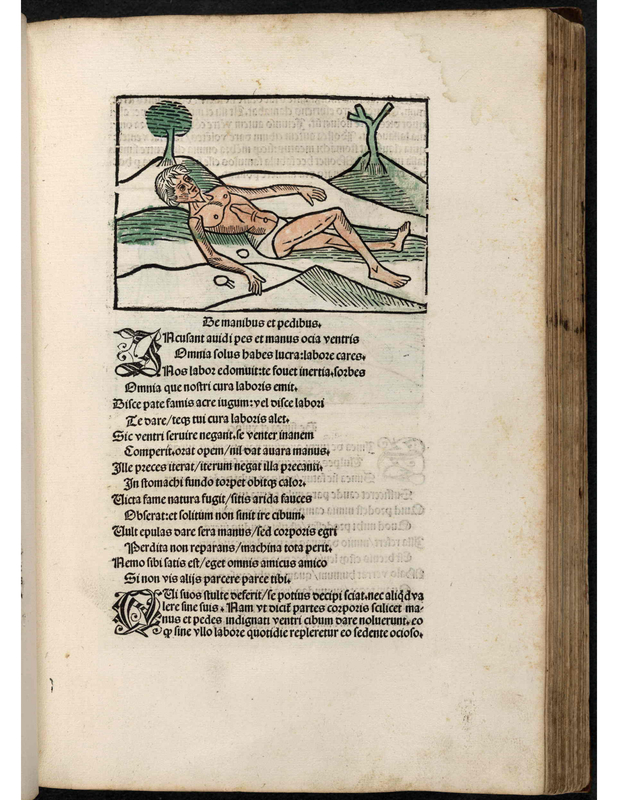
A person lies in a field, there are trees in the distance, one has leaves the other does not. The person is almost entirely naked wearing nothing but undergarments. The person has their arms and legs spread out, highlighting their hands and feet.
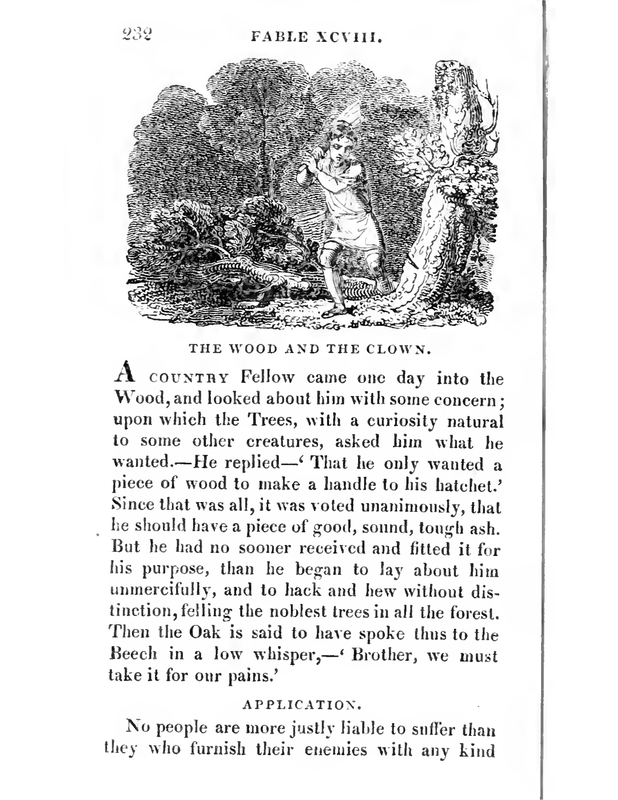
In the middle of the image there is a man standing, holding a hatchet above his head. Surrounding the man are many trees, branches, bushes, and plants.
Amelia Osborne, wearing a bonnet, is shaking hands with Peggy O’Dowd, who has just entered the sitting room in a riding-habit, eager to meet the newest addition to the officers’s ladies. Through the doorway behind Mrs. O’Dowd are two officers of the regiment.
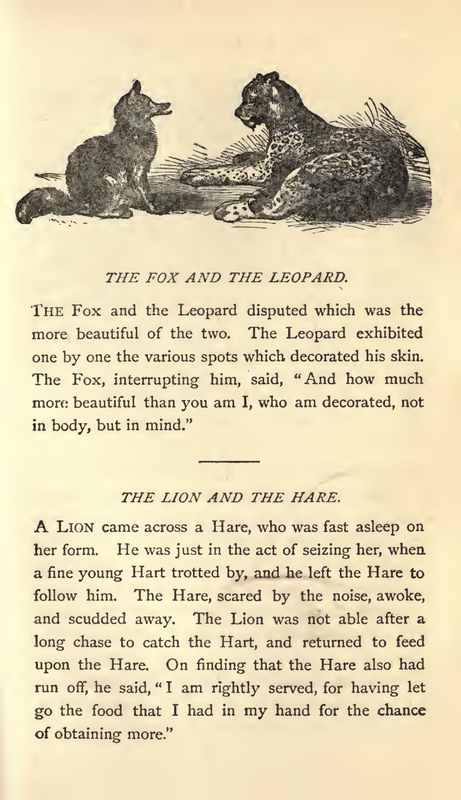
A fox and a leopard are sitting on a field. The fox is on the left side of the image and the leopard on the right. They are facing each other and are sitting close to each other portraying the absence of hostility.
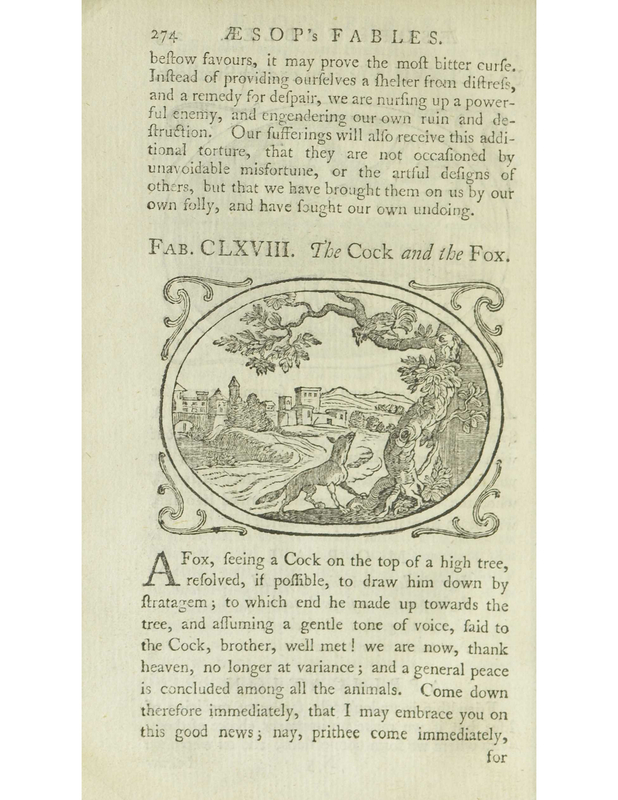
A fox stands at the base of the tree, looking up towards the cock. The cock sits in a high branch of the trees. The cock is leaning down towards the Fox. The two are in discussion. In the background there is a path that leads to a large village.
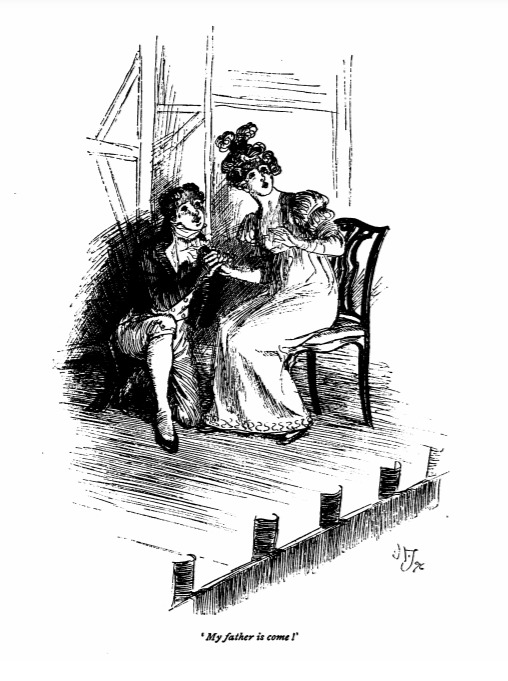
Here we see Maria Bertram and Mr. Crawford rehearsing the play, “Lover’s Vows.” Both look up from the scene in shock when Julia came into the rehearsal room to announce that their father, Sir Thomas had come home early. This put a swift end to the play, because he did not think acting to be a suitable pastime for respectable young people. This scene occurs in chapter 18. The characters are shown in the traditional regency style. Maria wears a regency style dress with an empire waistline. Mr. Crawford wears a waistcoat and tailcoat, with breeches and a cravat. The regency period dated to the early nineteenth century (1811-1820) when George, Prince of Wales, later George IV (r. 1820-1830), reigned as regent for his mentally ill father, King George III (r. 1760-1820). The regency period is associated with the rise of neoclassicism in art and fashion.
Here we see Gulliver lying on the table during dinner with the giants. The Farmer serves food from a large bowl on the centre of the table, holding a spoon. Bowls are laid out on the table in front of the giants. The farmer is in the centre of the image, with an old man across from him, and his wife behind him. The other characters in the image are the farmer’s children. Everyone is watching Gulliver. The same image appears in both the 1839 and 1843 Krabbe editions.
In this image we see a stack of Gulliver’s coins, taken from him when the Lilliputians took an inventory of his belongings. A Lilliputian knight is guarding Gulliver’s belongings, as Lilliputians try and take them. In the foreground we see a Lilliputian on the ground, reaching for the coins.
Here we see a depiction of the schools in Lilliput. The school system is a form of boarding school paid for by the Emperor, and as such interactions between children and parents is limited. The central figure is the headmaster, identified by his dark robes. Three children stand behind a gate on the left side of the image, while a man and a woman – the parents of the children – are ushered in. The headmaster holds out his arm to stop the parents from coming too close to the children, as the school limited physical contact with the children. According to Gulliver, parents were only permitted to visit their children twice a year for one hour. These visits were supervised by a teacher. Bringing gifts to the children was permitted and showing affection for them was strictly limited. This image comes when Gulliver describes the education system in Lilliput in the sixth chapter in which Gulliver discusses the values and traditions of the Lilliputians. The same image appears in the 1843 Krabbe edition.
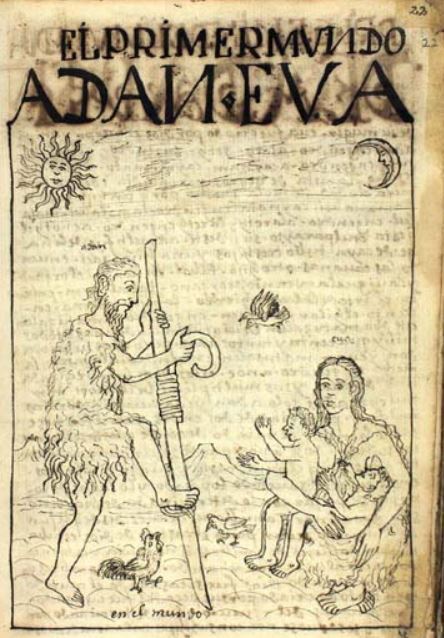
This illustration depicts Adam and Eve in the first age of the world. The author of the text believes there are five ages, or eras of the world, with the age of Adam and Eve being the first. Adam is illustrated making some form of spear or weapon, and Eve is illustrated holding their first two sons, Cain and Abel. There are birds flying in the sky and a rooster is depicted on the ground by Adams feet. The word “Adan” (Adam) is written above Adam’s head and the word “Eua” (Eve) is faintly visible above Eve’s head to identify them. The sun is depicted in the top left-hand corner of the image, while the moon is depicted on the top right-hand corner. The words “en el mundo” are written at the bottom of the image, which translates to “in the world.”
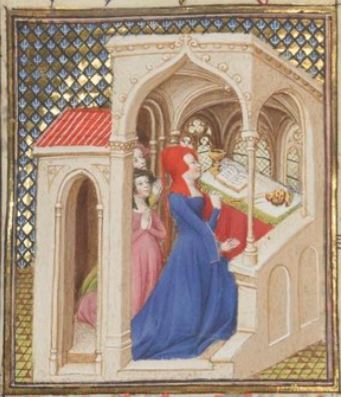
This illumination depicts a woman named Sulpicia standing in the centre of the image inside of a temple. Sulpicia is renowned for having been a devoutly chaste woman. Boccaccio explains that Sulpicia was chosen out of one hundred women to consecrate a statue to Venus in the city of Rome. She was chosen for being considered the most chaste out of all the other women. The other chaste women are depicted standing behind Sulpicia.
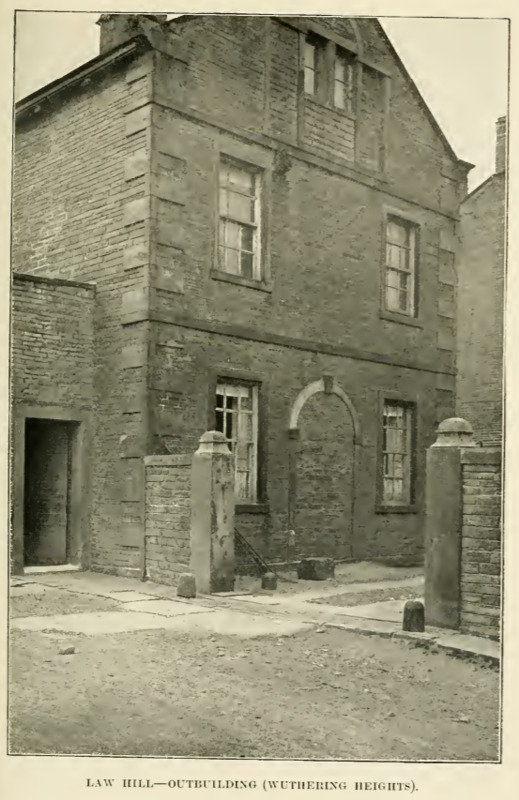
Here we see an image of Law Hill, a house near Halifax, England, on which Emily Bronte based the estate of Wuthering Heights. In this image we see the outbuilding of the house, taken from the courtyard on the back of the house. An outbuilding is another building on the property, typically used for storage. This is the third in a series of photographs of the house, with others of the front and the back. The image is a reproduction of a photograph using a technique called photogravure, where photographs are taken on plates which could then be etched on to create a plate for use in a printing press.
Inside a home, a man sits on a chair. He has long, curly hair and wears a tall hat. His clothing seems like those of novelty, or superiority. The man has his right hand lifted in the air, with one finger sticking out. In front of him is a small dragon on the ground, and a small axe. The dragon’s eyes are all black, and a deep cut to its neck is making it bleed out. An arch-shaped window shows a field far out.
A group of Tupinambá people in five canoes approach a large European ship near the coast. In the canoe closest to the ship, Tupinambá men communicate with the European sailors. There is also a European man standing in the middle of that canoe. The two men in the canoe on the right have been fishing, there is a pile of fish in the bottom of the canoe and one of the men holds a fish towards the ship. An Indigenous village can be seen near the shore behind the ship, and three men with bows and arrows walk along the shore.
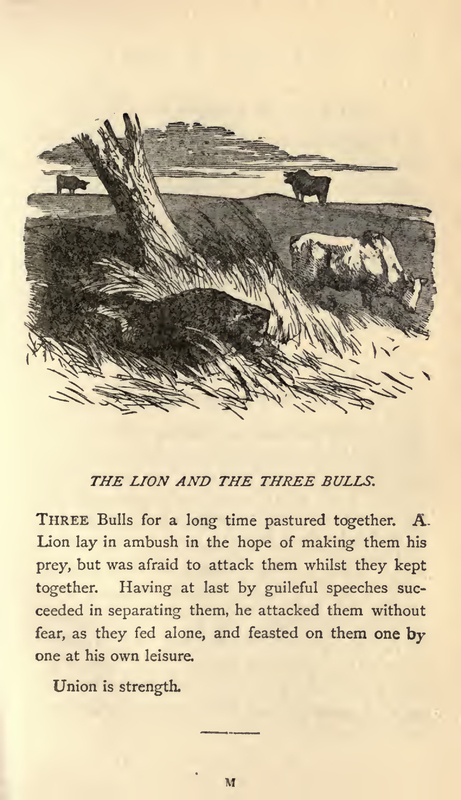
On the field, the lion hides behind the grass and the tree. It looked at three bulls who ate grass on the field. Otherwise, three bulls were still claim and didn’t see the lion.
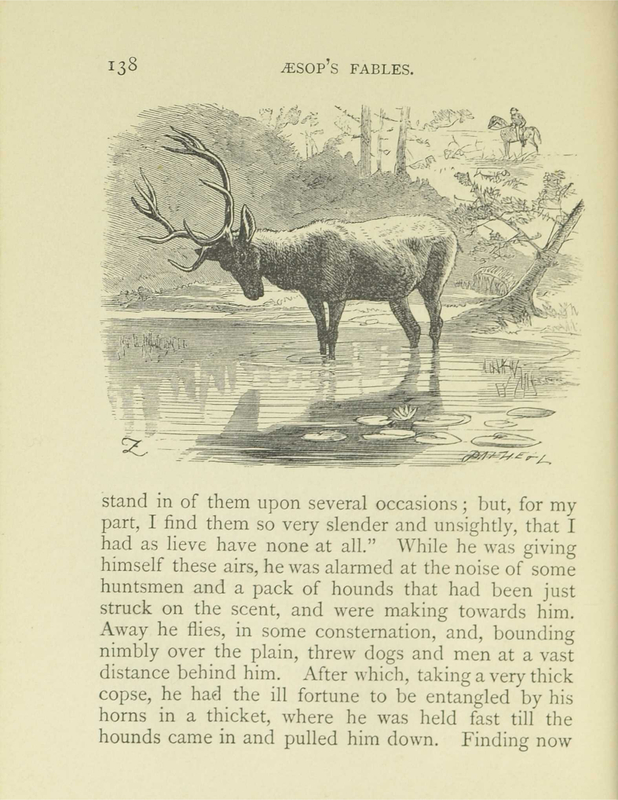
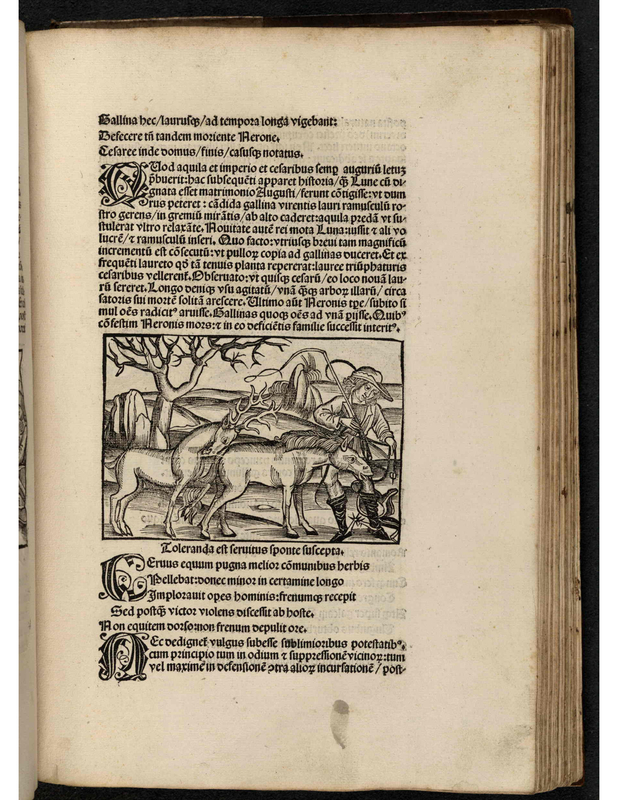
A man holding a whip in one hand is accompanied by a horse who seems interested in what the man is holding in his other hand. A deer stands behind the horse, in a stance as if it is charging. The horse and the man seem unaware of the deer.
In the foreground, a group of Tupinambá women prepare a ceremonial club for executing the captive. One woman holds the feathered end of the club, while another paints or carves the thicker end. In the background, another group of women prepares the captive man for the ceremonial killing by painting designs on his head. Several of the women carry small children strapped to their backs.
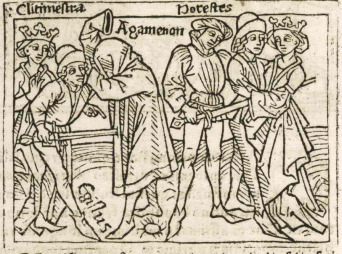
Clytemnestra, the queen of Mycenae, is depicted on the far left-hand side of the engraving with a crown on her head. We know that this is in fact Clytemnestra as her name is engraved directly above her head. In front of Clytemnestra is the person she has been having an affair with, Aegisthus. His name is engraved beside his leg. Aegisthus and Clytemnestra, as explained by Boccaccio, had conjured a plan to kill Clytemnestra’s husband, king Agamemnon, in order to gain control of Mycenae. Clytemnestra gave Agamemnon a piece of clothing that had no neck hole, so as he struggled with the garment, the adulterer Aegisthus pierced Agamemnon with a sword (this is depicted on the left-hand side of the engraving). Agamemnon’s name is engraved above his head in order to identify him as his head is under the clothing. Orestes, the son of Agamemnon and Clytemnestra, sought to avenge his father’s death. He is depicted on the right-hand side of the engraving, killing both his mother and Aegisthus. Orestes’ name is engraved at the top of the engraving to identify him.
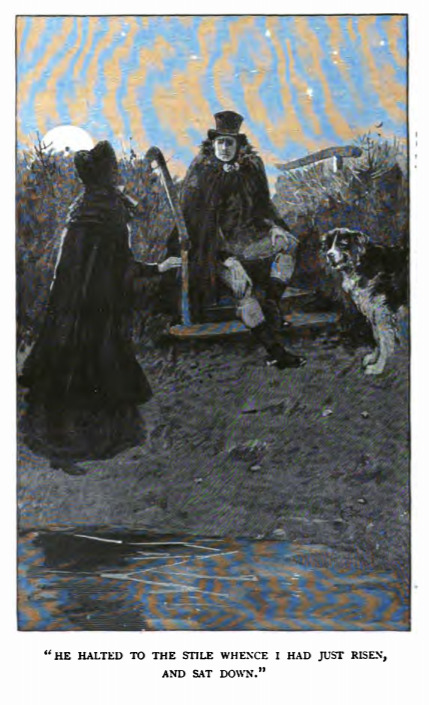
Here Jane first meets Mr. Rochester. While walking into town, she met Mr. Rochester whose horse slipped on ice and knocked Mr. Rochester off hurting his ankle. Not knowing who the other was, Jane offered to help Mr. Rochester. She tried to calm his horse but was unable, so she helped Mr. Rochester take a seat, then get back onto his horse. Mr. Rochester’s dog, Pilot, stands next to him.

![[Amelia Meets Mrs. O’Dowd]](https://cemvccol.ace-net.training/files/large/b311bfd65fca3b27e5dfa4e11df116c41d2916f4.jpg)

![[Gulliver eats with the farmer’s family]](https://cemvccol.ace-net.training/files/large/4762a1efcdf7591872717ef5373444835e81fb1b.jpg)
![[Lilliputians stand next to a stack of Gulliver’s coins]](https://cemvccol.ace-net.training/files/large/369898a1025f814898600e0201aba43e9c9b872b.jpg)
![[the Lilliputian education system]](https://cemvccol.ace-net.training/files/large/bbb0fd8a52bd8993b10cf0fe5b1f77f051e7110b.jpg)
![[The Novelty Man Who Killed the Dragon]](https://cemvccol.ace-net.training/files/large/5e280a54508fec5d613f5f4c1a5d28e3b6c90589.jpg)
![[Tupinambá people in canoes approach a European ship]](https://cemvccol.ace-net.training/files/large/0b93dc72ce3fa572050e4c0ebc634c4734cfc3fe.jpg)
![[Tupinambá women prepare for the ceremonial killing of a captive]](https://cemvccol.ace-net.training/files/large/d8667379f8d1f7e8bf0f048857699e6c1c676dfd.jpg)