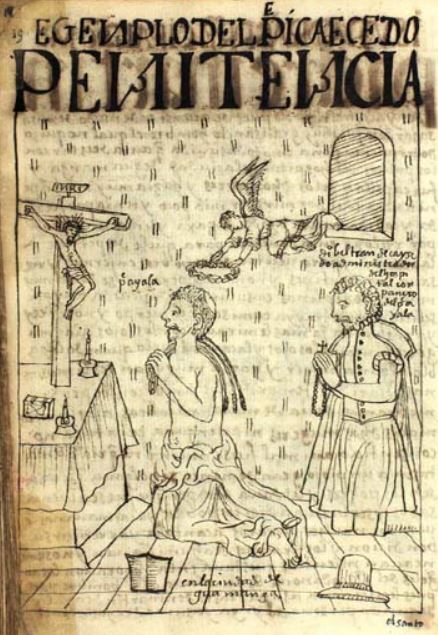
This illustration depicts Martín de Ayala, step brother to the author (Felipe Guaman Poma de Ayala) in the centre of the image kneeling before a crucifix. He is illustrated holding a lash as he whips himself in penance before the altar. “Padre Ayala” is written above and to the left of his head to identify him. There is a winged spirit flying through the window placing a halo upon Martín de Ayala’s head. Behind Martín de Ayala is his companion, Diego Beltrán de Caysedo. The words “Diego Beltrán de Caysedo, administrador del hospital, conpañero del padre Ayala” are written above his head, which translates to “Diego Beltrán de Caysedo, administrator of the hospital, companion to Father Ayala.” The bottom of the image notes that this takes place in the city of Huamanga, as it reads “en la ciudad Guamanga.”
A hare is sitting next to a tortoise on a dirt path. A fox is sitting across from them. There are trees along the side of the path. The hare and tortoise seem scared.
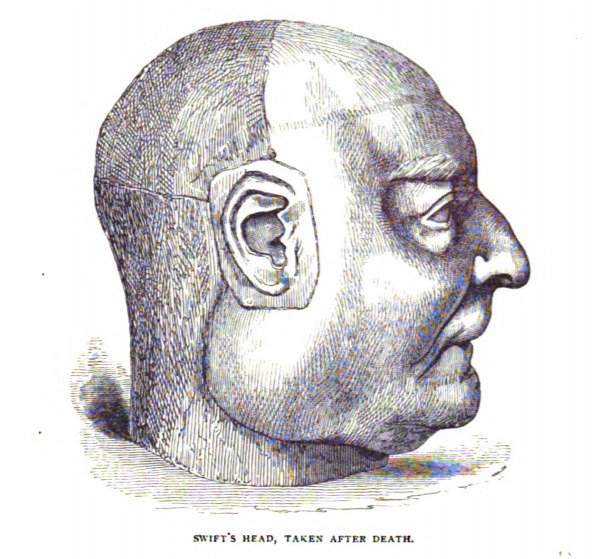
Here we see the profile of Swift’s head. After his death, Swift’s head was cut off and a cast was made of his brain. This was done as a way of immortalizing his life and work. This image appears as part of the biography of Jonathan Swift.
Here Gulliver explains his situation to two Houyhnhnms. He asks them for shelter, and in return he says he will make them a present in return for the favour using his knife. The Houyhnhnms spoke between themselves and agreed to help Gulliver. During their conversation Gulliver heard the two saying the word “yahoo”, so Gulliver repeated the word back to them. The Houyhnhnms looked surprised, then proceeded to teach Gulliver the correct pronunciation of the word. The Houyhnhnms then took in Gulliver and taught him the language. The same image appears in the 1843 Krabbe edition.
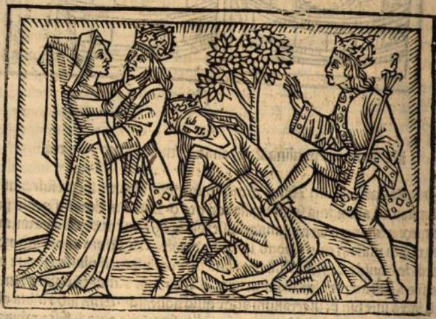
The two figures on the left are likely intended to represent Pármeno and Areusa, whom Celestina unites as a reward for Pármeno’s loyalty. To the right, we see Celestina interacting with a group of four male figures. This scene is not in any way related to the events of Act VII.[This illustration is identical to those found in Acts I (folio 9r), IX (folio 67r), XI (folio 80r), XII (folio 83v), XIV (folio 96v), XVI (folio 106v), and XIX (folio 115v).]
George Osborne stands, looking uncomfortable, with his hand slightly extended in greeting towards Rebecca Sharp. Miss Sharp is seated in a one-armed chair under a portrait. She is looking challengingly up at Mr. Osborne and has a single finger extended in his direction.
This engraving depicts two separate events. The scene on the left side of the engraving depicts a woman named Sabina Poppaea, a woman of noble birth, seducing Emperor Nero. She was incredibly beautiful, as well as cunning. She sought power and found it by marrying Emperor Nero, although she did not hold her power for long. The right side of the engraving depicts her tragic fate. Emperor Nero is depicted kicking a pregnant Sabina Poppaea out of rage, which ends up killing her.
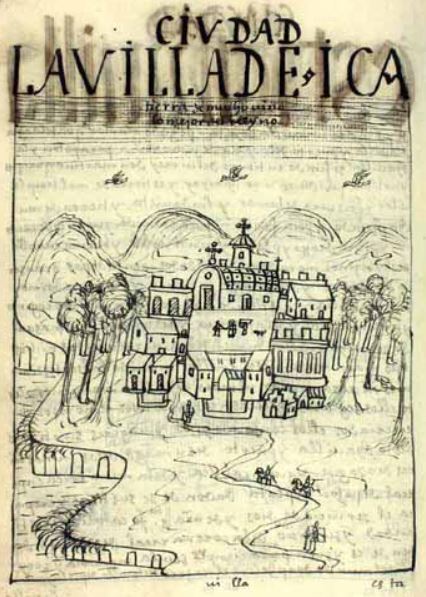
This image is depicted in the author’s chapter where he discusses cities, towns, villages, and provinces in colonial South America. This image depicts the town of Ica in southern Peru. The town is arranged in a cluster of buildings that form a square in the centre where three people and a dog can be seen walking. A mountainous landscape is visible in the background with birds flying in the sky. There are tall tropical trees surrounding the city. There is a winding path that leads in and out of the city. There are two people riding horseback on this path and two people walking. The author explains that Ica had the best wine in the kingdom and was plentiful in food such as meat and especially fish as it is near the coast. The caption at the bottom of the image reads “uilla” [town].
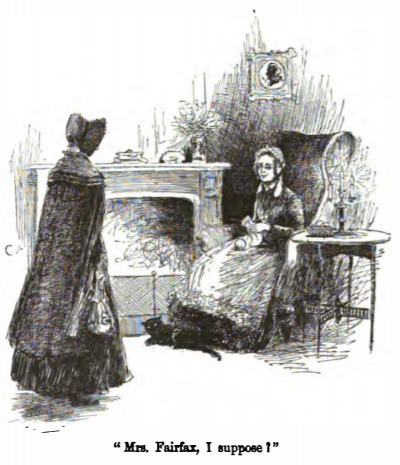
Here we see Jane’s arrival at Thornfield Hall. Jane stands on the left facing Mrs. Fairfax, the elderly housekeeper. Jane arrived at Thornfield late at night. When she arrived, she thought that Mrs. Fairfax was the owner of the house, rather than the housekeeper. She found out later that it was not the case.
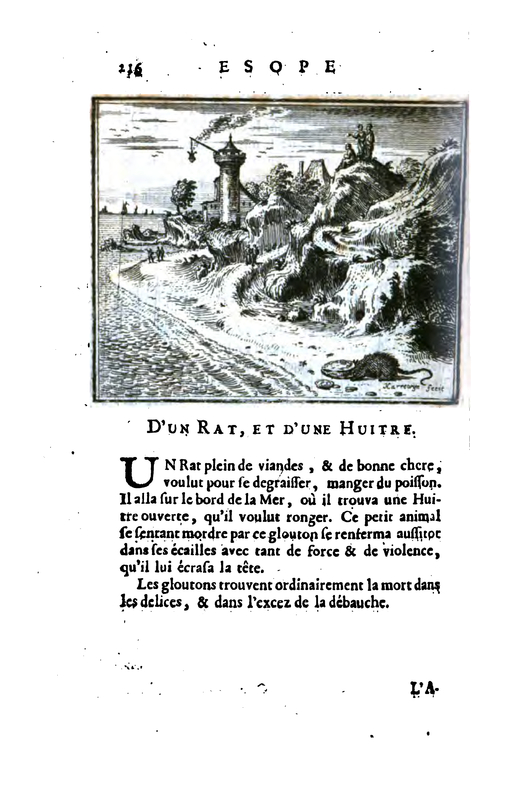
On the bottom side of the illustration, a rat has its head in an open oyster, presumably eating it. The rat and oyster are along the shore. In the background, there appear to be people looking out on the water, buildings, tree, and ships. The illustration has the signature of Harrewijn in the bottom right corner.
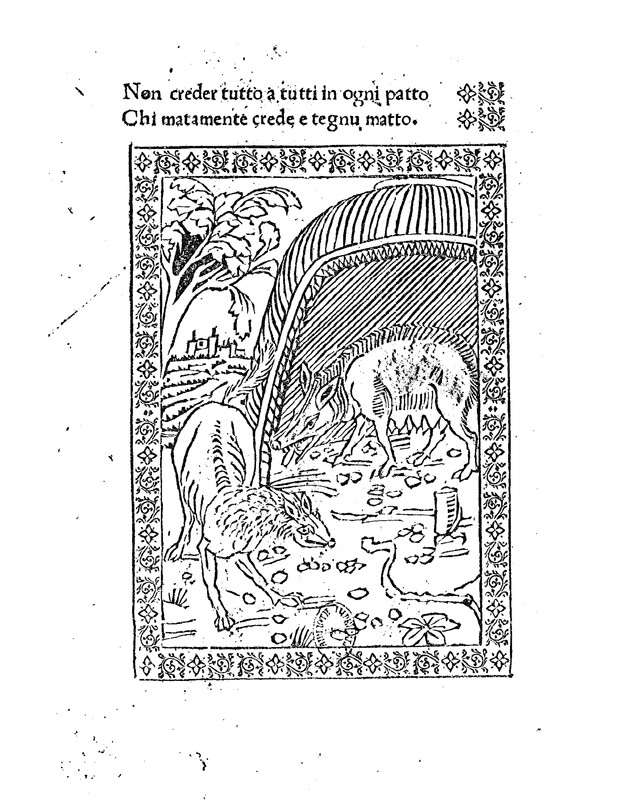
Two ferocious creatures in what seems like a forest are facing off, one on the left and one on the right side. A castle lies in the distance to the top left of the image as does a tree with large leaves. the image is bordered with a vine design and the signature of Liberale de Verona is stamped on the bottom.
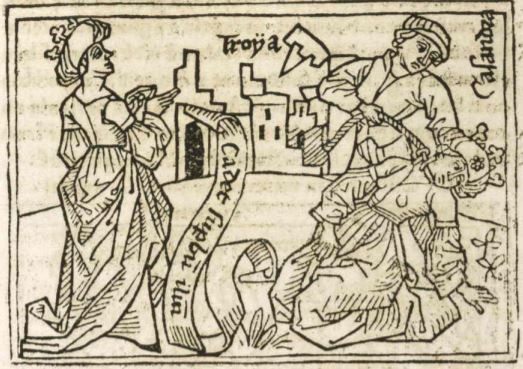
This engraving depicts Cassandra, the daughter of king Priam of Troy on the right-hand side of the engraving being killed under the order of Clytemnestra, who is on the left-hand side of the engraving. Boccaccio explains that Cassandra was brought to Mycenae after the Trojan War as king Agamemnon’s mistress. Agamemnon’s wife, Clytemnestra did not like this, and ordered Cassandra to be killed. Cassandra is depicted with a rope around her neck and a man pulling on the rope. Clytemnestra is depicted with a pleased look on her face as she watches Cassandra die. Cassandra’s name is engraved in the top right-hand corner of the engraving to identify her. The fallen city of Troy is depicted in the background of the engraving.
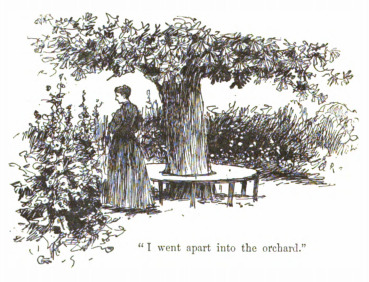
Here we see Jane Eyre standing underneath a tree in the orchard outside Thornfield. She went for a walk after putting Adele, the young girl for whom Jane is governess. She stands, looking at the flowers near a tree with a bench built around the trunk of the tree. It is a nice summer evening, and soon Mr. Rochester comes out to join her.
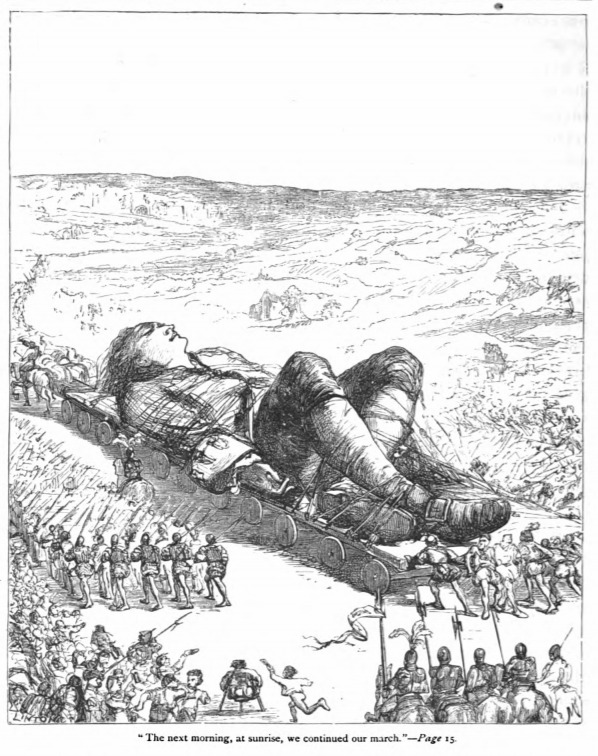
After spending days on the shore of Lilliput, Gulliver was transported to the city of Lilliput on a large gurney. The trip took a day and a half to reach the city, stopping overnight. The journey was guarded by guards, and the gurney was pulled by thousands of Lilliputian men.
Here we see a statue depicting Justice in Lilliput. Justice is represented by a woman who holds a bag of coins in one hand and a sword in the other. She sits on a podium with two eyes on the front, one on either side, and another two on the back (the side and back eyes are not visible in this image) meaning that Justice sees everything. The podium is placed in a recessed archway with a set of scales on either side. Two Lilliputians stand in front of the statue looking up at it, while three guards stand on the right, in the shade of the statue. The same image appears in the 1843 Krabbe edition.
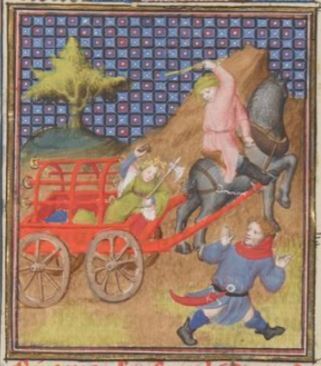
Berenice, the queen of Cappadocia, is illustrated in the centre of the image standing in a chariot. She is depicted with an axe in her left hand and a rock in her right. Her arm is in the air as she is about to throw the rock at the man on the right side of the image who is running away from her. The man running away from Berenice is Caenus, a servant who killed Berenice’s children under the order of Mithridates (her brother). Berenice kills this servant to avenge her children’s deaths. There is a chariot driver who is depicted riding the horse.
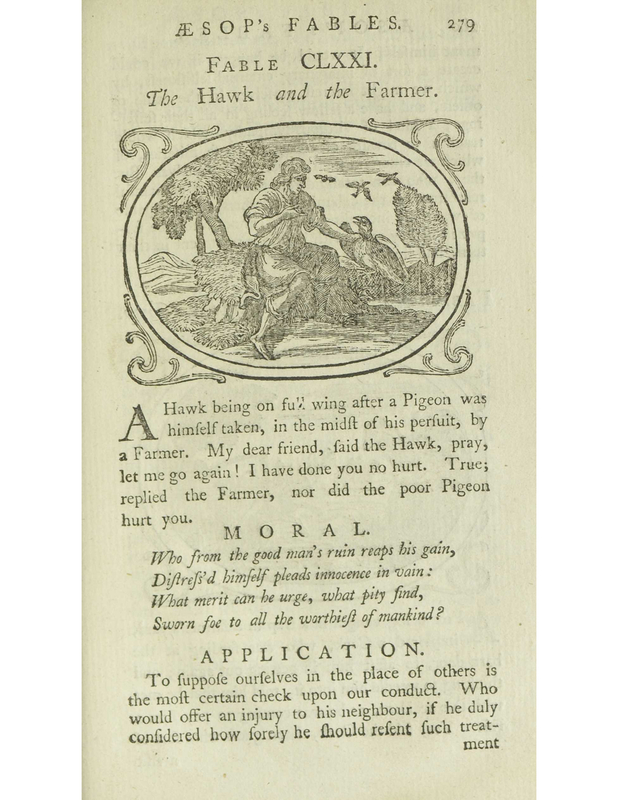
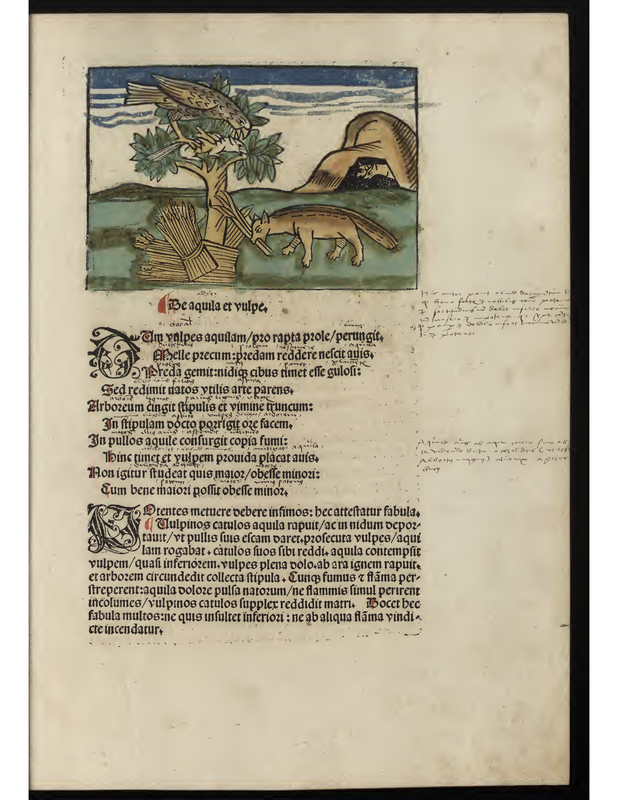
A man sits outside at the base of a small trees. He is grabbing a hawk around their neck. In the background three more hawks fly away from the scene. The farmer is explaining something to the hawk.
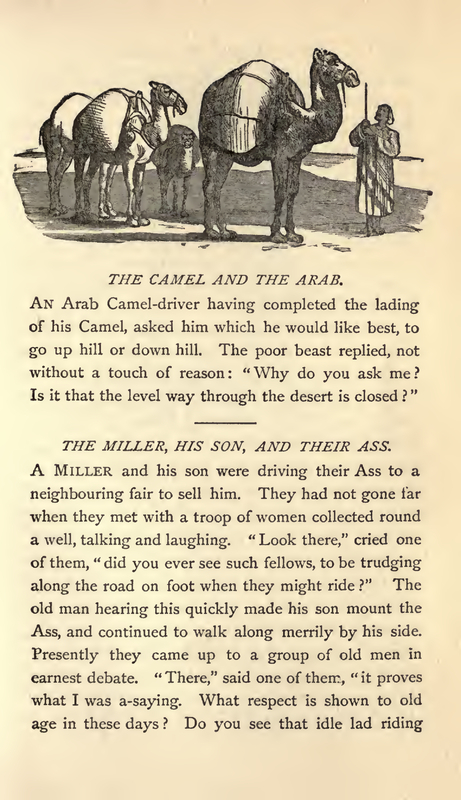
There are four camels lined up in a desert. A man is standing beside the camel in front with a staff in his hand. The man is looking up at the camel and seems to be talking to it.


![[The Hare and the Tortoise]](https://cemvccol.ace-net.training/files/large/a506f4d4be49a5e2d25d551b07e46db70d3dcd2d.jpg)
![[Gulliver shows a Houyhnhnm his knife]](https://cemvccol.ace-net.training/files/large/0f4877af1bd224d3cf3651b7e7cd2457c2edec47.jpg)

![[Act VII – Areusa, Pármeno, Celestina, and Four Male Figures]](https://cemvccol.ace-net.training/files/large/5fd7ace51d70c9e6e3a1077d9ef849290cd5d33e.jpg)
![[George and Rebecca]](https://cemvccol.ace-net.training/files/large/1e0827bdedb8c3d917372fed047a9f80effeacb8.jpg)

![[Depiction of Justice on Lilliput]](https://cemvccol.ace-net.training/files/large/828b8be667909328217107442a675b0447a07814.jpg)
![[The Narrator]](https://cemvccol.ace-net.training/files/large/ce0d49c084b4c60f805d33f9e4ec831119cbd8ff.jpg)