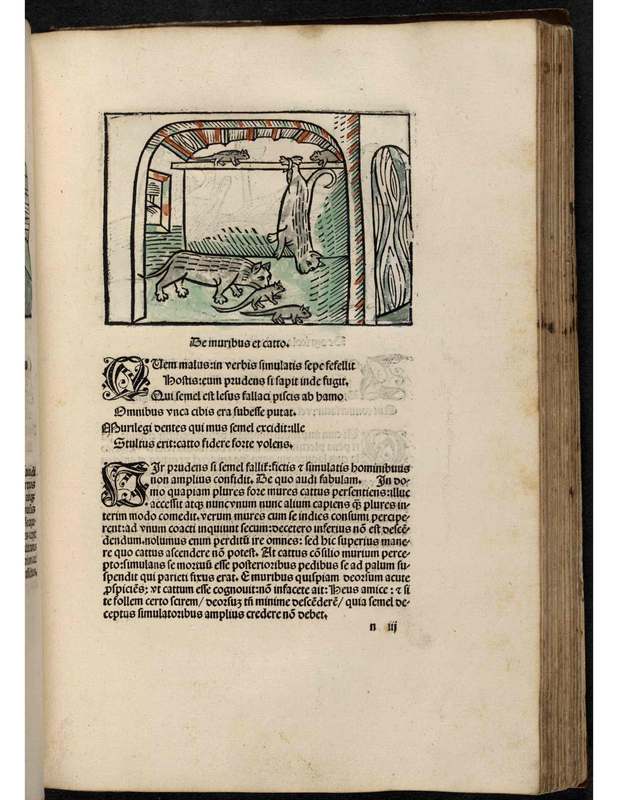
One cat hangs from as it back paws are tied to a bar in a house. Another cat carries a kitten in its mouth, while another kitten walks near by. There are two kittens walking on the bar on either side of the cat.
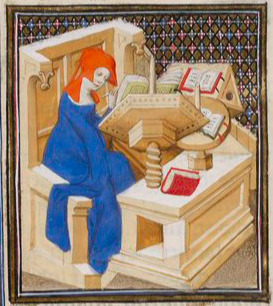
Proba was known for excelling in the liberal arts. This mainly consisted of reading important works, such as Virgil, which she became very familiar with. She read many topics, including sacred scriptures. Because she was so praised for her passion of reading, she is depicted at her study table surrounded by texts, scriptures and other works.
In this image we see a group of seven Lilliputian court officials and the Emperor at a table discussing Gulliver’s fate. Some argue that Gulliver should be pardoned or given a less severe charge than treason because of his work in defeating the Blefuscudian fleet during the war between Lilliput and Blefuscu. The Grand Admiral, however, insisted that Gulliver should be put to death because of his actions, specifically urinating on the Imperial Palace. The Grand Admiral is the second figure from the left in this image. He is wearing part of a suit of armour and does not wear a hat. The Emperor sits in the middle of the table, and can be identified by his headpiece with several large feathers coming out of the top. The men are seated in a large hall in the Imperial Palace. The throne can be seen in the distance behind the Emperor as can a row of columns on the right side and a large curtain on the left. The same image appears in both the 1839 and 1843 Krabbe editions.
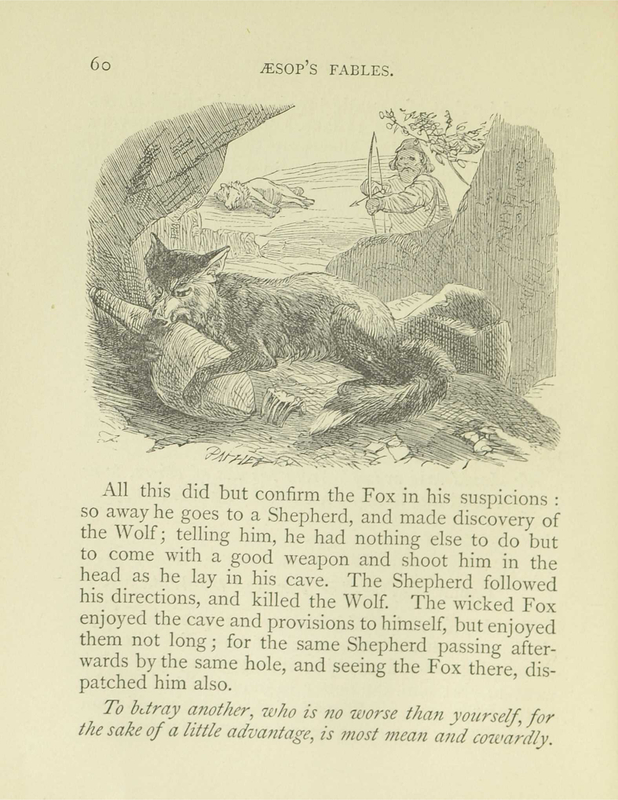
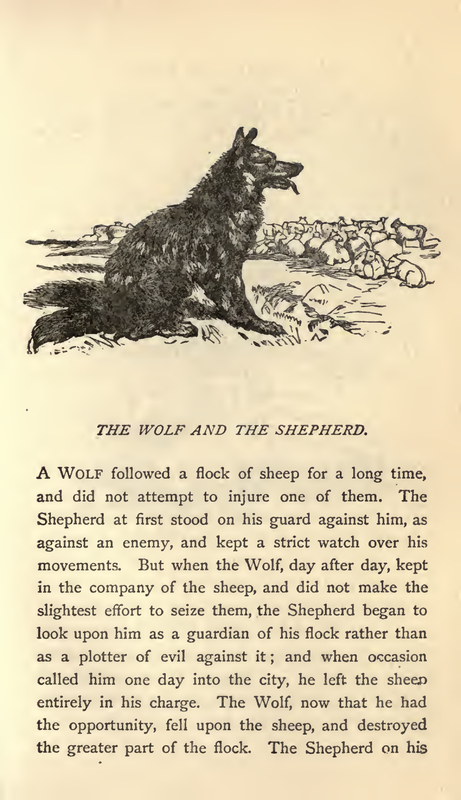
In the foreground of the image, we see a fox laying in a shallow cave chewing and eating a piece of meat it caught, beside the meat there are cleaned bones, appearing to be rib bones. In the background of the image behind the fox in the cave there is a hunter with a bow and arrow pointing directly at the fox. In the very back of the image on the left there is a wolf, laying on its side presumably dead.
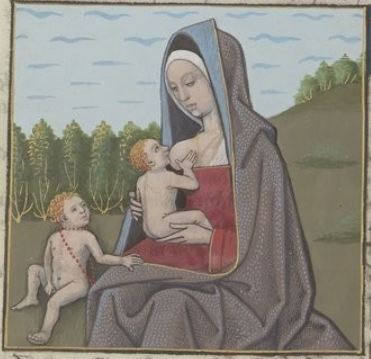
This image depicts a woman breastfeeding a child while another child sits by her on the ground. The woman in the image is Theoxena, a woman of Thessaly and the daughter of Prince Herodicus. Boccaccio explains that Theoxena’s husband and brother-in-law had been killed by King Philip of Macedon, and when he decreed that all the sons of the men he has killed must be executed as well, she knew she had to protect her family. Rather than dying at the hands of a horrible king, she wanted her family to die at her hands instead. Theoxena gave her child and her sister’s children the option of either drinking poison or stabbing themselves. The illumination does not reflect this story, as the image simply depicts Theoxena breastfeeding the children.
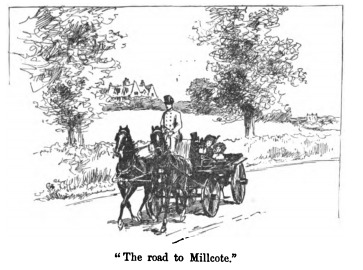
Here we see Jane Eyre, Mr. Rochester, and Adele out for a drive in their carriage. The carriage has an open top. In the distance we see Thornfield, as they drive along the road to go to Millcote, the town near Mr. Rochester’s estate. Tall trees from the Thornfield orchard line the road.
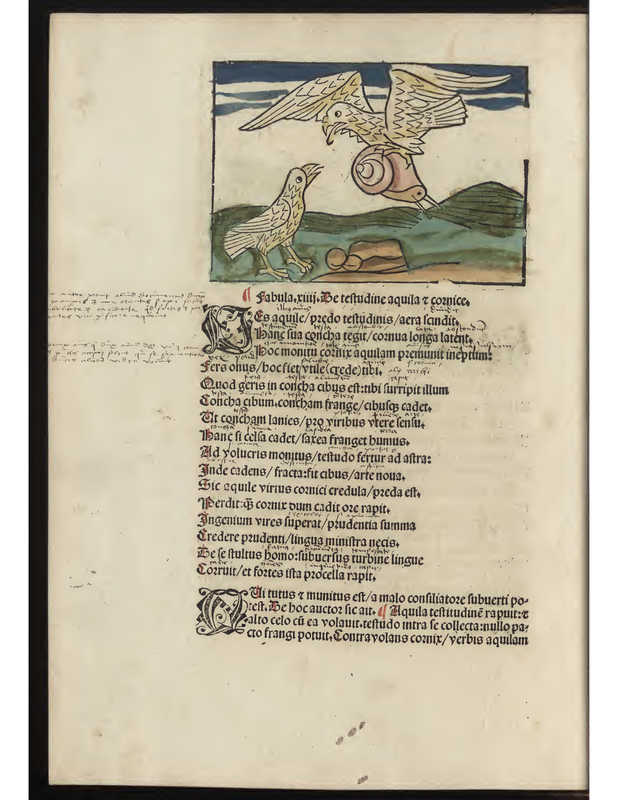
On the left-hand-side of the image a bird on the ground looks up, towards a similar bird who is flying through the sky with a snail grasped in its talons.
Two European ships are anchored near the coast, close to an island labelled ‘S. Catherina Ins.’ Several European men sit around a fire on the island, while others chop down a tree and gather brush. A canoe bearing several Tupinamá men and one European approaches the island from the left and five other canoes come from the right, with the five heading towards a rowboat filled with European men. On land several European men with spears explore an abandoned Tupinambá village near the shore. The frames of several of the structures are exposed and parts of the fence are broken. A large cross with a plaque hanging around it has been erected on the cape near the village and two European men stand beside it.
John Sedley, slightly stooped, holds a plate. George Osborne’s valet Trotter, surprised and slightly pleased, has just taken the glass of wine which Mr. Sedley offered him.
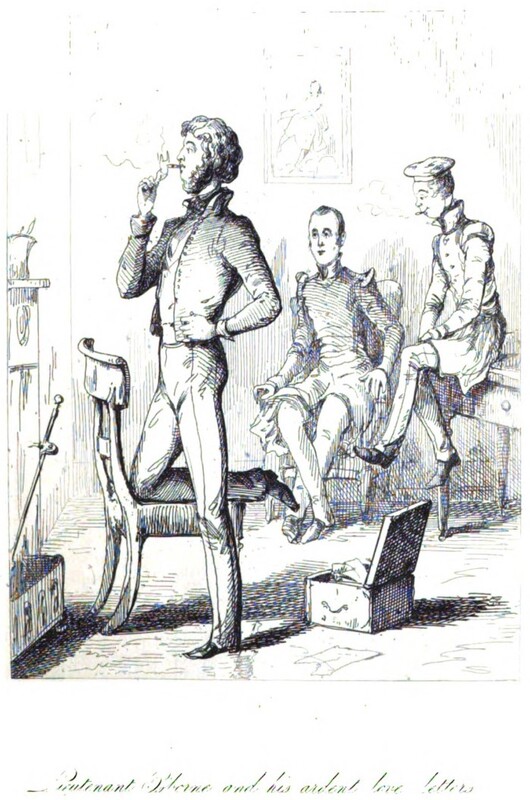
George Osborne stands facing the fireplace with one leg resting on a wooden chair, smoking a cigar which he has lit using a love letter. At the base of the chair is an open chest, filled with letters from Amelia Sedley. Two other officers are seated in the background. One is sitting on the edge of the desk, also smoking. The other is Dobbin, seated in an armchair over which a portrait of a woman hangs, looking appalled. Below the illustration is printed in cursive its title, “Lieutenant Osborne and his ardent love-letters.
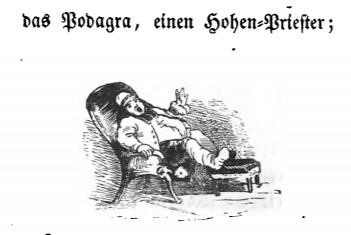
This image is of a high priest sitting in a chair with gout. Gout was the code word for the high priest. This image comes in a description of a conspiracy found by a professor from the Grand Academy on Balnibarbi. This idea is representing code word for terms in the conspiracy that Swift is satirizing. The professor advises that those named in the conspiracy papers be closely monitored at all times, naming specifically while they were using the bathroom, as this is when men were most thoughtful. This conspiracy is thought to be an allusion to the trial of Francis Atterbury, the bishop of Rochester for allegedly plotting with the Jacobites. Atterbury was charged with treason in 1722 and was exiled to France. The same image appears in the 1839 Krabbe edition.
In this image we see Gulliver, still tied up, drinking wine from a barrel, while two Lilliputians roll another barrel up to Gulliver using a ramp on his chest. This image appears where Gulliver was tied up on the beach of Lilliput. The same image appears in the 1839 Krabbe edition.
Two European men stand in the foreground with a Tupinambá man, all three gesture as if having an argument. Beside the group another Tupinambá man runs with his hands over his head, pursued by a winged demon with horns, a curly tail, and talons for feet. The demon has one hand on the man's back holds a switch raised above his head. In the background, other fearsome creatures torment Tupinambá people. The creatures may be based on the spiritual beliefs of the Tupinambá. There is also a village in the background, and a European ship anchored near the coast on the left.
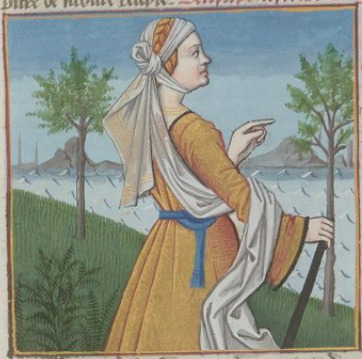
This illumination depicts a portrait of a woman named Gaia Cyrilla. She is illustrated on a side profile as she appears to be looking and pointing towards the water in the background of the image. Gaia was renowned for having been the wife of Tarquinius Priscus, king of the Romans. She was also famous for dedicating much of her life to the art of wool work and weaving.
The Houyhnhnms are a breed of horses. The Houyhnhnms created their own society and Gulliver believes them to be a superior society that is more virtuous than any other society Gulliver encountered. Gulliver’s first encounter with a Houyhnhnm was when it scared off a yahoo who was tormenting Gulliver. The Houyhnhnm was not violent. It looked startled at the sight of Gulliver but did not attack him. In the background of this image we see a group of yahoos running away. The same image appears in the 1843 Krabbe edition.
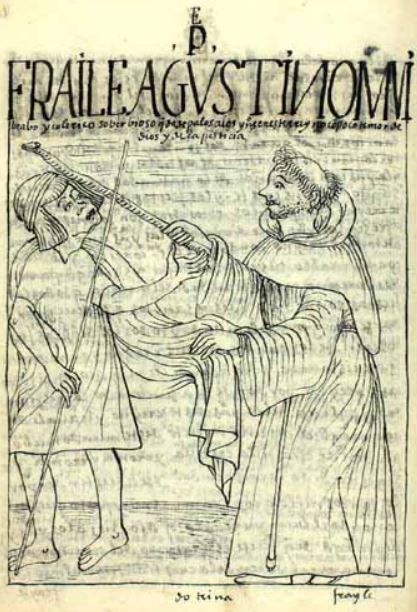
This image depicts an Augustinian friar physically abusing an indigenous man. The friar is dressed in his hooded habit and is standing on the right side of the image. He is illustrated holding a long stick as he uses it to beat the man while also pulling off the cloak that was wrapped around him. The author criticizes Augustinian friars for not fearing God or justice and for not treating the indigenous peoples of Peru with respect.
Four Indigenous Brazilian men pick and gather fruit from a tree. One man has climbed the tree to pick fruit and drop it down into the arms of another man on the ground. Two other men at the base of the tree gather the fruit and put it into a basket for transport. This illustration is a simplified and mirrored version of the one found on page 120 verso of Paris, 1557.
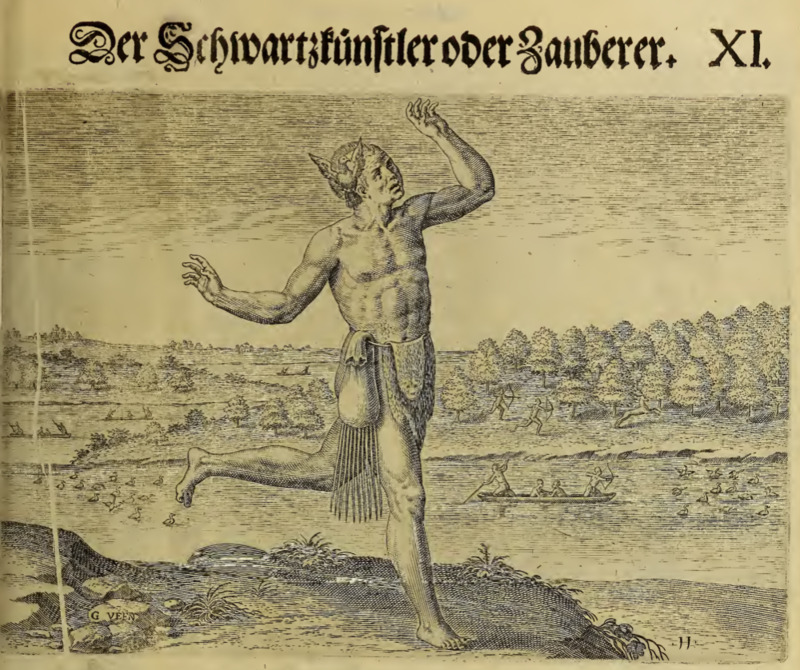
An Indigenous man, called an enchanter by the author, is shown standing on the bank of a river. He wears a black bird in his short hair as a symbol of his position. His only clothing is a hide tied around his waist, and a satchel hangs at his side. Behind him, other Indigenous people are seen in a canoe, hunting water birds with a bow and arrow.
This illustration depicts the goddess Venus (on the left-hand side), being admired by citizens for her beauty. Venus is depicted standing, while the other figures are kneeling down and reaching out towards her. Boccaccio explains that Venus’ beauty was almost unbelievable to witness, and that he wrote on the goddess solely based on her beauty.
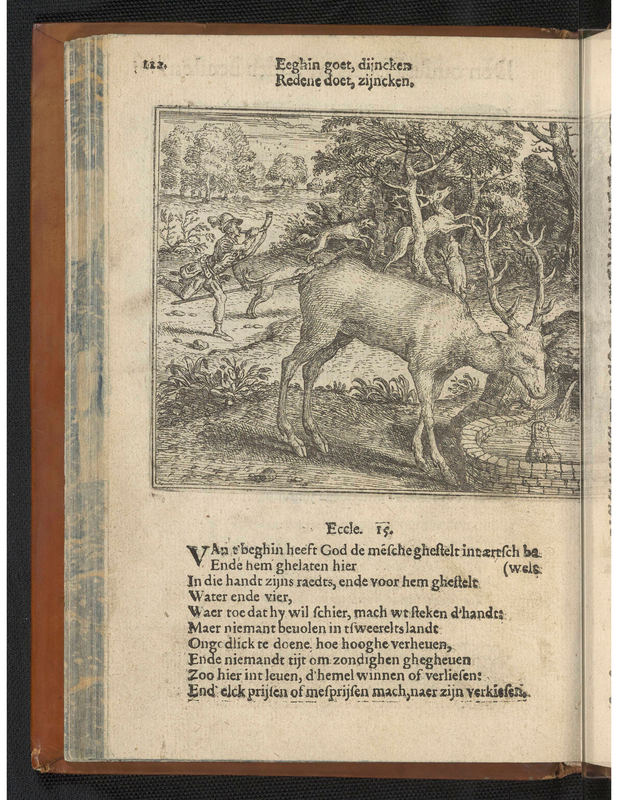
The deer and its reflection in the fountain'; a deer at right is looking into a fountain and sees itself; in the background we see a hunter blowing a horn and two dogs running after a second deer; Dutch letterpress on verso; illustration to Eduwaert de Dene's edition of Aesop's Fables, De Warachtighe Fabulen der Dieren (Pieter de Clerck, Bruges: 1567). c.1567

![[a meeting of Lilliputian officials]](https://cemvccol.ace-net.training/files/large/2f2f0e9e8b2e88032b401cb366cfdc5825a87ede.jpg)
![[European ships anchored along the coast near an abandoned Tupinambá village and the island Santa Catarina]](https://cemvccol.ace-net.training/files/large/4cfa08c598b7c5c3fe2d78c87639fa4500bd21a3.jpg)
![[Mr. Sedley and Trotter]](https://cemvccol.ace-net.training/files/large/4b8eafb2ea78f7313c6cbb7ca78d4e4839944049.jpg)
![[Gulliver drinks from a barrel]](https://cemvccol.ace-net.training/files/large/ce07c780b04651133b5609452021206681d51077.jpg)
![[A Tupinambá village full of mythological creatures]](https://cemvccol.ace-net.training/files/large/b0c450ec9d7fc2baaf6ca2a9f8bbfa7b6d132674.jpg)

![[Gulliver first encounters a Houyhnhnm]](https://cemvccol.ace-net.training/files/large/4dc2e1fa466737757b9d93b07255d19473de5f0a.jpg)
![[Indigenous Brazilian men pick fruit from a tree]](https://cemvccol.ace-net.training/files/large/33e7a15589a518ca100d40a8c18de0d05e9a5104.jpg)

![[Venus Being Admired for her Beauty]](https://cemvccol.ace-net.training/files/large/7f879e28dc5a47988a8abe1a5563fa7e560a8e35.jpg)