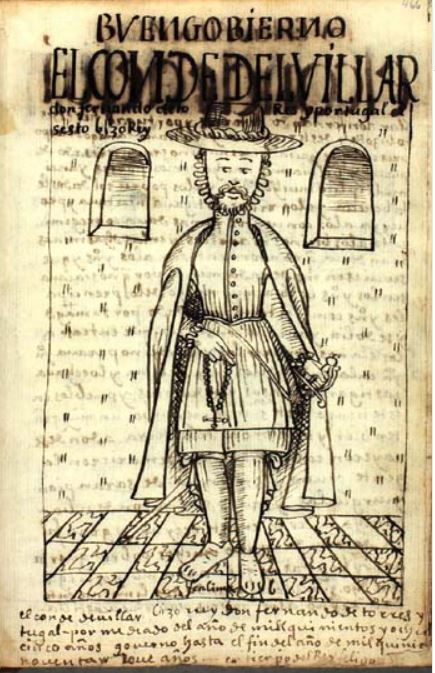
This image depicts a standing portrait of the Count of Villar and sixth viceroy of Peru, Don Fernando de Torres of Portugal. He is illustrated standing upright as he holds the hilt of his sword with his left hand and a rosary in his right. The author describes this viceroy to be a friend of the poor and a good Christian man. The large caption at the bottom of the image reads, “el conde de uillar, don fernando de torres y [por]tugal, por mediado del ano de mill quinientos y ochen[ta y] cinco anos gouerno hasta el fin del ano de mil quinien[tos] nouenta y [nu]eue anos en tienpo del rrey felipo [el segundo]” [the count of Vilar, Don Fernando de Torres of Portugal, governed in the middle of the year 1585 until the end of the year of 1599 in the time of King Philip II].
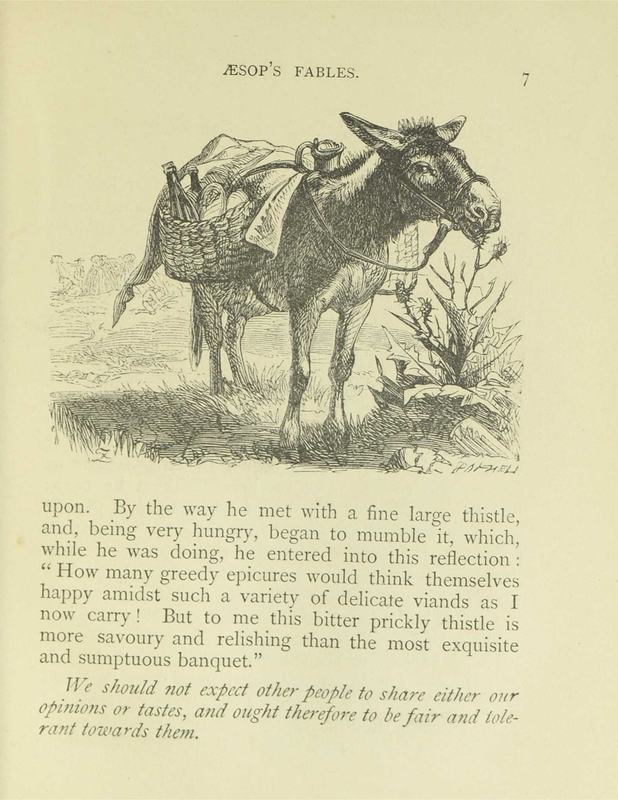
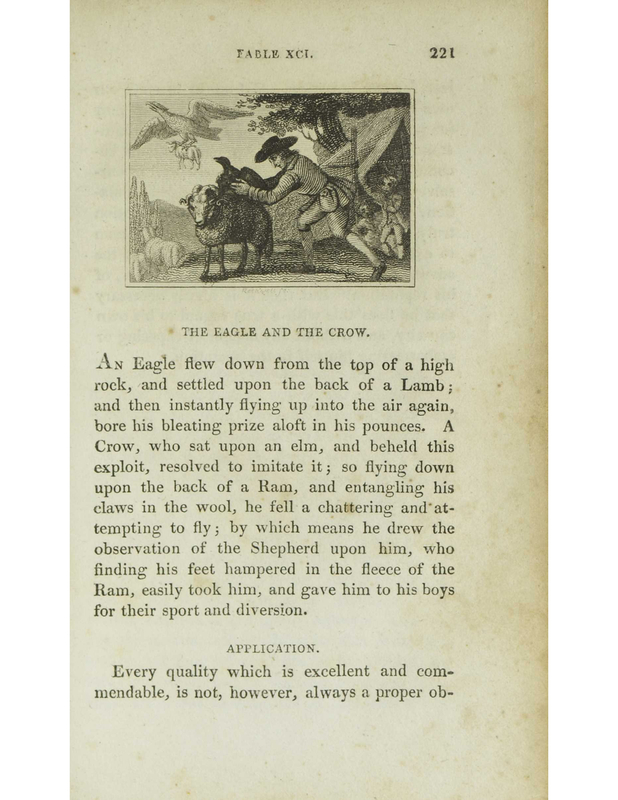
An ass was loaded with good provisions of several sorts, which, in the time of harvest, he was carrying into the field for his master and the reapers to cline upon
In this image we see a group of five Lilliputian officials all of whom have a disapproving look on their faces. Their status is indicated by their different forms of headpieces. Behind them we see Gulliver facing the other way, walking away from them. This image comes after Gulliver has been charged with treason forcing him to leave Lilliput. The same image appears in the 1843 Krabbe edition.
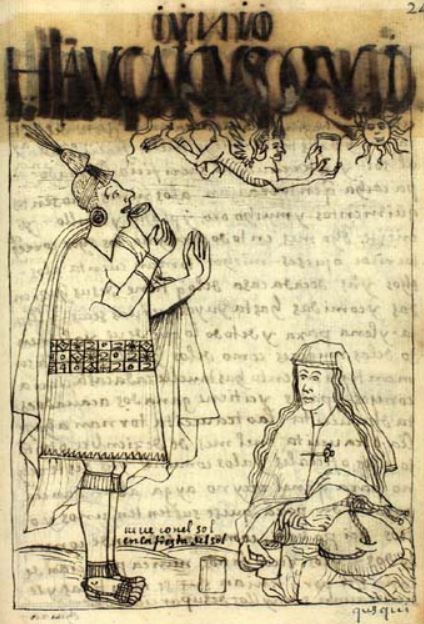
This chapter is dedicated to discussing the traditions and rituals of each month during the Inca Empire. The Incas tracked the months and years through the stars and their months consisted of thirty days. This image depicts the month of June, which was dedicated to celebrating the Sun festival called Inti Raymi by performing many child sacrifices. The Incas did this to rest from the previous harvesting months. The image depicts the Inca Emperor drinking while looking at the Sun for the Sun festival. There is a woman sitting on the ground as she pours a drink from a pot. The Sun is illustrated in the top right-hand corner of the image. There is a flying creature depicted in the sky as it brings a drink towards the Sun. The caption at the bottom of the image reads “ueue con el sol en la fiesta del sol,” which translates to “drink with the Sun at the Sun festival.”
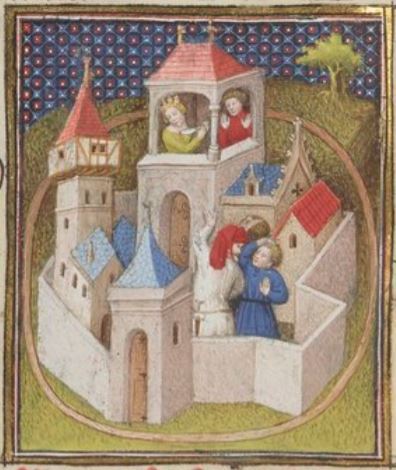
Dido, the founder and queen of Carthage, is illustrated on top of the city’s walls in the top centre of the image stabbing herself with a knife. After her husband, Acerbas, had been killed by her brother, she fled to Africa and founded Carthage and vowed to remain chaste in honour of her husband. When a foreign king asked for Dido’s hand in marriage and threatened to sack the city if she denied, she stabbed herself to protect her chastity.
Here we see Gulliver lying on the table during dinner with the giants. The Farmer serves food from a large bowl on the centre of the table, holding a spoon. Bowls are laid out on the table in front of the giants. The farmer is in the centre of the image, with an old man across from him, and his wife behind him. The other characters in the image are the farmer’s children. Everyone is watching Gulliver. The same image appears in the 1843 Krabbe edition.
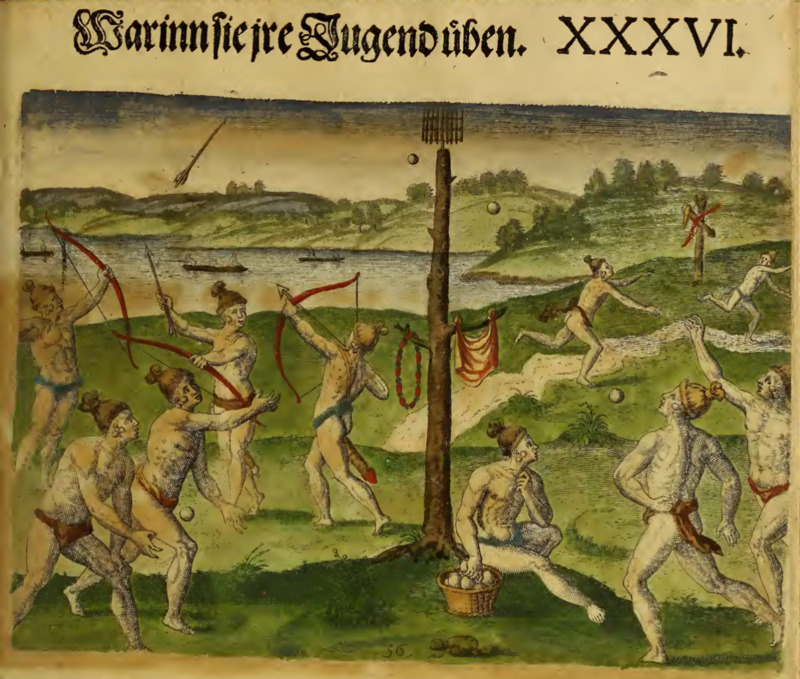
Several young Indigenous are gathered around a tree that has been mostly stripped of branches. A hoop hangs from one of the remaining branches and a rag hangs from the other, on either side of the tree about halfway up. Some of the youth are shooting bows and arrows, and others throw balls into the air. This illustration is identical to the one found on page 115 of Frankfurt 1591, but colored.
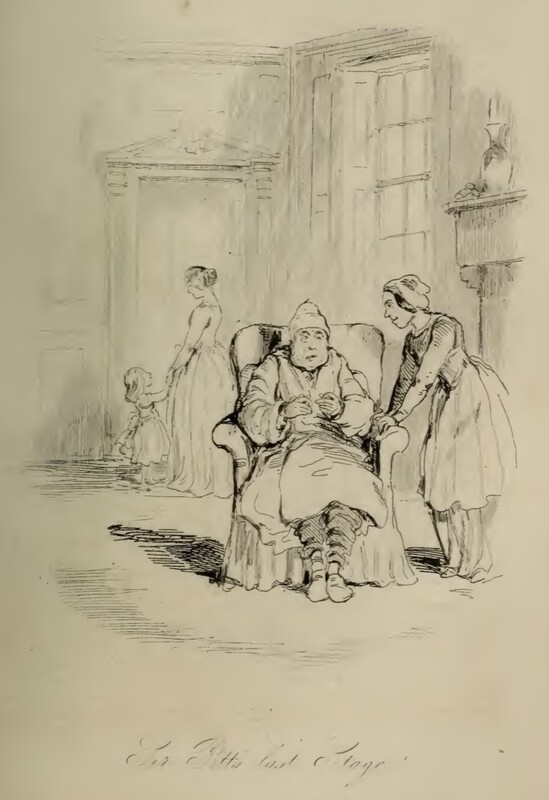
Sir Pitt Crawley, in a nightcap, sits in the chair in front of the fireplace in his apartments. Behind him, Lady Jane Crawley and her daughter, Matilda Crawley, are holding hands as they leave the room. Next to Sir Pitt, Miss Hester, now his nurse, has turned his chair away from the fire with a scowl on her face. Below the illustration is printed in cursive its title, “Sir Pitt’s last Stage”.
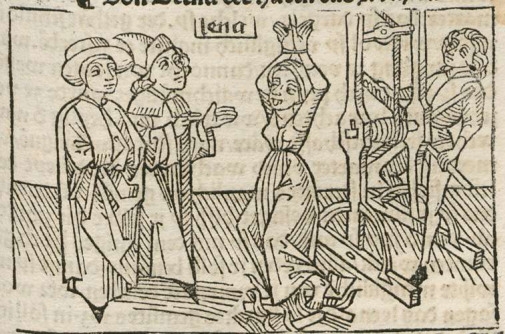
This engraving depicts the prostitute Leaena being tortured for information regarding a conspiracy. We know that the woman being tortured in this image is Leaena as her name, spelled as “Lena”, is engraved above her head. She is depicted with her hands bound by rope, which is attached to some form of torturing device that a man is controlling on the right side of the engraving. She is also depicted standing in a burning fire as another torturing method. Boccaccio explains that she is being tortured for being involved in a conspiracy to overthrow a tyrant. In order to avoid revealing information to those torturing her, she bites off her own tongue. Her tongue is depicted sticking out of her mouth in this engraving. The two figures on the left side are unknown by name, however, they are significant as they are the ones attempting to get information regarding the conspiracy from Leaena.
This engraving illustrates the importance that the goddess Juno holds to the city of Samos. The background of the engraving illustrates a temple which was erected in the goddess’ honour. The foreground of the engraving depicts a marble statue of Juno dressed in her wedding attire. There are people standing in front of the statue of Juno, most likely engaging in a wedding ceremony as Juno is a goddess of marriage. Boccaccio explains that Juno was sent to live in Samos during her early childhood years until she hit puberty and married her brother Jupiter. The people of Samos built the temple and statue to honour their connection to the goddess. There is a sun illustrated in the sky on the left side of the engraving and a moon on the right side.
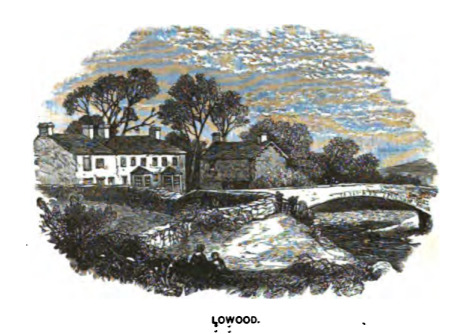
Here we see Lowood school for girls. Jane Eyre lived at Lowood from the ages of ten to eighteen. She was sent there by her aunt Reed after leaving Gateshead hall. She was a student there for six years and taught for two before leaving to be a governess at Thornfield hall. Two figures are visible in the foreground. The smaller figure on the right is Jane and the taller figure on the left in Helen Burns, Jane’s first friend at Lowood. Helen was four years older than Jane. She died after Jane’s first year of consumption.
This illustration depicts Niobe, queen of Thebes, on the right side of the illustration with her many children standing behind her. Niobe had many sons and daughters with her husband, king Amphion of Thebes, which made her incredibly proud. Boccaccio explains that when the city of Thebes was making sacrifices to Latona, the mother of Apollo and Diana, Niobe declared that she is more worthy of the sacrifices than Latona because she had more children than her. Niobe is depicted arguing this to two male (most likely noble) citizens of Thebes in the illustration, who seem discontent with her statements. Niobe eventually was punished for speaking against the Gods by having all her children die.
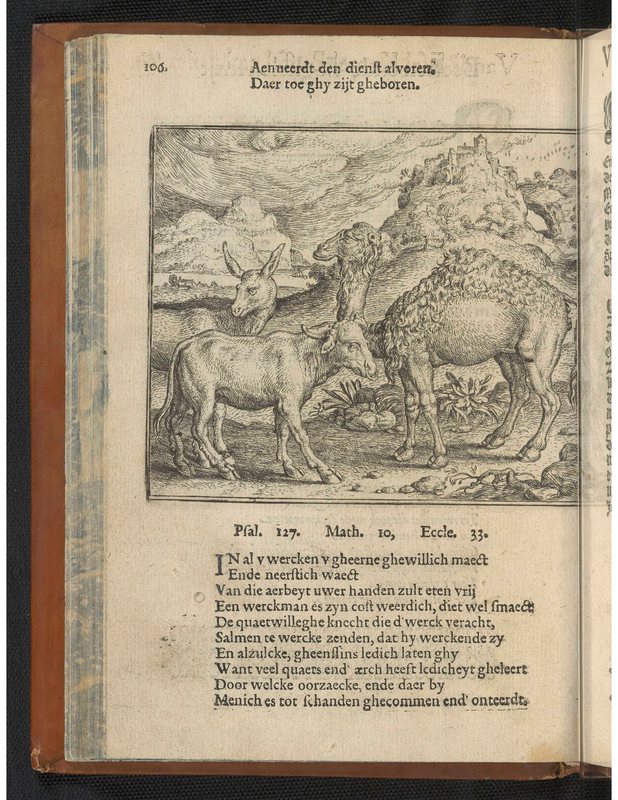
The donkey, camel, buffel and mule'; a camel, mule and donkey standing in a landscape; Dutch letterpress on verso; illustration to Eduwaert de Dene's edition of Aesop's Fables, De Warachtighe Fabulen der Dieren (Pieter de Clerck, Bruges: 1567). c.1567Etching
Joseph Sedley is asleep at the dinner table, leaning back in his chair. On the table in front of him are the remains of dinner, including his plate and cup and a decanter. He is framed in the letter O from “On”.
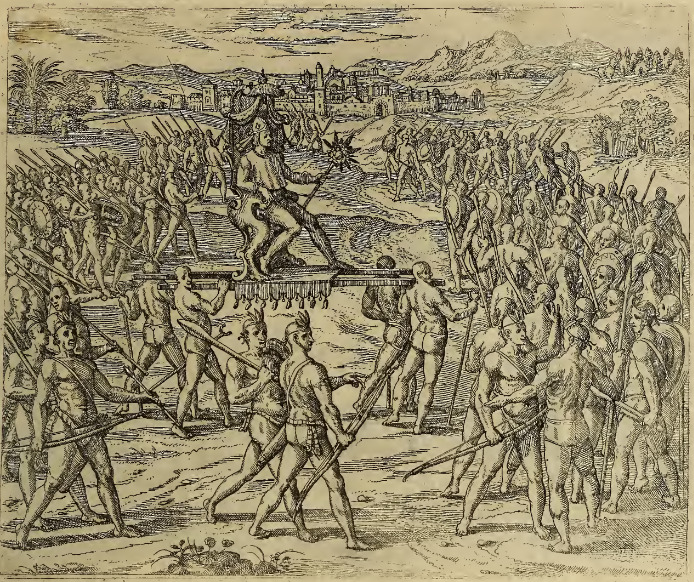
The Inca Emperor Atahualpa (Atabalipa) arrives at the city Caxamalca (Cajamarca) in Peru to meet Francisco Pizarro. Atahualpa is carried towards the city on an ornate litter born by four soldiers. He wears a headdress, short-sleeved tunic, and beaded necklace, and carries a scepter fashioned to resemble the sun. He is accompanied by many warriors, who are armed with a combination of spears, clubs, bows and shields. Some of the men wear feathered headdresses and loincloths. The fortified city Caxamalca (Cajamarca) is visible in the background. This image is identical to one found on page 6 (121) of Frankfurt, 1596.
An Tupinambá man is shown standing behind a table. He wears a feathered headdress and face stones in his cheeks and chin and holds a large rattle in one hand. There are several face stones and a feathered headdress sitting on the table in front of him. In the background another person lays in a hammock.
This illustration depicts the virgin Mary in the centre of the image. She is kneeling with her hands in prayer as she is crowned by both the son of god (on the left) and by god (on the right). Jesus is holding a cross to symbolize his crucifixion, and there are holes in his hands and feet to also further demonstrate his sacrifice, God is depicted resting his hand on an orb which signifies his power over the world. The holy spirit is depicted as a bird in the sky above Mary’s head.
Rebecca Sharp is seated on the arm of a chair in the great hall at Queen’s Crawley, looking at a large painting of a woman. It is hung on the wall between paintings of other Crawley ancestors. To the left is a cabinet, and to the right a high-backed armless chair.
Two deer stand next to each other both looking to the left of the image. There is a seemingly broken fence nearby. Men are riding horses in a field behind them. The deer are surrounded by trees.
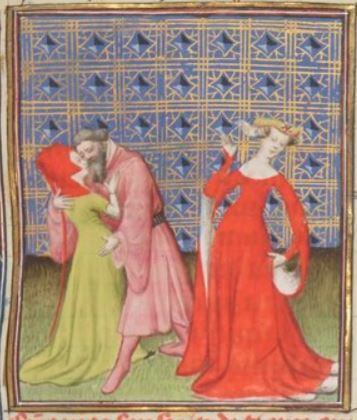
This illumination depicts Scipio Africanus, a Roman general, committing adultery with a young servant girl on the left side of the image. The woman on the right side of the image is his wife, Tertia Aemilia. She is depicted looking away after discovering her husband and his mistress as they commit adultery. Instead of confronting her husband about the affair, she devises a plan to get rid of the mistress. Tertia Aemilia married the young servant girl off to a freedman. She does this so that no one finds out about the affair so that it does not ruin her reputation. Boccaccio explains that he chose to write on Tertia Aemilia because the way she handled the affair and how she used her cunning was admirable.
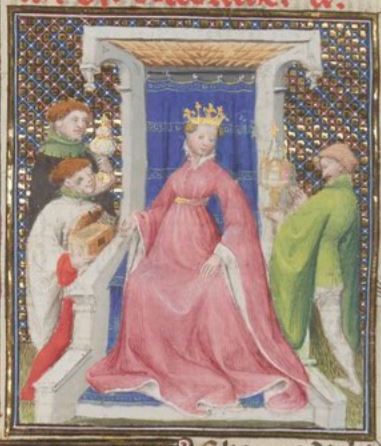
This illumination depicts Queen Joanna of Jerusalem and Sicily sitting on a throne with her subjects surrounding her. She is depicted wearing a crown to demonstrate her royal status. Her subjects appear to be handing her gifts. Boccaccio explains that Joanna was a praiseworthy subject to write on as she was an impressive ruler which was not common for women during her time.

![[Lilliputian officials]](https://cemvccol.ace-net.training/files/large/b2cd5b9912e965e1633ea9e7ae191b6117933e4a.jpg)
![[Gulliver eats with the Giants on Brobdingnag]](https://cemvccol.ace-net.training/files/large/44cd0529eafd28ed4161b526bd75fab073421b16.jpg)
![[Juno of the City of Samos]](https://cemvccol.ace-net.training/files/large/5495e99a50e3c239af9deb0b8a1152aa9124cddd.jpg)
![[Niobe Commits Hubris Whilst Surrounded by her Children]](https://cemvccol.ace-net.training/files/large/7e28c12fb44080029426c689feb7fcc82906d37b.jpg)
![[Vanity Fair Volume I. Chapter XXVI Historiated Initial, O]](https://cemvccol.ace-net.training/files/large/17f07ebe6913017ea60d34a8e0ab51e364282dfd.jpg)
![[A Tupinambá man with face stones holds a rattle in front of a table]](https://cemvccol.ace-net.training/files/large/b829772c8dc2117d0b2900c43686eb71e82d3e70.jpg)
![[The Coronation of Virgin Mary by the Holy Trinity]](https://cemvccol.ace-net.training/files/large/c046a87e4fd9ff08ff39198706abb6dc659e5dc6.jpg)
![[Vanity Fair Vol. I Chapter VIII Opening]](https://cemvccol.ace-net.training/files/large/42adcf41ef095beb44b3f711fbdb4d5b1735c0a7.jpg)
![[The Stag and the Fawn]](https://cemvccol.ace-net.training/files/large/6de90b43c1a0042f4c24d108d8b1f5011adad557.jpg)