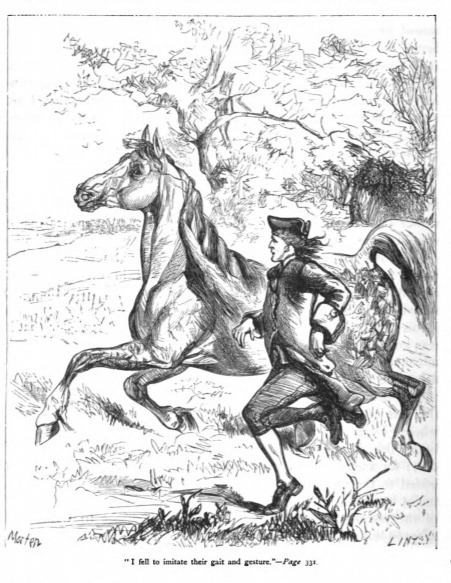
During his time in the Country of the Houyhnhnms, Gulliver began to despise his own reflection because he looked like a Yahoo. He tried to act like a Houyhnhnm as best as he could by imitating the actions of the Houyhnhnms. He admired the virtue of the Houyhnhnms and began to detest humans.
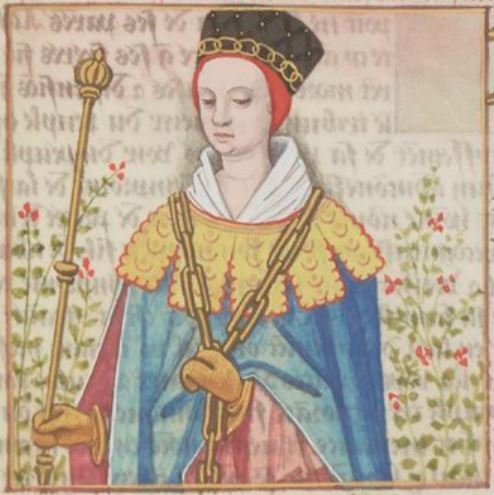
This illumination depicts a portrait of Dripetrua, the daughter of King Mithridates of Pontus. She is depicted in royal garb while holding a scepter in her right hand. Boccaccio explains that she was born with two sets of teeth and was incredibly hideous, however, she was also very devoted to her father, which deserved praise.
An eagle is resting, tucked in a bed with a blanket. The blanket is decorated with a large flower pattern. The bed is tall, with two drawers next to it. On those drawers is a set of plates and a jar. The resting eagle looks in pain. Another eagle is standing in front of the bed, looking at the ill-eagle. To the left of the standing eagle, is a lone detached eagle leg laying on the ground. On the wall on the left side of the bed is an open window, and a small shelf.
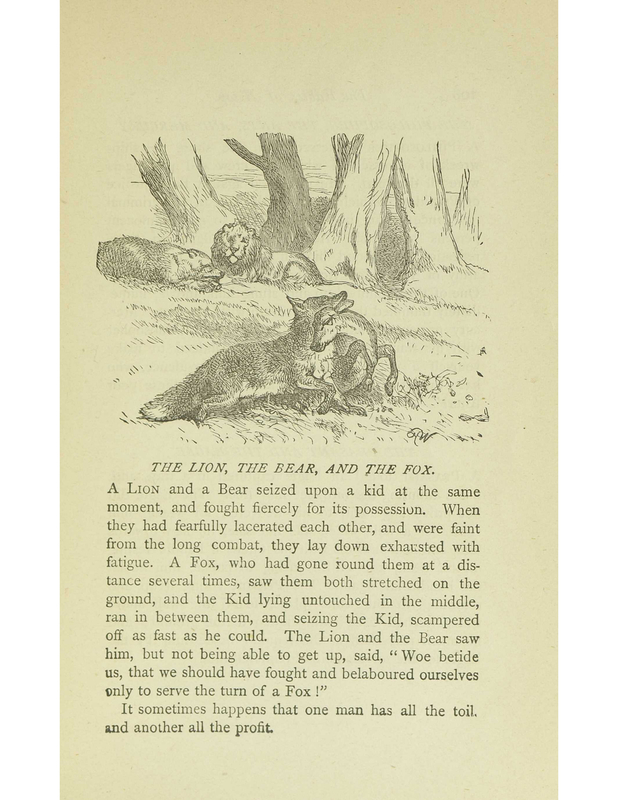
In the foreground, a fox is lying on the ground and fiercely holding down a kid by its neck. In the background, a bear and a lion are resting on the ground below a large patch of trees.
Three Indigenous Brazilian men are in the process of chopping down a tree. One man swings a hatchet at the trunk of the tree, while the other two gather logs or branches. One of the men wears a feathered headdress. This image is identical to one found in Frankfurt, 1557.
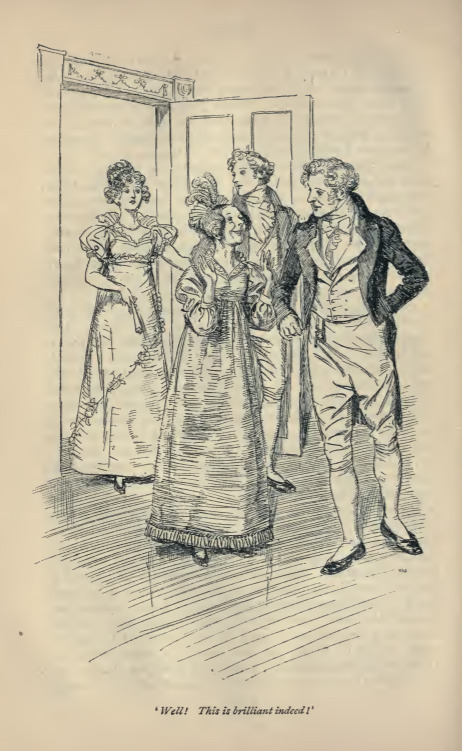
In this image we see Miss Bates walking into the ballroom at the Crown Inn on Mr. Weston’s arm. Behind them we see Emma and Frank Churchill. The Westons gave a ball in Frank’s honour during his visit to Highbury. Miss Bates was thrilled with the sight of the room as it was finely cleaned and decorated. This scene occurs in chapter 38. The characters are shown in the traditional regency style. Miss Bates and Emma wear the regency style dress with empire waistlines. Miss Bates has feathers in her hair and Emma holds a fan. Mr. Weston and Frank Churchill wear waistcoats and tailcoats with breeches and cravats. The regency period dated to the early nineteenth century (1811-1820) when George, Prince of Wales, later George IV (r. 1820-1830), reigned as regent for his mentally ill father, King George III (r. 1760-1820). The regency period is associated with the rise of neoclassicism in art and fashion.
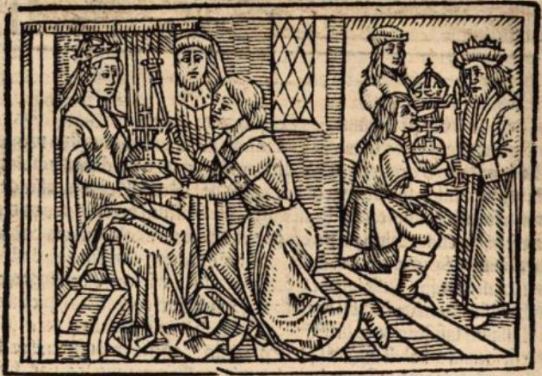
The left side of the engraving depicts Empress Irene of the Eastern Roman Empire sitting on her throne. There is a man kneeling in front of her presenting her with the globus cruciger to demonstrate her authority. The right side of the image depicts the pope crowning Charlemagne as emperor. The pope did not recognize Irene’s rule as she was a woman, which led him to coronate Charlemagne as emperor. He is presenting Charlemagne with a crown as well as the globus cruciger.
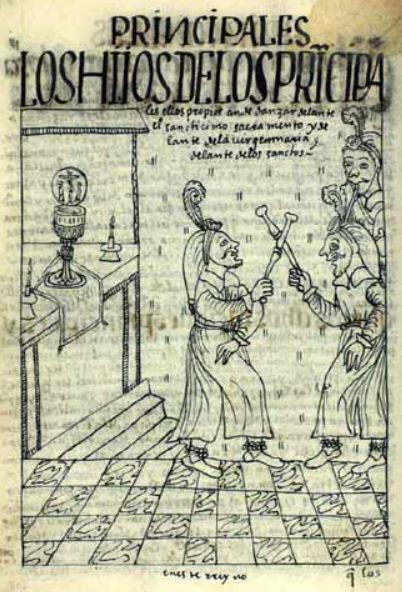
This image is illustrated in a chapter that discusses the descendants of the Inca and Andean nobles under Spanish colonial rule in Peru and their importance to a revived Andean society. This image depicts three native men dressed in traditional dancing attire as they dance before the holy sacrament on the left side of the image. The author explains that the dancing was performed to honour God and King David who also danced before the sacrament. The caption at the bottom of the image reads, en este rreyno [in this kingdom].
Here we see three Lilliputian seamstresses taking measurements for Gulliver’s clothes and bedsheets. Two women hold either end of a measuring tape, while the third stands in the middle taking measurements. The three women stand on top of Gulliver who is covered with a sheet. Gulliver has a bandana wrapped around his head which is resting on a basket. The same image appears in the 1839 Krabbe edition.
A group of animals and a person stand near each other. One animal has decided to bite the persons leg while the other two animals are staring at each other.
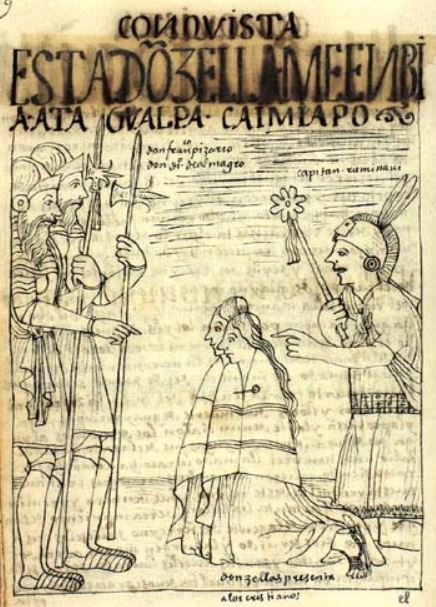
This chapter focuses on discussing the arrival of Spaniards and the Spanish conquest of Peru. This image depicts Don Diego de Almagro and Don Francisco Pizarro on the left side of the image dressed in armour and holding spears. Their names are written beside them to identify them. These two men were leading conquistadors in the conquest of Peru. They are being presented with two young women who are kneeling before them. The man standing behind the women is identified as Captain Rumi Naui. The caption at the bottom of the image describes the scene as it reads, Donzellas presenta a los cristianos [maidens presented to the Christians].
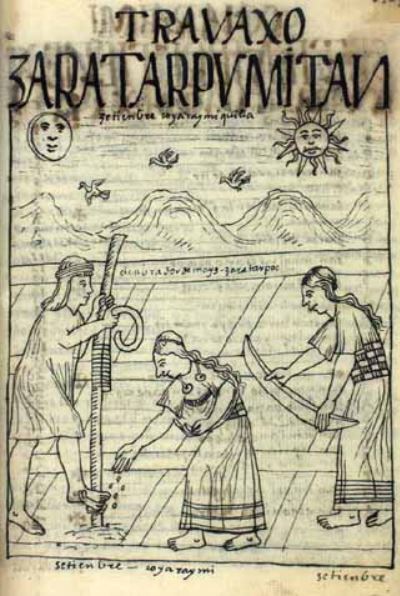
This image is reflected in the final chapter of Ayala’s chronicle where he provides a description of labours and festivals that occur in the rural areas of the Spanish colonial Andes during each month of the Inca calendar year. This image depicts the month of September which was dedicated to sowing corn, potatoes, and other valuable food into the soil. The two indigenous women and the indigenous man in the image are standing in an organized field that is laid out in a grid pattern. The man is illustrated standing on a tool that puts holes into the field to place seeds in. The woman in front of him is depicted throwing the seeds into the soil. The woman behind her is bending over while holding another agricultural tool to help with the sowing, presumably to aid in covering the seeds with the soil. The moon and sun are illustrated at the top of the image. The mountainous Andean landscape is visible in the background with birds flying over top. The caption written on the field reads cienbrador de maýs, zara tarpoc [corn farmer]. The caption at the bottom of the image reads setienbre, coya raymi [september, tenth month].
In this image we see a group of giants crowding around to get a look at Gulliver. Most of the faces of the giants are obscured in some way to show that they are huddling close together. Gulliver stands in the centre of the ring of giants. Gulliver leans forward towards the giant on the far left as though he is speaking to one of the giants with his hat in his hand. This giant is likely the farmer who found him as he is not wearing a hat, just as he was shown in other images. All the other giants wear some form of cap. The same image appears in the 1839 Krabbe edition.
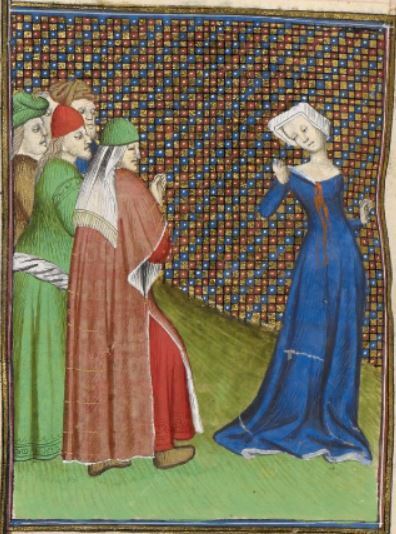
This illumination depicts a woman named Lucretia stabbing herself with a knife. There are people depicted on the left side of the image watching Lucretia carry out this act. Boccaccio explains that a relative of Lucretia’s husband (Collatinus) had raped her during the night. This man’s name was Sextus, and he had been welcomed into Lucretia and Collatinus’ home as a guest before he committed this crime. Lucretia told her husband, her father (Tricipitinus) and a relative named Brutus what Sextus had done to her. These are presumably the men illustrated on the right. After she told them what Sextus had done to her, she killed herself in shame of what happened.
The Blackbrook sisters, daughters of Admiral Blackbrook, look disgruntled by Captain Rawdon’s choice of Rebecca Sharp as his dancing partner. The illustration is stated to be part of a letter from Miss Sharp to Miss Sedley.
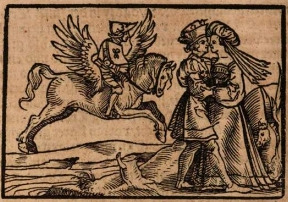
Medusa is illustrated on the right side of the engraving embracing the god Neptune. Medusa is depicted in her human form in this engraving before having been turned into a monster by Minerva. Boccaccio explains that Minerva transforms Medusa into a monster because she was angry that she had sexual relations with Neptune inside one of her temples. Boccaccio also explains that Medusa ends up giving birth to a Pegasus, which is engraved behind Medusa on the right side of the engraving. The hero Perseus is depicted riding his Pegasus on the left side of the engraving as he is on his way to conquer Medusa’s kingdom.
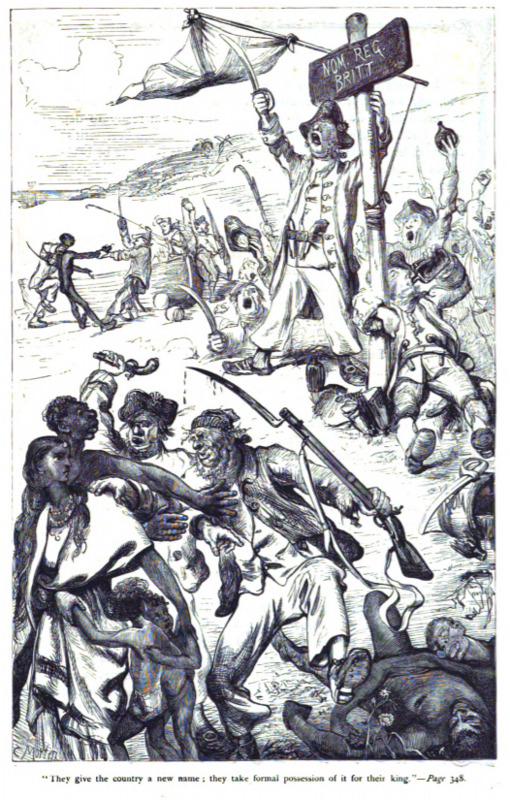
Gulliver tells the reader that he was initially reluctant to write about his adventures out of fear that the countries he visited might be colonized. The British Empire was the largest empire in the world and infamous for colonizing other nations. Gulliver wanted to protect the foreign lands he visited from imperialization.
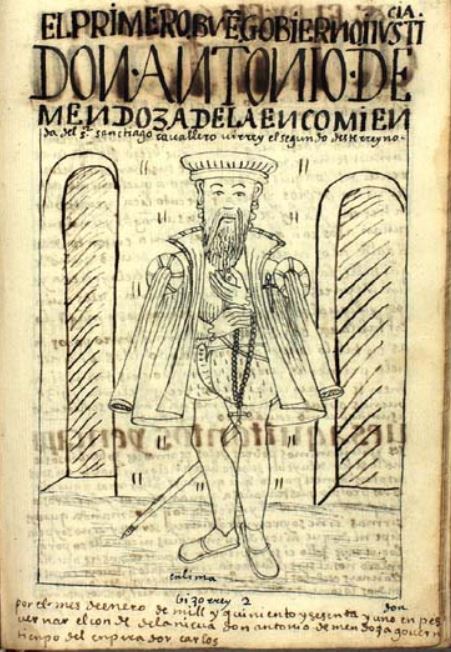
This chapter of the book focuses on discussing the good government of post-conquest Peru that the Spanish viceroys maintain. This image depicts Don Antonio de Mendoza, a knight of the order of Santiago and the second viceroy of post-conquest Peru. The author describes the viceroy to have been a friend of the poor and a dedicated servant of God and the King of Spain. Mendoza is illustrated wearing traditional Spanish-European clothing and holding a rosary in his hands. The caption at the bottom of the image reads, en lima/por el mes de enero de mill y quiniento y sesenta y uno enpeso a gouernar el conde de la nieua/don antionio de mendoza governo en tienpo del enperador carlos [in Lima/ The Count of Nieva governed in the month of January, 1561/ Don Antionio de Mendoza governed during the reign of emperor Charles V].

![[The Injured Eagle]](https://cemvccol.ace-net.training/files/large/6b93ac0512134e4a5c6f3594e123b7eb37e24079.jpg)
![[Indigenous Brazilian men chop down a tree]](https://cemvccol.ace-net.training/files/large/85caceb60631c41e42d616ca802d32ec5f6c7084.jpg)
![[Vanity Fair Vol. I Chapter XXIII Inhabited Initial]](https://cemvccol.ace-net.training/files/large/27033e686649745d29f5b6b8068d09ef6510e5ae.jpg)
![[Seamstresses on Lilliput measure Gulliver for new clothes]](https://cemvccol.ace-net.training/files/large/fd6b5085e392342c18e25f5de889198a0bef52cb.jpg)
![[Animal Attacks Person]](https://cemvccol.ace-net.training/files/large/c7e01498009ce384bbacde53501644ac445f4213.jpg)

![[A crowd of giants examine Gulliver]](https://cemvccol.ace-net.training/files/large/c648488ae93e1e76d57828226485e174599fa5cd.jpg)
![[The Blackbrook Sisters]](https://cemvccol.ace-net.training/files/large/a10cf91de348db87924dc81fbe9f1127611d3bb2.jpg)