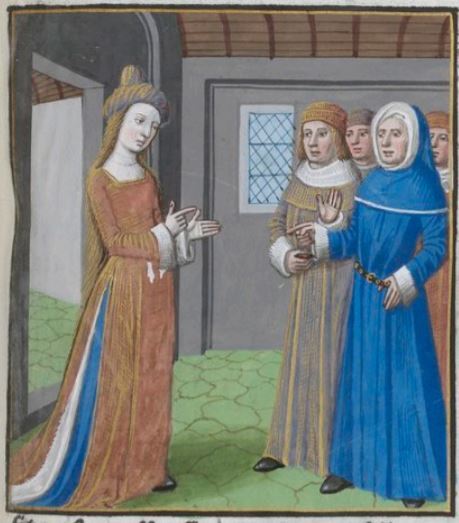
This image depicts Hortensia, the daughter of famous orator Quintus Hortensius, speaking in front of the triumvirs. Hortensia inherited the gift of oration from her father, and when the triumvirs raised taxes unbearably high, she spoke so eloquently to them that they revoked the taxes. The triumvirs have pleasantly surprised looks on their faces as they are impressed with Hortensia’s abilities. Hortensia appears to look confident as she speaks to them.
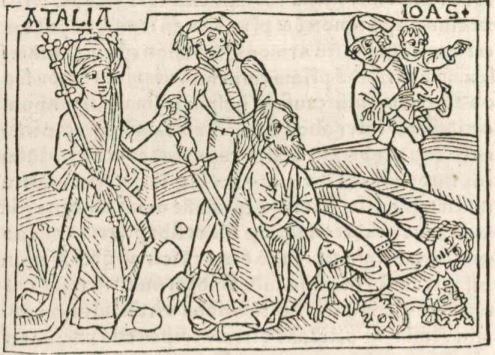
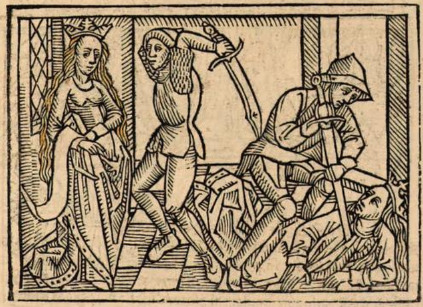
This engraving depicts Athaliah, queen of Jerusalem, executing the descendants of David. Athaliah is depicted on the left-hand side of the engraving holding a scepter and pointing. We know that this is Athaliah as her name, written as Atalia, is engraved above her head. Boccaccio explains that Athaliah’s father was the king of Israel, and her husband was the king of Jerusalem. When her husband died, and her son (who succeeded his father) died, she seized power and slaughtered the descendants of David to avoid anyone taking her power and throne. There is a man depicted with a sword who is about to execute a man, under Athaliah’s orders. There are three other men illustrated who had already been slain. There is a person in the background of the engraving carrying a child named Jehoash (his name is written as Ioash above his head). This child is Athaliah’s grandson who escaped her executions.
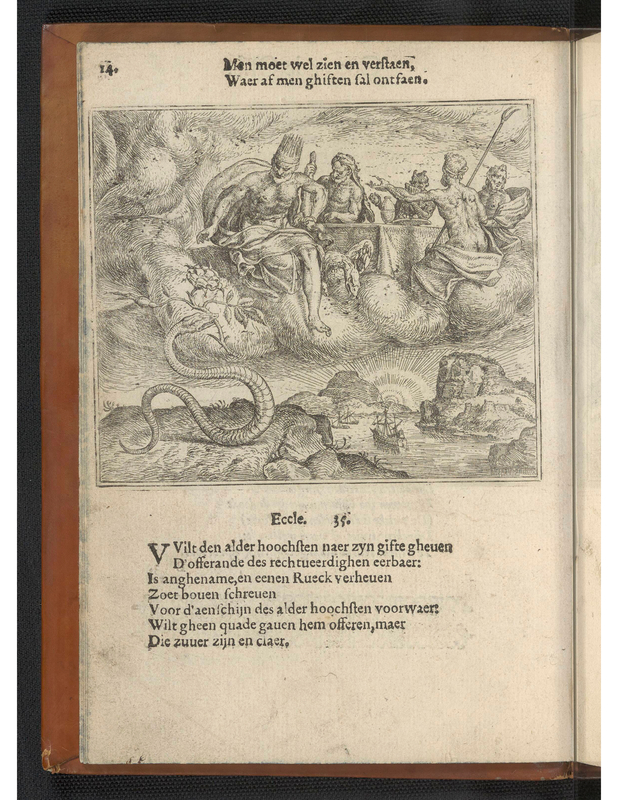
Five robed men sit around a table in the clouds looking down over a fjord. The man sitting at the head of the table wears a crown and an eagle is perched at his feet. The crowned man looks down to earth where a snake holds a rose in its jaws, looking up to the clouds. The remaining men at the table are in conversation. One of the men at the back left side of the table has horns. Below the clouds, on earth, a ship sails in a fjord towards a setting/rising sun hidden behind the rocky cliffs.
A group of French traders stand in a small boat near the coast while one of their group stands on the shore speaking with a group of Tupinambá men. The French appear to be trading for monkey, parrots, and possibly brazilwood, and they have a large bird cage on their boat. There is a Tupinambá village nearby and a group of people stand near the shore, some holding bows and arrows. A European man, captive of the Tupinambá, swims out to the French boat but is prevented from boarding so swims back to shore.
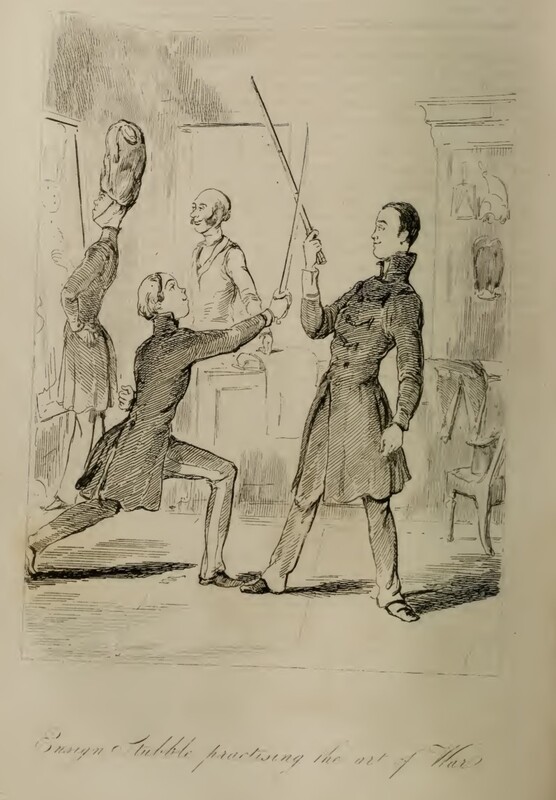
Tom Stubble holds up a new sword at the accoutrement-maker’s, lunging at the much taller William Dobbin, who parries with his bamboo walking-stick. Both men are smiling. In the background a store employee can be seen, along with a man trying on a tall guard’s hat. Below the illustration is printed in cursive its title, Ensign Stubble practising the art of War.
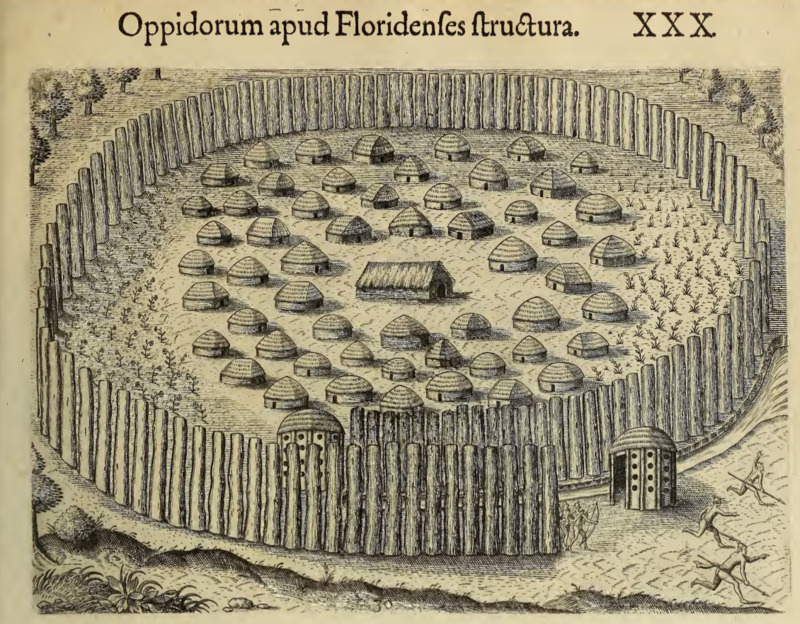
An Indigenous town is shown. The town is surrounded by large logs stuck into the ground, forming a large fence with one entrance. At both the exterior and interior of the gap there is a tall hut. Inside the fence, many round structures sit in a cluster. At the center of the cluster is a larger rectangular building.
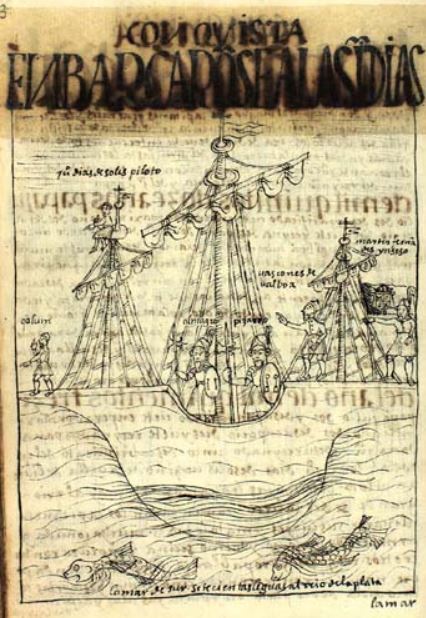
This chapter focuses on discussing the arrival of Spaniards and the Spanish conquest of Peru. This image depicts a Spanish ship setting sail towards the West Indies with the intentions of conquering the New World and becoming rich with the abundances of gold and silver.. There are six figures identified on the ship. The figure standing at the bow of the ship is identified as golum [Columbus]. The figure sitting on a lookout point on the mast is identified as juan dias de solis, piloto [Juan Dias de Solis, pilot]. The next four figures are labelled as Almagro, Pizarro, Uasco Nunes de Ualboa, and Martin Fernandes Ynseso. The caption at the bottom of the image reads la mar de sur, setecientas leguas al río de la plata [the South Sea, seven hundred leagues to Rio de la Plata].
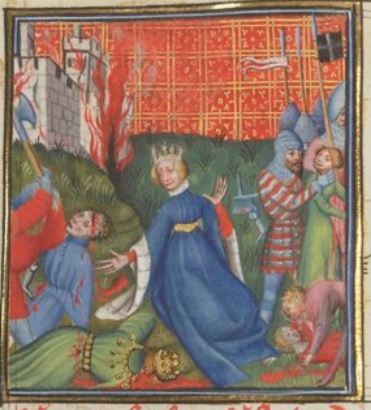
This illumination depicts Hecuba, the queen of Troy and wife of king Priam of Troy, in the centre of the image. Boccaccio explains that he wrote on Hecuba to highlight her terrible misfortunes. She had watched many of her children die, including the hero Hector, and watched her husband be disemboweled. Along with watching her loved ones violently die, she watched her entire city fall to the ground. Many believe she had become a slave to the Greeks once the city was taken. She is illustrated watching her loved ones die in this illustration. The city of Troy is burning in the background on the left side.
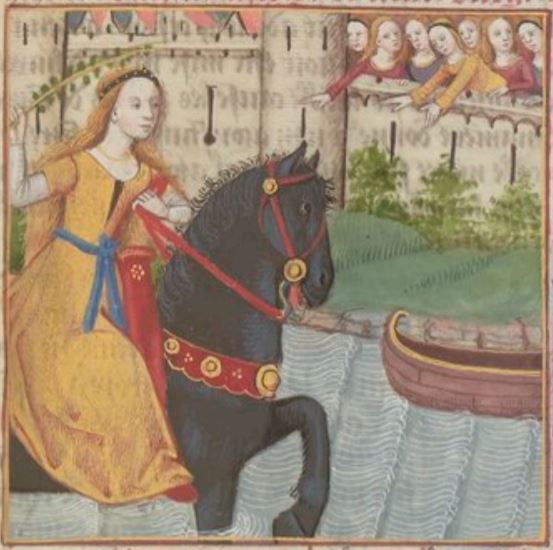
This illumination depicts Cloelia, a young Roman woman, riding a horse through a deep river with many women looking at her from behind a wall. Boccaccio explains that Cloelia was given to a foreign king as a hostage, and when she escaped, she took many other hostages with her to get back to Rome. The other women in the image are still captive as they are behind a wall and reaching out towards Cloelia for help. While escaping, she came across a river that was too treacherous to pass. She found a horse, and despite never having ridden one, she got herself and the other women across safely by means of this horse.
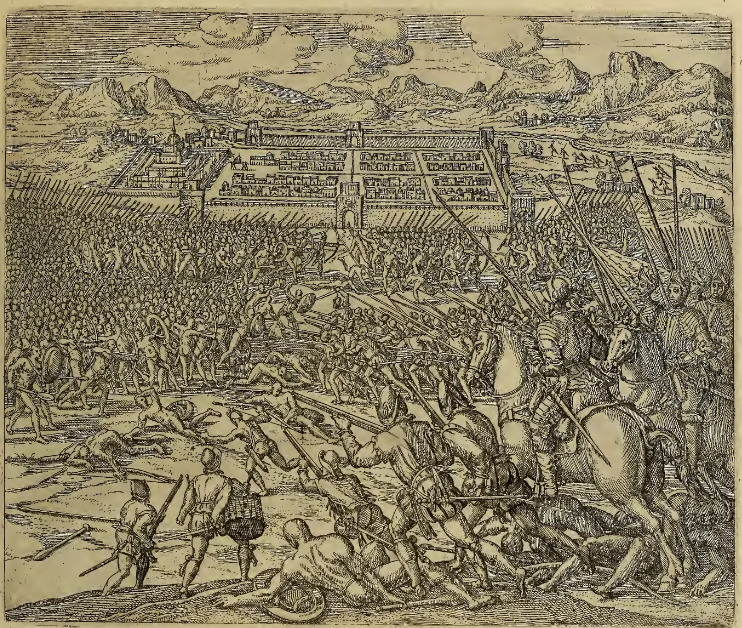
The Incas raised an army to fight the Spanish who occupied Cuzco after the execution of Atahualpa, but they were not successful in retaking the city. Here, the Spanish and the Incan army engage in battle outside the walls of Cuzco. The Incas, massed to the left, fight with bows, spears and shields. The Spaniards, some of whom ride horseback, are armed with muskets, spears and swords, and wear armor. Several Inca men have fallen to the ground as their army is pushed back by the Spanish. This image is identical to one found on page 13 (135) of Frankfurt, 1596.
This engraving depicts a young servant girl getting stabbed in the chest with a sword by a man standing above her. This young servant girl is disguised to look exactly like Harmonia, the daughter of Gelon (brother to the king of Syracuse). Boccaccio explains that there was a rebellion in Syracuse against nobility, and before the murderers could get to Harmonia, her nurse disguised this young woman to look like Harmonia. The real Harmonia is depicted on the left side of the engraving. There is a man swinging a sword above his head which appears to be heading in Harmonia’s direction, however, Boccaccio explains that Harmonia hid from the murderers until they killed the look-alike servant.
A Tupinambá village is shown, comprised of four long structures arranged in a circle and surrounded by a fence. Inside the village a group of women dance in a circle around a bearded man wearing a feathered headdress. Several of the women carry small children in slings on their backs. Several long poles with skulls mounted on the ends have been planted in the ground around the fence.
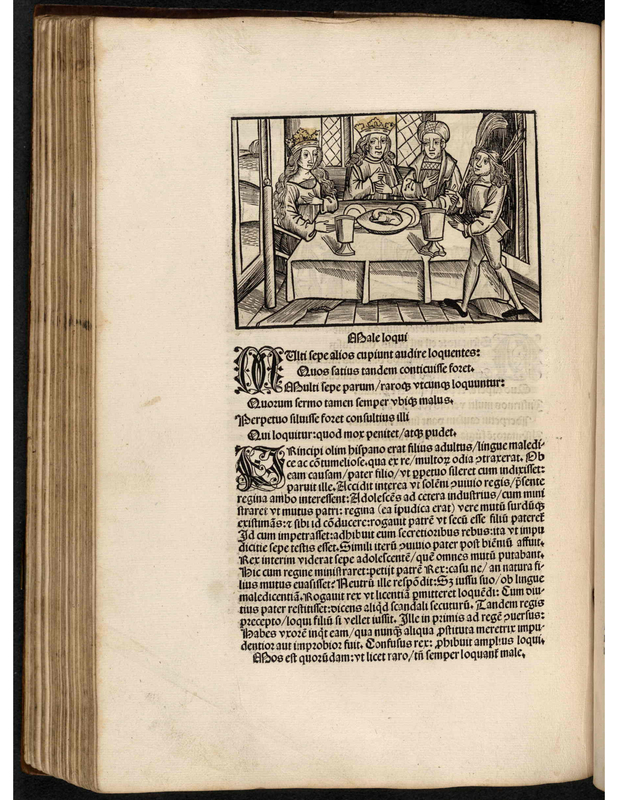
Three women are seated around a dinner table. Two women are wearing crowns, and the other is wearing a headdress. There are large cups and a bird resembling dinner on the plate in the centre. A fourth woman is standing, presumably serving the seated women.
After being banished from his own kingdom, King Metabus of the Volscians fled into exile. Metabus is illustrated in the foreground of the image kneeling on the ground with his hands together in prayer. He is looking up at a statue which is standing on a tall platform. The statue is in the shape of the goddess Diana. Metabus is asking Diana for her help to save his young child, Camilla, from the river which flows behind him. The background of the image depicts Metabus throwing his child, Camilla, across the river after wrapping her in tree bark and tying her to his lance. With the help and protection of Diana, Camilla makes it safely across the river while tied to the lance. Metabus ends up swimming across the river after Camilla is thrown, to which he finds out that the made it safely across.
In a field, there is a lion and a horse. On the lower left corner, the lion is lying on the ground with dead eyes. The horse is standing on its two front legs and kicking the horse in the face with its hind legs. Behind them are tall fruit trees.
A pair of young children stand by the seaside. The girl is wearing a bonnet and has her fingers gripped behind her back, while the boy is holding onto the string of a kite. The kite is shaped like a cone with a rounded top, and flies next to the letter I.
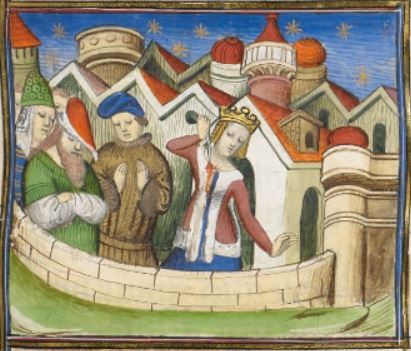
Dido (also called Elissa), the founder and queen of Carthage, is illustrated within the city walls in the centre of the image stabbing herself with a knife. After her husband, Acerbas, had been killed by her brother, she fled to Africa and founded Carthage and vowed to remain chaste in honour of her husband. When a foreign king asked for Dido’s hand in marriage and threatened to sack the city if she denied, she stabbed herself to protect her chastity. The city of Carthage is in the background of the image. There are three citizens standing beside Queen Dido.
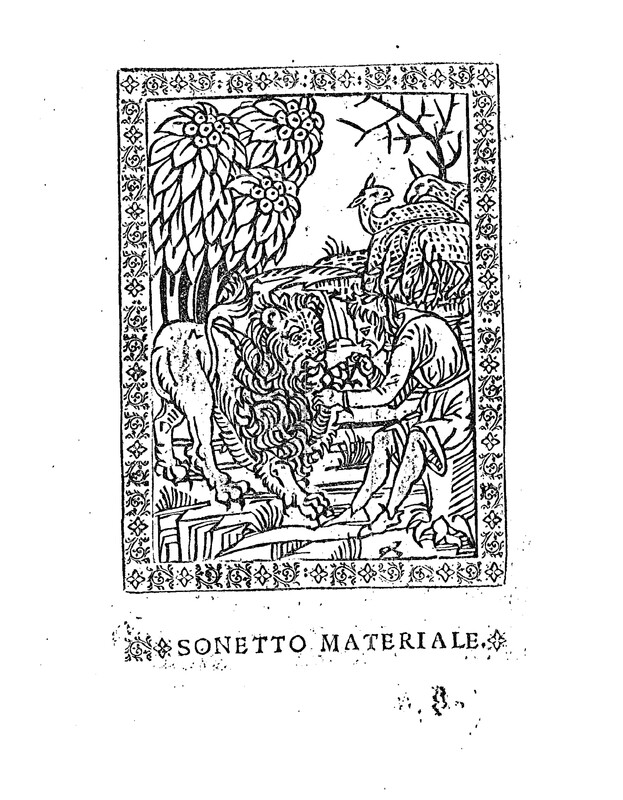
A Man is sitting on a stump in the forest and is holding onto the maine of a Lion, the lion stares at the man and it has large claws. There are two birds of unknown type perched above the man, looking at eachother. in the background there is a dead tree to the right and live trees to the left. The image is bordered by a vine design
Mr. Pitt Crawley introduces Miss Briggs, his aunt’s companion, to Lady Jane Sheepshanks, his betrothed, with a smug look on his face. Miss Briggs, on her way home from the library, is holding one of her books and has dropped two others. Mr. Pitt is clasping her free hand in both of his, while Lady Jane is half hidden behind him, looking shy.

![[A group of Frenchmen trade with the Tupinambá]](https://cemvccol.ace-net.training/files/large/85dfde2eec98d5e9949000bb2ccecdba09d1e9f6.jpg)

![[Tupinambá women dance around a man wearing a headdress]](https://cemvccol.ace-net.training/files/large/516d87e7c7f62322cd450026e4245b25587f6295.jpg)
![[Metabus Throwing His Daughter Camilla Over a River]](https://cemvccol.ace-net.training/files/large/601eb2d29466dad6c2c0aebfd25254f36bde1af9.jpg)
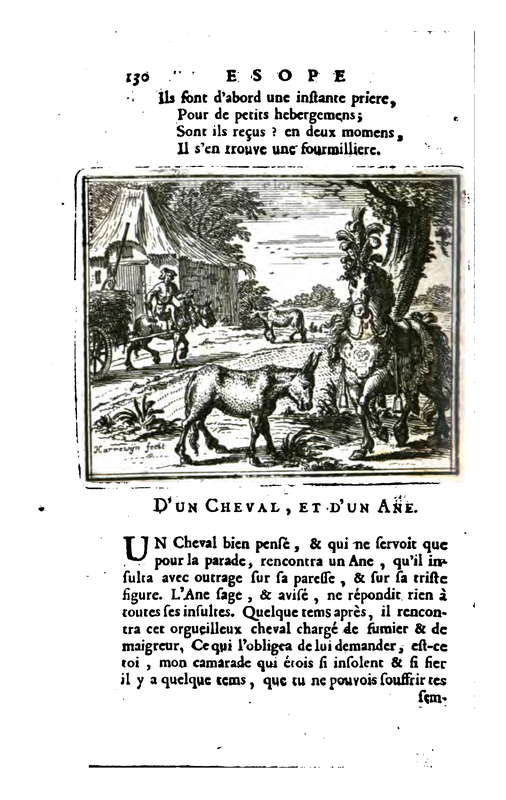
![[The Lion and the Angry Horse]](https://cemvccol.ace-net.training/files/large/72ce3908edc8d488c90d0227dfb9dba991f59686.jpg)
![[Vanity Fair Chapter XXXVI Inhabited Initial]](https://cemvccol.ace-net.training/files/large/4ca85943a1b56c8d613dffdcfaf20bd54b9aced9.jpg)
![[Mr. Pitt Introduces Lady Jane to Miss Briggs]](https://cemvccol.ace-net.training/files/large/ae36006a0b2c793b3769807095e92547a17513b3.jpg)