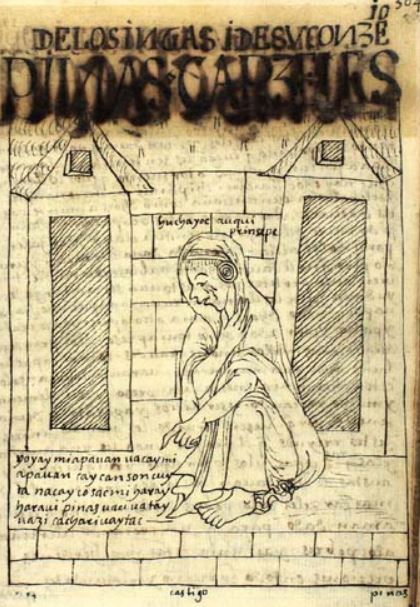
This chapter is dedicated to discussing the justice and punishment systems of the Inca Empire. The author discusses five methods of punishment in detail, and this image represents the second punishment. This image depicts prisons that nobles were sent to in the Inca Empire. A uchayoc auqui [guilty prince] is illustrated squatting in front of the jail structure. The prince is depicted holding his cloak with his right hand and crying as he points with his left hand to a block of text that reads yuyaymi apauan uacaynu apauan caycan soncuyta nacaycosacmi haray haraui pinas uaci uatay uazi cachariuaytac [My thoughts take me, weeping takes me, this bad heart I will sacrifice it. Jail house let me out].
Astonished by the concept of clothing, Gulliver’s master examines both his clothes and his body. His Master noted that Gulliver’s body was different from that of the yahoos, in colour, softness and smoothness of the skin, and lack of hair, saying he must be a perfect yahoo. This reflects the European prejudice against Native Americans. Gulliver explained to his master why Europeans wear clothing, both for decency and for protection against the elements. His master questioned why someone would want to hide what nature had given them, as the Houyhnhnms were not ashamed of their bodies. Nevertheless, his master told Gulliver to do as he wished. The same image appears in the 1839 Krabbe edition.
Here we see a Houyhnhnm overseeing Yahoos carrying bales of hay on their backs. The Yahoos were used to work for the Houyhnhnms, seen here. This section of the book serves as a commentary on Native Americans and colonization. The Houyhnhnms were used to represent European colonizers and Yahoos were used to represent Native Americans.
What seems to be a crow, or an eagle, is perched upon a tree. Below it is a fox which seems aggravated towards the crow. This illustration is framed with flower vines.
El Cid and soldiers are all armed with spears and wearing armour. The soldiers are all wearing chainmail under their tunics. They are all wearing helmets and riding white horses. El Cid is taking the lead riding a brown horse he is wearing a tunic with a cape and a hat. He has medium length hair and a beard. On the right of the soldiers there are walls.
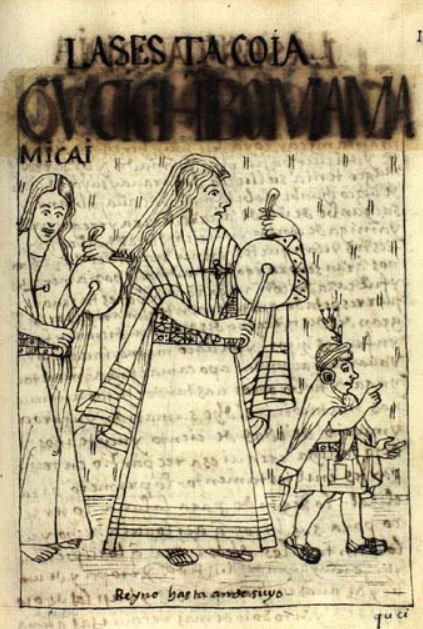
This illustration depicts Mama Michay, the sixth Coya [Queen] of the Inca Empire. She was married to the Inca King, Inca Roca. The author describes her to be a beautiful woman. She is depicted in the centre of the image as she holds a drum. There are other people in the image who are depicted playing music with her. The words Reyno hasta Ande Suyo are written at the bottom of the image, which translates to He reigned to Ande Suyo. This is referring to her husband, who ruled the regions up until Ande Suyo.
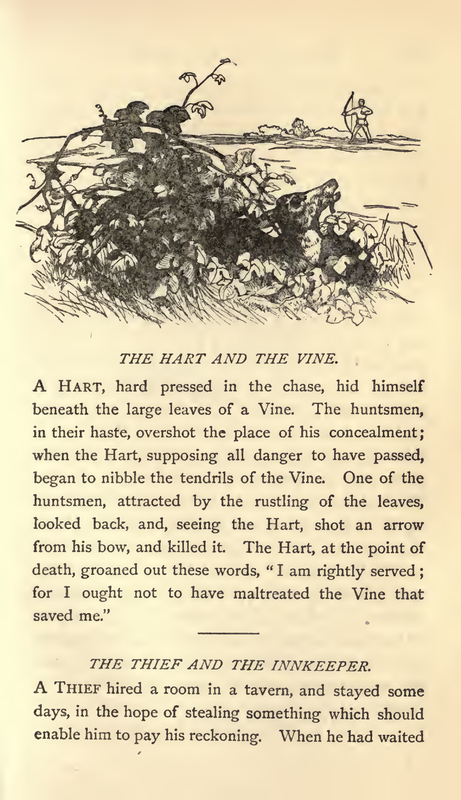
The head of a hart is sticking out from a cluster of leaves. In the distance, a man is standing with a bow in his hands. The positon of the man's hands and the absence of an arrow in his hand suggests that he has just shot the arrow at the hart. There seems to be an arrow sticking out from the side of the hart's mouth.
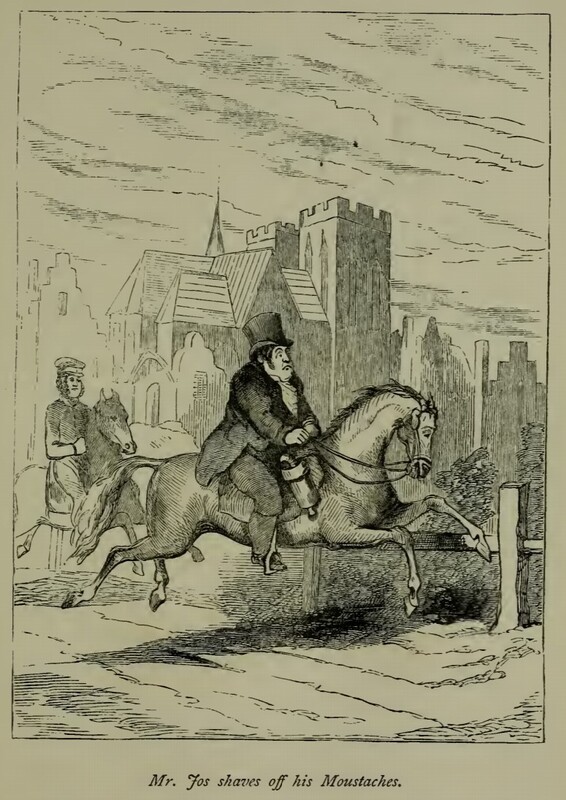
Joseph Sedley, freshly shaven, upon one of a pair of horses he has just purchased from Rebecca Crawley for an unreasonably large sum in order to flee from Brussels. Behind him is Isidor, his valet, on the other horse from the pair. Below the illustration is printed in cursive its title, Mr. Jos shaves off his Moustaches.
Two men engaged in conversation. Both are wearing robes while one is also wearing a crown. In front of them is a miniature man, on top of a column. The miniature is also wearing a robe, and his hat has been cut out of the frame.
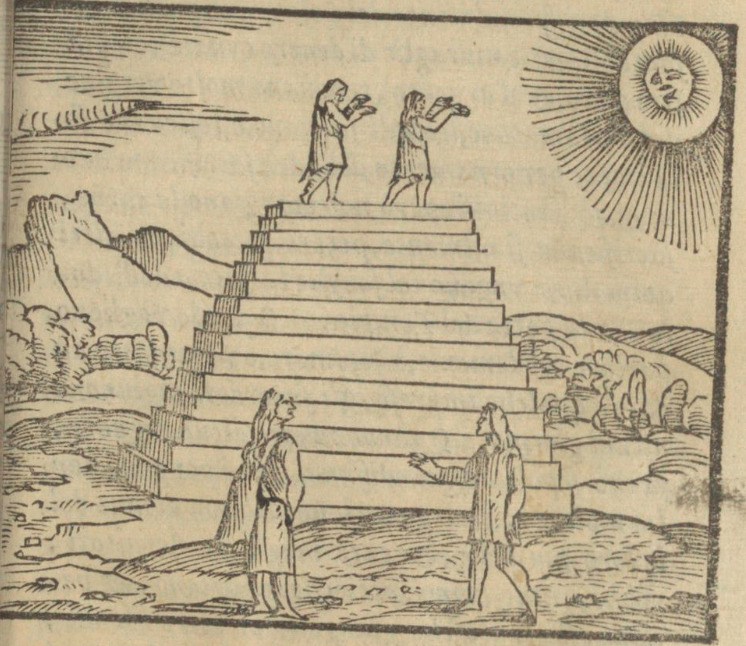
Two Indigenous people in Peru stand atop a step pyramid to worship the sun. They face the sun, with their hands raised towards it. The sun has been designed here with a face that gazes down towards the worshippers. At the base of the pyramid, two other Indigenous people stand in conversation. This image is identical to one found on page 166 verso of Venice, 1565.
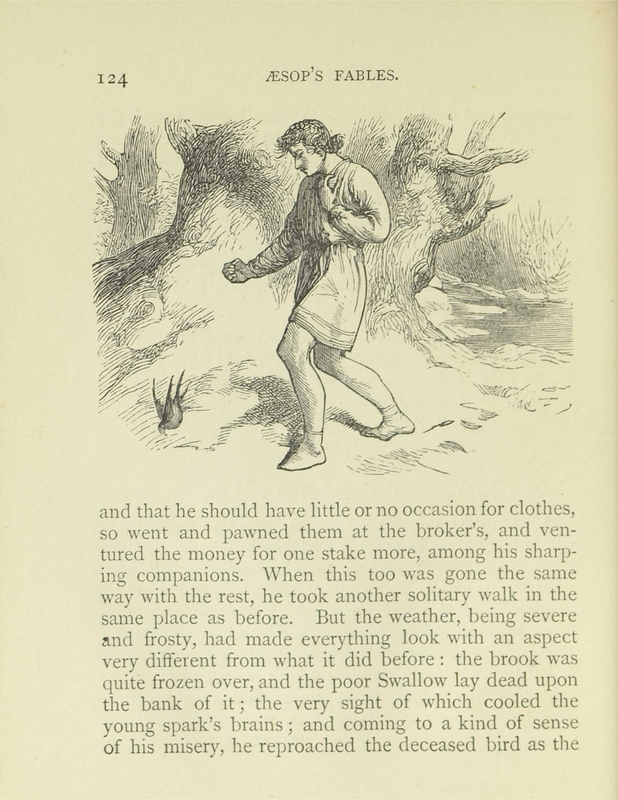
A man in front of a large tree clutches one hand to his heart and outstretches the other in a fist to a dead swallow on the ground.The man is centre of the page, the swallow is to the left.
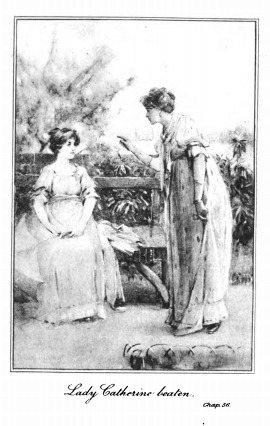
Here we see Elizabeth Bennet and Lady Catherine de Bourgh. Lady Catherine was Mr. Collins’ patron. She also hoped that her daughter would be the one to marry Mr. Darcy. She disapproved of Elizabeth’s rejection of Mr. Collins and her marriage to Mr. Darcy. Lady Catherine came to Longbourn to express her disapproval when rumours began to circulate regarding Elizabeth’s engagement to Mr. Darcy. She tried to force Elizabeth to never accept Mr. Darcy’s proposal, which Elizabeth refused. Upon this refusal, Lady Catherine left Longbourn quite angry. In this image, Elizabeth sits on a bench while Lady Catherine stands in front of her, pointing her finger in disapproval. This scene occurs in chapter 56 and is noted underneath the title of this image. The characters are shown in the traditional regency style, with both Elizabeth and Lady Catherine wearing the regency style dress with an empire waist. Their hair is worn tied up, as was tradition for women after their coming out before the queen, signaling her entrance into society. The regency period dated to the early nineteenth century (1811-1820) when George, Prince of Wales, later George IV (r. 1820-1830), reigned as regent for his mentally ill father, King George III (r. 1760-1820). The regency period is associated with the rise of neoclassicism in art and fashion. The same image appears as a frontispiece for the Dent 1893, 1894, 1895, 1896, and 1897 editions of Pride and Prejudice.
This illustration is interesting, seeing as no characters embrace during the seventeenth act. Areusa does manipulate Sosia into revealing when and where Calisto meets with Melibea, but he does not describe in any detail the nature of their encounters.
Here we see a hoof of Gulliver’s master. This image appears at the beginning of the fourth chapter, in which Gulliver’s master explains the Houyhnhnms philosophy on truth and falsehood. The letter M appears on the hoof is the first letter of the chapter. The same image appears in the 1843 Krabbe edition.
There is an illustration at the top of the page, and below this illustration is a body of text. In the illustration, a short man with curly hair while standing towards the right of the illustration is talking to a man and woman who are sitting together. The man and woman are dressed smart, and the woman is facing away from the short man while putting her hand on the chest of the man beside her.
This image depicts a cardinal sitting in a large chair in the centre of the page. He is illustrated holding a long staff and wearing a capelo on his head. His left hand is raised as he speaks to the men sitting beside him. There is an arzoobispo [archbishop] sitting on the cardinal’s right and a obispo [bishop] to the cardinal’s left. They are both looking towards the cardinal as they listen to him. The cardinal is seated in the centre to demonstrate that he is a higher order than the archbishop and bishop. The location is identified at the bottom of the image as it reads, Lima.
An Indigenous group from Newfoundland (as identified by the author) prepare to go to war. The group marches in a procession with large drums made from animal skins stretched over a wooden frame and bones as drumsticks. One man is carried on the shoulders of several others and holds a ceremonial weapon or other object. Most members of the group are barefoot and wear tunics, several have capes tied around their necks, and others wear headdresses of feathers or leaves.
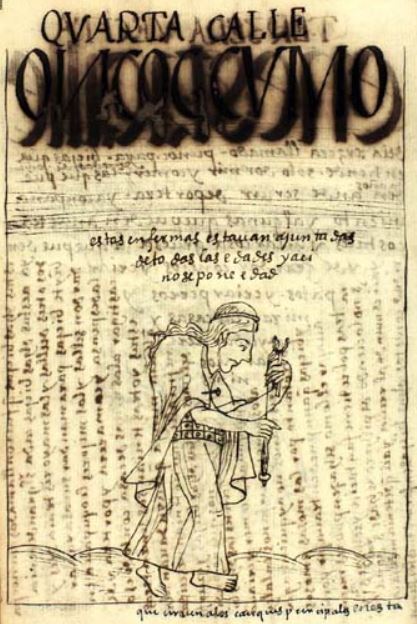
The author explains that there were ten paths for women to follow in the Inca Empire based on age division. This group was called oncoc cumo [sick hunchback]. These were women who had disabilities such as physical deformities, illnesses, loss of hearing and blindness. The author explains that those who were capable of work would weave or spin and those who could not work would be used as concubines. The image depicts a hunchbacked woman who is spinning yarn while she walks. The caption on the image reads estas enfermas estauan ajuntadas de todas las edades y aci no se pone edad, que ciruen a los caciques prencipales, which translates to these sick women were of all ages so no age is given, they serve the noble caciques.
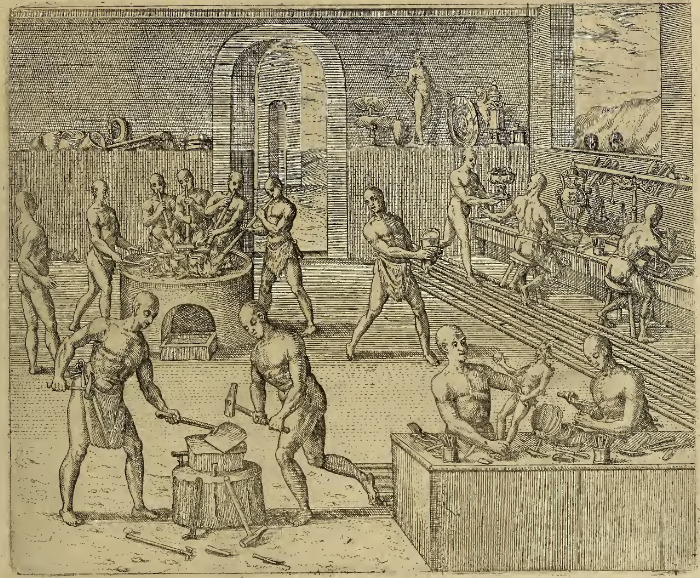
A group of Inca men work with gold in a space that is both forge and workshop. In the middle of the room is a large round kiln or furnace with a fire burning on top, in which several pots have been placed. A group of men stand around the kiln, blowing on the fire through hollow reeds. In the foreground two men hammer a sheet of gold, and beside them at a table two men use fine engraving and carving tools to ad detail to gold statuettes and ornaments. On the left there is a second, similar worktable. On a recessed shelf along the far wall of the building are several finished pieces, including a large plate, several vessels and a small statue. This image is identical to one found on page 27 (163) of Frankfurt, 1596.

![[Gulliver’s master examines his body]](https://cemvccol.ace-net.training/files/large/04f5ec5623ae8f80c9f8f579c6d20bee0003d321.jpg)
![[A Houyhnhnm oversees Yahoos working]](https://cemvccol.ace-net.training/files/large/e56f062eccb93e30ece06aa8be4bd10527e6e1b6.jpg)
![[The Cid marching into battle with his troops]](https://cemvccol.ace-net.training/files/large/c27f9f26d2e1c6cd72cb64820aebc6f509979f46.jpg)

![[Men Conversing in Front of a Miniature Man]](https://cemvccol.ace-net.training/files/large/f9b04c9c4a37c600fff2bc673a01d9085a800d08.jpg)
![[Vanity Fair Vol. I Chapter IX Historiated Initial]](https://cemvccol.ace-net.training/files/large/938b820dd79b751e3ed736cfa84506cd098b8ab5.jpg)
![[Act XVII – Calisto and Melibea (?) Locked in Embrace]](https://cemvccol.ace-net.training/files/large/da0c847f2290e0393ae14f27b21817549a1870ba.jpg)
![[hoof of Gulliver’s Houyhnhnm master]](https://cemvccol.ace-net.training/files/large/eab52c47f8f0639ef47b9608c1ac16b2eda54a15.jpg)
![Vita et Fabulae [A smartly dressed man and woman converse while another man stands and listens]](https://cemvccol.ace-net.training/files/large/c7071fe83695af86caf751bf32ad965b0c384a26.jpg)
![La S[an]ta Madre Iglecia, Papa de Roma, Cardenal en Todo Oorental de las Yndias del Piru, Segunda Persona de su Santidad](https://cemvccol.ace-net.training/files/large/68358a71b805d39e4dead35626cf830e74774045.jpg)
![[War procession of an Indigenous group from Newfoundland]](https://cemvccol.ace-net.training/files/large/afd3e3665db033c564defb0d99a48a8cde466c95.jpg)