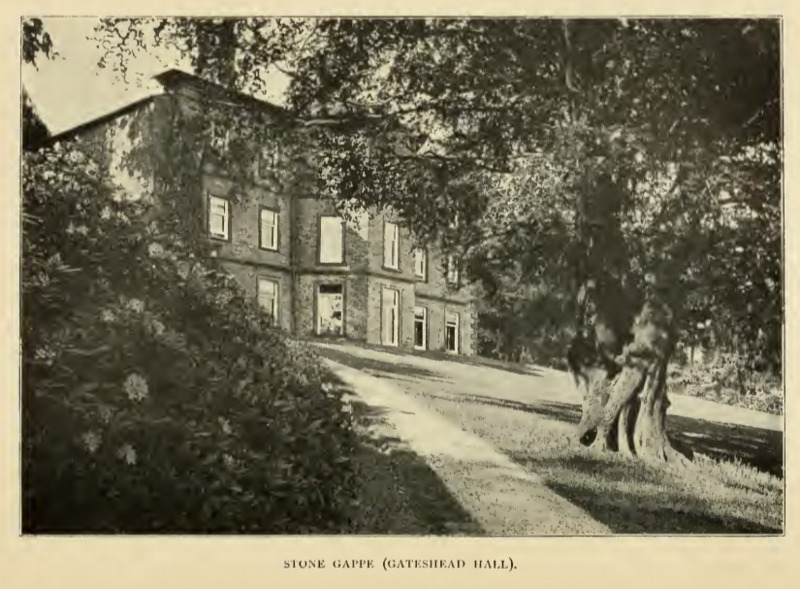
Here we see an image of Stone Gappe, a house in Lothersdale, a town in North Yorkshire. This house is supposedly that on which Gateshead Hall – the house where Jane lived with her aunt Reed – was based. The same image appears in the 1899 Bigelow, Brown, and Co edition of Jane Eyre.
This image comes when Gulliver imagines himself as one of the immortals from Luggnag. Gulliver imagines witnessing the changes in the world such as the rise and decline of empires, seeing ancient cities, the first European contact with the other continents, and the development of medicine, among others. In this image we see Gulliver as an old man looking over the ruins of Pompeii while Mount Vesuvius smokes in the background. The tops of Roman buildings are visible sticking out of the ash and stone that covered the city. Gulliver rests his foot on the skull of one of the victims. He stands next to destroyed capitals of pillars and marble carvings. When Swift wrote the first edition of Gulliver’s Travels in 1727, excavations at Pompeii had not yet begun, however by the time of this edition in 1839, the excavations at both Pompeii and Herculaneum were well underway, and there was a growing public fascination with the ancient Roman cities. This contemporary fascination is likely why this site was chosen to illustrate Gulliver’s imaginings of witnessing major historical events, as many of the readers of the novel in the 1830s would be able to identify the site, even though Pompeii was likely not was Swift was imagining when he wrote this passage. The same image appears in the 1839 Krabbe edition.
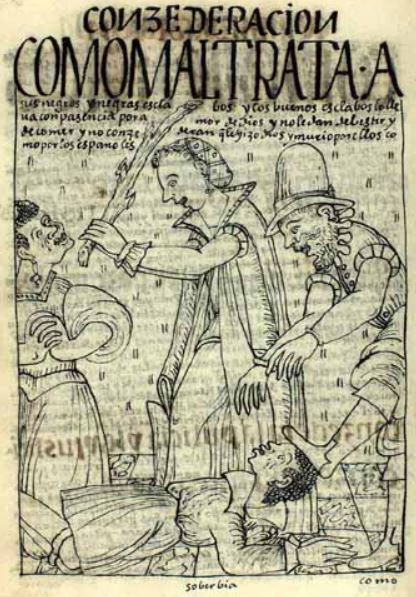
This image depicts the poor mistreatment of African slaves in Spanish colonial Peru. There is a black woman on the left side of the image with tears running down her face as she holds her hands together pleading the Spanish official to not beat her with a stick. The official standing in front of her about to strike her with the stick in his hands. The black man is depicted falling to the ground after being beaten by a Spanish official. The Spanish official is depicted kicking him in the head. They are all dressed in Spanish/European clothing. The author criticizes the Spanish officials for their mistreatment of the good Christian slaves. The caption at the bottom of the image reads, soberbia [arrogance].
As Celestina leaves Calisto’s house, Calisto tells Pármeno to accompany her to ensure she arrives home safely. Celestina persuades Pármeno to join her and Sempronio in their plot to scam Calisto, and she promises him a share of the profit, as well as her prostitute Areusa, in exchange for his new loyalty. He relents to her bribery, and they both go to Areusa’s house, where Pármeno remains for the night while Celestina returns home. To the right of the illustration, we see Pármeno and Celestina in conversation. She is wearing a robe and a veil, while he is depicted with a hat and a sword mounted on his belt. To the left, both Pármeno and Areusa can be seen unclothed in bed together. Oddly enough, Areusa appears to be wearing a veil despite her nudity.
In this image there is a battle taking place. In the background there are a bunch of soldiers fighting, there are tips of spears visible. There are many men on horses fighting, and there is a flag among them as well. There are two men that seem locked in combat at the center of the image. One is wearing amour and a helmet and he is using both of his hands to strike at the other soldier who is holding up his shield to defend himself. The man with the shield has a scimitar in the other hand. On the far right of the image there is another soldier about to send an arrow flying.
The Reverend Mr. Binny sits on a sofa with Georgy Osborne on his lap. Opposite him sits Amelia Osborne, to whom he has just proposed marriage and been turned down. She is knitting or crocheting. Above the sofa is a framed portrait of the elder George Osborne.
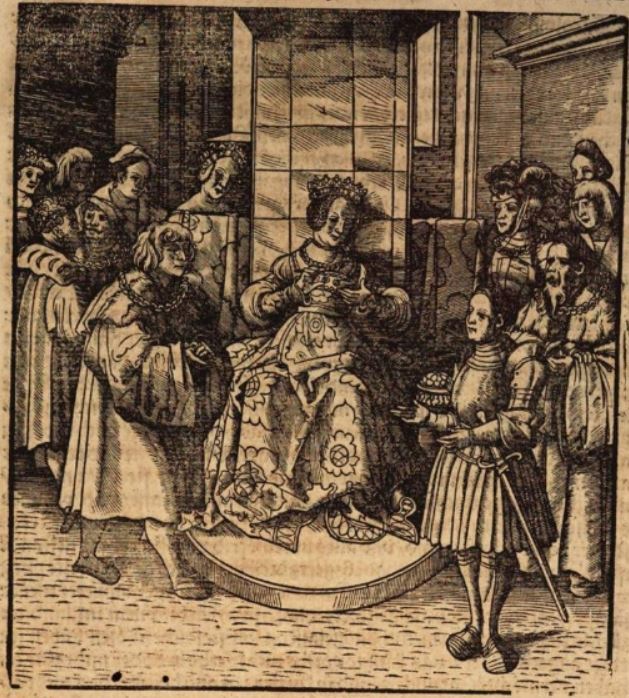
This engraving depicts Queen Joanna of Jerusalem and Sicily sitting on a throne with her subjects surrounding her. She is depicted wearing a crown, as well as a dress with floral designs on it. Boccaccio explains that Joanna was a praiseworthy subject to write on as she was an impressive ruler which was not common for women during her time.
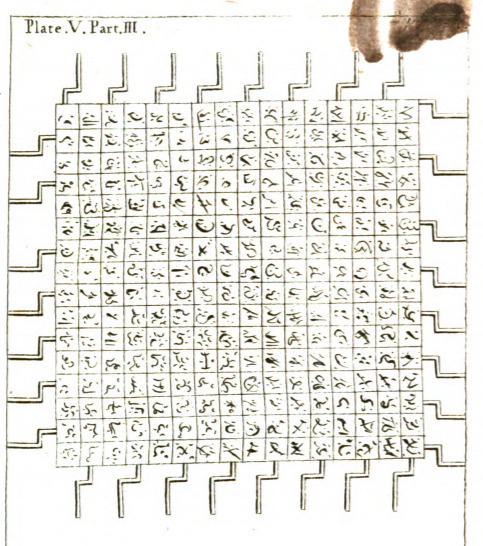
This image depicts an invention created by Laputan Projectors. The invention is to rework the Laputan language. On each of the squares is a symbol representing a phrase in the Laputan language. There are handles which would be turned to create different phrases which would then be analyzed. The same image appears in other editions of Gulliver’s Travels, including those in other languages.
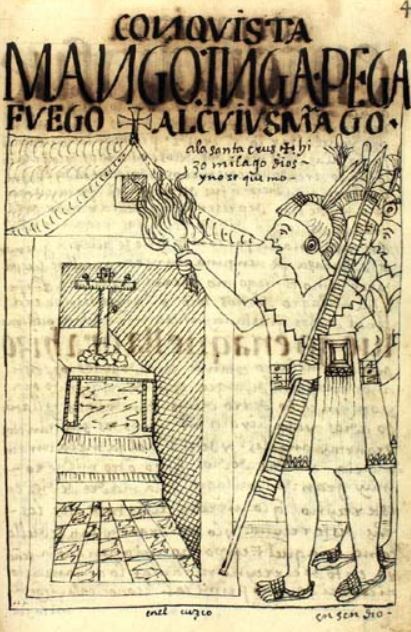
This chapter focuses on discussing the arrival of Spaniards and the Spanish conquest of Peru. This image illustrated the Inca emperor, Manco Inca, attempting to set a Christian temple on fire to regain control of Cusco. There is a cross on the roof and on the altar inside the temple to demonstrate that it is a Christian space. The author explains that the temple was called Cuyus Manco, the house of the Inca, until the Spaniards took it from them and converted it to a Christian temple. Manco Inca and his two soldiers are illustrated with a surprised expression due to the temple not catching on fire. This was taken as a sign from God that the church was now established within the kingdom. The caption at the top of the image below the heading reads, a la santa crus [cross] hizo milago dios y no se quemo [With the Holy Cross God performed a miracle and it did not burn]. The caption at the bottom of the image reads, en el cuzco [In Cusco].
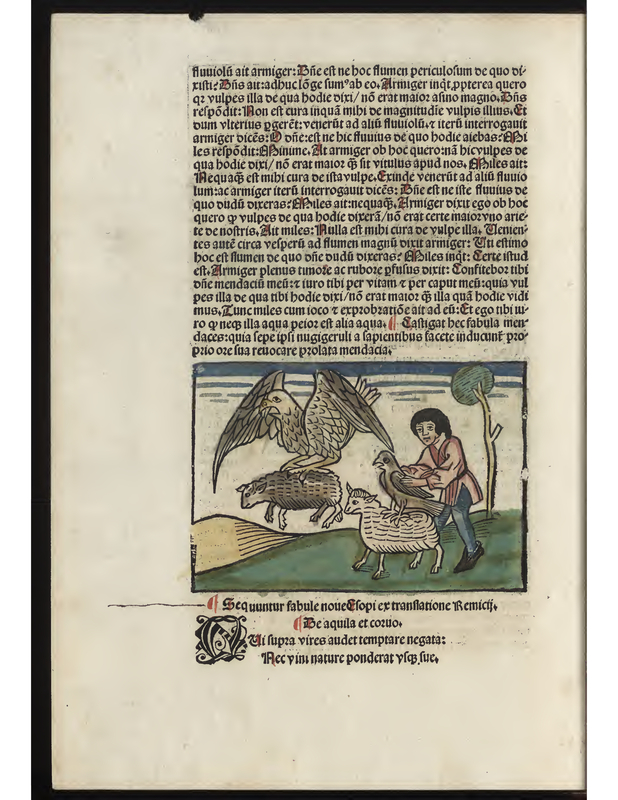
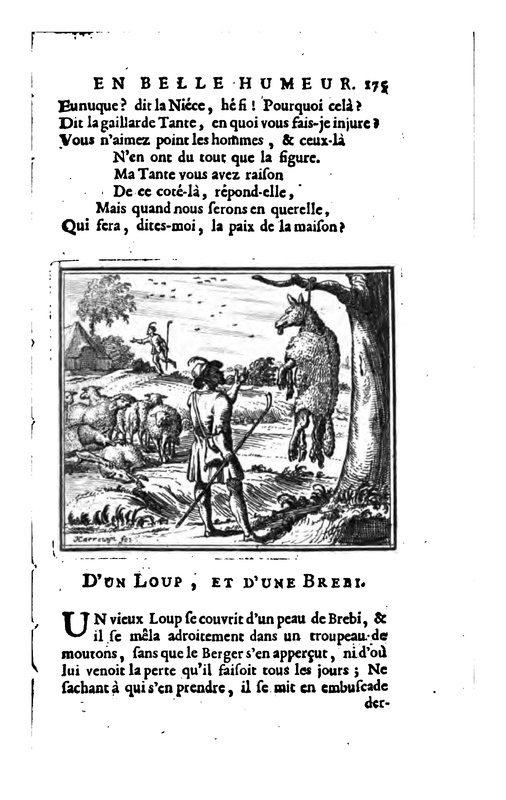
A wolf is hanging from a tree by its neck while a man is standing beside the wolf with a long pole in his hand. In the distance is another man up on a hill with a group of sheep standing infront of him.
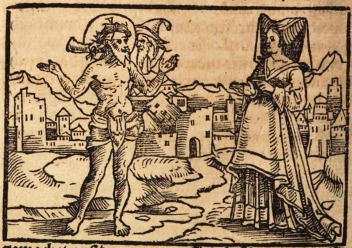
This engraving depicts the sibyl named Erythraea (also known as Eriphila) on the right side of the engraving with her fingers pointing to the man on the left side of the engraving. The man she is pointing to is the son of God, Jesus Christ. Boccaccio explains that Erythraea was so intelligent that her prophecies were taken as Gospel rather than fortune-telling. She even prophesized the entire events from the life and death of Jesus, which is why he is depicted in this engraving. Boccaccio explains that Erythraea had also prophesized the fall of Troy, which is assumed to be the city in the background of the engraving. There is an unidentified man’s head engraved beside Jesus.
In this image we see the farmer from Brobdingnag picking up Gulliver and examining him, holding Gulliver between his fingers. This image shows the size difference between Gulliver and the Giants of Brobdingnag. A sheathe with a knife hangs from the giant’s waist. The Giant has long straight hair and wears short pants, a loose shirt and a vest over it. He stands amid the field of wheat where he found Gulliver. The same image appears in the 1839 Krabbe edition.
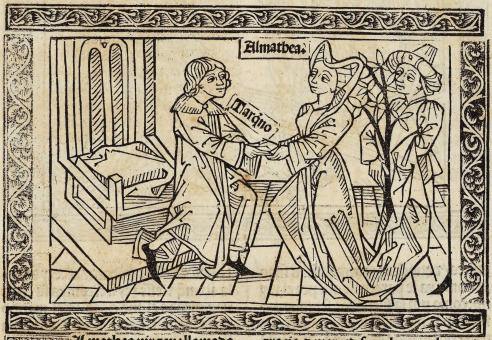
This engraving depicts the sibyl Amalthea handing over books to Tarquinius Priscus. We know that these figures are indeed Amalthea and Tarquinius Priscus as their names are engraved beside and above their bodies to identify them. Amalthea, as explained by Boccaccio, brought 9 books for Tarquinius Priscus, and when he failed to pay her the full price, she burned 3 books at a time until he paid her what she was owed. There is a man standing behind Amalthea depicted holding a tree of some sort.
Two figures, a woman holding a stick or thin staff and a man in a curved hat, walk along a path. A sign by the side of the road reads To London. Two sets of forked branches in the background form the letter W from We.
This illumination depicts the famous poetess, Sappho, sitting on the left side of the image looking at her book which is placed on the lectern in front of her. The book in front of her is assumed to be some of her own poetry. She is illustrated wearing an orange dress and a head piece. There are three people on the right side of the image who are most likely other poets. Boccaccio explains that Sappho was included among the most famous of poets.
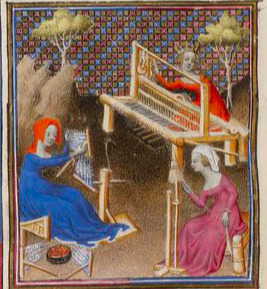
Gaia Cyrilla is seen in a red dress as the back of an image. She is wearing a crown and working with wool, which was an art she dedicated herself to. Two women work with her at different stages of the wool-working process. They work on the dyeing, carding, weaving and spinning of the wool. She was so talented that she was loved by the public, creating a lasting fame.
A satisfied looking boy standing on a rectangular box or platform holds in front of him a stick. On it are a turnip disguised as a head and a ragged sheet or coat, forming the semblance of a ghost. A terrified looking man is on his knees with his arms raised in front of the ghost, a shovel dropped beside him. A tall fence in the background forms the letter W from We.
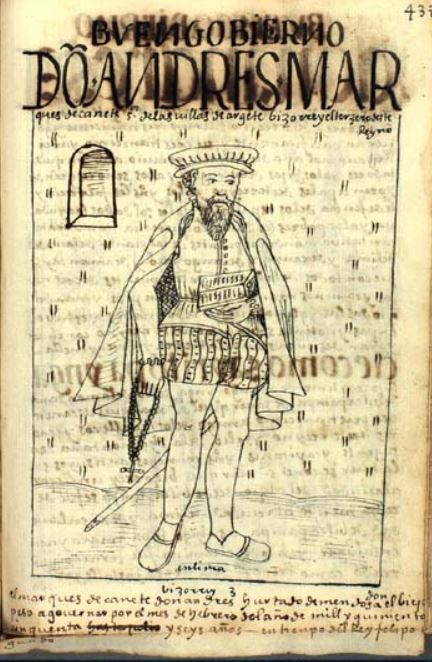
This chapter of the book focuses on discussing the good government of post-conquest Peru that the Spanish viceroys maintain. This image depicts Don Andres, Marquis of Canete, lord of Argete, and the third viceroy of post-conquest Peru. The author describes him to be a devout Christian who governed Peru peacefully with the well-being of the indigenous peoples as a priority. He is illustrated wearing traditional Spanish/European clothing while holding a rosary in his right hand and an open book in his left hand. The caption written at the bottom of the image reads, en Lima/bizorrey 3/el marques de canete don andres hurtado de mendosa el biejo empeso a gouernar por el mes de hebrero del ano de mill y quinientos cinquenta y seys anos en tienpo del rrey felipo el segundo [in Lima/third viceroy/the Marquis of Canete, Don Andres Hurtado de Mendoza began his rule in the month of February in the year 1556 in the time of King Philip II].
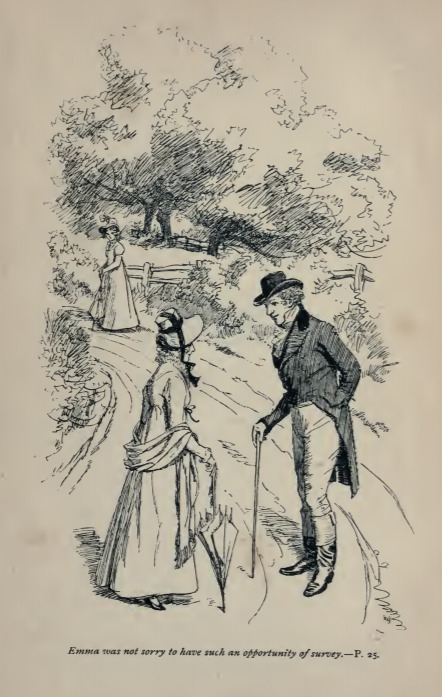
Here we see Harriet speaking with Mr. Martin while Emma looks on at a distance. Harriet was interested in Mr. Martin and the two became close after she spent the summer living with his family on the farm on which he worked. Mr. Martin asked Harriet to marry him, but Harriet, influenced by Emma, turned him down. Emma fancied herself a matchmaker and tried to set up Harriet with Mr. Elton. Emma believed Mr. Elton to be interested in Harriet, but in reality, he wanted to marry Emma. This scene occurs in chapter 4, on page 25 as noted underneath the image. The characters are shown in the traditional regency style, with Emma and Harriet wearing the regency style dress with an empire waist. Their hair is worn tied up, as was tradition for women after their coming out before the queen, signaling her entrance into society. They wear bonnets to protect her face from the sun. Bonnets were a popular accessory at this time because going for walks was a common pastime, and pale skin was believed to be the most fashionable as a means of indicating a woman’s status in the upper class, who did not have to perform outdoor labour. They also carry parasols to further provide shade from the sun. Mr. Martin wears a waistcoat and tailcoat, and a top hat and carries a walking stick. The regency period dated to the early nineteenth century (1811-1820) when George, Prince of Wales, later George IV (r. 1820-1830), reigned as regent for his mentally ill father, King George III (r. 1760-1820). The regency period is associated with the rise of neoclassicism in art and fashion.
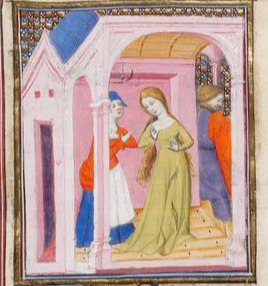
When her husband was proscribed, Curia hid him in the walls of their house so that he could not be found. She acted as though he was gone, and her fake mourning had everyone fooled into believing her lie. The image depicts Curia, wearing a green gown, mourning with her friends and family while her husband hides in the walls. He is seen hiding to the far right of the image, wearing purple and red.

![[Gulliver imagines himself as an immortal seeing the rise and fall of empires]](https://cemvccol.ace-net.training/files/large/b08ed70a22c0ac632491383e301a278d7f696990.jpg)
![[Act VII] Celestina spreect tot Pármeno](https://cemvccol.ace-net.training/files/large/585a5b70a518c4582a6480ac4414def4e5d68640.jpg)
![[The Cid and his troops fighting in a battle]](https://cemvccol.ace-net.training/files/large/8d285401f0d4fccdf6493c9ba5fb230b2636472a.jpg)
![[Mr. Binny Proposes]](https://cemvccol.ace-net.training/files/large/7d06c053f479f89daf413ade56f076593c25bd09.jpg)

![[The farmer from Brobdingnag picking up Gulliver]](https://cemvccol.ace-net.training/files/large/b4f8df2b8a958bf738a2566d19611bf5e9e17833.jpg)
![[Vanity Fair Chapter XII Inhabited Initial]](https://cemvccol.ace-net.training/files/large/feac0576343211f1ec214a85c73a03a92a462f6b.jpg)
![[Sappho Sitting While She Reads]](https://cemvccol.ace-net.training/files/large/b207466a248683f7f6b32b954adf16442d9dcc75.jpg)
![[Vanity Fair Vol. I Chapter XIX Inhabited Initial]](https://cemvccol.ace-net.training/files/large/69c280e65f712acb55c44d9e4af389ce647a2eff.jpg)