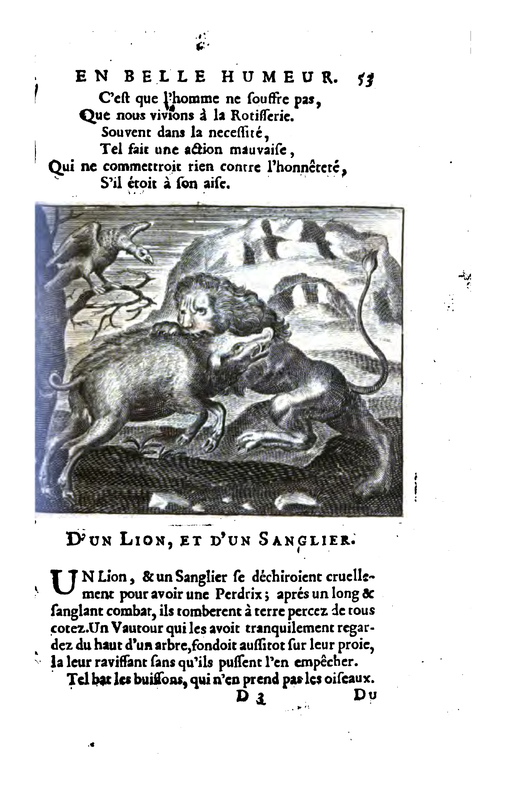
In this image there is a lion grabbing a boar by his neck. While the lion is expressing angry in his facial expression, the boar is expressing terror. There is a tree on the side and an eagle is sitting on top watching them and is ready to take off. There appears to be a lion's den in the background, under a mountain. This scenario is happening on a what appears to be a grass field.
After spending the night with Areusa, Pármeno wakes up to find that it is midday. Areusa asks him to stay and talk, but he feels concern that his master Calisto will be upset with his absence. He tells her that they will have plenty of time to talk later, and asks her to join him for supper at Celestina’s house later that night. She is pleased by this suggestion, and he departs (to the left he is seen leaving). When Pármeno arrives at Calisto’s house, he is greeted by Sempronio, who chides him for his lateness (seen to the right). Pármeno reveals to Sempronio the reason for his lateness, and explains his love for Areusa. The inclusion of this illustration in the eighth act is odd, since it is completely unrelated to any of the scenes contained in the act. I suspect that the use of this illustration (in place of the more relevant 1580 Antwerp edition illustration) is perhaps a consequence of the 1580 woodblock being misplaced or destroyed in the intervening 36 years. Consequently, it would not make sense to associate a particular character with any of these figures. However, we can see that each female figure is wearing a robe and a veil, while the lone male figure is wearing a hat.The entire image is identical to the one found on page 157 of the text, and nearly identical to the one found on page 64. The composition is also wholly distinct from any of the illustrations found in the 1580 Antwerp edition.
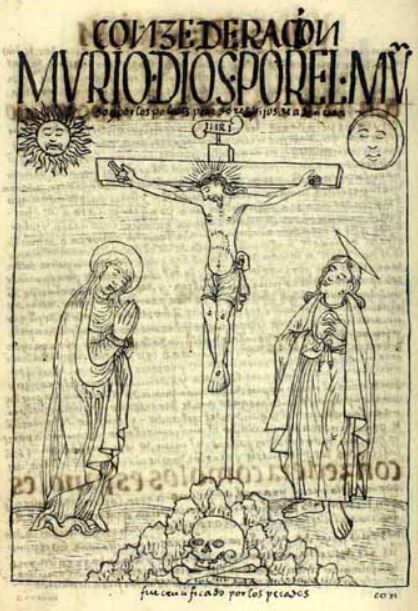
This image depicts the crucifixion of Jesus Christ. He is depicted nailed to the cross with a skull and cross bones beneath him to symbolize the place where he was crucified. There is a moon at the top right corner of the image and a sun on the right. There are two figures on the ground, the one on the left (presumably his mother, Mary) is depicted with a round halo above her head as she holds her hands together and prayer and looks to the ground. The other unidentified figure holds their hands together in prayer as they look up at Christ. The initials I.N.R.I are written above the cross which means Iesus Nazarenus, Rex Iudaeorum [Jesus of Nazareth, King of the Jews]. The caption at the bottom of the image reads, Fue crucificado por los pecados [He was crucified for the sins].
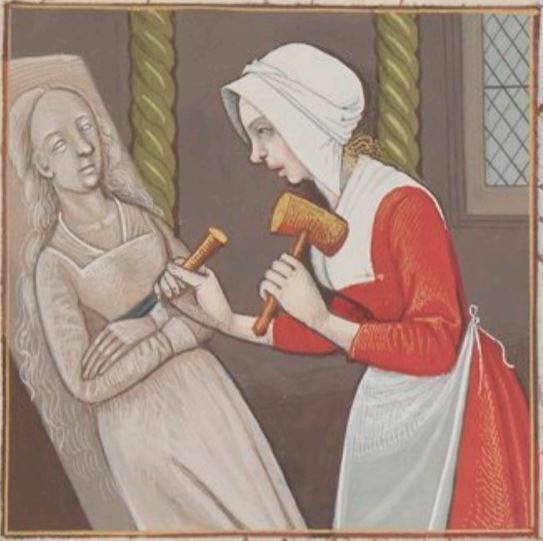
This illumination depicts the young Roman virgin Marcia holding a chisel in her right hand and a hammer in her left as she sculpts out a figure of a woman. Boccaccio explains that Marcia is worthy of renown for her chastity and for her sculpting and artistic abilities. She is known to have mostly painted and sculpted figures of women, which is why she is sculpting a statue of a woman in the image.
The Cid and his company stand in front of a clergyman, presumably either Abbott Don Sancho or Bishop Jerome. The clergyman carries a flag. The words NIPTE KAMPADOR IXXO can by read behind them. Kampador is presumably a translation of the Cid’s title Campeador, but it is unclear what the rest of it means.
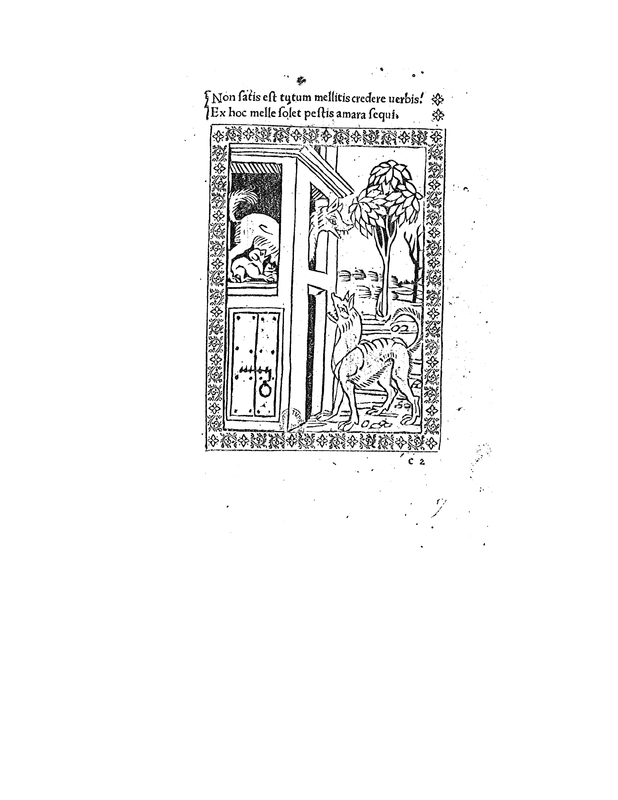
There are two large dogs, one is outside of the house, the other is on the second floor looking out the opening with a taunting demeanor. The dog that is outside looks irritated. The dog on the second floor is a female dog and there is a pup suckling from it.
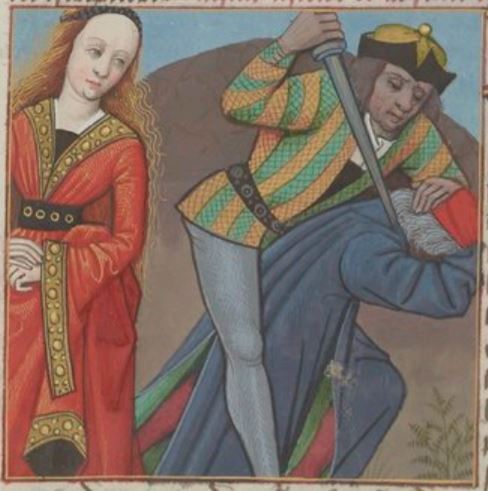
This illumination depicts the queen of the Galatians standing on the left side of the image as she watches her servant decapitate a man. This woman’s name is unknown; however, she is the wife of King Drigiagon. After being taken as a captive of Roman enemies, the Galatian queen was defiled by a Roman centurion. To seek her vengeance, once she was freed through ransom, she ordered her servant to decapitate the man who raped her. This image depicts her servant attacking the centurion with his sword. The Galatian queen uses the severed head to prove to her husband that she was defiled by this man. Boccaccio explains that she wrote on this woman to highlight her daring and courageous nature.
The entirety of the illustration is of a house with a tall tower. Behind that house are never-ending fields. Birds are perched on the trees in front of the house, and atop the tower. On the upper left corner is a flying bird, going in the direction of the tower’s rooftop.
In this image, we see a large group of Lilliputian women sitting in a circle around Gulliver. The only part of Gulliver visible in the image are his feet. The women are dressed in the style of the eighteenth century, wearing large hoop skirts, corsets, and large sleeves. They wear long veils attached to the bottom of their heads. The image comes during Gulliver’s description of the Lilliputian women. The same image appears in the 1843 Krabbe edition.
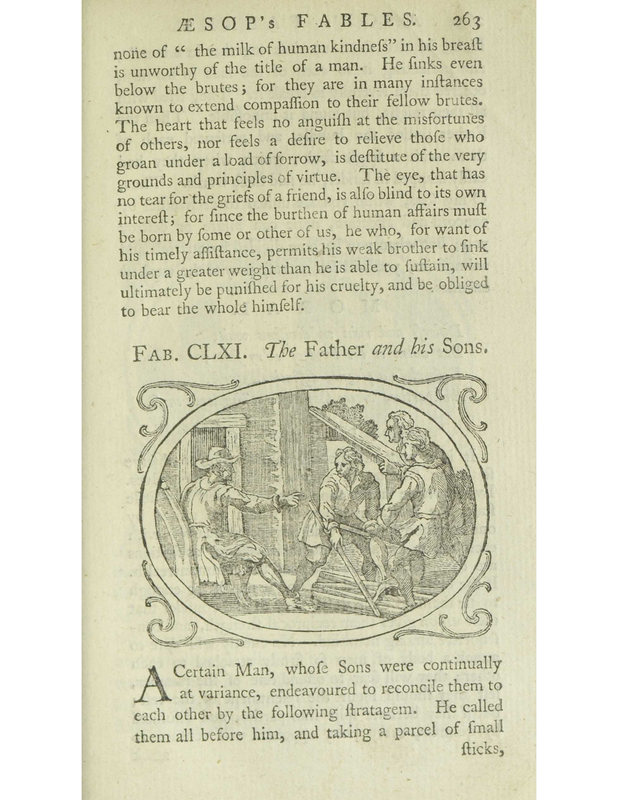
An older man directs three younger men who are standing on top of a wood pile. They are outside with several buildings in the background. The father is leaning on one of the buildings.
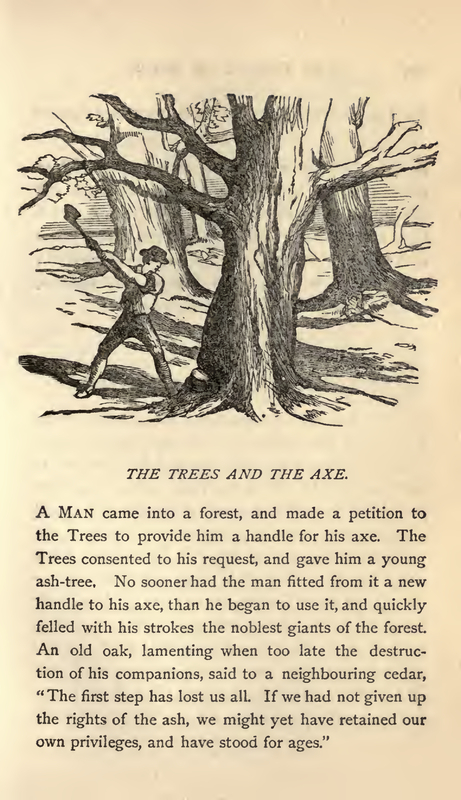
A man is in a forest, standing beside one of the tress. He is standing in a wide stance, and he is in the motion of swinging an axe which he wields in both hands. He is striking the bottom of the tree which already has a cut suggesting he has been striking it for some time.
Here we see a depiction of the schools in Lilliput. The school system is a form of boarding school paid for by the Emperor, and as such interactions between children and parents is limited. The central figure is the headmaster, identified by his dark robes. Three children stand behind a gate on the left side of the image, while a man and a woman – the parents of the children – are ushered in. The headmaster holds out his arm to stop the parents from coming too close to the children, as the school limited physical contact with the children. According to Gulliver, parents were only permitted to visit their children twice a year for one hour. These visits were supervised by a teacher. Bringing gifts to the children was permitted and showing affection for them was strictly limited. This image comes when Gulliver describes the education system in Lilliput in the sixth chapter in which Gulliver discusses the values and traditions of the Lilliputians. The same image appears in the 1839 Krabbe edition.
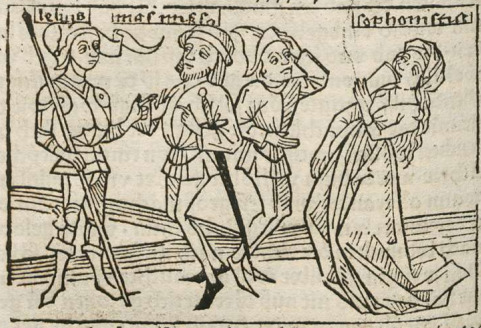
Masinissa, the King of Numidia is depicted on the left side of the engraving speaking with a man named Laelius. Laelius is depicted pointing at Masinissa as he reproaches him for marrying a captive of the Romans. We know that these figures are Masinissa and Laelius as the creator engraved their names written as Masmissa and Lelius above their heads. Not able to disobey Laelius, Masinissa ordered a servant to give Sophonisba, his wife, a cup of diluted poison. Sophonisba is depicted on the right side of the engraving willingly drinking the poison. The servant in front of Sophonisba looks astonished at how willfully she drank the poison. We know that the woman depicted in the engraving is Sophonisba as her name is engraved above her head.
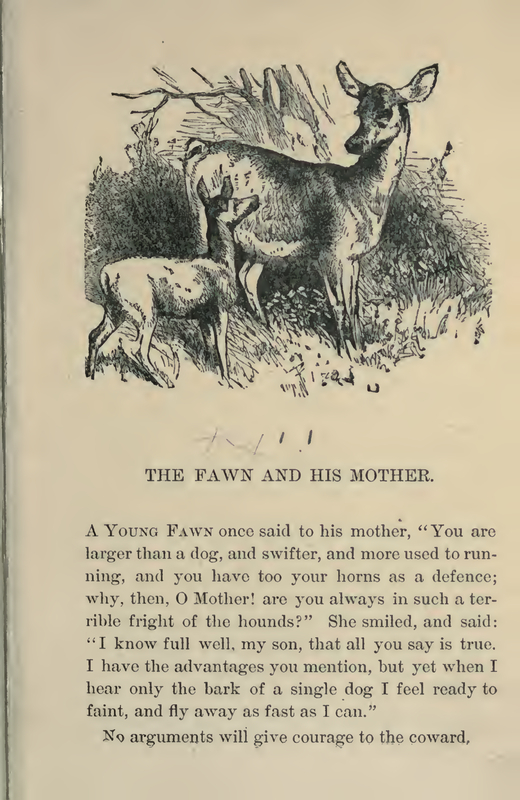
A fawn and his mother are in the forest. The young fawn, much smaller than its mother, is looking up from the left hand-side of the image. His mother stands tall in the middle of the image, looking to the left in the direction of her kid.
Jones, a reader of the story, is seated in an armchair with his legs crossed and feet on an open-backed chair. He is holding his copy of the book in his right hand and holding a pencil to underline a phrase in it with his left.
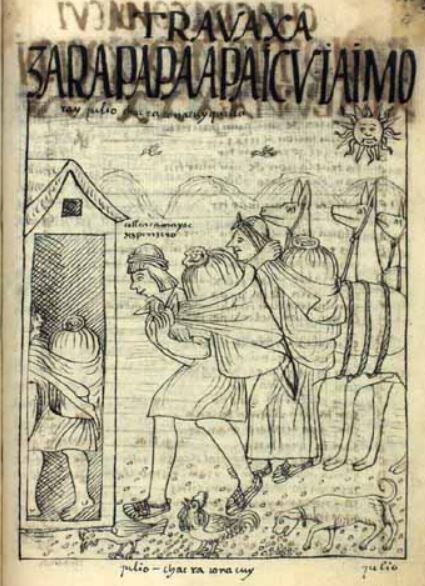
This image is reflected in the final chapter of Ayala’s chronicle where he provides a description of labours and festivals that occur in the rural areas of the Spanish colonial Andes during each month of the Inca calendar year. This image depicts the month of July, which was a month of distributing the harvest from the corn and potato fields. The sun is shining in the top right corner of the image. There are three indigenous men illustrated carrying large sacks of their harvest on their backs as they walk into a small hut, presumably to store the harvest until they distribute it. One man is standing in the doorway of the hut as he looks back to the other two men. They have three llamas accompanying them. By their feet are two chickens and a dog eating feed off the ground. The mountainous Andean landscape is illustrated in the background of the image with birds flying over top. The caption written beside the hut reads collca camayoc, despensero [manager of the barns]. The caption at the bottom of the image reads julio, chacra conacuy [july, eighth month].
Here we see a magic lantern, which was a form of image projection developed in the seventeenth century, becoming popular in the eighteenth century, and used until the twentieth century. Glass slides with images on them would be placed in front of a light source and one or more lenses and then projected. The magic lantern was the predecessor of the twentieth century slide projector. In this image we see several slides on the table in front of the lantern and a candle next to it. There are human figures on the slides and likely represent the various historical figures with whom Gulliver spoke throughout the eighth chapter. In the nineteenth century the magic lantern became a popular tool for education, and it is likely that they could be used in classrooms to teach children about history and historical figures. This image appears at the end of the eighth chapter. The same image appears in the 1839 Krabbe edition.
An Indigenous man wearing a feathered headdress and ornament at his back starts a fire by twirling a long stick against a log on the ground. Another man, also wearing a feathered headdress and carrying a bow, watches and smokes a cigar (or similar item). Several women and children are also amongst the group, including a small child carried in a basket on a woman’s back and another child who carries a miniature bow and kneels on the ground to watch the fire starting. This image is identical to one found in Frankfurt, 1557.
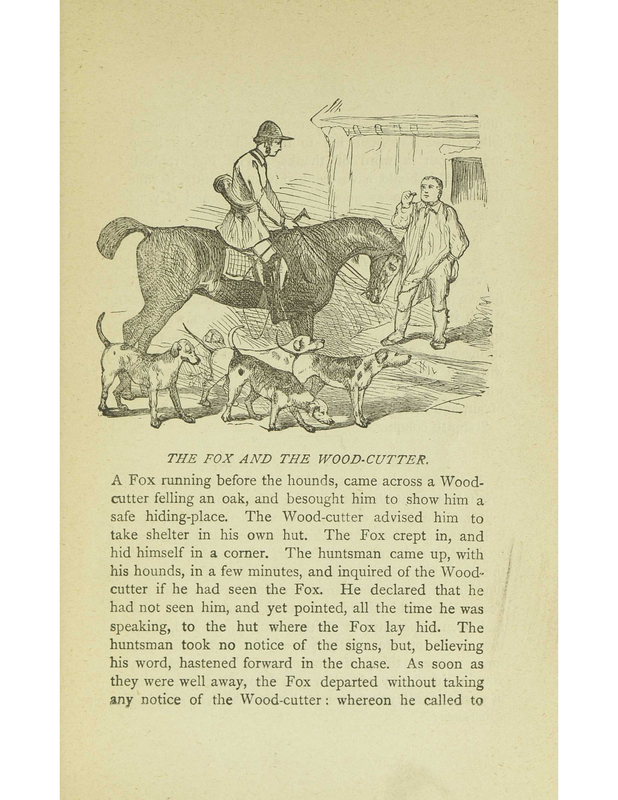
A man wearing a horse-ridding uniform is upon his horse. He wears a calling horn on his back and holds what seems to be an axe in his left hand, meaning he is the woodcutter. They have come to a stop in front of a man. The man looks up at the woodcutter with a curious look. Five hounds sniff at the feet of the horse.
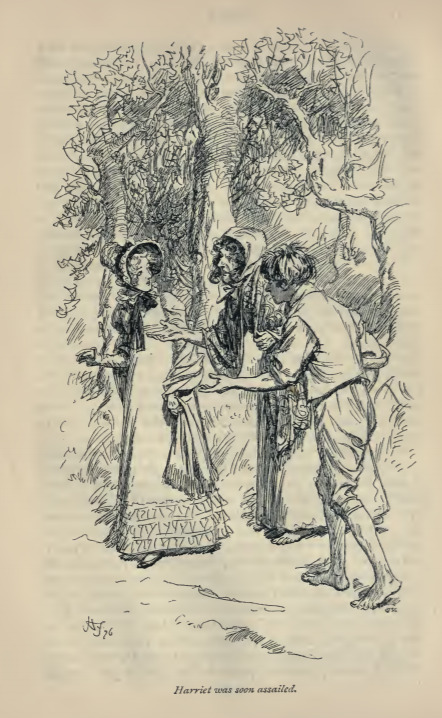
In this image we see Harriet being accosted by gypsies on her way home from the ball. The gypsies asked for money and Harriet was distressed. Frank Churchill was walking along the same road and chased them away, bringing the distressed Harriet to Hartfield. This scene occurs in chapter 39. The characters are shown in the traditional regency style. Harriet wears a dress with an empire waistline and a bonnet, and a shawl wrapped around her shoulders. The gypsies wear loose fitting clothes and are barefoot. The regency period dated to the early nineteenth century (1811-1820) when George, Prince of Wales, later George IV (r. 1820-1830), reigned as regent for his mentally ill father, King George III (r. 1760-1820). The regency period is associated with the rise of neoclassicism in art and fashion.

![[Act VIII] Pármeno spreect tot Areusa syn lief](https://cemvccol.ace-net.training/files/large/e3500027a28de647af142a9fae1cd915631a8a37.jpg)

![[The Cid meeting with a clergyman]](https://cemvccol.ace-net.training/files/large/f940980c0c30dd8a3ff13ec8d13c44d349f16861.jpg)
![[The Birds and the Tower]](https://cemvccol.ace-net.training/files/large/4d0a3ee6e05fecbe2802025595b05866f807c0ff.jpg)
![[A group of Lilliputian women sitting in a circle around Gulliver]](https://cemvccol.ace-net.training/files/large/3ee5c730069b1c17ff5f6b8b97e88c9bb555e6a1.jpg)

![[The Lilliputian education system]](https://cemvccol.ace-net.training/files/large/478a3b9cf7beb054d1921ad5aed394e8e64fecd7.jpg)
![[Jones Reading this Story]](https://cemvccol.ace-net.training/files/large/edad131bade4f253313c20d08e21455501544891.jpg)

![[an eighteenth century magic lantern]](https://cemvccol.ace-net.training/files/large/9c7c164572c6e9718ce6f0e93f634d71abeef46f.jpg)
![[Method of starting a fire of the Indigenous Brazilians]](https://cemvccol.ace-net.training/files/large/f0c20e26f7481338264aa6bc8a058bdbfc7a0296.jpg)