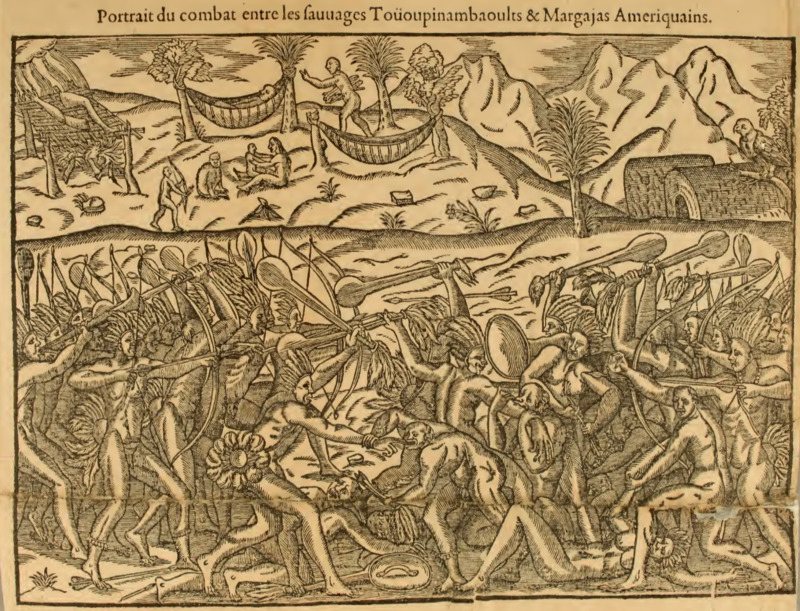
Two groups of Indigenous people are shown engaged in conflict. Individuals on both sides wield a combination of bows and arrows and clubs as weapons. A few people also carry small shields. Members of both groups wear feathered headdresses and feathered adornments slung around their shoulders and hanging at their backs. In the background behind the warring groups there is an Indigenous village with several people going about their lives. There are two long structures on the right and two hammocks strung between trees. One person lounges in a hammock, another carries firewood. A woman sits on the ground with a child while another child carrying a small bow walks nearby. A monkey also sits near the group. To the left, a rack with several human limbs on it sits over a large fire.
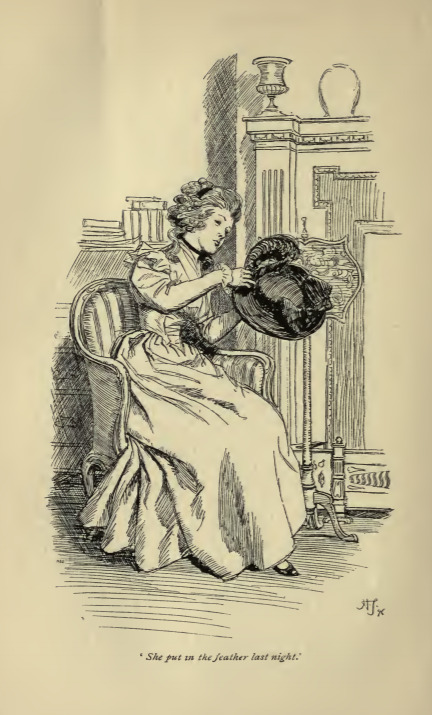
In this image Lucy Steele trims her sister, Anne’s, cap with feathers. Anne was the one who let the secret of Lucy and Edward’s engagement out. Lucy was livid and swore she would never help Anne again, including trimming her cap. Lucy quickly calmed down and agreed to add feathers to her bonnet. This scene occurs in chapter 38. The characters are shown in the traditional regency style. Lucy Steele wears a regency style dress with an empire waistline. She holds Anne’s bonnet as she adds feathers. The regency period dated to the early nineteenth century (1811-1820) when George, Prince of Wales, later George IV (r. 1820-1830), reigned as regent for his mentally ill father, King George III (r. 1760-1820). The regency period is associated with the rise of neoclassicism in art and fashion.
This image depicts Celestina standing outside. She is wearing a robe and veil, with what appears to be a rosary hanging from her waist. Her rosary and veil are coloured red; based on the imprecise quality of the colouring, this may be something that was done by hand (perhaps at a later date). The illustration itself is surrounded on three sides by a decorative border, with each side featuring a different design.The entire panel is nearly identical to the panels found at the end of the book and on pages 51, 82, 105, 150, 162, and 221 (where no red is present).
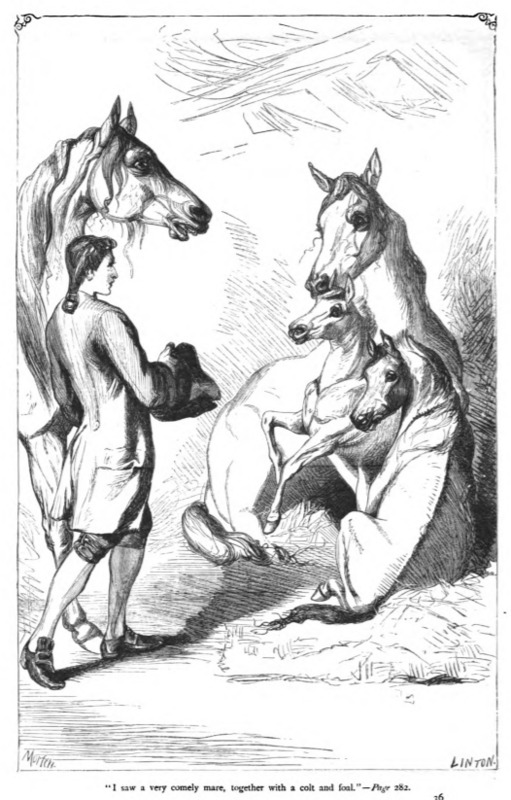
After meeting the Houyhnhnm, Gulliver went back to their house and met their family. Here Gulliver meets his master's wife and children. Gulliver lived with this family of Houyhnhnms for the next five years.
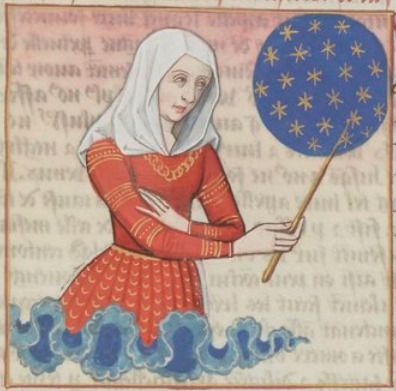
This illumination depicts Proba holding a stick in her hand as she points to the world. This is to represent her teaching history to the world. Proba is renowned for her intellect and intensive knowledge of literature, including works from Virgil. Proba had taken lines from the Aeneid, Bucolics, and the Georgics and transformed them into a cento focusing on the Old and New Testaments. Proba was said to have known the Scriptures by memory, which was something not even many men were able to do.
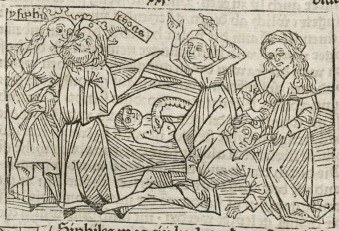
Hypsipyle and her father King Thaos of Lemnos are depicted on the left side of the engraving. We know that the figures are Hypsipyle and Thaos as the creator engraved their names beside their bodies. Hypsipyle appears to be in discussion with her father, as she tells him that the women of Lemnos are planning to turn on all the men of the city and kill them. Boccaccio explains that Hypsipyle warns her father of the crime so that she can help him escape. There is a woman on the right side of the engraving with a sword in her left hand and a man’s head in her right as she carries out the plan to kill the men of the city. Later in life, Hypsipyle has a ward named Archemorus. He is depicted in the background of the engraving, lying on the ground with a snake biting into his chest. This kills the child, and Hypsipyle is illustrated with her hands in the air as she grieves for him.
Two groups of Indigenous Brazilians engage in conflict. Members of both groups are armed with bows and arrows and clubs, and some carry shields. Several individuals blow into long instruments resembling a type of horn, and at least one person blows into a conch shell. There are two structures visible in the background, one of which is on fire.
An ornately decorated title page. Two figures playing musical instruments appear atop the pedestals on either side of the illustration. The male figure on the left is playing the panpipes (or syrinx), and his horns and goat’s legs indicate that this is possibly a representation of the Greek deity Pan. The figure on the right is female and also has the legs of a goat, but it is difficult to ascertain her identity from this illustration alone. The entire image is nearly identical to the one found on the title page. The first difference can be seen in the top left corner, where the feathers and coat of arms have been replaced by an aged man with a stick of some sort. The second difference is found in the inscription, which reads: Gedruckt und vollendt in der kayserlichen stat Augspurg durch Sigismund Grymm Doctor/ unnd Marx Wirsung/ nach der geburt Christi M. D. XX. Am. xx. tag Decemb. This can be roughly translated as: [Printed and completed in the Imperial State (City) of Augsburg by Doctor Sigismund Grymm/ and Marx Wirsung/ MDXX after the birth of Christ on the XX day of December (December 20th, 1520).] The prefix ‘Doctor’, attached to the name of Sigismund Grymm, refers to his education and his previous role as a physician and pharmacist (his professions before he became a printer/publisher).
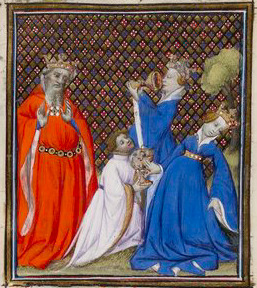
When Masinissa, Sophonisba’s husband, realized that he could not keep his promise that Sophonisba would never fall into Roman hands, he knew there was only one way he could protect her. He ordered his loyal servant to bring him poison that he kept for emergencies as such. He offered it to Sophonisba and told her that he felt it was what he had to do, but that it was her decision to make. Unhappy about her fate, but knowing it was what was best for her, Sophonisba drank the poison without any fear. Masinissa is depicted in the red cloak, looking sadly at Sophonisba. The servant who offered the poison is in the white cloak, looking upward at Sophonisba who is depicted drinking the poison and then falling to her death. She wears the blue gown, and in the first depiction is drinking out of the goblet of poison. In the second depiction, the goblet is passed back to the servant, and she is falling to her death.
After arriving in Lisbon, Gulliver stayed with the captain of the ship that brought him from New Holland to Portugal, Don Pedro. Gulliver refused to go outside in Lisbon, so after arriving at Don Pedro’s house, he would look out the window, trying to readjust to life in Europe. Here we see Gulliver looking out the window terrified. Gulliver found readjusting to European life very difficult, because he became so accustomed to the Country of the Houyhnhnms and the virtue of the Houyhnhnms, that in Europe all he saw were the vices of humans. The same image appears in the 1839 Krabbe edition.
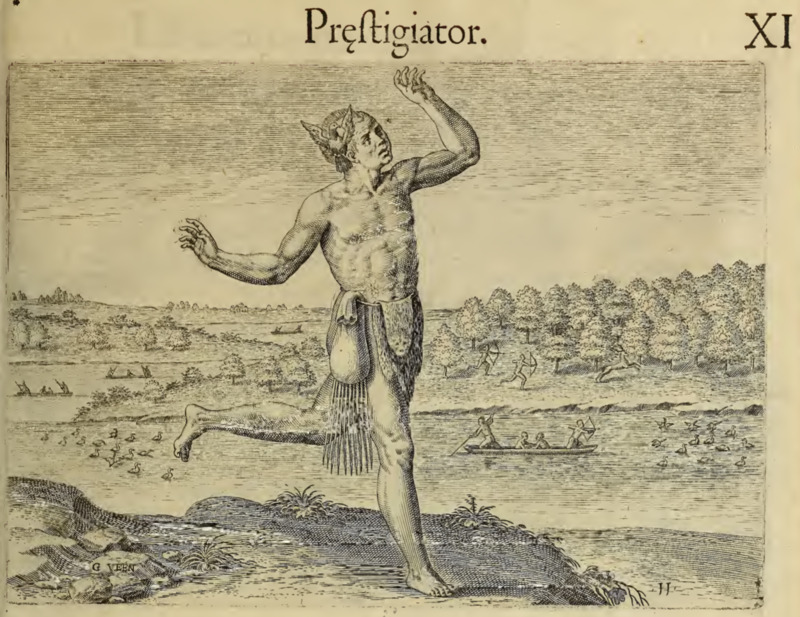
An Indigenous man, called a conjurer or trickster by the author, is shown standing on the bank of a river. He wears a black bird in his short hair as a symbol of his position. His only clothing is a hide tied around his waist, and a satchel hangs at his side. Behind him, other Indigenous people are seen in a canoe, hunting water birds with a bow and arrow.
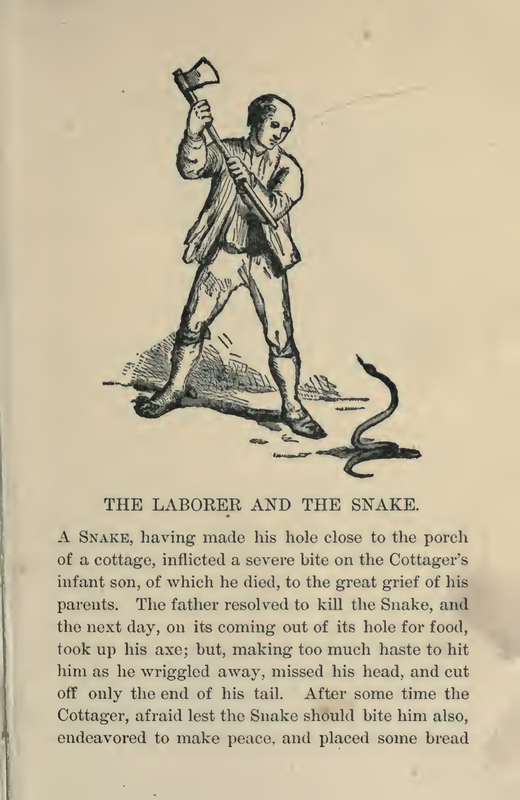
A man is standing wide stance, holding an axe with both hands up in the air. On the ground at his feet, a snake is stretching up to half its length, looking at the man with its tongue sticking out. The man does not seem afraid. His face lacks expression.
Pictured in this image is two men and seven visible monkeys, there is one monkey sitting above everyone in a chair wearing a crown while talking to the man in front of him. All the monkeys surround the main monkey wearing the crown.
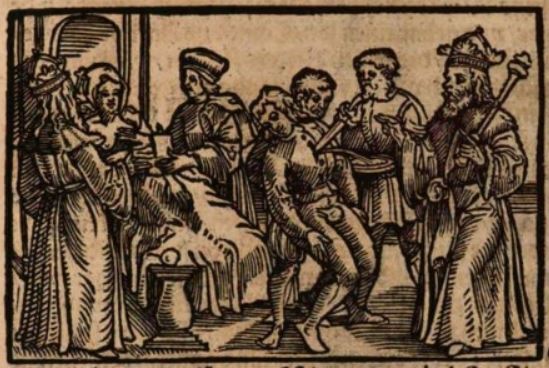
This engraving depicts Faustina Augusta, the wife of Emperor Marcus Aurelius Antoninus, on the left side of the image lying in a bed. There is a doctor hovering over her body while rubbing an ointment over her chest to cure her illness. Her husband Marcus Aurelius is standing on the other side of the bed. Faustina Augusta had fallen ill due to being passionately in love with a gladiator. The doctor suggested killing the gladiator and using his blood to cure her of her sickness and overwhelming lust for him. Marcus Aurelius is depicted on the right side of the engraving wearing a crown and holding a scepter as he watches his men kill the gladiator that his wife was in love with. One of the men is holding a bowl underneath the gladiators wounds so they can use the blood to treat Faustina Augusta.
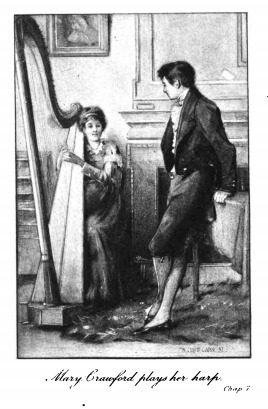
Here we see Mary Crawford playing her harp at the parsonage near Mansfield Park. Miss Crawford arrived at the parsonage near Mansfield after her sister and her husband, Dr. And Mrs. Grant, moved in. Miss Crawford and her brother, Henry Crawford, quickly became close friends with the Sir Thomas’ children, Thomas, Edmund, Maria, and Julia, and their cousin, Fanny. Miss Crawford had her harp brought from her home in Northamptonshire. Playing music was seen as a noble pastime for upper class women in this era, and women were expected to be skilled in some form of artistic endeavor, typically either music or drawing. In this image, Edmund stands next to Miss Crawford playing the harp, listening intently. Edmund fell in love with Miss Crawford and intended to marry her. This scene occurs in chapter 7 as noted underneath the title of this image. The characters are shown in the traditional regency style. Mary Crawford wears the regency style dress with an empire waist. Her hair is worn tied up, as was tradition for women after their coming out before the queen, signaling her entrance into society. Edmund wears a waistcoat and tailcoat, and knickers that stop at the knee. The regency period dated to the early nineteenth century (1811-1820) when George, Prince of Wales, later George IV (r. 1820-1830), reigned as regent for his mentally ill father, King George III (r. 1760-1820). The regency period is associated with the rise of neoclassicism in art and fashion. The same image appears as the frontispiece for the Dent 1893, 1894, 1895, 1896, and 1897 editions of Mansfield Park.
Here we see Gulliver after he returned home to his family in England. Gulliver is sitting in the centre, surrounded by his friends and family. This image appears at the end of the third part, when Gulliver returned home after five and a half years following his travels in Laputa, Balnibarbi, Glubbdubdrib, Luggnagg, and Japan. The same image appears in the 1843 Krabbe edition.
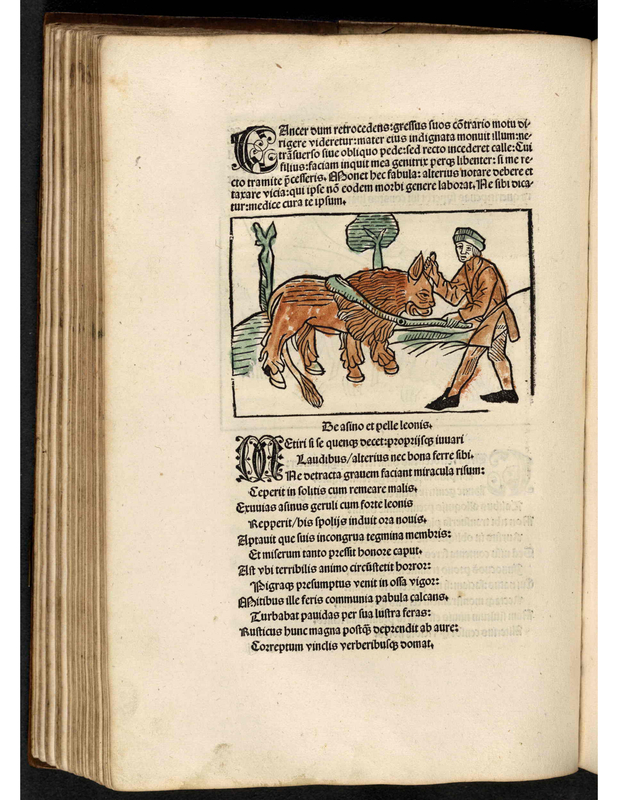
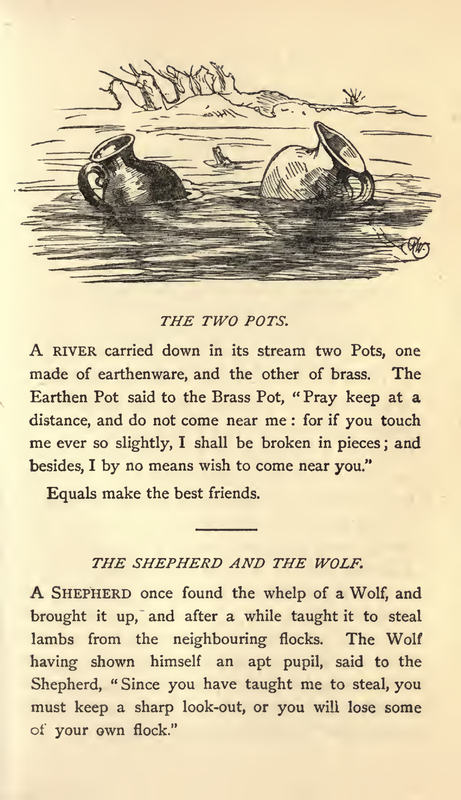
A man standing on the left side of the image grabs the ear of a donkey wearing a lion’s skin. In the background, there is a tree with leaves in the centre, and a tree without leaves and branches on the left side of the image.
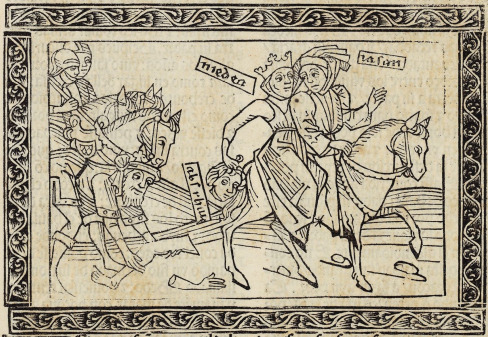
Jason of Thessaly and Medea of Colchis are illustrated riding on a horse together as they flee from Medea’s father, King Aeetes. Boccaccio explained that Medea betrayed her father by helping Jason on his task to find the Golden Fleece. Jason is seated at the front of the horse and Medea is riding behind him. We know that this is Jason and Medea as their names are engraved beside their heads in order to identify them. Medea is depicted holding a severed head in her left hand, which is the head of her brother, Aegialeus (his name is also engraved beside his head). Medea had dismembered her own brother and scattered his limbs around the road behind her and Jason in order to distract her father from pursuing them. King Aeetes is illustrated on the left-hand side of the engraving as he is picking up his son’s limbs.
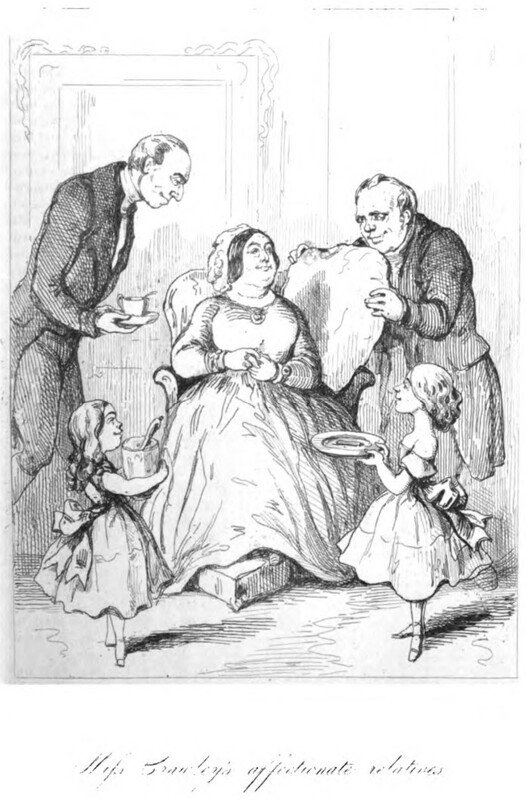
Miss Matilda Crawley is seated in a large, comfortable armchair. She is looking to the right of the image at her brother, Sir Pitt Crawley, who is adjusting one of her cushions. To the left is her other brother, Reverend Bute Crawley, who is bringing her a cup and saucer with a spoon. At her feet are Violet, holding a tall jar or vase, and Rose, holding a plate, both attired in fancy dresses. Below the illustration is printed in cursive its title, Miss Crawley’s affectionate relatives.

![[Title Page - Celestina]](https://cemvccol.ace-net.training/files/large/83c8674422fc250e897e36cb163d403483e39254.jpg)

![[Conflict between two groups of Indigenous Brazilian people]](https://cemvccol.ace-net.training/files/large/ef4b6f87d9555b1b6d402f5d5b26c8e36c5cf040.jpg)
![[Closing Page – Colophon]](https://cemvccol.ace-net.training/files/large/676172a796b02e33a64dc79d6ec388cdd567db99.jpg)

![[Gulliver’s looking out the window]](https://cemvccol.ace-net.training/files/large/8e981233f68627809c8d3f3f60bef309c7d56e01.jpg)
![[Two Men and the Monkeys]](https://cemvccol.ace-net.training/files/large/5094031632ac7da3d922813e19b9eb74aee06e83.jpg)
![[Gulliver returns home to his family]](https://cemvccol.ace-net.training/files/large/77a24f24f9272cb1f8a3fb2a72d2747b79ddb059.jpg)