Gulliver explains the various medicines used in England to treat disease. In this image we see a man sitting on a chamber pot. At this point in the story Gulliver is explaining intestinal and digestive issues and their treatments. The same image appears in the 1843 Krabbe edition.
As Calisto and his servants arrive at Melibea's house, Calisto orders Pármeno to see whether Melibea is home. However, Pármeno suggests that it would be more appropriate if he was the one with whom Melibea first spoke. In this image, we see Melibea and Calisto standing on separate sides of the door talking to one another. Their hands are outstretched toward the same point on the door, giving the semblance that they are trying to connect regardless of a prohibitive barrier. Sempronio and Pármeno are at his side, armed to stand guard as Calisto and Melibea have their private encounter. Lucrecia stands behind Melibea, touching her back either as a sign of comfort or concern.Calisto does not see Melibea that night. She instead asks him to return to her house the following night, where she will be waiting in her garden.
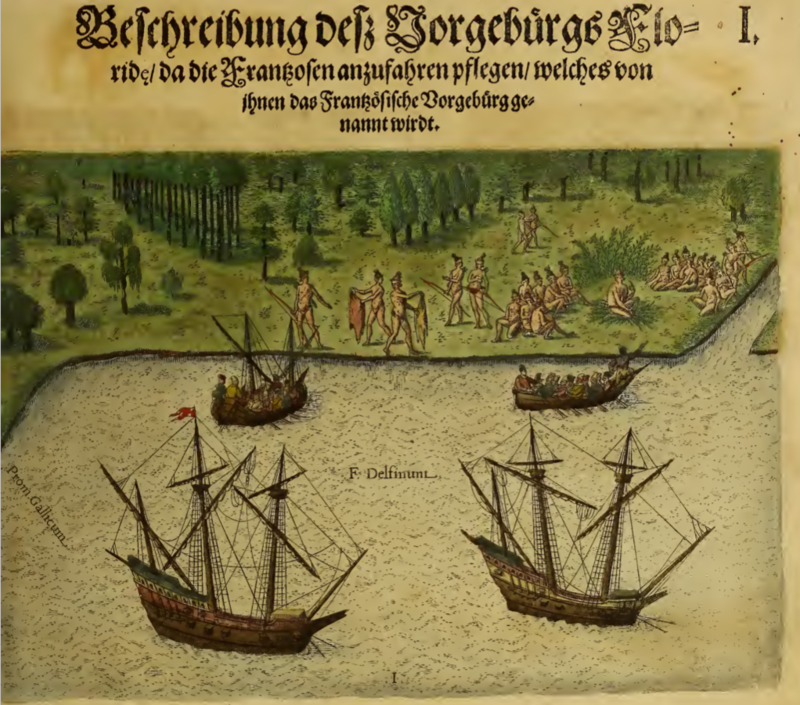
Two large ships are pictured off the coast, two smaller boats full of settlers are being rowed closer to shore. A number of Indigenous people are shown on land, several hold bows and arrows, and a few others hold large pieces of fabric. A group sits on the ground in a semi-circle with one individual at the center. This illustration is identical to the one found on page 37 of Frankfurt 1591, but colored.
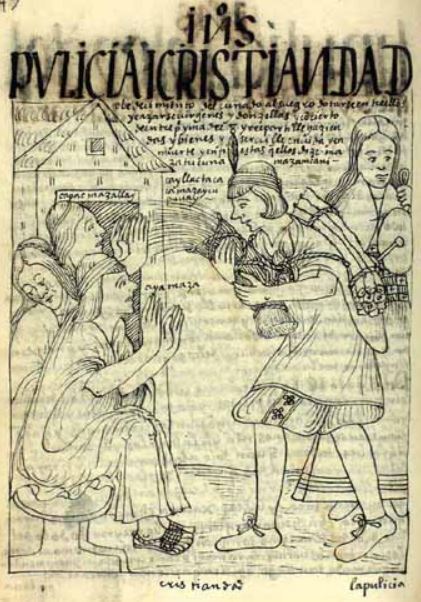
This image depicts a marriage between two indigenous people in Spanish colonial Peru. The man and woman on the right side of the image are the couple who had just gotten married and their family sits on the left side of the image in front of a house. Two family members are depicted speaking to the couple while a woman turns her head away with tears on her face. The married man is depicted holding what appears to be a bundle of straw in his arms and firewood on his back. The woman is holding a drum. The caption at the top of the image reads, obedecimiento del cuñado al suegro dotarse entre ellos y cazarse uírgenes y donzellas y concierto de entre padre y madre y rrepartille haziendas y bienes y seruille en uida y en muerte y en fiestas que ellos dize maza tucuna [brother-in-law obedience to the father-in-law: marry virgins and maidens, morther and father distribute goods and properties and in the party, they say let’s make brother-in-law]. The dialogue written by the married man’s head reads, cayllacta, caca, mazay, cupuuay [give me no more, maternal uncle and brother-in-law of mine]. The dialogue written above the man closest to the house on the left replies, capac mazallay [my prosperous brother-in-law]. The other man has dialogue written by his mouth which reads, aya maza [brother-in-law of value].
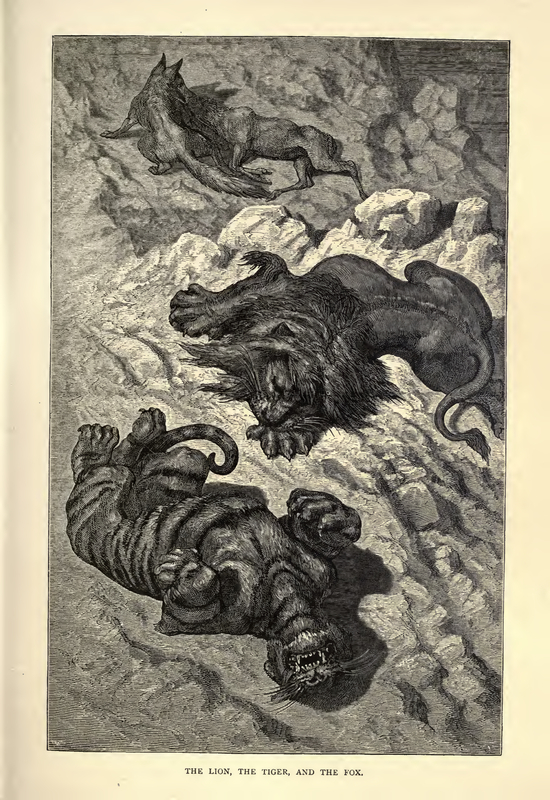
A tiger is lying on its back, showing its belly and baring its teeth. Next to the tiger, further right on the image, a lion is lying down its head towards the tiger. In the distance, two foxes are running away from the tiger and the lion.
This image is a landscape overlooking a river in Dublin. The image is in a preface to the story, which provides a bibliography of the author, Jonathan Swift. A mouse is in the foreground, with a dog farther back. The scene is painted from the top of a hill, looking down towards several houses leading into a town, and a bridge crossing a river. The same image appears in the 1839 Krabbe edition.
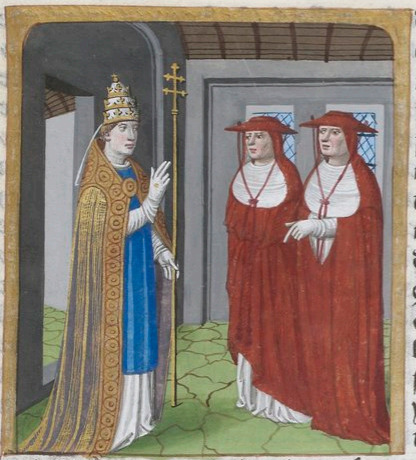
In order to follow her lover to England while he attended school, a maiden named Joan disguised herself as a man and went to school with her lover. Joan had excelled in academics and became incredibly knowledgeable. Continuing to dress as a man, Joan went to Rome and was eventually elected to succeed as Pope, known as Pope John. Pope John (Joan) is illustrated on the left side of the image dressed as a man while wearing papal regalia and the triregnum on her head. There are ecclesiastic women, presumably nuns, standing in front of Pope John (Joan) as he appears to be speaking with them.
Rawdon Crawley, smoking a cigar, leans over the billiards table as he lines his cue up with a ball. On the other side of the table is a man holding his cue vertically in front of himself. In the background to the right are two other men, one standing and wearing a suit, and the other seated on the edge of a table next to a bottle and smoking a cigar.
This image is of a large anchor with rope. Two large ships are visible in the background. The image appears at the beginning of a letter from Richard Tymp, Swift’s cousin. The anchor is also used to represent the letter I, as the first letter of the German word ich (meaning I), which is the first word of the chapter. The same image appears in the 1843 Krabbe edition.
In this image we see Gulliver sitting on a base of a column, looking up at a member of the cavalry on Brobdingnag. The cavalry rides a horse and holds a sword. He wears military attire and helmet. Gulliver tells the reader that when measuring the horse and its rider together they stand over one hundred feet tall. The same image appears in the 1839 Krabbe edition.
This is a bust of Stella Johnson. Johnson was a woman who had a romantic relationship with Swift. The image is a part of Swift’s biography which precedes Part One of Gulliver’s Travels. The same image appears in the 1839 Krabbe edition.
When Sempronio arrives at Celestina’s house, he berates her for not making progress quickly enough. She explains that she will receive greater rewards if she gives Calisto many small victories with extended gaps between them. She asks Sempronio to join her in this scam, offering him a share in the profits and her prostitute Elicia in exchange for his loyalty, to which Sempronio readily agrees. Celestina departs for Melibea’s house (to the left of the illustration), and in the meantime, Sempronio spends the night with Elicia at Celestina’s house.Celestina and Elicia are both wearing robes, while Celestina also has a veil and a rosary. Sempronio is depicted wearing a hat, and he is holding a sword in his right hand.[The figures in this illustration are used in multiple other illustrations throughout this edition.]
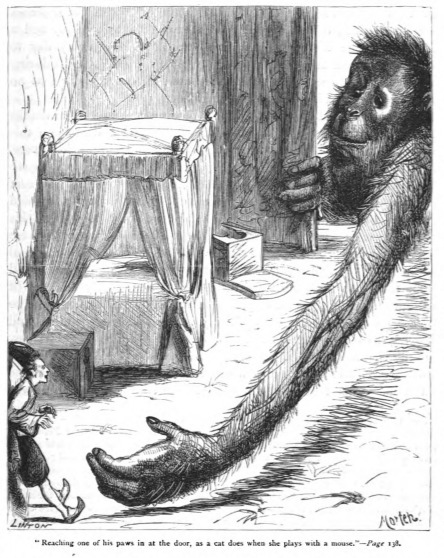
Here a monkey from Brobdingnag kidnapped Gulliver from his house. The monkey belonged to a member of the kitchen staff and escaped the kitchen. It found Gulliver in his house and reached in a window and pulled Gulliver out. The monkey carried Gulliver around the palace and up onto the roof. The monkey eventually tried to feed Gulliver. When the monkey was caught it was killed and Gulliver was left to recover.
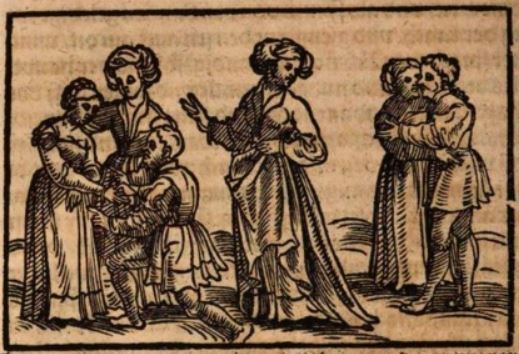
This engraving depicts Scipio Africanus, a Roman general, committing adultery with a young servant girl on the right side of the image. The woman in the centre of the engraving is his wife, Tertia Aemilia. She is depicted looking at her husband and his mistress as they commit adultery. Instead of confronting her husband about the affair, she devises a plan to get rid of the mistress. The left side of the engraving depicts Tertia Aemilia marrying the young servant girl off to a freedman. She does this so that no one finds out about the affair so that it does not ruin her reputation. The freedman is depicted kneeling down as he holds the servant girl’s hand. Boccaccio explains that he chose to write on Tertia Aemilia because the way she handled the affair and how she used her cunning was admirable.
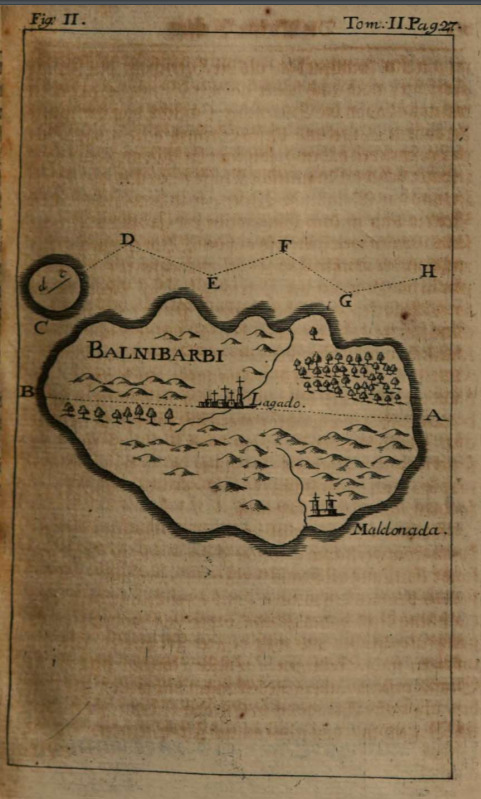
This image depicts the fictional island of Balnibarbi. There are regions of hills in the Southern, and North-West areas of the island. Forests are also shown in the North-East and Central regions. The city of Lagado is in the centre of the island. The town of Maldonada is in the South-East of the island. Above the island are letters, which depict the different ways in which the floating island of Laputa moves above Balnibarbi. The same image appears in the 1739 von Wiering edition.
There is a storyteller in the center of the picture, and he is holding a mirror. The storyteller is centered in the picture on a podium, inside a tented area. The person is surrounded by a lion, peacock, owl, monkeys, horse, camel, chicken, and a dog. There is a owl about to drop a crown-like structure on the story teller. There are several people in the photo besides the storyteller, two in the tent and two on the outside of the street.
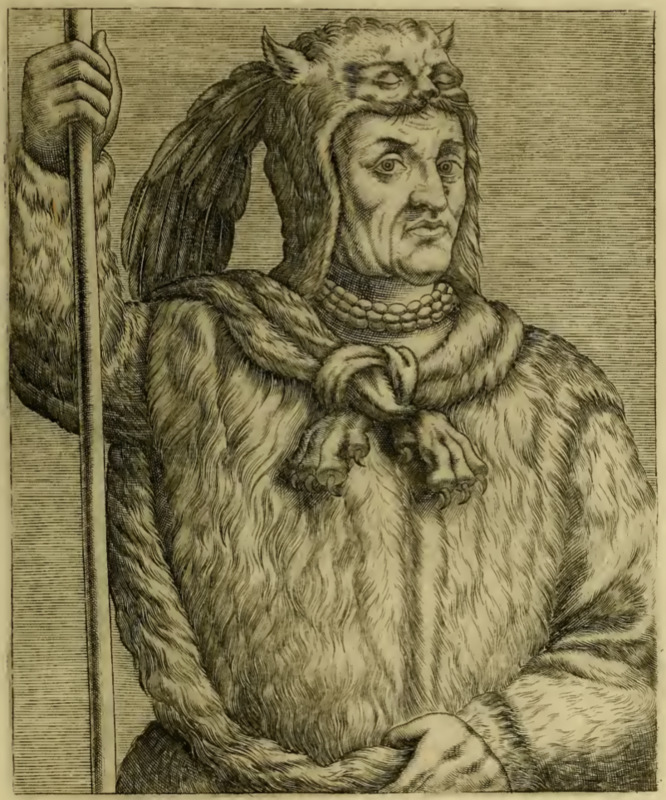
Paraousti Satouriona (also called Saturiwa, or Satiroa according to Thevet – Paraousti may be a title rather than the name of the man) is shown in portrait from the waist up. His torso is angled slightly to his left and he gazes at the viewer. He wears an animal skin cap with the ears, eyes and nose of the animal attached and a large feathered tassel hanging from the back. He wears a multi-strand beaded necklace, a thick tunic of fur, and a fur cape with the paws of the originating animal still attached and tied at his neck. He holds a spear in his right hand. Paraousti Satouriona was a notable chief who led the Timucua group of peoples in Florida when the French were undertaking colonial projects in the region. Not much is known about him outside of his dealings with the French colonists, with whom he maintained largely amiable relations.
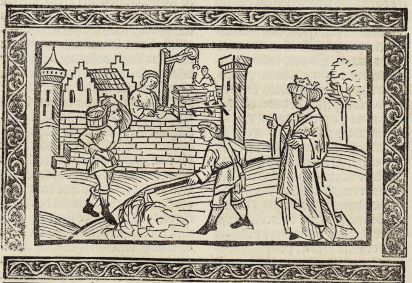
This engraving depicts Elissa, who was later called Dido, standing at the foreground of the engraving watching people build the city of Carthage. She is illustrated with her hands pointing at the city and men as she over sees the construction. Boccaccio explains that Dido had stolen her brother’s treasure in retaliation of him murdering her husband. After fleeing with her brother’s treasure, she made her way to Africa where she established and became queen of the city of Carthage.
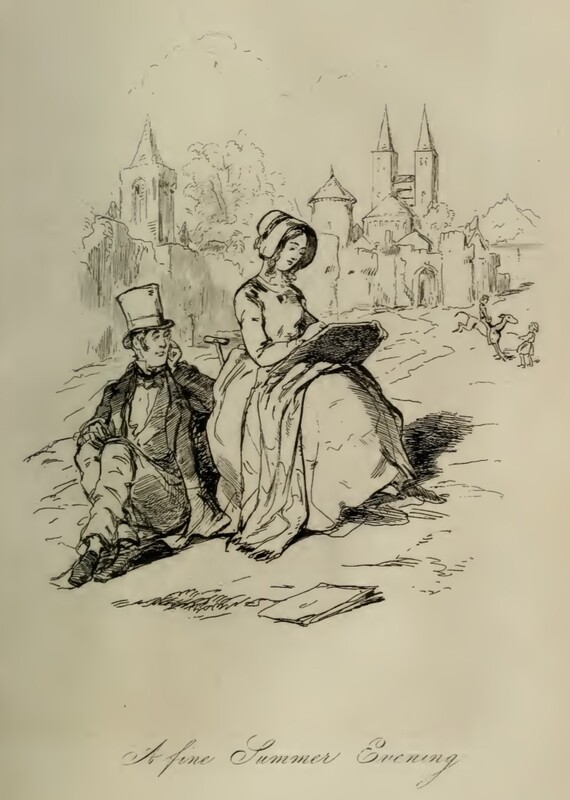
Amelia Osborne sits on a stool on the beach, drawing in her sketchbook. William Dobbin sits on the sand next to her, watching her with an expression of bliss. Further down the shore, a boy is riding a kicking donkey whose lead rope is held by a girl. In the background is a castle and tower on a cliff. Below the illustration is printed in cursive its title, A fine Summer Evening.
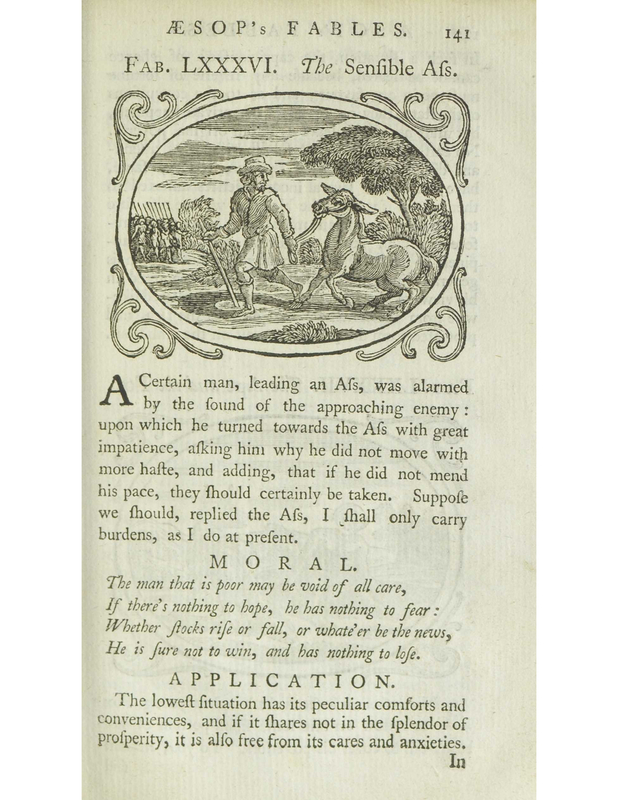
A lion is confronted by three sheep. The three sheep carry in age, inferred from their difference in horn stature. The lion has a long beard style mane, and is standing above the remains of another sheep. All of the animals appear aggressive except for the smallest sheep. The lion is on the left side of the image and the sheep are on the right side.

![[a man sits on a chamber pot]](https://cemvccol.ace-net.training/files/large/91965395dff5ed404e0c5c45f5f8ac5101e352b7.jpg)
![[Act XII - Calisto, Joined by Sempronio and Pármeno, Talks to Melibea Through the Door of Her House]](https://cemvccol.ace-net.training/files/large/1392c53f356ca4b21523af590286ee14f395346d.jpg)

![[A landscape in Dublin]](https://cemvccol.ace-net.training/files/large/ec8981627a65e36443d4b915f1a2be275a2b1f83.jpg)

![[Rawdon Playing Billiards]](https://cemvccol.ace-net.training/files/large/5f6c1ef5a26690fa7c24b9867972887eed4176b5.jpg)

![[Ship’s anchor]](https://cemvccol.ace-net.training/files/large/fbb7f0c413e8f46fb935b245090a71954e33354a.jpg)
![[A member of the cavalry on Brobdingnag]](https://cemvccol.ace-net.training/files/large/cc60a7967b02c1b0d5df212b397e8313c2f472cc.jpg)
![[Stella Johnson]](https://cemvccol.ace-net.training/files/large/dd0649c25007164583b48f931288398472a9387c.jpg)
![[Act III – Celestina Leaves to Visit Melibea While Sempronio Stays with Elicia]](https://cemvccol.ace-net.training/files/large/9943bce760c7b2dff1c25f4c52184da336ddcc7a.jpg)

![[The Knowledge Speaker]](https://cemvccol.ace-net.training/files/large/0c64083cf59dcdef34305fee6b0dfb7dc795857d.jpg)
![[Lion Confronted by a Pack of Sheep]](https://cemvccol.ace-net.training/files/large/5c2b609f9ae202d82a0f0a78efc1809d74eaaada.jpg)