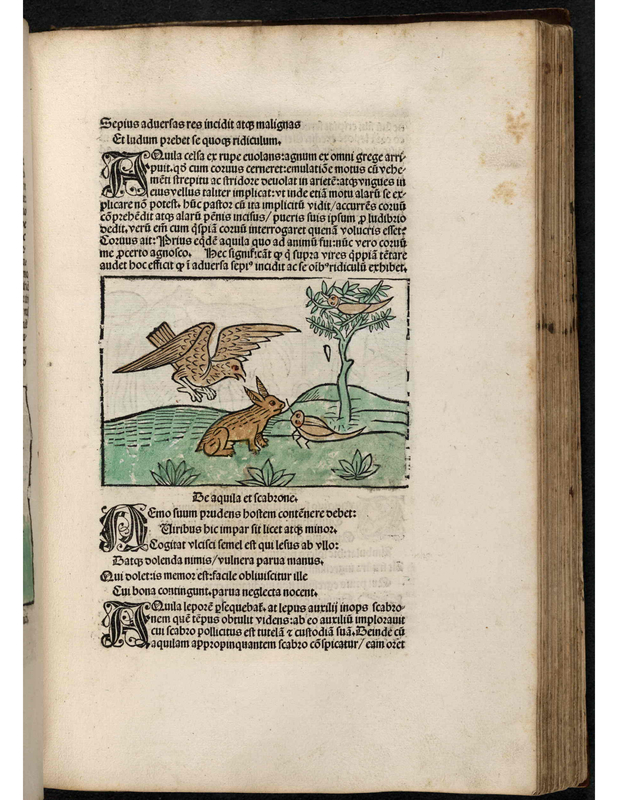
A rabbit, and what appears to be a cricket, face each other, while and an eagle is flying towards the rabbit from behind in hunt. There is a tree neat, and another bird watches.
An Indigenous man is in the process of chopping down a palm tree with a hatchet. Another man sits nearby sharpening a stick for an arrow or spear with a knife. A woman also sits nearby with a child on her lap. There is a single structure in the background.
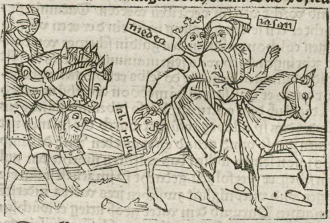
Jason of Thessaly and Medea of Colchis are illustrated riding on a horse together as they flee from Medea’s father, King Aeetes. Boccaccio explains that Medea betrayed her father by helping Jason on his task to find the Golden Fleece. Jason is seated at the front of the horse and Medea is riding behind him. We know that this is Jason and Medea as their names are engraved beside their heads in order to identify them. Medea is depicted holding a severed head in her right hand, which is the head of her brother, Aegialeus (his name is also engraved beside his head). Medea had dismembered her own brother and scattered his limbs around the road behind her and Jason in order to distract her father from pursuing them. King Aeetes is illustrated on the left-hand side of the engraving as he is picking up his son’s limbs.
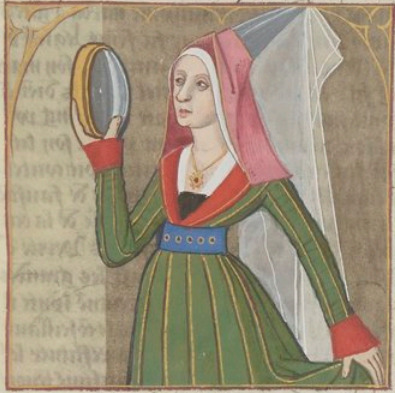
This illumination depicts a portrait of Faustina Augusta, the wife of Emperor Marcus Aurelius Antoninus, looking into a mirror and admiring her beauty. Faustina Augusta was renowned for her beauty and had her portrait engraved onto bronze, copper and silver coins. She was, according to Boccaccio, the first woman called Augusta by order of the senate. She is also famous for having been unfaithful to her husband as she had many affairs, including one with a gladiator.
Here we see the Houyhnhnm’s house. After meeting the Houyhnhnms they invited him back to their house. Gulliver was then introduced to the Houyhnhnm’s family. Gulliver then lived with this family of Houyhnhnms for five years, until he left the country.
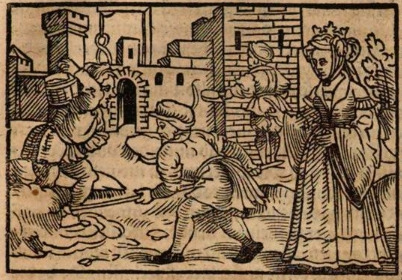
This engraving depicts Elissa, who was later called Dido, standing at the foreground of the engraving on the right-side watching people build the city of Carthage. She is illustrated with her hands pointing at the city and men as she oversees the construction. Boccaccio explains that Dido had stolen her brother’s treasure in retaliation of him murdering her husband. After fleeing with her brother’s treasure, she made her way to Africa where she established Carthage and became queen of the city. There is a man constructing a brick wall in the background, and a man carrying a bucket on the left side of the engraving. There is also a man shoveling the ground in front of Elissa.
Here we see Gulliver’s reunion with his family. He was embraced by his wife and children, but he recoils. Gulliver finds himself disgusted by his family, preferring instead the family he lived with in the Country of the Houyhnhnms. Gulliver was especially distraught that he was a parent and had brought children into the world who lacked the virtues of the Houyhnhnms. The same image appears in the 1843 Krabbe edition.
Pictured in this image is a man with a knife in his pocket while he holds onto a branch on the tree. Around the man is six birds sitting on the other branches and trees. A bag is also sitting on the ground next to the man.
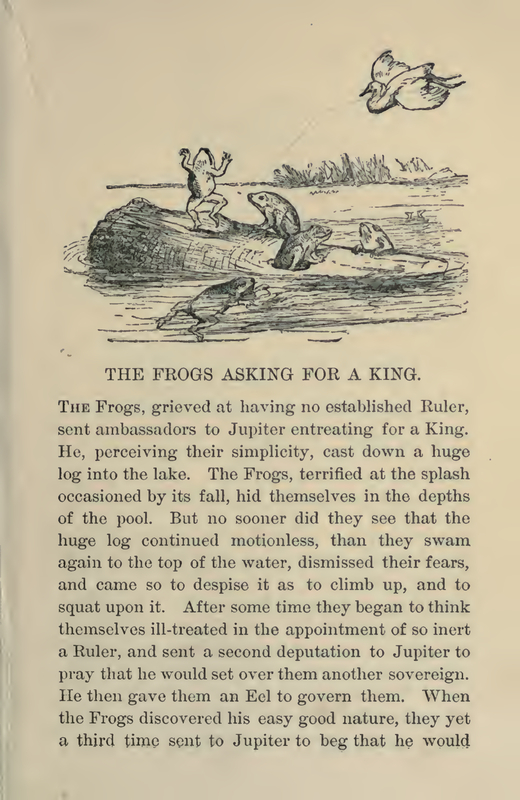
A log of wood is floating in a lake with 4 frogs sitting on it, while another is climbing on the log, and a sixth frog is swimming up to it. One of the frogs is on both of its back legs, both its front legs up in the air as it is looking up in the sky. In the upper right corner, a crane is flying in the sky, getting ready to land in the lake.
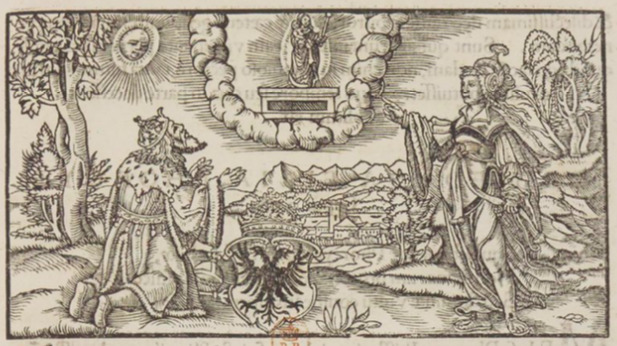
Eriphila was a sibyl, or fortune teller, who lived on the island of Erythrae. She was recognized for her extremely accurate predictions – so accurate that they were essentially resumes rather than predictions. Though she appears to have a large stomach in the photo, she was a virgin. In the photo she can be seen recognized for her extremely accurate predictions – so accurate that they were essentially resumes rather than predictions. In the image, she is seen describing a prediction of the future to an onlooker.
Here we see Gulliver walking through the streets of Lisbon with Don Pedro. Gulliver had a difficult time readjusting to life in Europe as he was accustomed to the virtues of the Houyhnhnms. Gulliver hold a cloth with rue or tobacco to his nose so he cannot smell the city, which Gulliver could not stand. The same image appears in the 1839 Krabbe edition.
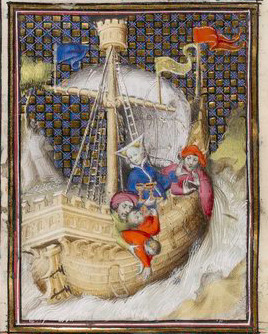
When Theoxena found out that the threat of the Romans was nearing, she knew she could not let her nephews die by their hand. She thought it would be noblest to die by their own hand, before they could be captured and killed. While on the ocean, a Roman boat approached, and she knew the time had come. She placed poison and daggers in front of her nephews, and told them to choose whichever way they wanted to die. In the image, the family is on the sea. Theoxena, wearing the blue gown, watches as her husband, with the pink hat, throws her nephews into the sea as they die. Behind Theoxena is the last live nephew, watching as his brothers are thrown into the sea.
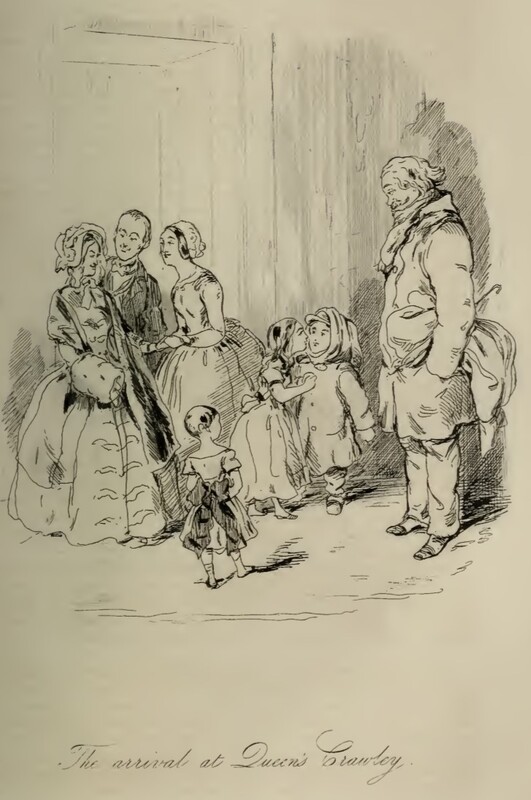
Matilda Crawley greets her cousin, the younger Rawdon Crawley, while her brother Pitt Binky hangs back and watches. To their side is Mr. Rawdon Crawley, watching his son. In the background, Sir Pitt and Lady Jane are greeting Rebecca Crawley, who has just arrived at Queen’s Crawley with her husband and son. Below the illustration is printed in cursive its title, The arrival at Queen’s Crawley.
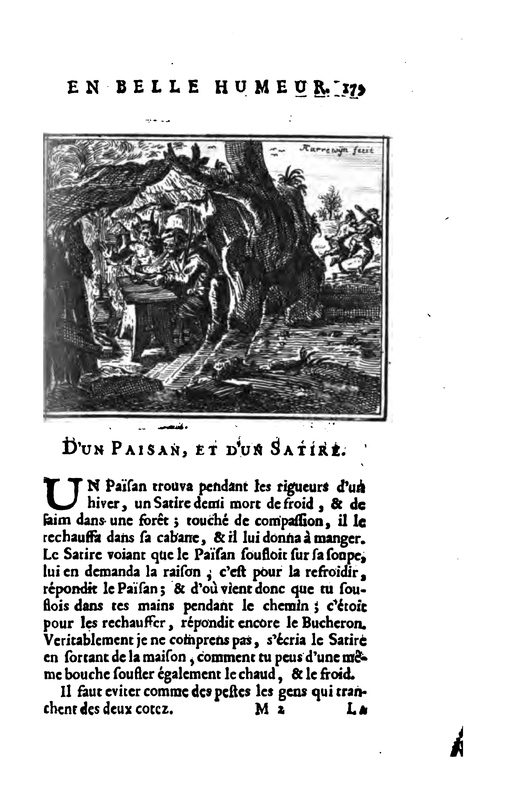
A peaceful being found during the rigors of a winter, a satire half dead of cold, and of hunger in a forest; touched of compassion, he warmed him in his hut, and he gave him to eat.
As midnight approaches, Calisto (central figure), Sempronio (leftmost figure), and Pármeno (left-central figure) leave for Melibea’s house. Calisto asks Pármeno to knock on her door, but Pármeno replies that it would be best if his was the first voice she heard. When Calisto knocks, he is first greeted by Lucrecia (rightmost figure?), who confirms his identity. Calisto and Melibea (right-central figure; only her shoulder and headpiece are showing) talk for some time through the door, but soon Pármeno and Sempronio hear a commotion in the distance and flee. They realize the noise is coming from the alguacil’s (justice’s) men patrolling another street, and they head back toward Melibea’s house. However, the alguacil’s men soon enter upon the street where Melibea’s house lies, causing Calisto and his servants to flee to Calisto’s house. While Calisto takes his rest, Sempronio and Pármeno decide to pay Celestina a visit.
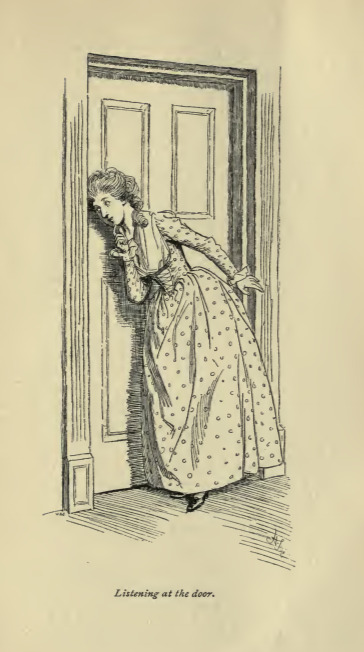
In this image Anne Steele listens at the door while Lucy and Edward were discussing their engagement. Anne reiterates what he heard at the door to Elinor while on a walk in Hyde Park. Elinor wondered how she knew everything and asked if she was in the room while they discussed their plans. She said she was listening at the door and Elinor was appalled at the impropriety of this. This scene occurs in chapter 38. The characters are shown in the traditional regency style. Anne Steele wears a regency style dress with an empire waistline. The regency period dated to the early nineteenth century (1811-1820) when George, Prince of Wales, later George IV (r. 1820-1830), reigned as regent for his mentally ill father, King George III (r. 1760-1820). The regency period is associated with the rise of neoclassicism in art and fashion.
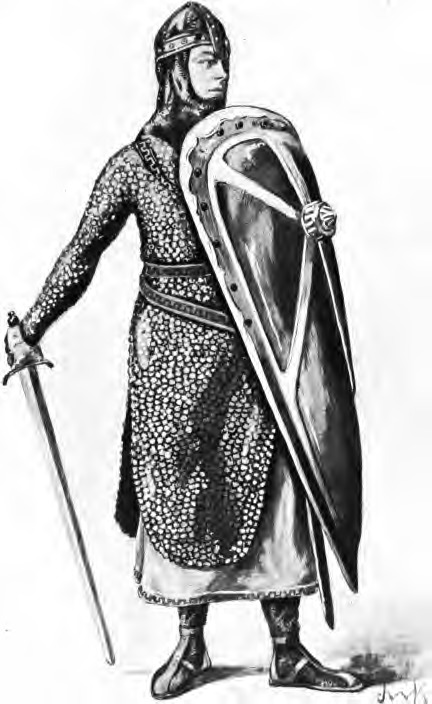
This image depicts Martin Pelaez, an Asturian knight previously noted for his cowardice. The Cid was able to make him into a worthy and brave knight over time, in part due to the shame that he was not allowed to sit with the more worthy knights while they ate. He was instead made to sit at the Cid’s table, which would normally be an honour but was in this case supposed to reinforce that he was not like the other knights due to his cowardice.
Three people belonging to the Tupinambá Indigenous group are shown; a man, woman and child (possibly a family unit). The man stands in front holding a bow in his right hand and arrows in his left. He wears a necklace and an adornment on his chin and is otherwise nude. The woman stands behind him with one hand on his shoulder and a baby in her other arm. Her hair is long, and she is nude. There is a hammock behind the group.
Jane Crawley stands between the doors of the bailiff’s as the young janitor opens the inner door to let her through. She has come to pay Rawdon’s bills after he wrote to her and his brother when Rebecca said that she would not come.

![[An Indigenous Brazilian man chops down a tree]](https://cemvccol.ace-net.training/files/large/7cf97af5df810a4576deff3ee94769afeb35cebc.jpg)
![[The Houyhnhnm’s house]](https://cemvccol.ace-net.training/files/large/7eb8f3382452b8e33474a834ed97766724d41cff.jpg)

![[Gulliver is reunited with his family in England]](https://cemvccol.ace-net.training/files/large/aad954459c32ace8c5eb209f6de5d9e9f47c9aad.jpg)
![[One Man and Many Birds]](https://cemvccol.ace-net.training/files/large/0974dedda5db6fe77d4e897b2f239248959ac8f3.jpg)

![[Gulliver walking outside in Lisbon with Don Pedro]](https://cemvccol.ace-net.training/files/large/fbe378138b529b6f45c664588c97eeda0c5fcc92.jpg)

![[Act XII (First Illustration) – Calisto Talks to Melibea and Lucrecia Through Melibea’s Door While Sempronio and Pármeno Stand Guard]](https://cemvccol.ace-net.training/files/large/c32d9515194ad23455a77940b274f9c177e9c12f.jpg)
![[A Tupinambá man, woman and child]](https://cemvccol.ace-net.training/files/large/325d6e1340abbe9a4582c54c92521ce3116101ef.jpg)
![[Lady Jane at the Bailiff’s]](https://cemvccol.ace-net.training/files/large/b350f328436c22edafb498c42110875296247020.jpg)