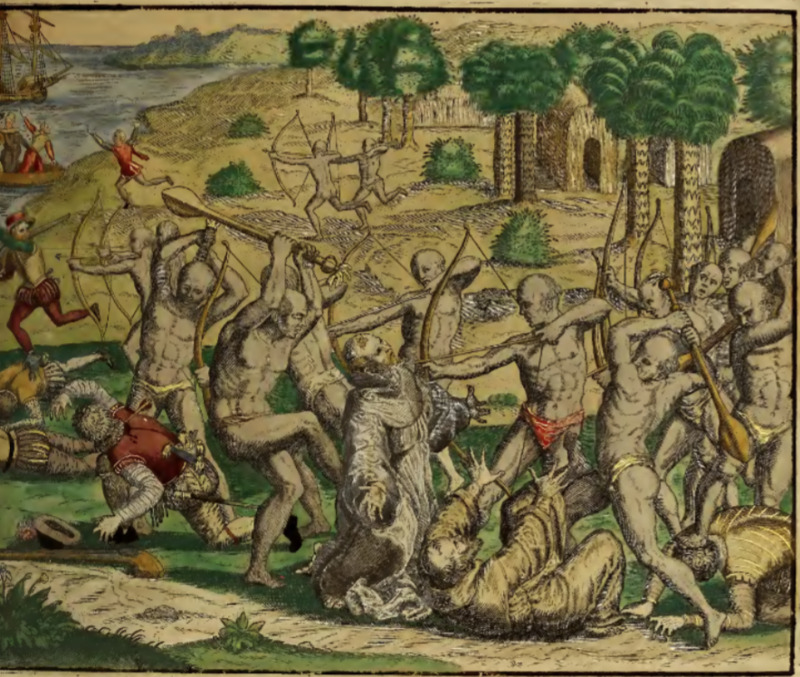
In Venezuela, a group of Indigenous people kill Spanish soldiers and monks. At the center of the group, two monks have been knocked to the ground. One lays on his back with his hands in the air to ward of blows from the club that an Indigenous man holds poised above him. The other monk is on his knees with his arms spread wide, and an Indigenous man is about to shoot an arrow into his throat while another holds a club over his head. In the background, Spanish soldiers flee the attack in a rowboat, while others who have not managed to escape are killed on shore, their muskets dropped to the ground. A European ship is anchored further along the coast. Several dwellings are visible among the trees on the right. This image is identical to one found on page 179 of Frankfurt, 1594, but colored.
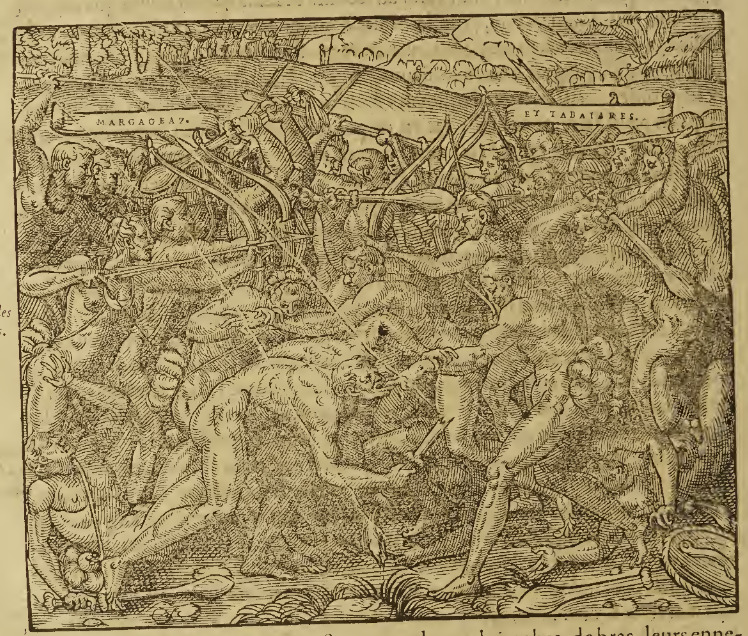
wo groups of Indigenous people (the Margageaz and the Tabaiares, according to the author) are shown engaged in combat. Both groups are comprised of men wielding an assortment of clubs, bows and arrows, shields and spears. Some also use their teeth as weapons, biting the hands and arms of their enemies. Members of both groups wear necklaces and round feathered adornments hanging at their backs. In the background, a group of combatants stands on a hill and to the right a structure appears to be on fire. This image is identical to one found on page 942 verso of Paris, 1575 (Chaudière).
Here we see an image of a donkey. It appears when the Council of the Houyhnhnms discussed the possibility of exterminating the yahoos. One of the reasons for this was to correct the mistake of the Houyhnhnms ancestors, who failed to breed donkeys which were more hygienic and had better agility than the yahoos. The same image appears in the 1843 Krabbe edition.
An unburning fireplace, with the kettle fallen onto the coals. On the mantle is a clock with two figures. A pair of slippers are abandoned in front of it, and on the wall to the side, the poker-holder is decorated with the letter T from There, with markings leading up the wall to another marking of the same letter.
The left panel depicts Calisto’s servant Pármeno wearing a hat, with a sword mounted on his belt. To the right we see Calisto’s other servant Sempronio (here spelled ‘Sepronio’, likely a printing error), who is also wearing a hat with a sword mounted on his belt. Both figures are placed outside. The left panel is identical to those found on pages 60, 146, and 173, and nearly identical to those found on pages 263 (where it is labeled ‘Sosia’), 299 (labeled ‘Pleberio’), and 326 (labeled ‘Sosia’). The right panel is nearly identical to those found on pages 114 (where it is labeled ‘Sempronio'), 263 (labeled ‘Calisto’), 271 (labeled ‘Calisto’), 326 (labeled ‘Tristan’), and 350 (labeled ‘Pleberio’).
Here we see the Queen of Brobdingnag’s dwarf shaking an apple tree to drop apples on Gulliver. Gulliver was walking through the garden when the dwarf saw him and began to shake the tree, dropping apples on Gulliver to torment him. In the image, Gulliver is lying underneath four apples with only his head and arms sticking out. The dwarf shakes the tree. The same image appears in the 1839 Krabbe edition.
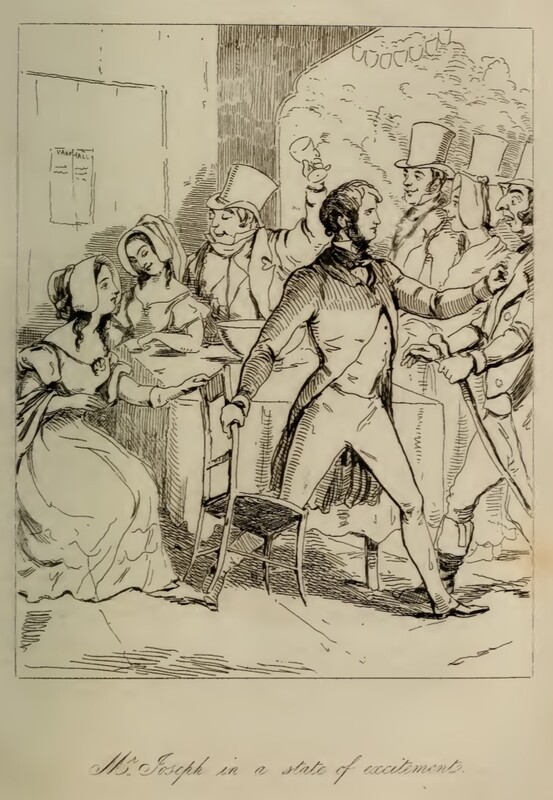
In the center of the image is Joseph Sedley, waving around his cup and singing. On the table before him is the bowl of alcohol of which he has drunk all by himself. Amelia Sedley and Rebecca Sharp are seated at the table to the left of the image, with Rebecca gazing down at Amelia, who looks concerned. To the right is George Osborne, holding onto his chair and facing a crowd of onlookers, the nearest of which he is blocking from coming closer. Below the illustration is printed in cursive its title, Mr. Joseph in a state of excitement.
A barefoot woman with loose, wild hair stands amongst scattered rocks. She holds a twisted, tapered stick with the letter S from Such curling up into the air off the end of it.
Here we see an overturned boat. This image appears at the end of Part Two. It symbolizes Gulliver’s return from Brobdingnag, and his impending departure on his third voyage in which he visited Laputa, Luggnagg, Balnibarbi, and Glubbdubdrib.
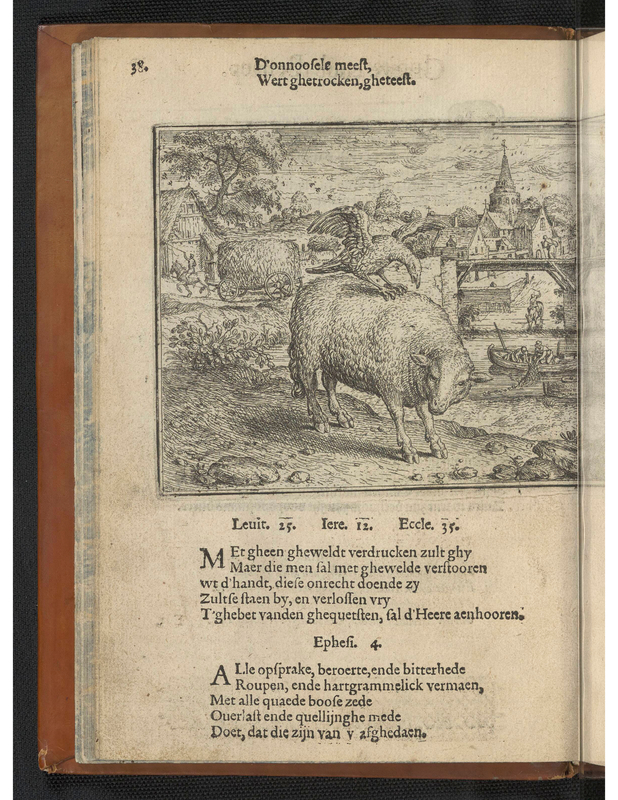
A crow and a sheep stand on a hill in front of a town. The crow stands on the sheep’s back with its wings spread. They sheep has its head bowed and looks at the crow from the corner of its eyes.
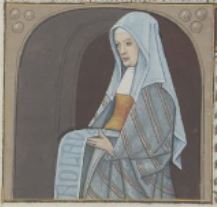
This illumination depicts a portrait of a Greek woman named Leontium. Boccaccio explains that Leontium was an intellectual scholar and philosopher and became renowned for criticizing and speaking against certain philosophers of her time. Boccaccio believes her fame was hindered by becoming a prostitute.
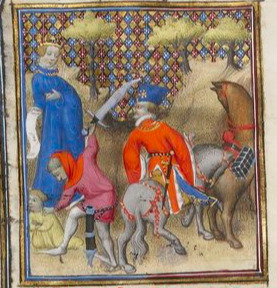
Medea, Queen of Colchis, wears a blue gown on the left of the image. She looks downward as her little brother is dismembered – an order that she gave. She made the order to have her young brother dismembered and body parts scattered throughout a field as a distraction so that she could get an advance while fleeing from her father. Her little brother is in a yellow robe in the bottom left corner of the image. The man with the horses is who was tasked with the duty of dismembering the child.
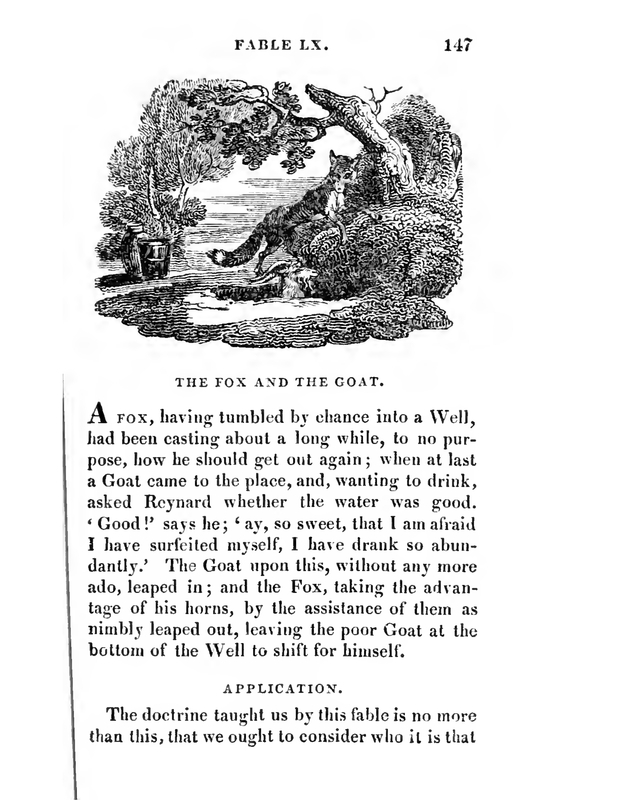
A goat is in a well, with only its head and back above the surface. It has a distressed expression on its face. A fox stands above the goat, with its hind paws on the goats horns and its front paws on the land near the well. Behind them, to the right, there is a tree leaning over the well. On the left-hand side of the well there is a small bucket and a pot.
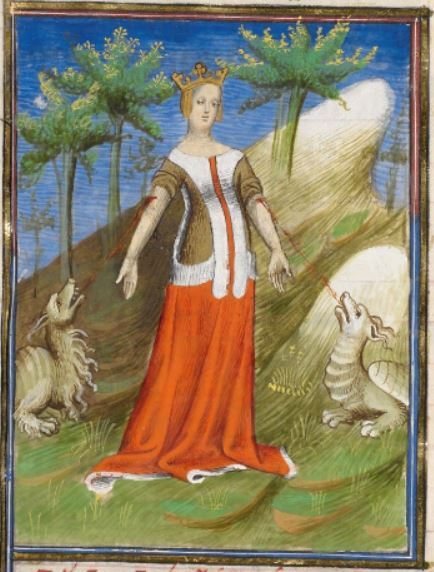
This illumination depicts Queen Cleopatra of Egypt killing herself. Her and her lover, Mark Antony, both killed themselves to avoid dying at the hands of Octavian. Boccaccio believes that Cleopatra killed herself by cutting her wrists and putting asps (vipers) at the wounds to poison herself. She is illustrated standing in the centre of the image with her wrists cut and her blood falling to the snakes by her feet to symbolize them poisoning her wounds.
Here we see a centry posted outside Gulliver’s door in Luggnagg. The officer with whom Gulliver spoke said he must be confined until permission from the Court could be granted to Gulliver to stay on the island as he was a guest. Despite his confinement, Gulliver’s quarters included gardens. Gulliver had several visitors during his confinement who came to ask him about his home, with the help of an interpreter Gulliver hired while on the ship from Glubbdubdrib. The same image appears in the 1843 Krabbe edition.
Sir Pitt Crawley leans against a fireplace at his brother Rawdon Crawley’s house. He is dressed in his Court suit and has a thin sword at his side. Mrs. Rebecca Crawley is seated on a chaise next to him, turned in his direction to admire his uniform.
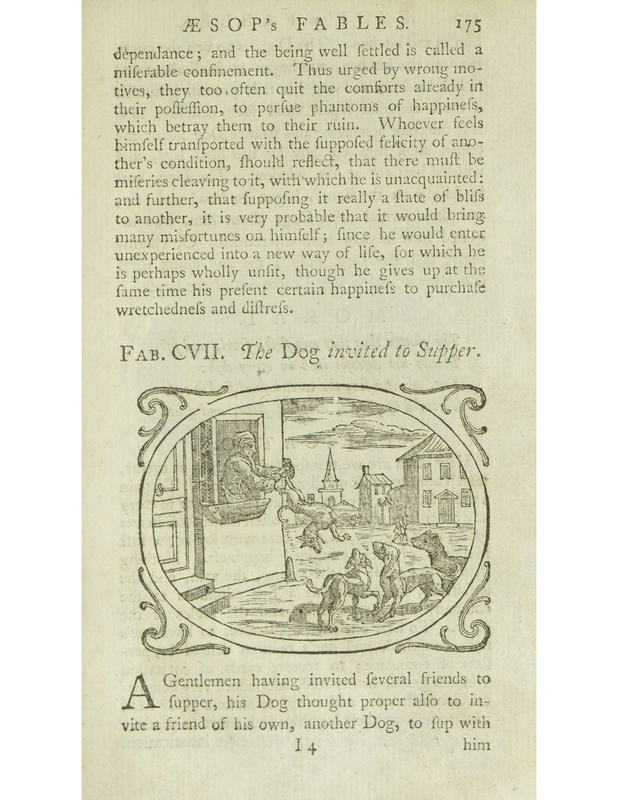
A man leaning outside the window of a house holds a dog upside down by its hind legs. Three dogs to the right of the house are all watching the man handling the dog. There is a town in the background.
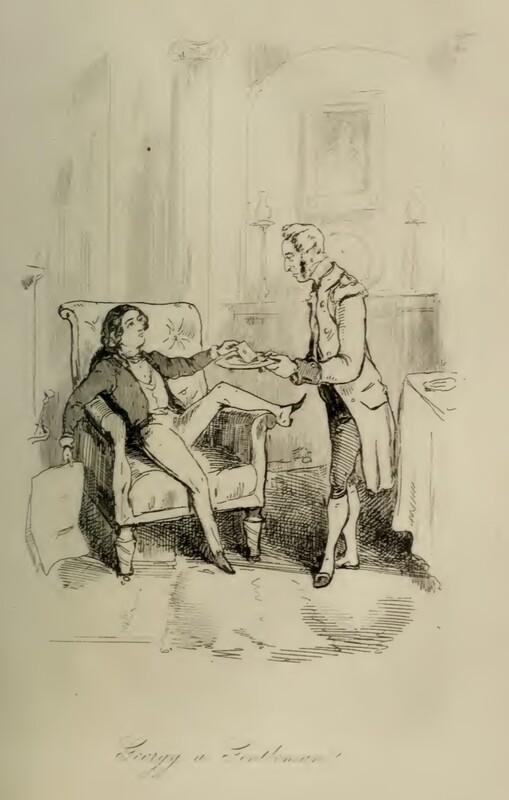
Georgy Osborne lounges in an armchair, with one arm dangling a sheet of paper over the side and one leg up over the arm of the chair. He is taking a letter which a serving man has presented to him on a platter. Below the illustration is printed in cursive its title, Georgy a Gentleman.
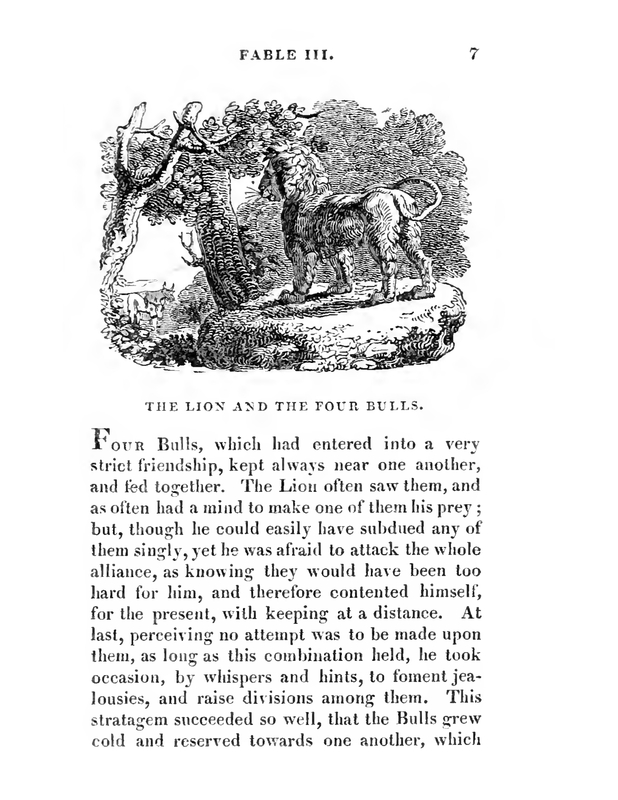
A Lion was preying on 4 bulls from a distance on a higher rock. The friendship hence the proximity of them made hunting difficult. In order to break up the alliance, the Lion attempted to divide them via jealouies.
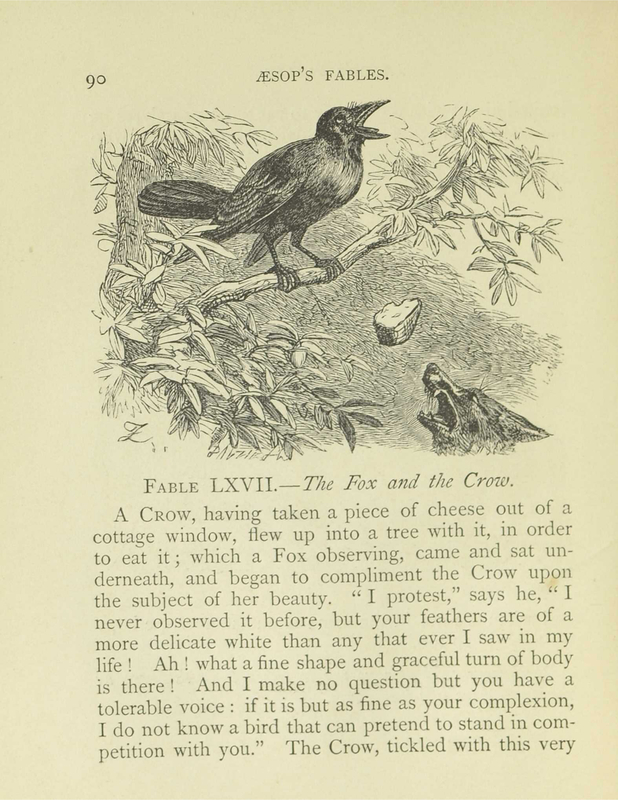
A crow sits on a branch nestled in a tree, its beak open as if singing. Below it, the head of a fox is seen reaching up with an open mouth to catch the piece of cheese falling towards it, dropped by the crow.

![[a donkey]](https://cemvccol.ace-net.training/files/large/54e98aae16e4f973d73911be8e57ef7f08f23185.jpg)
![[Vanity Fair Volume II. Chapter XXVI Inhabited Initial, T]](https://cemvccol.ace-net.training/files/large/41f0ca4cbe00c5126a9f4be2075a96cfae3666d1.jpg)
![[Act IX – Pármeno and Se(m)pronio]](https://cemvccol.ace-net.training/files/large/64c15a0193a1d463a24ecadba2fb590fe2b60eae.jpg)
![[The Queen of Brobdingnag’s dwarf torments Gulliver by shaking a tree]](https://cemvccol.ace-net.training/files/large/2c075ce226996c2fcba2537ce2df4af57fe340b6.jpg)

![[Vanity Fair Volume II. Chapter XXVIII Inhabited Initial, S]](https://cemvccol.ace-net.training/files/large/956d1cb3e565795cfd7a1d497785a090dfeee846.jpg)
![[An overturned boat]](https://cemvccol.ace-net.training/files/large/f14e4560c188d84ef2654b9cef06d7532fcfb885.jpg)
![[a guard outside Gulliver’s door in Luggnagg]](https://cemvccol.ace-net.training/files/large/8af46aa344685a17aeb60f148a026c703cb44d39.jpg)
![[Rebecca Admires Sir Pitt’s Court Suit]](https://cemvccol.ace-net.training/files/large/ce5a086230135ccf0cc0319ccdaac2b2c940bc21.jpg)