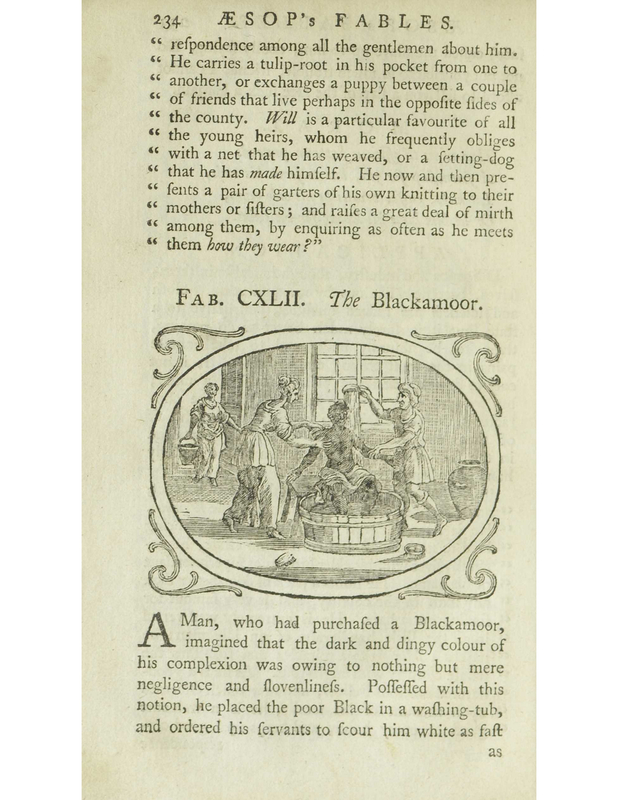
The scene is taken place outside, in the background there is a building with an alley to the right where a woman is walking with a bucket. There are two women washing the Blackamoor who is sitting in a wooden bath tub full of water with a vase to the right along other objects on the ground.
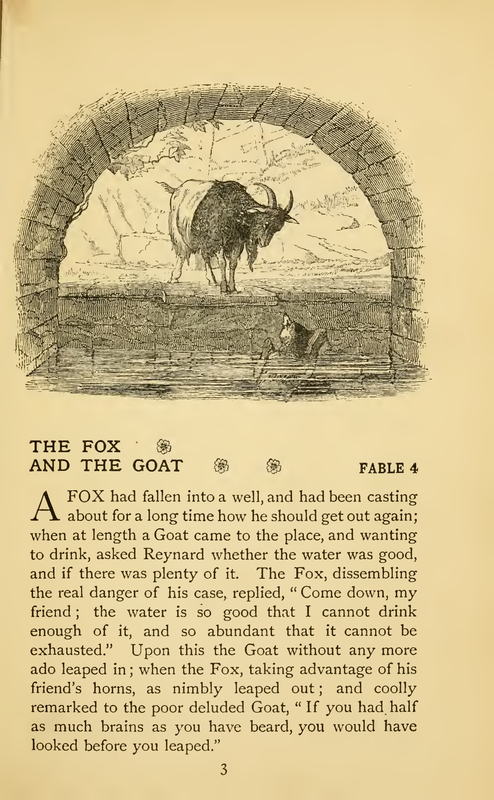
A goat is looking down at the water, where a fox is seen floating around. It looks like the fox cannot get out of the water. There is an arch of stone with an entrace to the outdoors, which is where the goat is situated. The water where the fox is floating in ressembles a well.
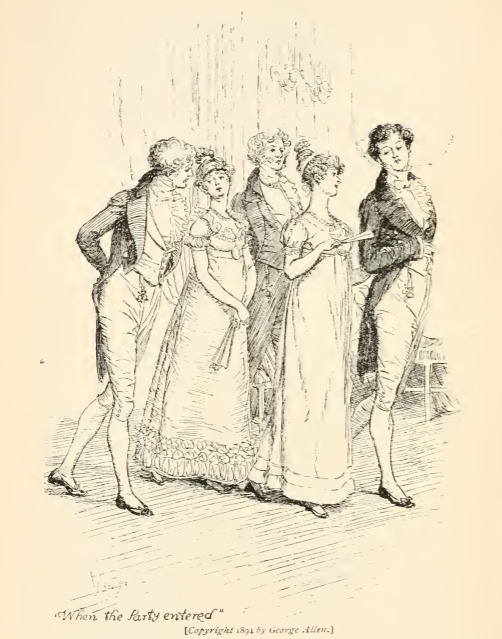
In this image Mr. Bingley, Mr. Darcy, Mrs. Hurst, and Caroline enter the ball in Meryton. The ball was given shortly after Mr. Bingley’s arrival in Hertfordshire. This scene occurs in chapter 3. The characters are shown in the traditional regency style. Mr. Bingley and Mr. Darcy wear waistcoats and tailcoats with cravats. The women wear regency style dresses with empire waistlines and carry fans. Fans were used at this time to communicate to others across the room at balls. The regency period dated to the early nineteenth century (1811-1820) when George, Prince of Wales, later George IV (r. 1820-1830), reigned as regent for his mentally ill father, King George III (r. 1760-1820). The regency period is associated with the rise of neoclassicism in art and fashion.
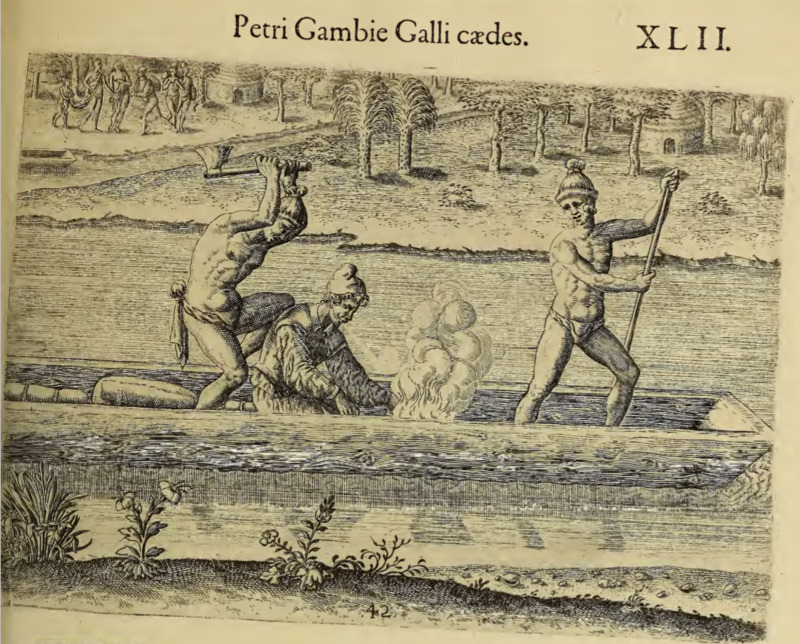
Three men are shown in a dugout canoe. An Indigenous man in the front of the canoe uses a long pole to maneuverer the boat in the river. Another Indigenous man stands in the rear of the canoe, looming over a colonist who kneels in the center of the boat (according to the title, he is a Frenchman named Pierre Gamble). The Indigenous man holds a small axe raised over the colonist’s head. A fire burns in the center of the boat, in front of the colonist.
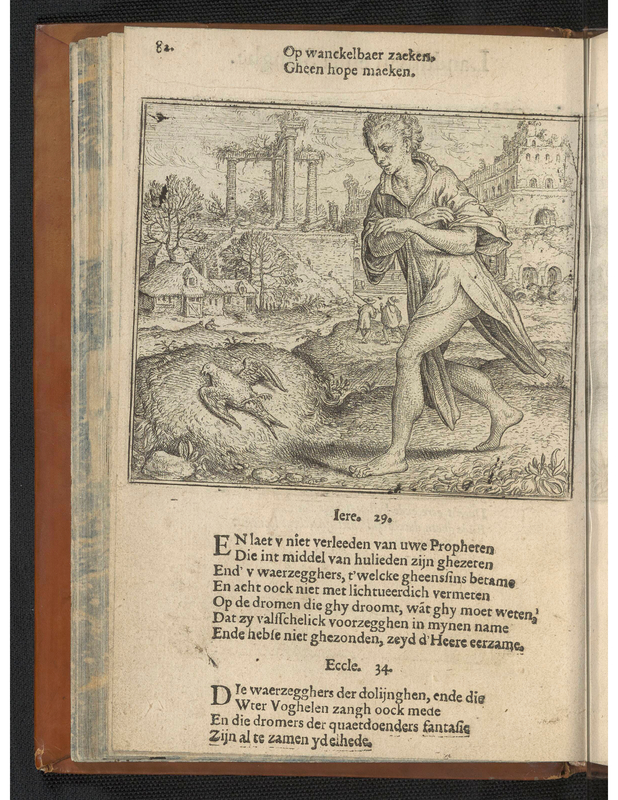
A person walks toward a bird that is laying on its back on the ground. In the background, is a village with large buildings and pillars. along with houses.
Two groups of Indigenous people are shown engaged in conflict. Individuals on both sides wield a combination of bows and arrows and clubs as weapons. A few people also carry small shields. Members of both groups wear feathered headdresses and feathered adornments slung around their shoulders and hanging at their backs. In the background behind the warring groups there is an Indigenous village with several people going about their lives. There are two long structures on the right and two hammocks strung between trees. One person lounges in a hammock, another carries firewood. A woman sits on the ground with a child while another child carrying a small bow walks nearby. A monkey also sits near the group. To the left, a rack with several human limbs on it sits over a large fire.
A family walks down a path next to a stone marked with an X. The man is holding the boy’s hand and carrying a basket on a stick over his shoulder. The woman is covered in a shawl, carrying a basket on one arm, and holding a walking stick in the other. She is turned to face away from the stone marker. In the background are a mesa and the letter F, from Friend.
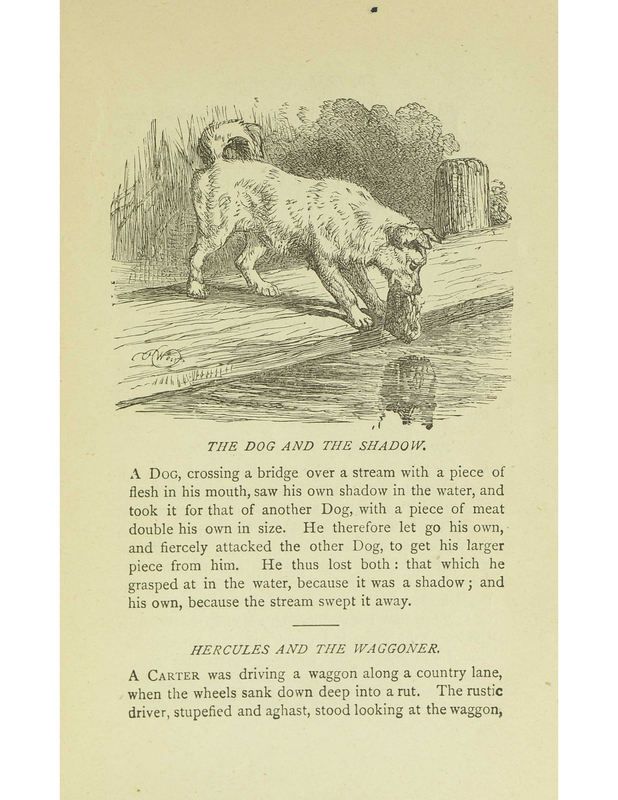
A dog is on a sidewalk, looking down at the water. It holds something in its mouth that looks like a piece of meat. The dog is looking curiously at its shadow in the water.
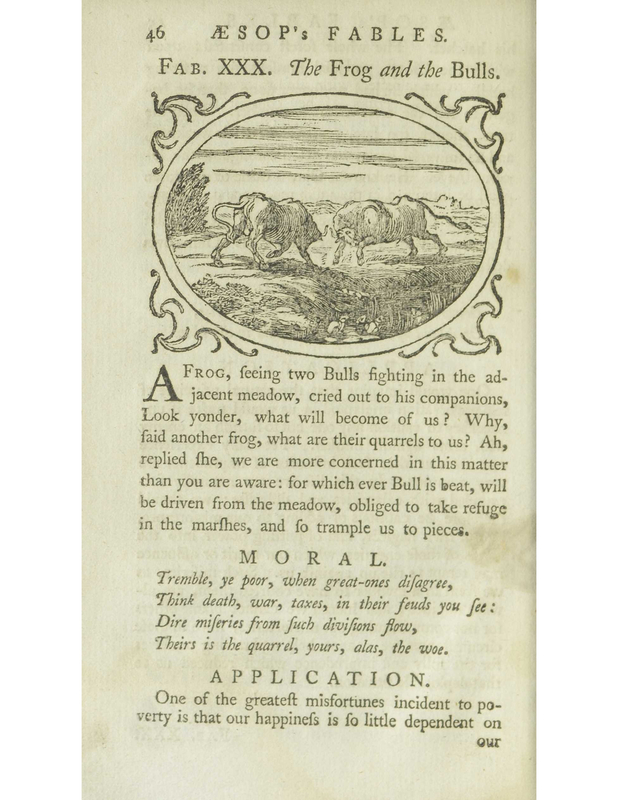
Two bulls stand in a field, fighting one-another, swinging their horns. One bull's back is facing us, while the appearance of the other bull is visible.
In this image we see Gulliver’s ship setting sail shortly after returning from Brobdingnag. His wife and family protested his leaving again since he was very confused after returning from Brobdingnag. Nevertheless, Gulliver decided to set sail again and here we see the ship leaving the port. The same image appears in the 1843 Krabbe edition.
Colonel Rawdon Crawley visits his son, the younger Rawdon Crawley at the Whitefriars, where the boy is attending school. Rawdy is standing tall and proud in his black gown and breeches. In the background are assorted other boys, talking and playing games.
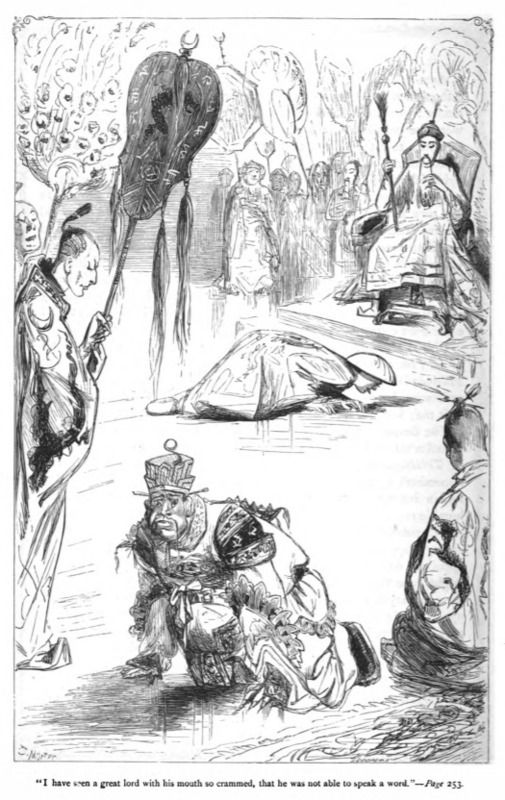
Here we see the custom of licking the floor in front of the throne at the court of Luggnagg. This was understood to be a sign of respect. If the person performing this ritual were not in the king’s favour, then extra dust might be thrown on the floor. The person performing the ritual would not be allowed to spit out the dust so their mouth could become so dry they could not actually speak to the king.
The two figures represented here are Melibea (on the right) and her father Pleberio (on the left). We know this must be the case, since the only other character included in the 20th act is Lucrecia, who only talks with Pleberio in his bedchamber. Thus, we can infer that this illustration depicts the scene in which Pleberio and Melibea are walking outside, after she reveals to him that she has been afflicted by an illness of the heart (but before she reveals to him the cause of this illness).Pleberio is depicted in an odd attire: he is wearing a large hat, a loose-fitting cloak, and a shoulder belt upon which eight bells are hung. In his right hand he is holding what resembles a large walking stick, although the pointed end at the bottom gives it the appearance of a spear. As with all other representations of female characters in this edition, Melibea is depicted wearing a long robe. However, unlike the other female representations, she is not wearing a veil. No part of this image is found anywhere else in this edition.
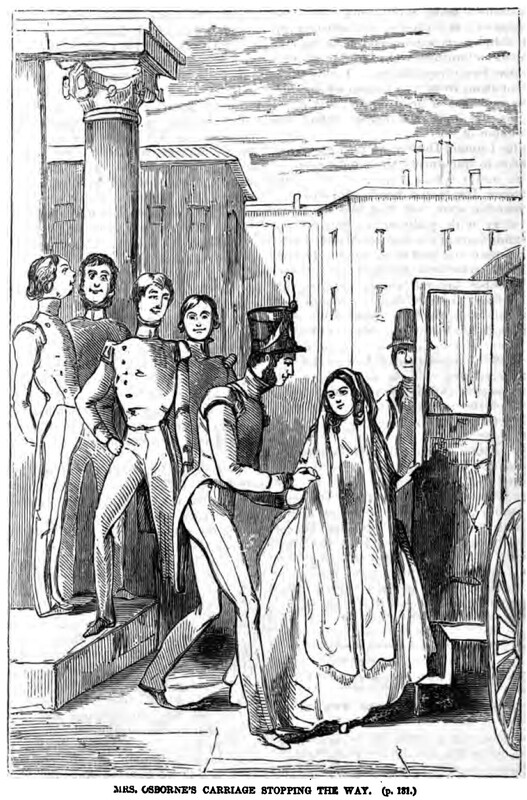
William Dobbin holds Amelia Osborne’s hand as she exits her carriage at the inn after the party. Behind the carriage door, the footman can be seen, and to the left of Dobbin, four young men are talking and smiling on the stair. Below the illustration is printed in cursive its title, MRS. OSBORNE’S CARRIAGE STOPPING THE WAY. (p. 131.).
In this image we see Gulliver standing next to a giant’s feet, looking up at the giant. Gulliver just comes up to the giant’s ankles, showing the scale between Gulliver and the giant. There are ropes around the giant’s ankles. The same image appears in the 1839 Krabbe edition.
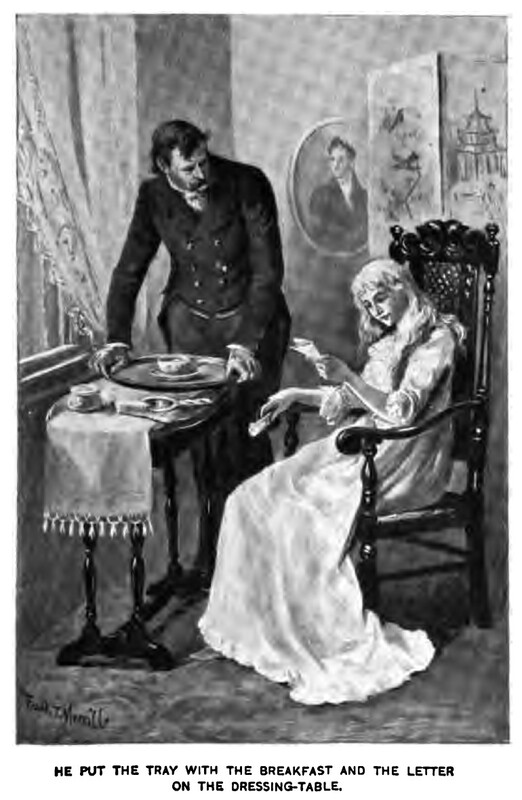
The image depicts a scene from page 51, in which Rawdon Crawley brings the letter telling of his father’s death to his wife. Rebecca Crawley is shown seated in a high-backed wicker chair, holding the letter in one hand while she reads it. Rawdon Crawley is leaning over the table in front of her, both hands still on the tray containing her breakfast. On the wall behind them is a portrait, partially covered by a screen decorated with images of architecture and birds.
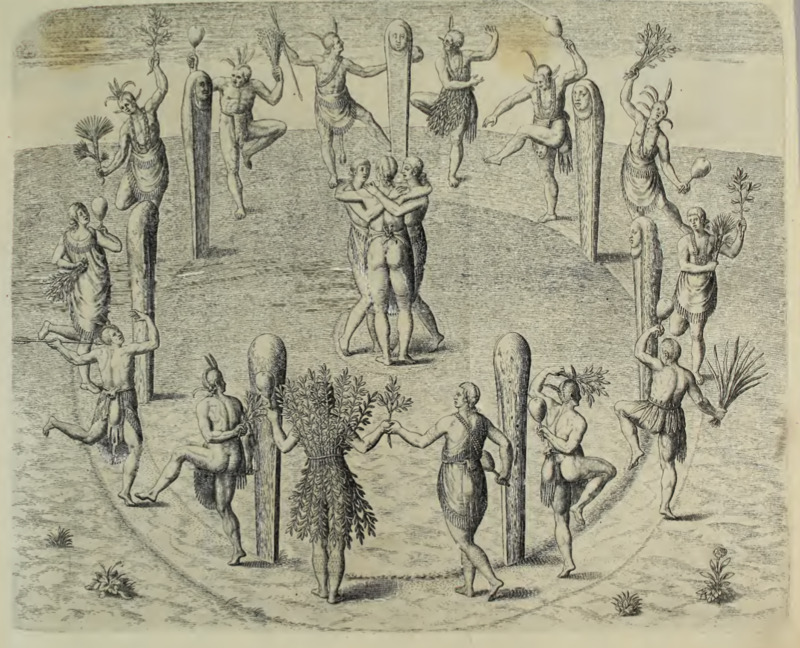
A group of Indigenous people are shown engaging in a dance. Three individuals embrace, and others dance in a circle around them. Some hold branches and other plants and objects in their hands. The circle is partially formed by wooden posts stuck into the ground. These posts have faces carved into the top of them, facing into the center of the dance circle.
This image is illustrated in a chapter that discusses and criticizes the government and society in Spanish conquered Peru. This image depicts an indigenous captain who was in charge of rounding up workers for the mines. If a worker fell ill, the captain would abuse his ability to charge the natives for hiring replacement workers. The captain is illustrated on the right side of the image handing money over to another man who is holding a card in his hand. The card reads, zedula del alquil [rental card]. The large caption at the bottom of the image reads, que los capitanes de todas las dichas minas deste rreyno cobre de los trauajos de los yndios de cada prouincia y se lo lleue y pague en la dicha prouincia a cada yndio. Porque no le gaste y lo lleue todo a su muger y hijos, porque se le paga en chicha o uino y pan. Y ancí no tiene de qué pagar tributo [The captains of the mines of this kingdom collect from the labour of the natives. Because the workers brings everything to his wife and children they are paid in either chicha, wine, or bread.]
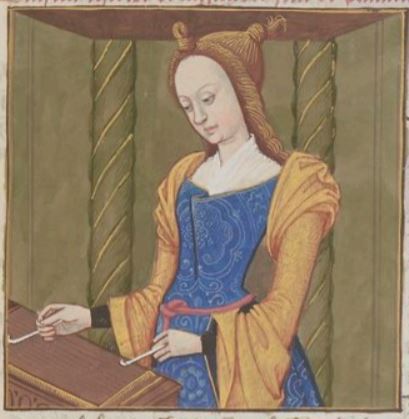
This illumination depicts a portrait of a woman named Cassandra, who was the daughter of Priam and Hecuba, the king and queen of Troy. Cassandra had the gift of foresight and predicted the events of the Trojan War and the downfall of her city. She even predicted her father’s death, as well as her own. Boccaccio explains that the god Apollo had given Cassandra the gift of foresight in exchange for her love, and when she denied him what she had promised, he made it so any prediction she had, no one would believe her.
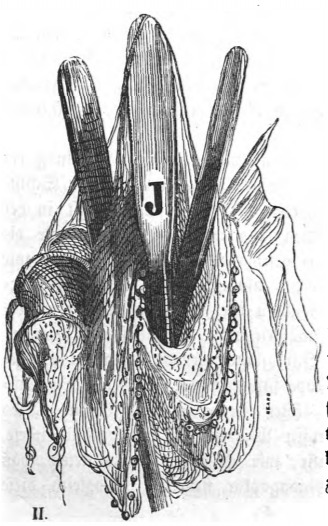
Here we see Gulliver’s paddles and fishing nets. This image appears at the beginning of the eleventh chapter in which Gulliver sails away from the Country of the Houyhnhnms and arrives on New Holland. The same image appears in the 1839 Krabbe edition.
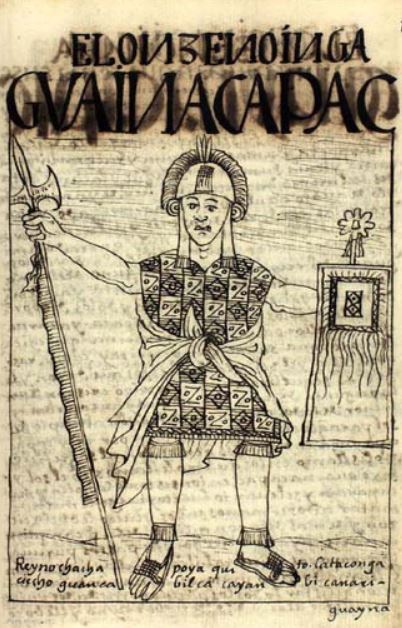
This illustration depicts the eleventh king of the Inca Empire, Huayna Capac Inca. He is depicted wearing an embroidered shirt while holding a shield in his left hand and an ax in his right. There are words written at the bottom of the image that reads Reynó Chachapoya, Quito, Lataconga, Ciccho, Guanca Bilca, Cayanbi, Cañari, which describes the regions of which this king ruled over.
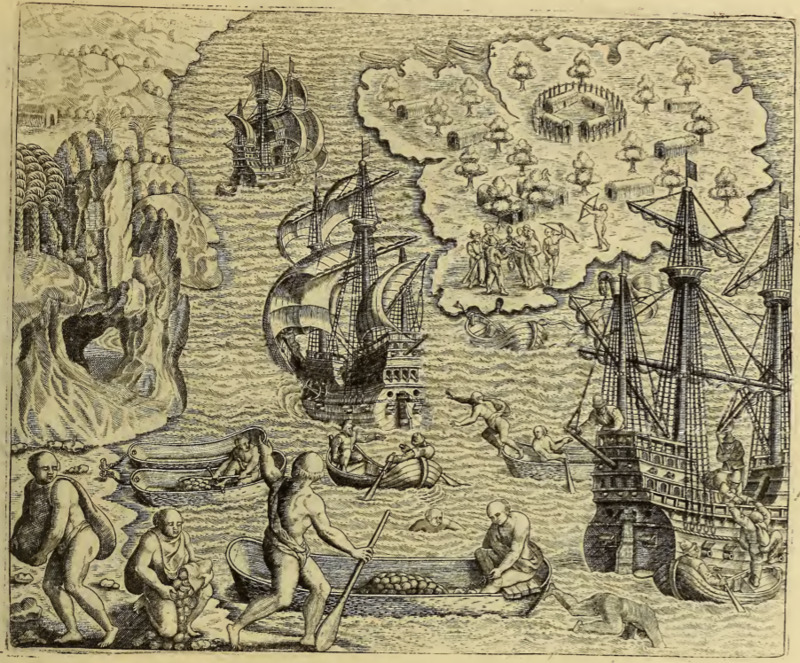
Near Cubagua, a small island off the coast of Venezuela, Indigenous people gather oysters to retrieve the pearls from them. They dive into the water to gather the oysters, which they load into small wooden boats and then into sacks carried over their heads. This island was known for its abundance of pearls. There are three large European ships in the channel between the island and the mainland. On the island, a group of Spaniards have come ashore and stand with a group of Indigenous people bearing bows and strands of pearls. There are several long dwellings on the island, including four arranged in a circle and surrounded by a fence.

![[Combat between the Tupinambá Indigenous group and the Margajas Indigenous Group]](https://cemvccol.ace-net.training/files/large/6305aabcc41db537717533e08cdc775f99c46fac.jpg)
![[Vanity Fair Chapter LIII Inhabited Initial]](https://cemvccol.ace-net.training/files/large/37d56b54b8198abf1eedd4c8d3cf10cdd7e95b0f.jpg)
![[Gulliver’s ship sets sail shortly after he returned from Brobdingnag]](https://cemvccol.ace-net.training/files/large/beea337b7a847c9501d1404d97473cc961d488c5.jpg)
![[The Two Rawdon Crawleys]](https://cemvccol.ace-net.training/files/large/16e76973a1e6cabb626215e5fa4b95fc47b335cf.jpg)
![[Act XX – Pleberio and Melibea]](https://cemvccol.ace-net.training/files/large/de8bfadca6c659e677d045ef98b1dbab02b31ab3.jpg)
![[Gulliver standing next to a giant’s feet]](https://cemvccol.ace-net.training/files/large/ba0fde574cdef66bc331be03fb952251a0792a13.jpg)
![In[di]o Capitan Alqvila a Otro Yndio por el Yndio Enfermo Azogado Porque no se Acaue de Murir](https://cemvccol.ace-net.training/files/large/906986889772f4f5746eaa686730e4582243417a.jpg)