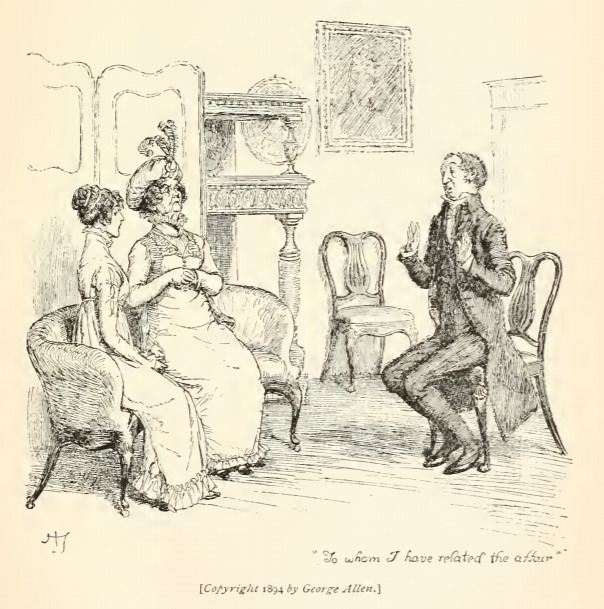
In this image Mr. Collins calls on Lady Catherine de Bourgh and her niece. Mr. Collins came to call after hearing of Lydia’s running away with Mr. Wickham. He then wrote to the Bennets to offers his condolences, spending the majority of his time talking about how Lydia’s behaviour threatens her sister’s prospects. In this letter Mr. Collins relates that Lady Catherine agrees with him. This scene occurs in chapter 48. The characters are shown in the traditional regency style. Lady Catherine and her niece wear regency dresses with empire waistlines. Lady Catherine wears an elaborate bonnet. Mr. Collins wears a waistcoat and tailcoat. The regency period dated to the early nineteenth century (1811-1820) when George, Prince of Wales, later George IV (r. 1820-1830), reigned as regent for his mentally ill father, King George III (r. 1760-1820). The regency period is associated with the rise of neoclassicism in art and fashion.
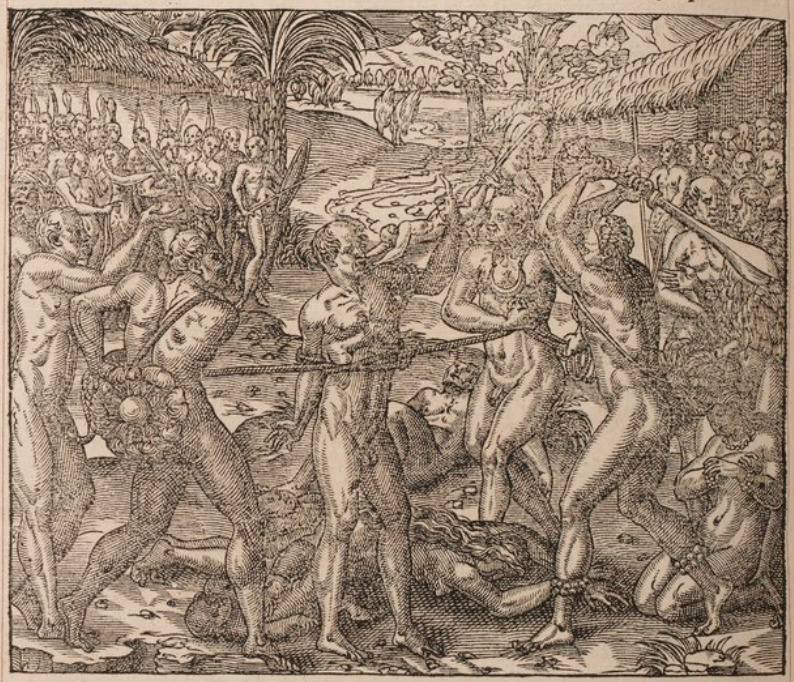
An Indigenous man has been taken captive by another Indigenous group and is about to be executed. He is restrained by a rope tied around his waist, with each end of the rope held taut. The captive gestures emphatically with one arm, perhaps in admonishment. Another man stands in front of him holding a club raised over his head, poised to swing. A woman and child lie prostrate on the ground behind the captive. Groups of people stand on either side of the captive to watch the execution, most of the men holding bows, clubs, and/or shields. Several structures are visible in the background. This image is identical to one found on page 945 verso of Paris, 1575 (l’Huillier).
Gulliver explains how war works in Europe to his Master. Gulliver describes cannons, muskets, pistols, bullets, gunpowder, bayonets, sieges, battles, retreats, attacks, bombardments, sea battles, horses’ roles on the battlefield, and the various ways soldiers die on the battlefield. Several of these elements are shown in this image, including naval warfare, cannons, soldier’s deaths. The same image appears in the 1843 Krabbe edition.
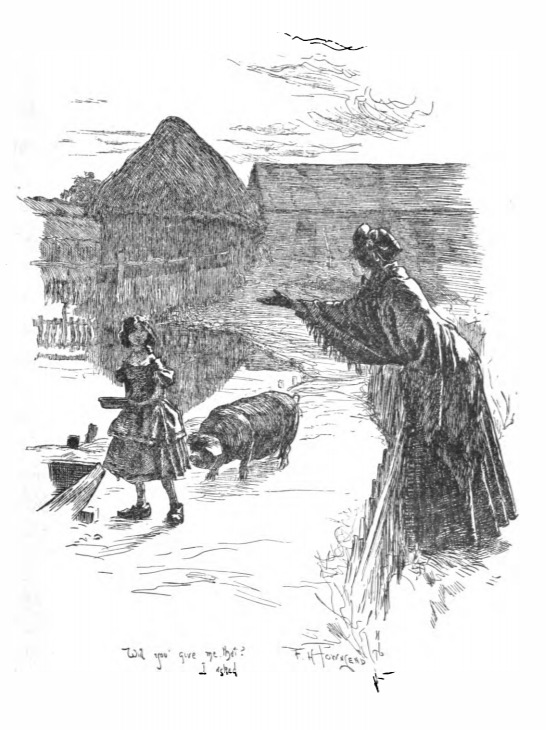
After breaking off her engagement to Mr. Rochester, Jane fled north as far as she could before she ran out of money. She arrived at the Moors of England when she could no longer afford a carriage. She slept outside for two days and two nights, before arriving at Moor House. During this time, she had to beg for food. Here she asks a young girl for her leftover porridge she was going to give to a pig.
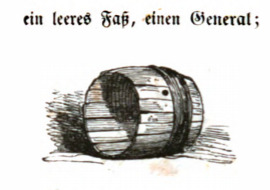
Here we see an empty barrel on its side. This is the code word for a general of the army. This image comes in a description of a conspiracy found by a professor from the Grand Academy on Balnibarbi. This idea is representing code word for terms in the conspiracy that Swift is satirizing. The professor advises that those named in the conspiracy papers be closely monitored at all times, naming specifically while they were using the bathroom, as this is when men were most thoughtful. This conspiracy is thought to be an allusion to the trial of Francis Atterbury, the bishop of Rochester for allegedly plotting with the Jacobites. Atterbury was charged with treason in 1722 and was exiled to France. The same image appears in the 1843 Krabbe edition.
This illustration depicts Claudia Quinta, a Roman matron, standing on a plank as she retrieves a statue of the goddess Ceres from a ship. Boccaccio explains that after Claudia Quinta was accused by other citizens of not being chaste, she prayed to the goddess to help prove her virtue. After a ship that contained a statue of Ceres had gotten stuck on a sandbar, Ceres gave Claudia Quinta the power to pull the ship to shore as proof of her chastity. Therefore, she is being depicted on the ship retrieving the statue.
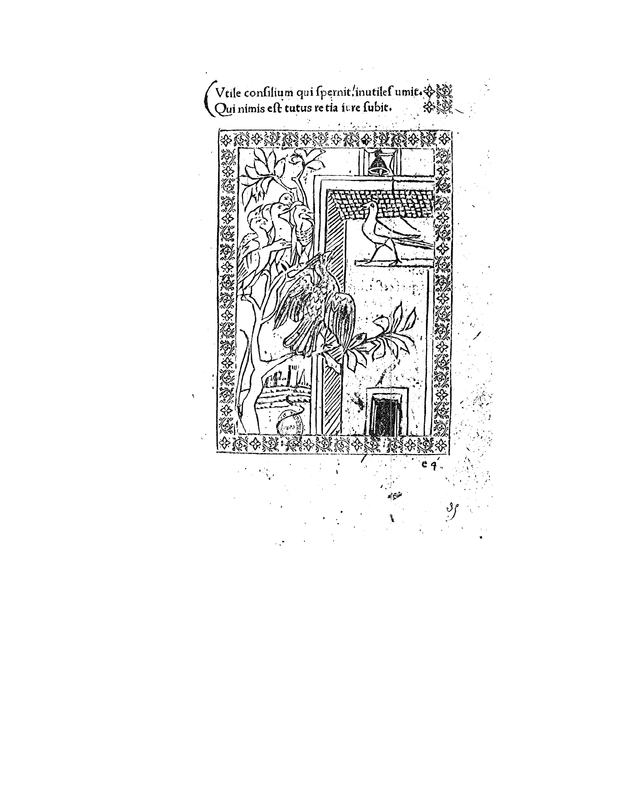
There is a bird perched on a building in the centre of the image. There are eigth birds perched on the tree who seem to be listening and arguing with the bird perched on the building. On top of the building there is a bell. One of the bird on the tree is flaring its feathers.
This image depicts three native Peruvians sacrificing a ram according to their ancient laws. The author criticizes those who practice the old ways of idolatry and refuse to participate in Christian traditions such as Lent. There is an indigenous man on the left side of the image holding the ears of the ram, while the person in the centre of the image inserts their arm into the abdomen of the ram. He reaches in to take out the heart. The ram’s legs are tied together. They would then eat the raw meat and blood of the ram. The woman on the right side of the image is holding a basket as she looks down at the ram. The caption at the top of the image reads, los carneseros como en tienpo de ydúlatra, mete la mano al derecho del corasón. Que no mate ací, cino como en este tienpo de cristiano que degüelle el pescueso del carnero. Que es hechisero ydúlatra que mata al uso antigo y sea castigado el yndio, yndia en este rreyno [the butchers put their hand to the right of the heart. Let him not kill here but like in this time of a Christian who slaughters the neck of a ram, he is an idolater, and the Indian is punished in this kingdom].
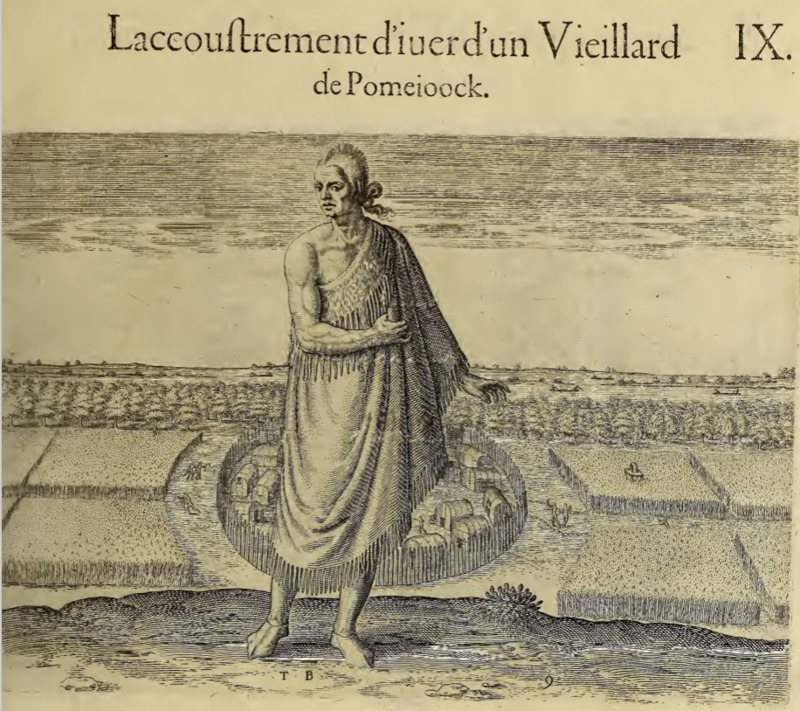
An old man stands on a hilltop. He wears a fringed garment draped around his body and over one shoulder. His hair is spiked down the middle of his head from forehead to nape of neck, where it is gathered into a knot. On his feet are slippers. Behind him on the ground below the hill, cultivated fields surround a village – a small group of dwellings with a fence around them.
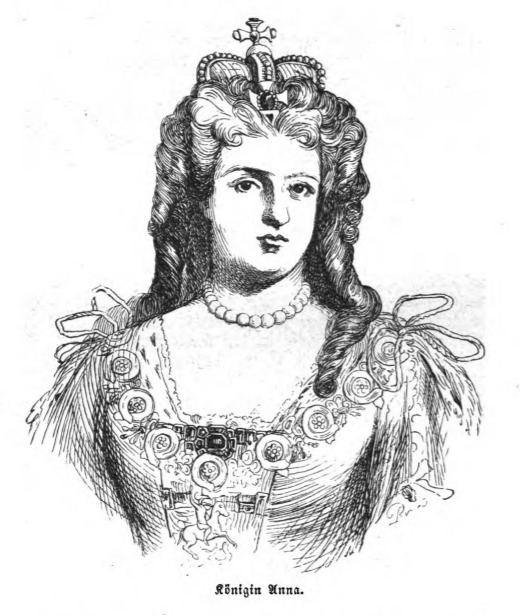
Here we see a bust of Queen Anne. This image appears when Gulliver explains England’s political system. Gulliver begins with the Glorious Revolution of 1688 which removed the Catholic James II, replacing him with Protestant William III. He continues on to explain to the war of Spanish Succession. He ends with the current system, with the accession of Queen Anne.
A group of women and children sit in a circle with several large dishes at the center. One of the dishes holds a human head and another holds entrails. Some of the women and children sip from bowls while others use their hands to eat. Two of the women have infants strapped to their backs in baskets or slings.
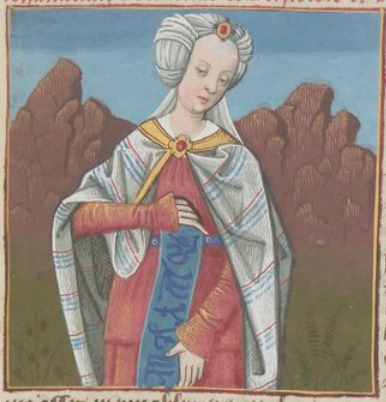
This illuminated image depicts a portrait of Libya, the daughter of King Epaphus of Egypt. She appears to be dressed in royal garments as she holds a piece of fabric with foreign lettering on it. Boccaccio explains that Libya bore a child with her husband, Neptune, who grew up to be a tyrant of Upper Egypt. Their child’s name was Busiris. Libya was so renown during her time that the region in Africa which she ruled was named after her.
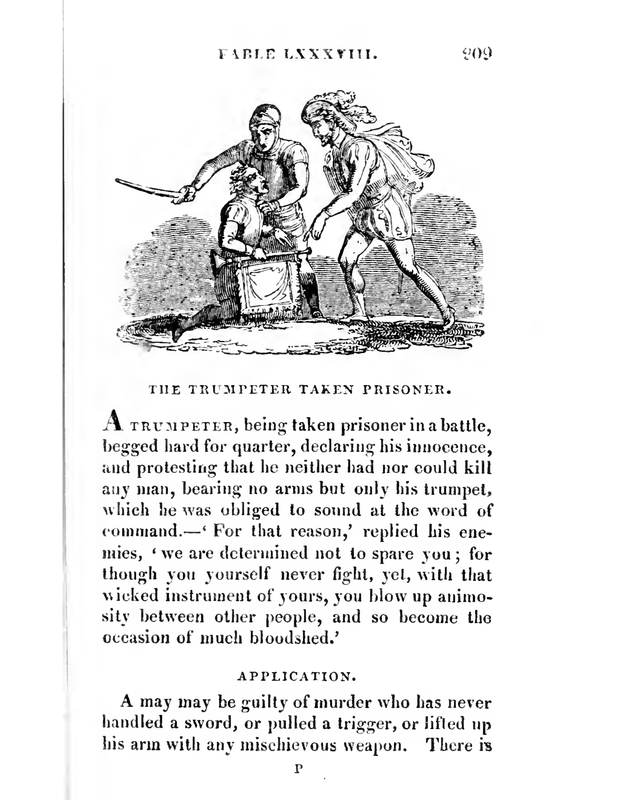
Two men stand over another man who is kneeling on the ground. The man on the left side is holding a sword in one hand, and the man on the right side is reaching down towards the man kneeling.
Sir Pitt Crawley leans against a fireplace at his brother Rawdon Crawley’s house. He is dressed in his Court suit and has a thin sword at his side. Mrs. Rebecca Crawley is seated on a chaise next to him, turned in his direction to admire his uniform.
Here we see busts of Nero, Henry VIII, and Charles IX, all of whom were very unpopular rulers. Nero was the Roman Emperor from 54-68 CE. He marked the last of the Julio-Claudian Dynasty. According to Roman historians, Nero was famous for his extravagance and corruption, and many thought he fiddled while Rome burned during the fire in 64 CE. While this is likely a myth, Nero did take civic land that was destroyed during the fire to build a new imperial palace. Henry VIII was the King of England from 1509-1547. Like Nero, he was widely thought to be a tyrant, as he was married six times, divorcing two wives, and beheading two more. Henry VIII split with the Catholic Church in the 1530s as he tried to get his first marriage to Catherine of Aragon annulled, creating the Church of England in the process. Charles IX was the King of France from 1560-1574. During his reign, religious wars broke out between Catholics and Protestants, and allowed the St Bartholomew’s Day Massacre in August 1572, where thousands of French Protestants were killed (between 5 000 to 30 000 according to modern estimates). All three of these rulers were thought to be tyrannical and immoral. The image appears in an appendix to Gulliver’s travels to Lilliput, which follows the conclusion of Gulliver’s trip to Brobdingnag. Gulliver’s description of the Lilliputian education is very negative, saying that what is taught is simply superfluous, and not anything of substance, as his bias makes him think that the European model for education is the correct model. He says that the teachers will blindly follow the emperor of Lilliput even if they are a tyrant, as many believed Nero, Henry VIII, and Charles IX to be. He also tells the reader that the Lilliputian teachers pay no attention to important dates, focusing more greatly on the character of the ruler. This method meant that students learned to judge historical figures, rather than the facts surrounding them. The same image appears in the 1839 Krabbe edition.
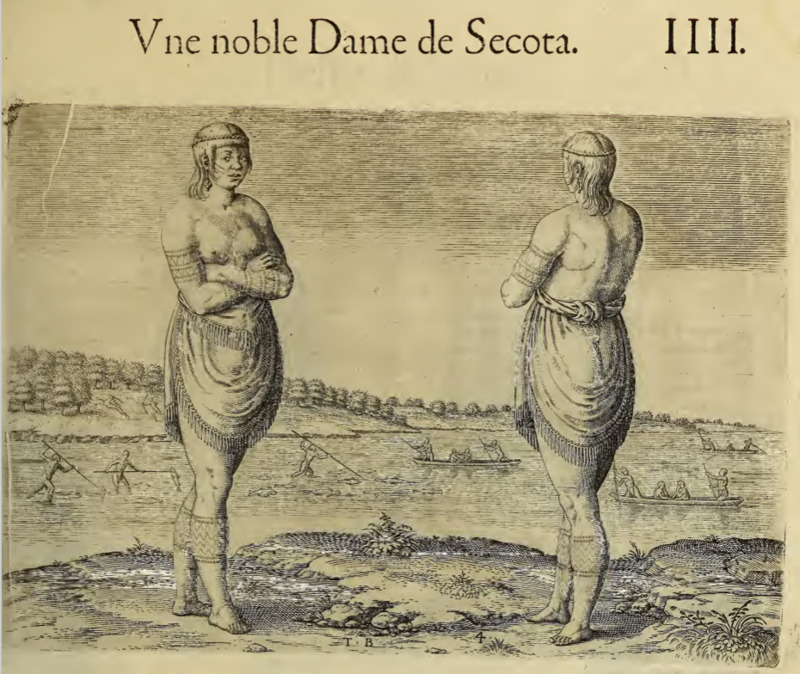
An Indigenous woman is pictured standing on the bank of a river, from the front and from behind. She wears cuffs on her upper biceps and forearms, and on her calves. Her clothing consists of a fringed skirt tied around her waist, she is barefoot and shirtless. In the background behind her, other Indigenous people can be seen in canoes and fishing in the river. On the opposite bank of the river there is a forest.
Three women are on one side and four men are on the other. One of the men seems to be kneeling or bowing down to a woman pointing down to him. He is holding a large stick as he kneels. The women are all wearing robes, while the men wear pants.
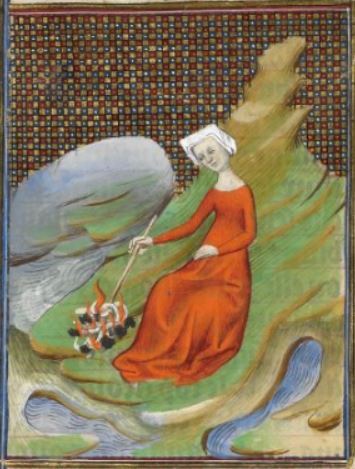
Manto, the daughter of the famous seer Tiresias, is depicted sitting in the centre of the image. She is depicted poking a stick into a fire as she looks through a pile of animal entrails. She used the movement and colour of the fire’s flames to tell the future, which is why there is a fire in the image. She also used the entrails of animals such as sheep and oxen for signs of the future.
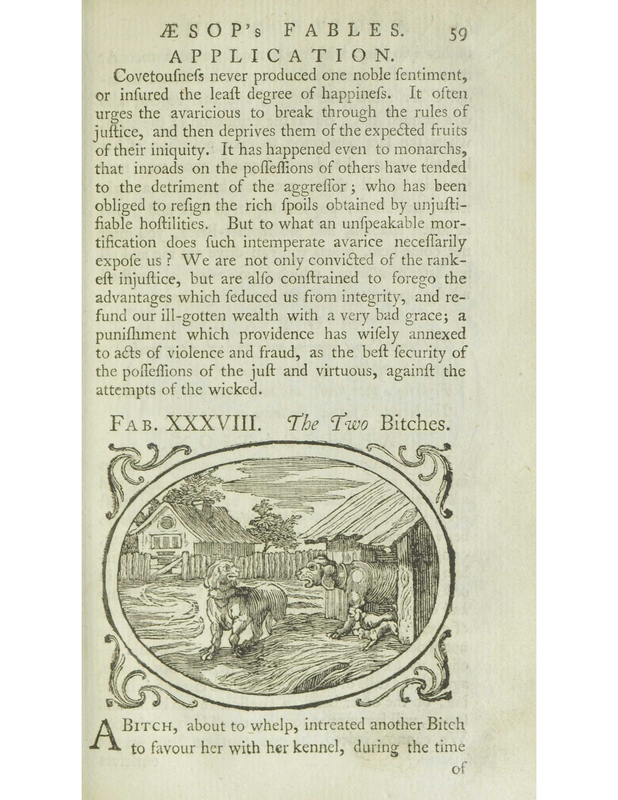
On the right side of the image, a dog is standing halfway out of its dog house with two puppies below it. She appears angry and seems to be barking at another dog who stands near the centre of the page, appearing startled. In the background stands a house with a fence surrounding it, with clouds in the sky above.
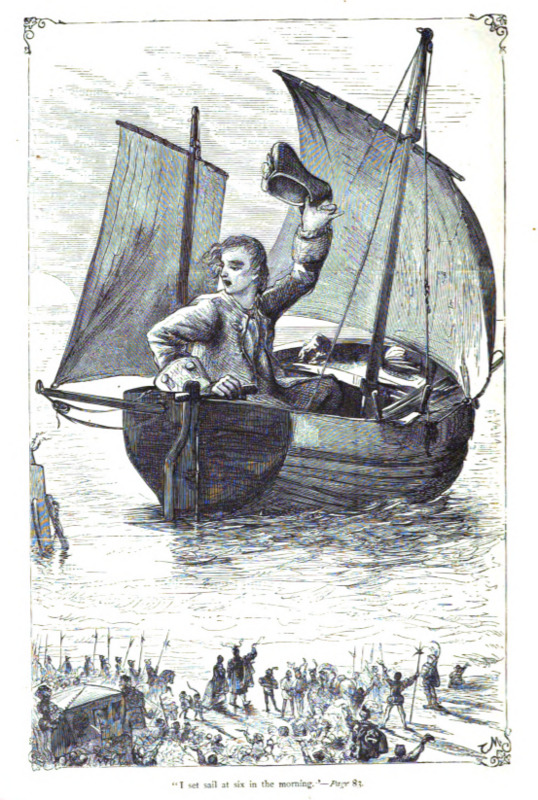
Here Gulliver leaves Blefuscu. He repaired the abandoned boat and added sails. He raises his hat to wave goodbye to the crowd. He then rowed out to sea where he was rescued by a large English ship and sailed with them back to England.

![[A battlefield]](https://cemvccol.ace-net.training/files/large/b5718c4497a8181f7e3ba976162295c2465d4c84.jpg)
![[Claudia Quinta Retrieves the Statue of Ceres from a Ship]](https://cemvccol.ace-net.training/files/large/13b4a312840164607502fcce69ff739d8b2b3b33.jpg)

![Q[ve] Mata El Carnero](https://cemvccol.ace-net.training/files/large/0417306059da9218973a7b54d6e77691320b6022.jpg)

![[A group of Tupinambá women and children share a cannibalistic meal]](https://cemvccol.ace-net.training/files/large/ee63b558ebc197d067dc228d4e316399063e7e60.jpg)

![[Rebecca and Sir Pitt]](https://cemvccol.ace-net.training/files/large/c5715d2bd35d122c3a1aa3814b97b9e95fb2b425.jpg)
![[Nero, Henry VIII, and Charles IX]](https://cemvccol.ace-net.training/files/large/3700e0354409c7c6a3ea4a6d5bb5e8c7b367f0e1.jpg)

![[Kneeling at women]](https://cemvccol.ace-net.training/files/large/1c1cd81da1af132367ae09990fd341d7d3f1b164.jpg)