Mr. Pitt Crawley introduces Miss Briggs, his aunt’s companion, to Lady Jane Sheepshanks, his betrothed, with a smug look on his face. Miss Briggs, on her way home from the library, is holding one of her books and has dropped two others. Lady Jane is half hidden behind Mr. Crawley, looking shy.
We know that the male figure on the right is Sempronio, since he is the only male character included in the third act. He is depicted holding a satchel in his right hand. Further, he is wearing a large hat and has a sword mounted on his belt. The female figure on the left is depicted wearing a robe, a veil, and a necklace. Her identity is ambiguous, since Sempronio interacts with both Celestina and Elicia in this act. Both figures are placed outside.The entire image is identical to the one found on page 58 of the text. Both the left and right panels are near carbon-copies of panels used multiple times throughout the earlier 1529 Lyon edition. However, the lower attention to detail in these illustrations makes it clear that they are reproductions and not duplicates. The artist likely referred to a copy of the 1529 edition when creating these illustrations.
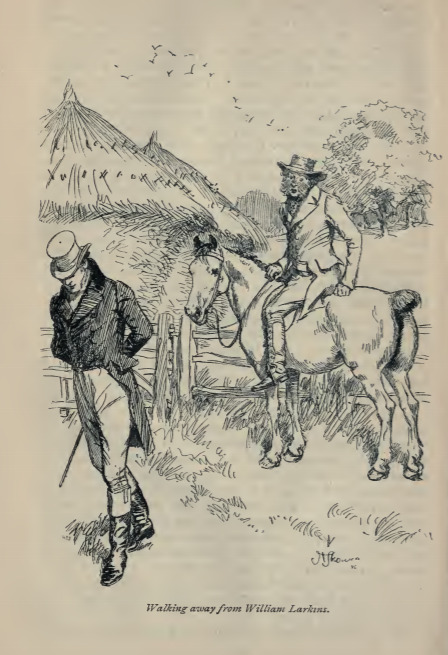
In this image Mr. Knightley walks away from his tenant, William Larkins. Mr. Knightley had gone to see Mr. Larkins to inform him that he would be leaving Donwell Abbey and moving to Harfield to live with Emma and Mr. Woodhouse. Mr. Woodhouse was always upset when something in his household changed, and Emma did not want to leave him alone. Mr. Knightley knew this and suggested that he move to Hartfield to avoid distressing Mr. Woodhouse. This scene occurs in chapter 51. The characters are shown in the traditional regency style. Mr. Knightley wears a tailcoat and an overcoat with a cravat. Mr. Larkins wears a riding habit with a tailcoat and brimmed hat. The regency period dated to the early nineteenth century (1811-1820) when George, Prince of Wales, later George IV (r. 1820-1830), reigned as regent for his mentally ill father, King George III (r. 1760-1820). The regency period is associated with the rise of neoclassicism in art and fashion.
In this image we see Gulliver eating with the Queen of Brobdingnag. She eats a drumstick while Gulliver sits on the table next to her. The queen wears lizard earrings. Gulliver sits at a smaller table underneath the queen’s arm. He has his own plate of food and looks up at the Queen as she eats. The same image appears in the 1843 Krabbe edition.
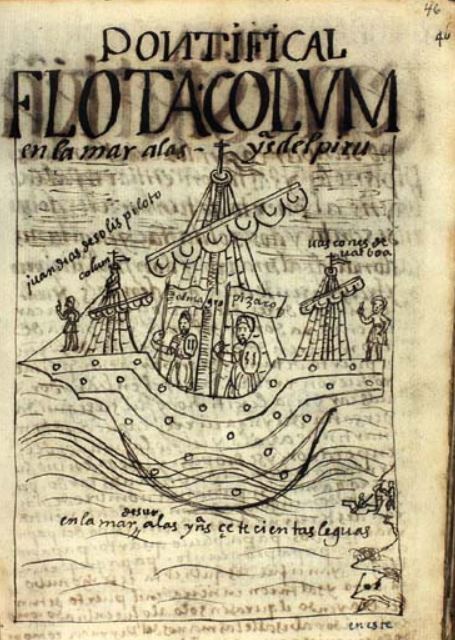
This illustration depicts the voyage of Columbus to the West Indies. The captain is depicted at the bow of the ship, with his name written above his head as Juan Dias de Solis, and the word pilot to identify his position. Beside the captain is Columbus, with his name written as, colum. The two captains of the embarkment, Don Diego de Almagro and Don Francisco Pizarro are illustrated in the centre of the ship holding flags. There is a man standing at the stern of the ship is identified as Vasco Nunes de Ualboa. There is an inscription below the ship which reads, en la mar a las yndias cetecientas leguas and translates to over the southern sea to the Indies 700 leagues.
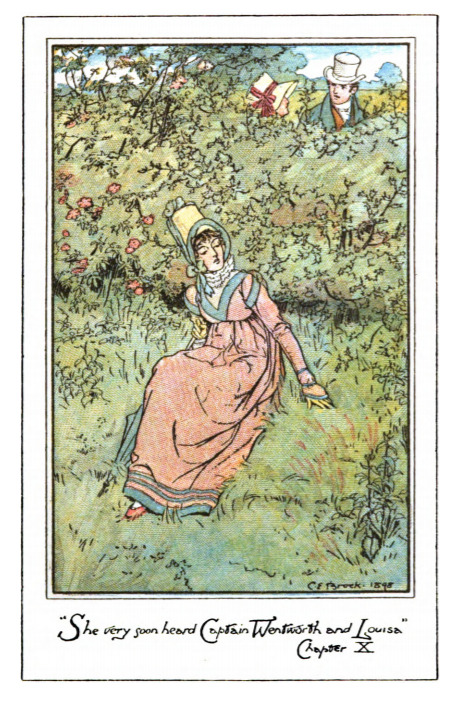
Here we see Anne sitting outside while on a walk with her companions at Uppercross. Anne wanted to avoid Captain Wentworth because he proposed to her eight years prior, but she refused. While on their walk, the party decided to take a break on a bank near the river. In this image, Anne is seen seated on a bank with the hedge row behind her. Louisa and Captain Wentworth are visible behind the hedge. Captain Wentworth was flirting with Louisa, but he was still in love with Anne. This scene occurs in chapter 10 as noted underneath the title of this image. The characters are shown in the traditional regency style, with Anne wearing the regency style dress with an empire waist. Anne and Louisa’s hair is worn tied up and wear bonnets. The bonnet had a large brim, used to protect a woman’s face from the sun. These bonnets were a popular style in this era as going for walks were common pastimes. Captain Wentworth wears a top hat. The regency period dated to the early nineteenth century (1811-1820) when George, Prince of Wales, later George IV (r. 1820-1830), reigned as regent for his mentally ill father, King George III (r. 1760-1820). The regency period is associated with the rise of neoclassicism in art and fashion.
There is an ox looking at a frog in a field of grass. The ox’s tail is swinging. The ox has horns on its head and spots on its body. There is a barn in the distance to the left of the picture. Some of the grass appears to be longer in some areas. The landscape appears to be mostly flat, with the exception of a few small mounds.
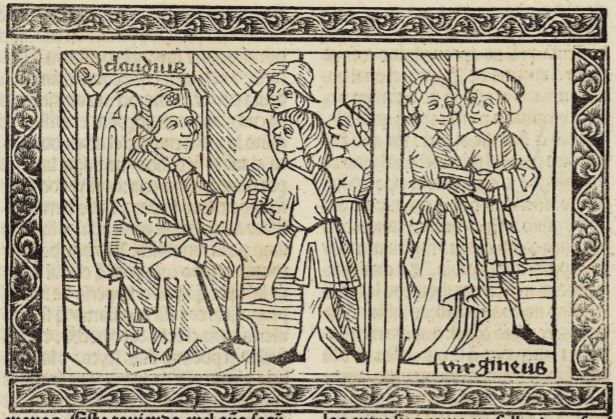
This engraving depicts the tragic fate of a young virgin woman from Rome named Verginia. Boccaccio explains that one of the decemvirs, Appius Claudius, fell madly in love with Verginia. Despite already being betrothed to another man, Claudius devised a plan to have Verginia as his own. Claudius had gotten one of his freedmen (Marcus Claudius) to capture Verginia and claim her as a slave. Verginia’s father, Verginius, went to the trial and protested the sentence of his daughter becoming a slave. Appius Claudius, however, was the judge presiding over the case, and officially decreed Verginia to be a slave. This court trial is depicted on the left side of the engraving, with Claudius sitting on the chair pointing towards Verginia, Verginius, and Verginia’s betrothed, Icilius. Claudius’ name is engraved above his head to identify him. After Claudius decrees Verginia to be enslaved, her father takes a knife and stabs her with it as his only way to save her. This is depicted on the right side of the engraving, which illustrates Verginius (his name is engraved above by his feet) piercing his daughter’s chest.
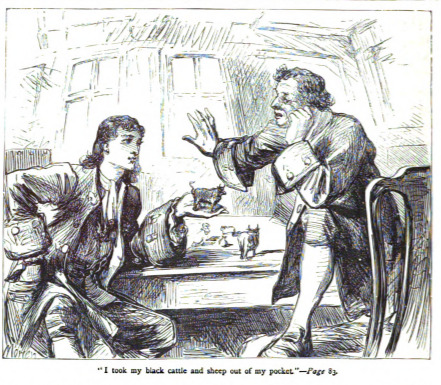
Here Gulliver speaks with the captain of the ship that rescued him. He shows the captain the miniature cattle and sheep that the Emperor of Blefuscu gave him to take back to England. The captain was shocked by the sight of the tiny animals.
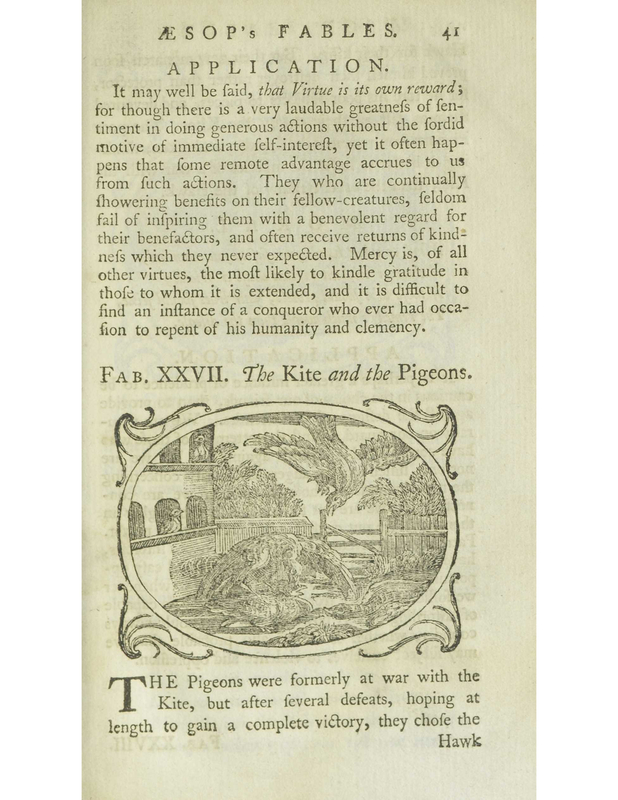
On the left side of the image is a large building where birds sit on a couple of the window sills. In the middle, a large pigeon swoops down towards two other pigeons, with one attacking the other. The pigeon in the middle, attacking the one on the bottom has its beak wide open, biting the head of the one on the ground.
Here we see a scientist from the Grand Academy on Balnibarbi’s hypothesis for a new manner of construction. This scientist’s suggestion was to build the house from the top down, starting with the roof and ending with the foundation. The roof would be held up by balloons during construction. The scientist claims he was inspired by the building methods of spiders and bees. Gulliver was quite impressed with this idea unlike many other ideas he saw at the Academy. The same image appears in the 1839 Krabbe edition.
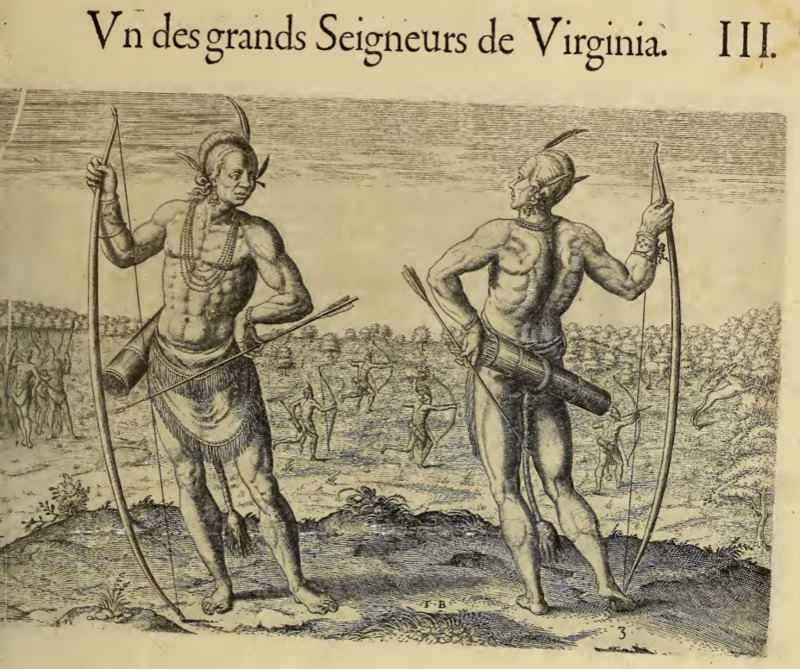
An Indigenous male is pictured standing on a hill, from the front and from behind. He wears beaded necklaces, beads around his left wrist and a cuff/wrist guard on his right, and fabric in the fasion of a fringed skirt tied around his waist. He is barefoot and shirtless, carries a longbow, and wears a quiver of arrows around his waist. In the background behind him there is a group of Indigenous people also holding longbows, and four people hunt deer. A forest is visible in the background.
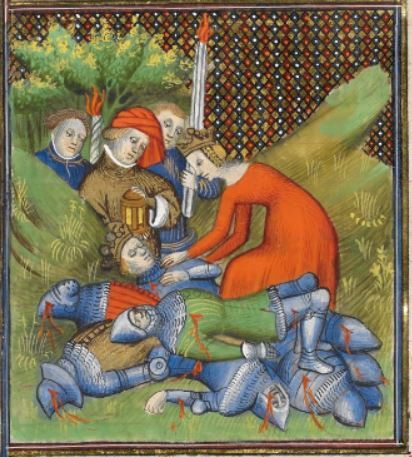
Argia, the daughter of King Adrastus of Argos, is depicted in the centre of the image holding the dead body of her husband, King Polynices of Thebes. Boccaccio explains that Polynices had fought in a war against his brother Eteocles and died on the battlefield. Argia snuck herself onto the battlefield after the war to see her husband’s body. She is accompanied by three servants. Boccaccio believes her to be praiseworthy as it took courage to risk her life in order to find her husband on the dangerous battlefield.
A man is trapped in a hole in the middle of a bush outside. There are many trees surrounding him. A path next to him leads to a big castle behind him. The man looks in distress and is trying to get out from the bush.
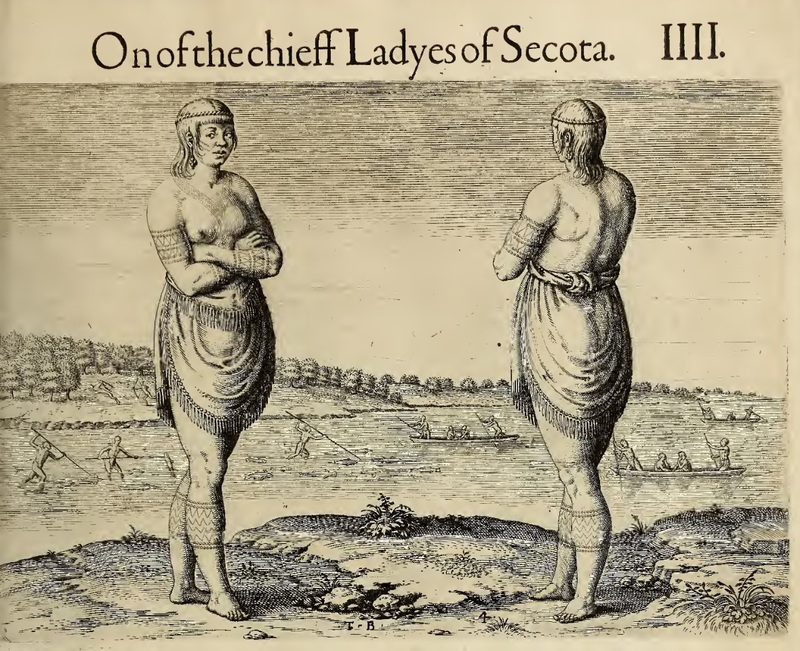
An Indigenous woman is pictured standing on the bank of a river, from the front and from behind. She wears cuffs on her upper biceps and forearms, and on her calves. Her clothing consists of a fringed skirt tied around her waist, she is barefoot and shirtless. In the background behind her, other Indigenous people can be seen in canoes and fishing in the river. On the opposite bank of the river there is a forest.
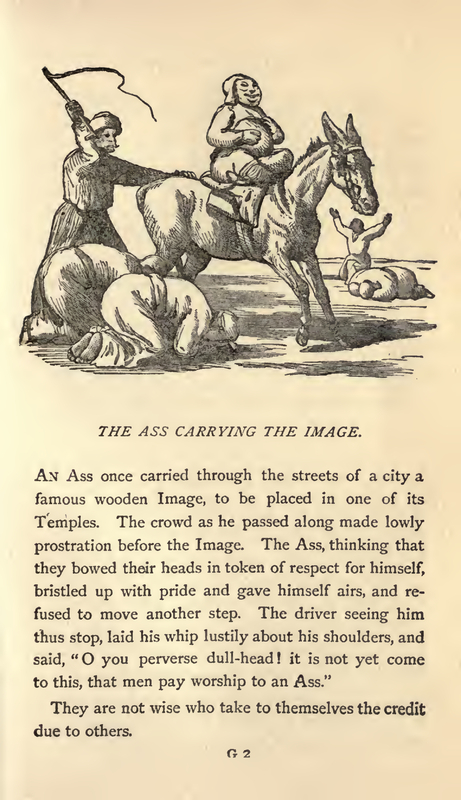
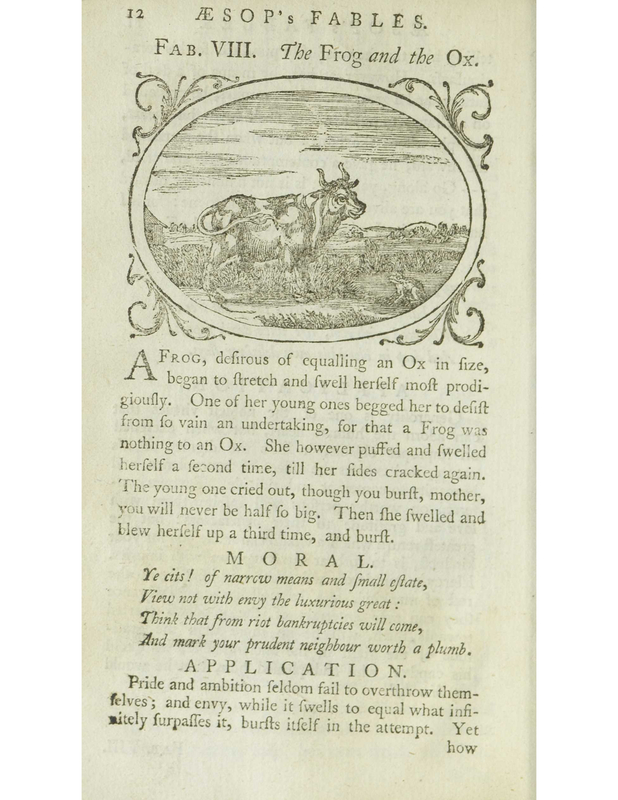
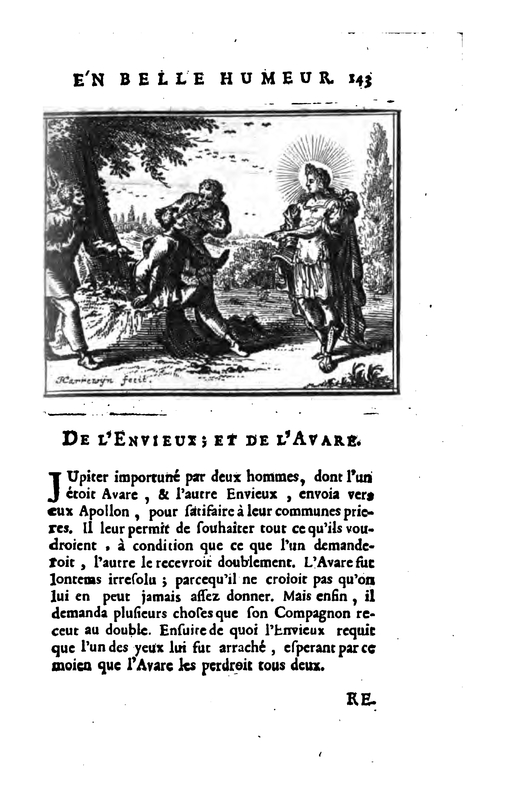
Two neighbors came before Jupiter and prayed for him to grant their desires. One was full of Greed, and the other was full of envy. So, to punish them both, Jupiter Granted that each can have whatever he wished for himself, but only on condition that his neighbour had twice as much. The greedy man prayed to have a room full of gold, but all his joy was turned to grief when he found that his neighbor had two rooms full of gold. The envious man, who could not bear to think of his neighbor having more joy than himself, prayed that one of his eyes be put out, by which means his neighbor would have both put out.
In the middle of the image is a lion sticking out its tongue. The lion is clawing a rat, while another rat is on top of a post on the right side of the image. The lion is tied to this post and the rat appears to be chewing the rope that has bounded the lion.

![[Mr. Pitt, Lady Jane, and Miss Briggs]](https://cemvccol.ace-net.training/files/large/182353cd639a4840cb9098b6831519f0133a80d5.jpg)

![[Act III – (?) and Sempronio]](https://cemvccol.ace-net.training/files/large/1db9498b697f3af65771ac41428c3685ce0c7347.jpg)
![[Gulliver eating with the queen of Brobdingnag]](https://cemvccol.ace-net.training/files/large/9307e66ea1ed3244e3f2e4218619780cb974866c.jpg)
![[A scientist from the Grand Academy of Lagado suggests a new method of construction]](https://cemvccol.ace-net.training/files/large/5014af98a3835d0559c02520cf8557c3b1b207f1.jpg)

![[Man trapped in hole in bush]](https://cemvccol.ace-net.training/files/large/47002cdf8a962dd18ed2d720d50f7b8dcbbfd394.jpg)
![[The Lion and Rats]](https://cemvccol.ace-net.training/files/large/e3f3a16da022860183b0fc1234e5a9b77256a841.jpg)